Foram encontradas 23.840 questões
Resolva questões gratuitamente!
Junte-se a mais de 4 milhões de concurseiros!


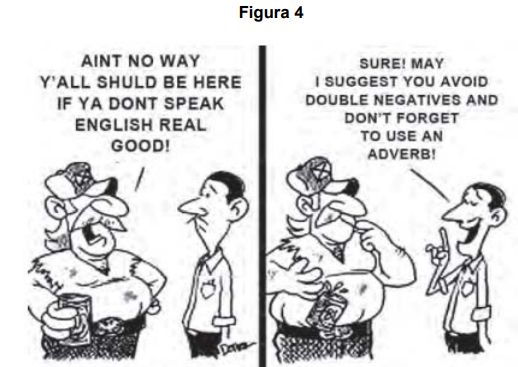
DONAR. Disponível em: <http://politicalgraffiti.wordpress.com>. Acesso em: 17 ago. 2011.
Considerando a relação entre linguagem e sociedade, analise o diálogo presente na charge (figura 4)
e assinale a alternativa que está em consonância com o que é descrito nos PCN de Língua Inglesa
sobre este tópico.
Fragmento 1 - No português brasileiro, observam-se mudanças no uso da língua pelos falantes de pelo menos cinco ordens: fonética, morfológica, sintática, léxica e semântica [...].
Muitos autores apontam então para a existência- no português brasileiro- de registros ou níveis de linguagem, ou seja, mudanças no uso da língua pelos falantes.
Em suma, seja na fala ou na escrita, cada usuário da língua utiliza vários registros de linguagem, em conformidade com seu nível social, a situação sociocomunicativa e as circunstâncias, e também em conformidade com a necessidade de imprimir a seu texto maior ou menor formalidade [...].
DIDIO, Lucie. Leitura e produção de textos: comunicar melhor, pensar melhor, ler melhor, escrever melhor. São Paulo: Ed Atlas, 2013. p. 33 -35.
Fragmento 2 - A variação é constitutiva das línguas humanas, ocorrendo em todos os níveis. Ela sempre existiu e sempre existiráꞏ, independentemente de qualquer ação normativa. Assim, quando se fala em Língua Portuguesa está se falando de uma unidade que se constitui de muitas variedades. Embora no Brasil haja relativa unidade linguística e apenas uma língua nacional, notam-se diferenças de pronúncia, de emprego de palavras, de morfologia e de construções sintáticas, as quais não somente identificam os falantes de comunidades linguísticas em diferentes regiões, como ainda se multiplicam em uma mesma comunidade de fala. Não existem, portanto, variedades fixas: em um mesmo espaço social convivem mescladas diferentes variedades linguísticas, geralmente associadas a diferentes valores sociais. Mais ainda, em uma sociedade como a brasileira, marcada por intensa movimentação de pessoas e intercâmbio cultural constante, o que se identifica é um intenso fenômeno de mescla linguística, isto é, em um mesmo espaço social convivem mescladas diferentes variedades linguísticas, geralmente associadas a diferentes valores sociais.
BRASIL. Secretaria de Educação Fundamental. Parâmetros curriculares nacionais: terceiro e quarto ciclos do ensino fundamental: língua portuguesa/ Secretaria de Educação Fundamental - Brasília:MEC/SEF, 1998. p. 29.
A cidadania e a consciência crítica são os objetivos principais dessa proposta didática presente nos PCN de Língua Estrangeira, os quais afirmam a possibilidade de se utilizar o aprendizado de línguas na escola para se compreender as várias maneiras de se viver a experiência humana.
A alternativa que apresenta a proposta didática mencionada nos PCN de Língua Estrangeira é
Sobre as incumbências dos docentes na Organização da Educação Nacional prevista no artigo 13 da Lei de Diretrizes e Bases da Educação Nacional - Título IV, analise as opções a seguir e identifique com V as verdadeiras e com F as falsas.
( ) Zelar pela aprendizagem dos alunos.
( ) Estabelecer estratégias de recuperação para os alunos de menor rendimento.
( ) Participar da elaboração da proposta pedagógica do estabelecimento de ensino.
( ) Participar da comunidade escolar e local em conselhos escolares ou equivalentes.
A alternativa que contém a sequência correta, de cima para baixo, é

Sobre o Wi-Fi, analise as assertivas e identifique com V as verdadeiras e com F as falsas.
( ) Wi-Fi é uma sigla que significa internet gratuita e ilimitada. ( ) Wireless é um tipo de Wi-Fi, só que público, ou seja, o sinal não é protegido por senha. ( ) Wi-fi é um tipo de rede sem fio, que permite, por meio de ondas de rádio, um dispositivo conectar- se à internet e transmitir dados para outro dispositivo.
A alternativa que contém a sequência correta, de cima para baixo, é
Observe a figura 2 para responder à questão.

Observe a figura 2 para responder à questão.
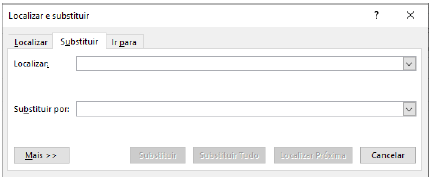
Observe a figura 1.
Figura 1_Janela Localizar e Substituir
I. O juiz _____________ os pleitos solicitados. II. Fernanda ________________ as pupilas no oftalmologista. III. O jurado do concurso ____________________ a contagem dos votos, perfeitamente. IV. Houve um ________________, acabou a tinta da impressora.
A alternativa que preenche, correta e sequencialmente, de cima para baixo, as lacunas dos trechos acima é
I. Entrei no quarto e olhei ao redor, a janela _______ aberta mantinha a penumbra. II. Todos os dias ele nos visita ao meio dia e _______. III. Elia desistiu de nos acompanhar, pois estava _______ cansada.
A alternativa que preenche, correta e sequencialmente, de cima para baixo, as lacunas dos trechos acima é


A alternativa que apresenta a classificação gramatical dos termos destacados acima, respectivamente, da esquerda para a direita, é
TEXT 8
“As far as practical conditions and educational relevance are concerned, virtually no major change has occurred in order to justify reframing our teaching. However, in what concerns social relevance, it is undeniable that the growth of the Internet has provided a new context for the use of the English language outside schools. For that reason, it is my belief that skills other than reading may now be taught in our classes without representing a return to a rationale that is alien to our schools. The teaching of writing in the context of Internet genres and practices is definitely necessary, if we want our students to have their own voice, becoming able to project their own local identities in global contexts.”
ALMEIDA, R. L. T. The teaching of English as a foreign language in the context of Brazilian regular schools: a retrospective and prospective view of policies and practices. Revista Brasileira de Linguística Aplicada, Belo Horizonte, v. 12, n. 2, 2012, p. 347.
The same word may belong to different word classes. In text 8, for example, the word "alien" is an adjective, but it could also be a noun in another context.
Select the group of words below in which there is ONE element that belongs to only one word class.
TEXT 8
“As far as practical conditions and educational relevance are concerned, virtually no major change has occurred in order to justify reframing our teaching. However, in what concerns social relevance, it is undeniable that the growth of the Internet has provided a new context for the use of the English language outside schools. For that reason, it is my belief that skills other than reading may now be taught in our classes without representing a return to a rationale that is alien to our schools. The teaching of writing in the context of Internet genres and practices is definitely necessary, if we want our students to have their own voice, becoming able to project their own local identities in global contexts.”
ALMEIDA, R. L. T. The teaching of English as a foreign language in the context of Brazilian regular schools: a retrospective and prospective view of policies and practices. Revista Brasileira de Linguística Aplicada, Belo Horizonte, v. 12, n. 2, 2012, p. 347.
Read the sentences below and decide which ones are in accordance with the ideas presented in the text. Mark the most adequate answer A-D.
I. The internet has introduced a new relevance for learning a foreign language.
II. Practical conditions and educational relevance have justified changes to teaching.
III. The use of the English language outside schools has always been considered relevant.
IV. The author claims that reading should be the focus of teaching English in schools.
V. Producing internet related texts may be a way to empower our students.
The correct option is
TEXT 7
“This, then, is the site of resistance, change, adaptation and reformulation. It is akin to what Canagarajah (1999) in his discussion of resistance to the global spread of English describes as a ‘resistance perspective’, highlighting the ways in which postcolonial subjects ‘may find ways to negotiate, alter and oppose political structures, and reconstruct their languages, cultures and identities to their advantage. The intention is not to reject English, but to reconstitute it in more inclusive, ethical and democratic terms.”
PENNYCOOK, A. Global Englishes and Transcultural Flows. New York: Routledge, 2007, p. 29.
The sentence that best preserves the meaning of the following excerpt “The intention is not to reject English,
but to reconstitute it.” is:
TEXT 6
“Probably the best-known and most often cited dimension of the WE (World Englishes) paradigm is the model of concentric circles: the ‘norm-providing’ inner circle, where English is spoken as a native language (ENL), the ‘norm-developing’ outer circle, where it is a second language (ESL), and the ‘norm-dependent’ expanding circle, where it is a foreign language (EFL). Although only ‘tentatively labelled’ (Kachru, 1985, p.12) in earlier versions, it has been claimed more recently that ‘the circles model is valid in the senses of earlier historical and political contexts, the dynamic diachronic advance of English around the world, and the functions and standards to which its users relate English in its many current global incarnations’ (Kachru and Nelson, 1996, p. 78).”
PENNYCOOK, A. Global Englishes and Transcultural Flows. New York: Routledge, 2007, p. 21.
According to the text, it is possible to say that the “circles model” established by Kachru
TEXT 5
“In other words, there are those among us who argue that the future of English is dependent on the likelihood or otherwise of the U.S. continuing to play its hegemonic role in world affairs. Since that possibility seems uncertain to many, especially in view of the much-talked-of ascendancy of emergent economies, many are of the opinion that English will soon lose much of its current glitter and cease to be what it is today, namely a world language. And there are those amongst us who further speculate that, in fifty or a hundred years’ time, we will all have acquired fluency in, say, Mandarin, or, if we haven’t, will be longing to learn it. […] Consider the following argument: a language such as English can only be claimed to have attained an international status to the very extent it has ceased to be national, i.e., the exclusive property of this or that nation in particular (Widdowson). In other words, the U.K. or the U.S.A. or whosoever cannot have it both ways. If they do concede that English is today a world language, then it only behooves them to also recognize that it is not their exclusive property, as painful as this might indeed turn out to be. In other words, it is part of the price they have to pay for seeing their language elevated to the status of a world language. Now, the key word here is “elevated”. It is precisely in the process of getting elevated to a world status that English or what I insist on referring to as the “World English” goes through a process of metamorphosis.”
RAJAGOPALAN, K. The identity of "World English”. New Challenges in Language and Literature. Belo Horizonte: FALE/UFMG, 2009, p. 99-100.
Ellipsis and substitution can be used as resources for avoiding repetition.
There are examples of ellipsis and substitution in the excerpt “And there are those amongst us who further speculate that, in fifty or a hundred years’ time, we will all have acquired fluency in, say, Mandarin, or, if we haven’t, will be longing to learn it.”.
Mark the alternative that contains an example of ellipsis only.
TEXT 5
“In other words, there are those among us who argue that the future of English is dependent on the likelihood or otherwise of the U.S. continuing to play its hegemonic role in world affairs. Since that possibility seems uncertain to many, especially in view of the much-talked-of ascendancy of emergent economies, many are of the opinion that English will soon lose much of its current glitter and cease to be what it is today, namely a world language. And there are those amongst us who further speculate that, in fifty or a hundred years’ time, we will all have acquired fluency in, say, Mandarin, or, if we haven’t, will be longing to learn it. […] Consider the following argument: a language such as English can only be claimed to have attained an international status to the very extent it has ceased to be national, i.e., the exclusive property of this or that nation in particular (Widdowson). In other words, the U.K. or the U.S.A. or whosoever cannot have it both ways. If they do concede that English is today a world language, then it only behooves them to also recognize that it is not their exclusive property, as painful as this might indeed turn out to be. In other words, it is part of the price they have to pay for seeing their language elevated to the status of a world language. Now, the key word here is “elevated”. It is precisely in the process of getting elevated to a world status that English or what I insist on referring to as the “World English” goes through a process of metamorphosis.”
RAJAGOPALAN, K. The identity of "World English”. New Challenges in Language and Literature. Belo Horizonte: FALE/UFMG, 2009, p. 99-100.
TEXT 5
“In other words, there are those among us who argue that the future of English is dependent on the likelihood or otherwise of the U.S. continuing to play its hegemonic role in world affairs. Since that possibility seems uncertain to many, especially in view of the much-talked-of ascendancy of emergent economies, many are of the opinion that English will soon lose much of its current glitter and cease to be what it is today, namely a world language. And there are those amongst us who further speculate that, in fifty or a hundred years’ time, we will all have acquired fluency in, say, Mandarin, or, if we haven’t, will be longing to learn it. […] Consider the following argument: a language such as English can only be claimed to have attained an international status to the very extent it has ceased to be national, i.e., the exclusive property of this or that nation in particular (Widdowson). In other words, the U.K. or the U.S.A. or whosoever cannot have it both ways. If they do concede that English is today a world language, then it only behooves them to also recognize that it is not their exclusive property, as painful as this might indeed turn out to be. In other words, it is part of the price they have to pay for seeing their language elevated to the status of a world language. Now, the key word here is “elevated”. It is precisely in the process of getting elevated to a world status that English or what I insist on referring to as the “World English” goes through a process of metamorphosis.”
RAJAGOPALAN, K. The identity of "World English”. New Challenges in Language and Literature. Belo Horizonte: FALE/UFMG, 2009, p. 99-100.
 Conheça nossos planos