Selecionar segmento
Estude com questões de diferentes segmentos
Atenção: Isso limpará todos os campos já preenchidos no filtro!
Foram encontradas 24.416 questões
Resolva questões gratuitamente!
Junte-se a mais de 4 milhões de concurseiros!


Ano: 2024
Banca:
ADVISE
Órgão:
Prefeitura de Serra da Raiz - PB
Provas:
ADVISE - 2024 - Prefeitura de Serra da Raiz - PB - Psicopedagogo
|
ADVISE - 2024 - Prefeitura de Serra da Raiz - PB - Professor de Ensino Fundamental I - Inglês |
ADVISE - 2024 - Prefeitura de Serra da Raiz - PB - Professor de Ensino Fundamental I - História |
ADVISE - 2024 - Prefeitura de Serra da Raiz - PB - Professor de Educação Infantil |
ADVISE - 2024 - Prefeitura de Serra da Raiz - PB - Professor de Ensino Fundamental I - Ciências |
ADVISE - 2024 - Prefeitura de Serra da Raiz - PB - Professor de Ensino Fundamental I - Educação Física |
Q2357575
Direito Constitucional
De acordo com a Constituição Federal de 1988, é possível afirmar que a educação básica pública atenderá prioritariamente ao ensino:
Ano: 2024
Banca:
ADVISE
Órgão:
Prefeitura de Serra da Raiz - PB
Provas:
ADVISE - 2024 - Prefeitura de Serra da Raiz - PB - Psicopedagogo
|
ADVISE - 2024 - Prefeitura de Serra da Raiz - PB - Professor de Ensino Fundamental I - Inglês |
ADVISE - 2024 - Prefeitura de Serra da Raiz - PB - Professor de Ensino Fundamental I - História |
ADVISE - 2024 - Prefeitura de Serra da Raiz - PB - Professor de Educação Infantil |
ADVISE - 2024 - Prefeitura de Serra da Raiz - PB - Professor de Ensino Fundamental I - Ciências |
ADVISE - 2024 - Prefeitura de Serra da Raiz - PB - Professor de Ensino Fundamental I - Educação Física |
Q2357574
Direito Constitucional
A Constituição Federal de 1988 dispõe que a educação, direito de todos e dever do Estado e da família, será
promovida e incentivada com a colaboração da sociedade, visando ao pleno desenvolvimento da pessoa, seu
preparo para o exercício da cidadania e sua qualificação
para o trabalho. De acordo com o texto constitucional, é
CORRETO afirmar que o acesso ao ensino obrigatório e
gratuito é direito:
Ano: 2024
Banca:
ADVISE
Órgão:
Prefeitura de Serra da Raiz - PB
Provas:
ADVISE - 2024 - Prefeitura de Serra da Raiz - PB - Psicopedagogo
|
ADVISE - 2024 - Prefeitura de Serra da Raiz - PB - Professor de Ensino Fundamental I - Inglês |
ADVISE - 2024 - Prefeitura de Serra da Raiz - PB - Professor de Ensino Fundamental I - História |
ADVISE - 2024 - Prefeitura de Serra da Raiz - PB - Professor de Educação Infantil |
ADVISE - 2024 - Prefeitura de Serra da Raiz - PB - Professor de Ensino Fundamental I - Ciências |
ADVISE - 2024 - Prefeitura de Serra da Raiz - PB - Professor de Ensino Fundamental I - Educação Física |
Q2357573
Direito Constitucional
Nos termos da Constituição Federal de 1988, é CORRETO afirmar que a destinação de recursos públicos para
auxílios ou subvenções às instituições privadas com fins
lucrativos é:
Ano: 2024
Banca:
ADVISE
Órgão:
Prefeitura de Serra da Raiz - PB
Provas:
ADVISE - 2024 - Prefeitura de Serra da Raiz - PB - Psicopedagogo
|
ADVISE - 2024 - Prefeitura de Serra da Raiz - PB - Professor de Ensino Fundamental I - Inglês |
ADVISE - 2024 - Prefeitura de Serra da Raiz - PB - Professor de Ensino Fundamental I - História |
ADVISE - 2024 - Prefeitura de Serra da Raiz - PB - Professor de Educação Infantil |
ADVISE - 2024 - Prefeitura de Serra da Raiz - PB - Professor de Ensino Fundamental I - Ciências |
ADVISE - 2024 - Prefeitura de Serra da Raiz - PB - Professor de Ensino Fundamental I - Educação Física |
Q2357572
Legislação Federal
De acordo com a Constituição Federal de 1988, é
CORRETO afirmar que as entidades beneficentes de assistência social que atendam às exigências estabelecidas
em lei são:
Ano: 2024
Banca:
ADVISE
Órgão:
Prefeitura de Serra da Raiz - PB
Provas:
ADVISE - 2024 - Prefeitura de Serra da Raiz - PB - Psicopedagogo
|
ADVISE - 2024 - Prefeitura de Serra da Raiz - PB - Professor de Ensino Fundamental I - Inglês |
ADVISE - 2024 - Prefeitura de Serra da Raiz - PB - Professor de Ensino Fundamental I - História |
ADVISE - 2024 - Prefeitura de Serra da Raiz - PB - Professor de Educação Infantil |
ADVISE - 2024 - Prefeitura de Serra da Raiz - PB - Professor de Ensino Fundamental I - Ciências |
ADVISE - 2024 - Prefeitura de Serra da Raiz - PB - Professor de Ensino Fundamental I - Educação Física |
Q2357571
Direito Previdenciário
Assinale a ÚNICA alternativa que apresenta um dos
objetivos que servem de base constitucional para a organização da seguridade social pelo Poder Público.
Ano: 2024
Banca:
ADVISE
Órgão:
Prefeitura de Serra da Raiz - PB
Provas:
ADVISE - 2024 - Prefeitura de Serra da Raiz - PB - Psicopedagogo
|
ADVISE - 2024 - Prefeitura de Serra da Raiz - PB - Professor de Ensino Fundamental I - Inglês |
ADVISE - 2024 - Prefeitura de Serra da Raiz - PB - Professor de Ensino Fundamental I - História |
ADVISE - 2024 - Prefeitura de Serra da Raiz - PB - Professor de Educação Infantil |
ADVISE - 2024 - Prefeitura de Serra da Raiz - PB - Professor de Ensino Fundamental I - Ciências |
ADVISE - 2024 - Prefeitura de Serra da Raiz - PB - Professor de Ensino Fundamental I - Educação Física |
Q2357570
Pedagogia
Este planejamento tem como foco o conteúdo acadêmico que será ensinado ao longo do ano letivo. Logo, se
refere ao planejamento:
Ano: 2024
Banca:
ADVISE
Órgão:
Prefeitura de Serra da Raiz - PB
Provas:
ADVISE - 2024 - Prefeitura de Serra da Raiz - PB - Psicopedagogo
|
ADVISE - 2024 - Prefeitura de Serra da Raiz - PB - Professor de Ensino Fundamental I - Inglês |
ADVISE - 2024 - Prefeitura de Serra da Raiz - PB - Professor de Ensino Fundamental I - História |
ADVISE - 2024 - Prefeitura de Serra da Raiz - PB - Professor de Educação Infantil |
ADVISE - 2024 - Prefeitura de Serra da Raiz - PB - Professor de Ensino Fundamental I - Ciências |
ADVISE - 2024 - Prefeitura de Serra da Raiz - PB - Professor de Ensino Fundamental I - Educação Física |
Q2357569
Pedagogia
Considere os itens abaixo sobre a proposta construtivista para a educação e assinale a alternativa CORRETA.
(__) Cabe ao professor criar um contexto que permita ao aluno avanços conceituais e comportamentais;
(__) O termo Construtivismo pressupõe um processo permanente, ou seja, o aluno está sempre em desenvolvimento;
(__) A função do professor se transforma de mediador para condutor do conhecimento, sendo aquele que está convicto de que também o aprendiz é que produz a aprendizagem;
(__) Na perspectiva da proposta construtivista, avaliar é acompanhar e valorizar todo o processo de construção do conhecimento do aluno.
Considerando-se (V) como Verdadeiro e (F) como Falso, a sequência CORRETA das proposições acima é:
(__) Cabe ao professor criar um contexto que permita ao aluno avanços conceituais e comportamentais;
(__) O termo Construtivismo pressupõe um processo permanente, ou seja, o aluno está sempre em desenvolvimento;
(__) A função do professor se transforma de mediador para condutor do conhecimento, sendo aquele que está convicto de que também o aprendiz é que produz a aprendizagem;
(__) Na perspectiva da proposta construtivista, avaliar é acompanhar e valorizar todo o processo de construção do conhecimento do aluno.
Considerando-se (V) como Verdadeiro e (F) como Falso, a sequência CORRETA das proposições acima é:
Ano: 2024
Banca:
ADVISE
Órgão:
Prefeitura de Serra da Raiz - PB
Provas:
ADVISE - 2024 - Prefeitura de Serra da Raiz - PB - Psicopedagogo
|
ADVISE - 2024 - Prefeitura de Serra da Raiz - PB - Professor de Ensino Fundamental I - Inglês |
ADVISE - 2024 - Prefeitura de Serra da Raiz - PB - Professor de Ensino Fundamental I - História |
ADVISE - 2024 - Prefeitura de Serra da Raiz - PB - Professor de Educação Infantil |
ADVISE - 2024 - Prefeitura de Serra da Raiz - PB - Professor de Ensino Fundamental I - Ciências |
ADVISE - 2024 - Prefeitura de Serra da Raiz - PB - Professor de Ensino Fundamental I - Educação Física |
Q2357568
Pedagogia
A Meta do PNE “Triplicar as matrículas da educação
profissional técnica de nível médio, assegurando a qualidade da oferta e, pelo menos, 50% (cinquenta por cento)
da expansão no segmento público” tem como uma de
suas estratégias:
Ano: 2024
Banca:
ADVISE
Órgão:
Prefeitura de Serra da Raiz - PB
Provas:
ADVISE - 2024 - Prefeitura de Serra da Raiz - PB - Psicopedagogo
|
ADVISE - 2024 - Prefeitura de Serra da Raiz - PB - Professor de Ensino Fundamental I - Inglês |
ADVISE - 2024 - Prefeitura de Serra da Raiz - PB - Professor de Ensino Fundamental I - História |
ADVISE - 2024 - Prefeitura de Serra da Raiz - PB - Professor de Educação Infantil |
ADVISE - 2024 - Prefeitura de Serra da Raiz - PB - Professor de Ensino Fundamental I - Ciências |
ADVISE - 2024 - Prefeitura de Serra da Raiz - PB - Professor de Ensino Fundamental I - Educação Física |
Q2357567
Pedagogia
A Lei Federal nº 11.645/08 torna obrigatório o estudo
da história e cultura afro-brasileira e indígena em quais
ambientes e níveis de ensino?
Ano: 2024
Banca:
ADVISE
Órgão:
Prefeitura de Serra da Raiz - PB
Provas:
ADVISE - 2024 - Prefeitura de Serra da Raiz - PB - Psicopedagogo
|
ADVISE - 2024 - Prefeitura de Serra da Raiz - PB - Professor de Ensino Fundamental I - Inglês |
ADVISE - 2024 - Prefeitura de Serra da Raiz - PB - Professor de Ensino Fundamental I - História |
ADVISE - 2024 - Prefeitura de Serra da Raiz - PB - Professor de Educação Infantil |
ADVISE - 2024 - Prefeitura de Serra da Raiz - PB - Professor de Ensino Fundamental I - Ciências |
ADVISE - 2024 - Prefeitura de Serra da Raiz - PB - Professor de Ensino Fundamental I - Educação Física |
Q2357566
Pedagogia
De acordo com a Lei n° 8.069/90, a comunidade formada pelos pais ou qualquer deles e seus descendentes é
chamada:
Ano: 2024
Banca:
ADVISE
Órgão:
Prefeitura de Serra da Raiz - PB
Provas:
ADVISE - 2024 - Prefeitura de Serra da Raiz - PB - Psicopedagogo
|
ADVISE - 2024 - Prefeitura de Serra da Raiz - PB - Professor de Ensino Fundamental I - Inglês |
ADVISE - 2024 - Prefeitura de Serra da Raiz - PB - Professor de Ensino Fundamental I - História |
ADVISE - 2024 - Prefeitura de Serra da Raiz - PB - Professor de Educação Infantil |
ADVISE - 2024 - Prefeitura de Serra da Raiz - PB - Professor de Ensino Fundamental I - Ciências |
ADVISE - 2024 - Prefeitura de Serra da Raiz - PB - Professor de Ensino Fundamental I - Educação Física |
Q2357565
Pedagogia
No contexto do ensino fundamental, descrito pela
BNCC, a alfabetização é o foco:
Ano: 2024
Banca:
ADVISE
Órgão:
Prefeitura de Serra da Raiz - PB
Provas:
ADVISE - 2024 - Prefeitura de Serra da Raiz - PB - Psicopedagogo
|
ADVISE - 2024 - Prefeitura de Serra da Raiz - PB - Professor de Ensino Fundamental I - Inglês |
ADVISE - 2024 - Prefeitura de Serra da Raiz - PB - Professor de Ensino Fundamental I - História |
ADVISE - 2024 - Prefeitura de Serra da Raiz - PB - Professor de Educação Infantil |
ADVISE - 2024 - Prefeitura de Serra da Raiz - PB - Professor de Ensino Fundamental I - Ciências |
ADVISE - 2024 - Prefeitura de Serra da Raiz - PB - Professor de Ensino Fundamental I - Educação Física |
Q2357564
Pedagogia
O conceito de educação integral com o qual a BNCC
está comprometida se refere à construção intencional de
processos educativos que promovam aprendizagens sintonizadas com as necessidades, as possibilidades e os interesses dos estudantes. Desse modo, podemos afirmar
que este conceito:
Ano: 2024
Banca:
ADVISE
Órgão:
Prefeitura de Serra da Raiz - PB
Provas:
ADVISE - 2024 - Prefeitura de Serra da Raiz - PB - Psicopedagogo
|
ADVISE - 2024 - Prefeitura de Serra da Raiz - PB - Professor de Ensino Fundamental I - Inglês |
ADVISE - 2024 - Prefeitura de Serra da Raiz - PB - Professor de Ensino Fundamental I - História |
ADVISE - 2024 - Prefeitura de Serra da Raiz - PB - Professor de Educação Infantil |
ADVISE - 2024 - Prefeitura de Serra da Raiz - PB - Professor de Ensino Fundamental I - Ciências |
ADVISE - 2024 - Prefeitura de Serra da Raiz - PB - Professor de Ensino Fundamental I - Educação Física |
Q2357563
Pedagogia
A citação abaixo é uma das Competências gerais da
Educação Básica disponibilizadas na BNCC:
Compreender, utilizar e criar _____________ de informação e comunicação de forma crítica, significativa, reflexiva e ética nas diversas práticas sociais (incluindo as escolares) para se comunicar, acessar e disseminar informações, produzir conhecimentos, resolver problemas e exercer protagonismo e autoria na vida pessoal e coletiva.
A lacuna acima deve ser preenchida CORRETAMENTE pelo conteúdo apresentado por qual alternativa?
Compreender, utilizar e criar _____________ de informação e comunicação de forma crítica, significativa, reflexiva e ética nas diversas práticas sociais (incluindo as escolares) para se comunicar, acessar e disseminar informações, produzir conhecimentos, resolver problemas e exercer protagonismo e autoria na vida pessoal e coletiva.
A lacuna acima deve ser preenchida CORRETAMENTE pelo conteúdo apresentado por qual alternativa?
Ano: 2024
Banca:
ADVISE
Órgão:
Prefeitura de Serra da Raiz - PB
Provas:
ADVISE - 2024 - Prefeitura de Serra da Raiz - PB - Psicopedagogo
|
ADVISE - 2024 - Prefeitura de Serra da Raiz - PB - Professor de Ensino Fundamental I - Inglês |
ADVISE - 2024 - Prefeitura de Serra da Raiz - PB - Professor de Ensino Fundamental I - História |
ADVISE - 2024 - Prefeitura de Serra da Raiz - PB - Professor de Educação Infantil |
ADVISE - 2024 - Prefeitura de Serra da Raiz - PB - Professor de Ensino Fundamental I - Ciências |
ADVISE - 2024 - Prefeitura de Serra da Raiz - PB - Professor de Ensino Fundamental I - Educação Física |
Q2357562
Pedagogia
De acordo com a Lei n° 9.394/96:
Art. 58. Entende-se por educação especial, para os efeitos desta Lei, a modalidade de educação escolar oferecida preferencialmente na rede regular de ensino, para educandos com deficiência, transtornos globais do desenvolvimento e altas habilidades ou superdotação.
Com base neste artigo, podemos afirmar CORRETAMENTE:
Art. 58. Entende-se por educação especial, para os efeitos desta Lei, a modalidade de educação escolar oferecida preferencialmente na rede regular de ensino, para educandos com deficiência, transtornos globais do desenvolvimento e altas habilidades ou superdotação.
Com base neste artigo, podemos afirmar CORRETAMENTE:
Ano: 2024
Banca:
ADVISE
Órgão:
Prefeitura de Serra da Raiz - PB
Provas:
ADVISE - 2024 - Prefeitura de Serra da Raiz - PB - Psicopedagogo
|
ADVISE - 2024 - Prefeitura de Serra da Raiz - PB - Professor de Ensino Fundamental I - Inglês |
ADVISE - 2024 - Prefeitura de Serra da Raiz - PB - Professor de Ensino Fundamental I - História |
ADVISE - 2024 - Prefeitura de Serra da Raiz - PB - Professor de Educação Infantil |
ADVISE - 2024 - Prefeitura de Serra da Raiz - PB - Professor de Ensino Fundamental I - Ciências |
ADVISE - 2024 - Prefeitura de Serra da Raiz - PB - Professor de Ensino Fundamental I - Educação Física |
Q2357561
Pedagogia
Considerando seus conhecimentos sobre história da
educação, leia o trecho abaixo para responder a presente
questão:
A criança brota como a flor, pois a natureza colocou nela diversas sementes. Seu desenvolvimento é apenas uma questão de as cultivar, mas também a planta deve ser podada e moldada pela educação de maneira a influir no processo de maturação. Porém, deve ser seguida pela transmissão de informações e instrução, o que por sua vez leva ao desenvolvimento da descrição.
Com base no texto podemos concluir:
A criança brota como a flor, pois a natureza colocou nela diversas sementes. Seu desenvolvimento é apenas uma questão de as cultivar, mas também a planta deve ser podada e moldada pela educação de maneira a influir no processo de maturação. Porém, deve ser seguida pela transmissão de informações e instrução, o que por sua vez leva ao desenvolvimento da descrição.
Com base no texto podemos concluir:
Ano: 2024
Banca:
ADVISE
Órgão:
Prefeitura de Serra da Raiz - PB
Provas:
ADVISE - 2024 - Prefeitura de Serra da Raiz - PB - Psicopedagogo
|
ADVISE - 2024 - Prefeitura de Serra da Raiz - PB - Professor de Ensino Fundamental I - Inglês |
ADVISE - 2024 - Prefeitura de Serra da Raiz - PB - Professor de Ensino Fundamental I - História |
ADVISE - 2024 - Prefeitura de Serra da Raiz - PB - Professor de Educação Infantil |
ADVISE - 2024 - Prefeitura de Serra da Raiz - PB - Professor de Ensino Fundamental I - Ciências |
ADVISE - 2024 - Prefeitura de Serra da Raiz - PB - Professor de Ensino Fundamental I - Educação Física |
Q2357555
Português
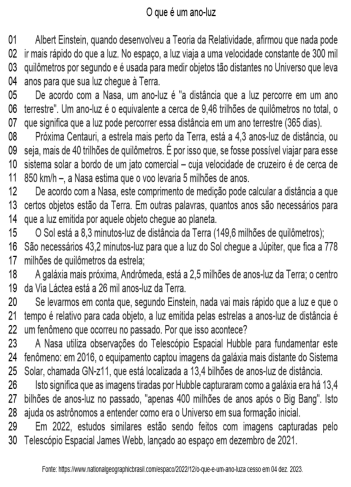
Levando-se em consideração que (V) significa Verdadeiro e (F) significa Falso, a sequência CORRETA das
proposições sobre acentuação e crase é, respectivamente:
(__) A ocorrência de crase (l.04) está incorreta, pois Terra é substantivo próprio;
(__) A ocorrência da crase (l.04) se dá pela transitividade do verbo ‘chegar’ e pela união da preposição ‘a’ e do artigo ‘a’;
(__) galáxia’ (l.26) é paroxítona, apenas, se for precedida por ‘as’;
(__) ‘próxima’ e ‘Andrômeda’ são proparoxítonas.
A sequência CORRETA corresponde a:
(__) A ocorrência de crase (l.04) está incorreta, pois Terra é substantivo próprio;
(__) A ocorrência da crase (l.04) se dá pela transitividade do verbo ‘chegar’ e pela união da preposição ‘a’ e do artigo ‘a’;
(__) galáxia’ (l.26) é paroxítona, apenas, se for precedida por ‘as’;
(__) ‘próxima’ e ‘Andrômeda’ são proparoxítonas.
A sequência CORRETA corresponde a:
Ano: 2024
Banca:
LJ Assessoria e Planejamento Administrativo Limita
Órgão:
Prefeitura de Turilândia - MA
Provas:
LJ Assessoria e Planejamento Administrativo Limita - 2024 - Prefeitura de Turilândia - MA - Assistente Social
|
LJ Assessoria e Planejamento Administrativo Limita - 2024 - Prefeitura de Turilândia - MA - Médico Clínico Geral |
LJ Assessoria e Planejamento Administrativo Limita - 2024 - Prefeitura de Turilândia - MA - Professor de Matemática |
LJ Assessoria e Planejamento Administrativo Limita - 2024 - Prefeitura de Turilândia - MA - Professor de Ciências |
LJ Assessoria e Planejamento Administrativo Limita - 2024 - Prefeitura de Turilândia - MA - Professor de Geografia |
LJ Assessoria e Planejamento Administrativo Limita - 2024 - Prefeitura de Turilândia - MA - Professor de Inglês |
LJ Assessoria e Planejamento Administrativo Limita - 2024 - Prefeitura de Turilândia - MA - Professor de História |
LJ Assessoria e Planejamento Administrativo Limita - 2024 - Prefeitura de Turilândia - MA - Enfermeiro |
LJ Assessoria e Planejamento Administrativo Limita - 2024 - Prefeitura de Turilândia - MA - Engenheiro Agrônomo |
LJ Assessoria e Planejamento Administrativo Limita - 2024 - Prefeitura de Turilândia - MA - Farmacêutico Bioquímico |
LJ Assessoria e Planejamento Administrativo Limita - 2024 - Prefeitura de Turilândia - MA - Médico Veterinário |
LJ Assessoria e Planejamento Administrativo Limita - 2024 - Prefeitura de Turilândia - MA - Nutricionista |
LJ Assessoria e Planejamento Administrativo Limita - 2024 - Prefeitura de Turilândia - MA - Professor de Língua Portuguesa |
LJ Assessoria e Planejamento Administrativo Limita - 2024 - Prefeitura de Turilândia - MA - Professor de Ensino Religioso |
LJ Assessoria e Planejamento Administrativo Limita - 2024 - Prefeitura de Turilândia - MA - Professor de 1° ao 5° Ano |
LJ Assessoria e Planejamento Administrativo Limita - 2024 - Prefeitura de Turilândia - MA - Professor de Educação Infantil |
LJ Assessoria e Planejamento Administrativo Limita - 2024 - Prefeitura de Turilândia - MA - Professor de Educação Física |
LJ Assessoria e Planejamento Administrativo Limita - 2024 - Prefeitura de Turilândia - MA - Psicólogo |
Q2357488
Noções de Informática
Assinale a alternativa que apresenta de forma
correta um exemplo de software.
Ano: 2024
Banca:
LJ Assessoria e Planejamento Administrativo Limita
Órgão:
Prefeitura de Turilândia - MA
Provas:
LJ Assessoria e Planejamento Administrativo Limita - 2024 - Prefeitura de Turilândia - MA - Assistente Social
|
LJ Assessoria e Planejamento Administrativo Limita - 2024 - Prefeitura de Turilândia - MA - Médico Clínico Geral |
LJ Assessoria e Planejamento Administrativo Limita - 2024 - Prefeitura de Turilândia - MA - Professor de Matemática |
LJ Assessoria e Planejamento Administrativo Limita - 2024 - Prefeitura de Turilândia - MA - Professor de Ciências |
LJ Assessoria e Planejamento Administrativo Limita - 2024 - Prefeitura de Turilândia - MA - Professor de Geografia |
LJ Assessoria e Planejamento Administrativo Limita - 2024 - Prefeitura de Turilândia - MA - Professor de Inglês |
LJ Assessoria e Planejamento Administrativo Limita - 2024 - Prefeitura de Turilândia - MA - Professor de História |
LJ Assessoria e Planejamento Administrativo Limita - 2024 - Prefeitura de Turilândia - MA - Enfermeiro |
LJ Assessoria e Planejamento Administrativo Limita - 2024 - Prefeitura de Turilândia - MA - Engenheiro Agrônomo |
LJ Assessoria e Planejamento Administrativo Limita - 2024 - Prefeitura de Turilândia - MA - Farmacêutico Bioquímico |
LJ Assessoria e Planejamento Administrativo Limita - 2024 - Prefeitura de Turilândia - MA - Médico Veterinário |
LJ Assessoria e Planejamento Administrativo Limita - 2024 - Prefeitura de Turilândia - MA - Nutricionista |
LJ Assessoria e Planejamento Administrativo Limita - 2024 - Prefeitura de Turilândia - MA - Professor de Língua Portuguesa |
LJ Assessoria e Planejamento Administrativo Limita - 2024 - Prefeitura de Turilândia - MA - Professor de Ensino Religioso |
LJ Assessoria e Planejamento Administrativo Limita - 2024 - Prefeitura de Turilândia - MA - Professor de 1° ao 5° Ano |
LJ Assessoria e Planejamento Administrativo Limita - 2024 - Prefeitura de Turilândia - MA - Professor de Educação Infantil |
LJ Assessoria e Planejamento Administrativo Limita - 2024 - Prefeitura de Turilândia - MA - Professor de Educação Física |
LJ Assessoria e Planejamento Administrativo Limita - 2024 - Prefeitura de Turilândia - MA - Psicólogo |
Q2357487
Noções de Informática
Hardware são os componentes físicos de um
computador tangíveis. O hardware é dividido em
dispositivos de entrada, dispositivos de saída,
dispositivos de armazenamento secundário e
componentes internos. Assinale a alternativa que
apresenta um hardware de saída.
Ano: 2024
Banca:
ADM&TEC
Órgão:
Prefeitura de Palmeira dos Índios - AL
Prova:
ADM&TEC - 2024 - Prefeitura de Palmeira dos Índios - AL - Professor(a) de Inglês |
Q2357450
Legislação dos Municípios do Estado de Alagoas
Considerando-se a Lei Municipal nº 1.240, 20 de
novembro de 1991, que dispõe sobre o Estatuto dos
Funcionários Públicos do Município de Palmeira dos
Índios/AL, analise as afirmativas a seguir:
I. Ao deslocamento do funcionário dentro do território do município a pedido ou de ofício, com preenchimento de claro de lotação no âmbito do mesmo quadro, dá-se o nome de remoção.
II. Ao deslocamento do funcionário, com respectivo cargo, para quadro de pessoal de outros órgãos ou entidade, cujos planos de cargos e vencimentos sejam idênticos, dá-se o nome de redistribuição.
Marque a alternativa CORRETA:
I. Ao deslocamento do funcionário dentro do território do município a pedido ou de ofício, com preenchimento de claro de lotação no âmbito do mesmo quadro, dá-se o nome de remoção.
II. Ao deslocamento do funcionário, com respectivo cargo, para quadro de pessoal de outros órgãos ou entidade, cujos planos de cargos e vencimentos sejam idênticos, dá-se o nome de redistribuição.
Marque a alternativa CORRETA:
Ano: 2024
Banca:
ADM&TEC
Órgão:
Prefeitura de Palmeira dos Índios - AL
Prova:
ADM&TEC - 2024 - Prefeitura de Palmeira dos Índios - AL - Professor(a) de Inglês |
Q2357449
Legislação dos Municípios do Estado de Alagoas
Considerando-se a Lei Municipal nº 1.240, 20 de
novembro de 1991, que dispõe sobre o Estatuto dos
Funcionários Públicos do Município de Palmeira dos
Índios/AL, analise as afirmativas a seguir:
I. Ao entrar em exercício, o funcionário nomeado para o cargo efetivo ficará sujeito a estágio probatório por um período de 40 meses, contando com os quatro meses necessários para submeter a avaliação para homologação.
II. Serão objetos da avaliação para o desempenho do cargo a serem observados durante o estágio probatório: a assiduidade, a disciplina, a capacidade de iniciativa, a produtividade e a responsabilidade.
III. O funcionário não aprovado no estágio será exonerado, ou, se estável, reconduzido ao cargo anteriormente ocupado, independentemente do cargo encontrar-se provido.
Marque a alternativa CORRETA:
I. Ao entrar em exercício, o funcionário nomeado para o cargo efetivo ficará sujeito a estágio probatório por um período de 40 meses, contando com os quatro meses necessários para submeter a avaliação para homologação.
II. Serão objetos da avaliação para o desempenho do cargo a serem observados durante o estágio probatório: a assiduidade, a disciplina, a capacidade de iniciativa, a produtividade e a responsabilidade.
III. O funcionário não aprovado no estágio será exonerado, ou, se estável, reconduzido ao cargo anteriormente ocupado, independentemente do cargo encontrar-se provido.
Marque a alternativa CORRETA:

 Conheça nossos planos