Questões de Concurso

Foram encontradas 5.205 questões

Resolva questões gratuitamente!

Junte-se a mais de 4 milhões de concurseiros!

Q2908099 Engenharia Elétrica

Com oito flip-flops ligados na configuração de um contador assíncrono, a quantidade máxima de pulsos que podem ser contados é

Alternativas
Q2908097 Engenharia Elétrica

Considere as afirmativas a seguir, que se referem a parâmetros de um amplificador operacional ideal.

I – A impedância de entrada é zero, e a de saída é infinita.

II – A banda passante é infinita.

III – O ganho de tensão diferencial e a rejeição de modo comum são infinitos.

Está correto o que se afirma em

Alternativas
Q2908096 Engenharia Elétrica

O Profibus pertence a uma classe de protocolos que incorpora conceitos chamados fieldbus que significa, primordialmente, o compartilhamento da inteligência, que fica distribuída em rede.

O protocolo Profibus

Alternativas
Q2908095 Legislação Federal

No Brasil, introduziram-se novos ambientes para a comercialização de energia no setor elétrico.

No Ambiente de Contratação Regulada (ACR), destinado às operações de compra e venda de energia para os agentes de distribuição, o mecanismo utilizado é o(a)

Alternativas
Q2908094 Engenharia Elétrica

Uma determinada máquina térmica recebe, através de uma fonte quente, 1,6 kJ de calor para iniciar seu ciclo. Desse calor, 400 J passam para a fonte fria.

Considerando-se que toda a energia que não é transformada em calor realiza trabalho, o rendimento da máquina térmica, em porcentagem (%), é

Alternativas
Q2908093 Engenharia Elétrica

Uma termelétrica de ciclo combinado é uma usina térmica que vem sendo adotada no mundo todo como solução para o uso do gás natural.

No ciclo combinado, o calor necessário para a caldeira da turbina a vapor é fornecido pelos gases quentes da exaustão do(a)

Alternativas
Q2908092 Engenharia Elétrica

Um ciclo termodinâmico se constitui de uma sequência de processos após os quais a matéria que o experimentou retorna ao estado inicial.

As usinas termelétricas em ciclo combinado representam a integração dos ciclos

Alternativas
Q2908091 Engenharia Elétrica

No Brasil, usam-se como produtoras de energia elétrica para comercialização as fontes

Alternativas
Q2908090 Engenharia Elétrica

O transporte de energia gerada nas usinas até as estações transformadoras e a interligação com outros sistemas de transporte de energia são realizados por linhas de transmissão. No Brasil, as linhas operam em diversas classes de tensão.

A classe de tensão, em kV, para linhas de subtransmissão (LST) e linhas de transmissão (LT) são, respectivamente,

Alternativas
Q2908089 Engenharia Elétrica

O Sistema de Medição para Faturamento (SMF) controlado através dos processos de contabilização de energia no âmbito da Câmara de Comercialização de Energia Elétrica (CCEE), como, também, da apuração das demandas pelo Operador Nacional do Sistema Elétrico (ONS) é composto por diversos elementos.

NÃO constituem um desses elementos os

Alternativas
Q2908085 Engenharia Elétrica

No Brasil, a reforma do setor elétrico ocorreu a partir da Constituição de 1988 com o art.175 que estabelece que as novas concessões devem ser licitadas. O modelo estimula a concorrência para aumentar a eficiência e a privatização das empresas, ocasionando um processo de desverticalização das empresas do setor elétrico.

Tal processo deu origem à separação das atividades de geração, transmissão e distribuição, e, no caso da

Alternativas
Q2908084 Inglês
Stanford physicists make new form of matter
The laser-cooled quantum gas opens exciting new realms of unconventional superconductivity
By Max McClure Stanford University News

Within the exotic world of macroscopic quantum effects, where fluids flow uphill, wires conduct without electrical resistance and magnets levitate, there is an even stranger family of “unconventional” phenomena: strongly interacting fermions, a class of particles that are often very difficult to understand on the quantum level. These materials often defy explanation by current theoretical physics, but hold enormous promise for the development of futuristic technologies as room-temperature superconductors, ultrasensitive microscopes and quantum computation. Last week the scientific world was appalled when a Stanford team made the announcement in Physical Review Letters that they had created the world’s first dipolar quantum fermionic gas– “an entirely new form of quantum matter,” as Stanford applied physics Professor and lead author Benjamin Lev puts it. Lev affirmed that this development represents a major step toward understanding the behavior of these systems of particles. Until now, research efforts had focused on cooling bosons – fundamentally different from fermions, and much easier to work with. But now the Stanford team extended these techniques to gases made of the most magnetic atom: a fermionic isotope of dysprosium with magnetic energies 440 times larger than previously cooled gases. He explained that when the thermal energy of some substances drops below a certain critical point, it used to be impossible to consider its component particles separately since the material becomes strongly correlated and its quantum effects become difficult to understand and study. Nevertheless, making the material out of a gas of atoms allows it to become visible. These quantum gases, the coldest objects known to man, are where researchers can observe zero-viscosity fluids – superfluids – that are mathematical cousins of superconductors. Thus far, the result of the Lev lab’s high-tech efforts is a tiny ball of ultracold quantum dipolar fluid. But the researchers have reason to believe that the humble substance will exhibit the seemingly contradictory characteristics of both crystals and superfluids. This combination could lead to quantum liquid crystals. Or it could yield a supersolid – a hypothetical state of matter that would, in theory at least, be a solid with superfluid characteristics. The researchers have already begun developing a microscope to make use of the dipolar quantum fluid’s unique characteristics. It is the “cryogenic atom chip microscope”, a magnetic probe that should measure magnetic fields with unprecedented sensitivity and resolution. “This kind of probe may even allow for a more stable form of quantum computation that uses exotic quantum matter to process information, known as a topologically protected quantum computer”, said Lev. “So this new approach is really incredibly exciting.” 

Available at: <http://news.stanford.edu/news/2012/june/lev-new- -matter-060512.html>. Retrieved on: 5 June 2012. Adapted.

According to the text, the cryogenic atom chip microscope

Alternativas
Q2908083 Inglês
Stanford physicists make new form of matter
The laser-cooled quantum gas opens exciting new realms of unconventional superconductivity
By Max McClure Stanford University News

Within the exotic world of macroscopic quantum effects, where fluids flow uphill, wires conduct without electrical resistance and magnets levitate, there is an even stranger family of “unconventional” phenomena: strongly interacting fermions, a class of particles that are often very difficult to understand on the quantum level. These materials often defy explanation by current theoretical physics, but hold enormous promise for the development of futuristic technologies as room-temperature superconductors, ultrasensitive microscopes and quantum computation. Last week the scientific world was appalled when a Stanford team made the announcement in Physical Review Letters that they had created the world’s first dipolar quantum fermionic gas– “an entirely new form of quantum matter,” as Stanford applied physics Professor and lead author Benjamin Lev puts it. Lev affirmed that this development represents a major step toward understanding the behavior of these systems of particles. Until now, research efforts had focused on cooling bosons – fundamentally different from fermions, and much easier to work with. But now the Stanford team extended these techniques to gases made of the most magnetic atom: a fermionic isotope of dysprosium with magnetic energies 440 times larger than previously cooled gases. He explained that when the thermal energy of some substances drops below a certain critical point, it used to be impossible to consider its component particles separately since the material becomes strongly correlated and its quantum effects become difficult to understand and study. Nevertheless, making the material out of a gas of atoms allows it to become visible. These quantum gases, the coldest objects known to man, are where researchers can observe zero-viscosity fluids – superfluids – that are mathematical cousins of superconductors. Thus far, the result of the Lev lab’s high-tech efforts is a tiny ball of ultracold quantum dipolar fluid. But the researchers have reason to believe that the humble substance will exhibit the seemingly contradictory characteristics of both crystals and superfluids. This combination could lead to quantum liquid crystals. Or it could yield a supersolid – a hypothetical state of matter that would, in theory at least, be a solid with superfluid characteristics. The researchers have already begun developing a microscope to make use of the dipolar quantum fluid’s unique characteristics. It is the “cryogenic atom chip microscope”, a magnetic probe that should measure magnetic fields with unprecedented sensitivity and resolution. “This kind of probe may even allow for a more stable form of quantum computation that uses exotic quantum matter to process information, known as a topologically protected quantum computer”, said Lev. “So this new approach is really incredibly exciting.” 

Available at: <http://news.stanford.edu/news/2012/june/lev-new- -matter-060512.html>. Retrieved on: 5 June 2012. Adapted.

According to the text, this new material has the opposing qualities of being

Alternativas
Q2908082 Inglês
Stanford physicists make new form of matter
The laser-cooled quantum gas opens exciting new realms of unconventional superconductivity
By Max McClure Stanford University News

Within the exotic world of macroscopic quantum effects, where fluids flow uphill, wires conduct without electrical resistance and magnets levitate, there is an even stranger family of “unconventional” phenomena: strongly interacting fermions, a class of particles that are often very difficult to understand on the quantum level. These materials often defy explanation by current theoretical physics, but hold enormous promise for the development of futuristic technologies as room-temperature superconductors, ultrasensitive microscopes and quantum computation. Last week the scientific world was appalled when a Stanford team made the announcement in Physical Review Letters that they had created the world’s first dipolar quantum fermionic gas– “an entirely new form of quantum matter,” as Stanford applied physics Professor and lead author Benjamin Lev puts it. Lev affirmed that this development represents a major step toward understanding the behavior of these systems of particles. Until now, research efforts had focused on cooling bosons – fundamentally different from fermions, and much easier to work with. But now the Stanford team extended these techniques to gases made of the most magnetic atom: a fermionic isotope of dysprosium with magnetic energies 440 times larger than previously cooled gases. He explained that when the thermal energy of some substances drops below a certain critical point, it used to be impossible to consider its component particles separately since the material becomes strongly correlated and its quantum effects become difficult to understand and study. Nevertheless, making the material out of a gas of atoms allows it to become visible. These quantum gases, the coldest objects known to man, are where researchers can observe zero-viscosity fluids – superfluids – that are mathematical cousins of superconductors. Thus far, the result of the Lev lab’s high-tech efforts is a tiny ball of ultracold quantum dipolar fluid. But the researchers have reason to believe that the humble substance will exhibit the seemingly contradictory characteristics of both crystals and superfluids. This combination could lead to quantum liquid crystals. Or it could yield a supersolid – a hypothetical state of matter that would, in theory at least, be a solid with superfluid characteristics. The researchers have already begun developing a microscope to make use of the dipolar quantum fluid’s unique characteristics. It is the “cryogenic atom chip microscope”, a magnetic probe that should measure magnetic fields with unprecedented sensitivity and resolution. “This kind of probe may even allow for a more stable form of quantum computation that uses exotic quantum matter to process information, known as a topologically protected quantum computer”, said Lev. “So this new approach is really incredibly exciting.” 

Available at: <http://news.stanford.edu/news/2012/june/lev-new- -matter-060512.html>. Retrieved on: 5 June 2012. Adapted.

In the text, the word in bold-face type is similar to the one in italics in

Alternativas
Q2908081 Inglês
Stanford physicists make new form of matter
The laser-cooled quantum gas opens exciting new realms of unconventional superconductivity
By Max McClure Stanford University News

Within the exotic world of macroscopic quantum effects, where fluids flow uphill, wires conduct without electrical resistance and magnets levitate, there is an even stranger family of “unconventional” phenomena: strongly interacting fermions, a class of particles that are often very difficult to understand on the quantum level. These materials often defy explanation by current theoretical physics, but hold enormous promise for the development of futuristic technologies as room-temperature superconductors, ultrasensitive microscopes and quantum computation. Last week the scientific world was appalled when a Stanford team made the announcement in Physical Review Letters that they had created the world’s first dipolar quantum fermionic gas– “an entirely new form of quantum matter,” as Stanford applied physics Professor and lead author Benjamin Lev puts it. Lev affirmed that this development represents a major step toward understanding the behavior of these systems of particles. Until now, research efforts had focused on cooling bosons – fundamentally different from fermions, and much easier to work with. But now the Stanford team extended these techniques to gases made of the most magnetic atom: a fermionic isotope of dysprosium with magnetic energies 440 times larger than previously cooled gases. He explained that when the thermal energy of some substances drops below a certain critical point, it used to be impossible to consider its component particles separately since the material becomes strongly correlated and its quantum effects become difficult to understand and study. Nevertheless, making the material out of a gas of atoms allows it to become visible. These quantum gases, the coldest objects known to man, are where researchers can observe zero-viscosity fluids – superfluids – that are mathematical cousins of superconductors. Thus far, the result of the Lev lab’s high-tech efforts is a tiny ball of ultracold quantum dipolar fluid. But the researchers have reason to believe that the humble substance will exhibit the seemingly contradictory characteristics of both crystals and superfluids. This combination could lead to quantum liquid crystals. Or it could yield a supersolid – a hypothetical state of matter that would, in theory at least, be a solid with superfluid characteristics. The researchers have already begun developing a microscope to make use of the dipolar quantum fluid’s unique characteristics. It is the “cryogenic atom chip microscope”, a magnetic probe that should measure magnetic fields with unprecedented sensitivity and resolution. “This kind of probe may even allow for a more stable form of quantum computation that uses exotic quantum matter to process information, known as a topologically protected quantum computer”, said Lev. “So this new approach is really incredibly exciting.” 

Available at: <http://news.stanford.edu/news/2012/june/lev-new- -matter-060512.html>. Retrieved on: 5 June 2012. Adapted.

In the second paragraph of the text, it is clear that

Alternativas
Q2908080 Inglês
Stanford physicists make new form of matter
The laser-cooled quantum gas opens exciting new realms of unconventional superconductivity
By Max McClure Stanford University News

Within the exotic world of macroscopic quantum effects, where fluids flow uphill, wires conduct without electrical resistance and magnets levitate, there is an even stranger family of “unconventional” phenomena: strongly interacting fermions, a class of particles that are often very difficult to understand on the quantum level. These materials often defy explanation by current theoretical physics, but hold enormous promise for the development of futuristic technologies as room-temperature superconductors, ultrasensitive microscopes and quantum computation. Last week the scientific world was appalled when a Stanford team made the announcement in Physical Review Letters that they had created the world’s first dipolar quantum fermionic gas– “an entirely new form of quantum matter,” as Stanford applied physics Professor and lead author Benjamin Lev puts it. Lev affirmed that this development represents a major step toward understanding the behavior of these systems of particles. Until now, research efforts had focused on cooling bosons – fundamentally different from fermions, and much easier to work with. But now the Stanford team extended these techniques to gases made of the most magnetic atom: a fermionic isotope of dysprosium with magnetic energies 440 times larger than previously cooled gases. He explained that when the thermal energy of some substances drops below a certain critical point, it used to be impossible to consider its component particles separately since the material becomes strongly correlated and its quantum effects become difficult to understand and study. Nevertheless, making the material out of a gas of atoms allows it to become visible. These quantum gases, the coldest objects known to man, are where researchers can observe zero-viscosity fluids – superfluids – that are mathematical cousins of superconductors. Thus far, the result of the Lev lab’s high-tech efforts is a tiny ball of ultracold quantum dipolar fluid. But the researchers have reason to believe that the humble substance will exhibit the seemingly contradictory characteristics of both crystals and superfluids. This combination could lead to quantum liquid crystals. Or it could yield a supersolid – a hypothetical state of matter that would, in theory at least, be a solid with superfluid characteristics. The researchers have already begun developing a microscope to make use of the dipolar quantum fluid’s unique characteristics. It is the “cryogenic atom chip microscope”, a magnetic probe that should measure magnetic fields with unprecedented sensitivity and resolution. “This kind of probe may even allow for a more stable form of quantum computation that uses exotic quantum matter to process information, known as a topologically protected quantum computer”, said Lev. “So this new approach is really incredibly exciting.” 

Available at: <http://news.stanford.edu/news/2012/june/lev-new- -matter-060512.html>. Retrieved on: 5 June 2012. Adapted.

According to the text, fermions

Alternativas
Q2908079 Matemática Financeira

Um produto teve seu preço original aumentado em 10% e passou a custar P reais.

Se, em vez de ser aumentado em 10%, o preço original do produto sofresse um desconto de 20%, o produto passaria a custar, em reais,

Alternativas
Q2908077 Matemática

Em um grande campo, há nove torres e cada uma delas deve ser conectada às demais por meio de cabos.

Se a conexão entre duas torres quaisquer sempre fizer uso de exatamente 20 cabos, quantos cabos serão necessários para ligar todas as nove torres entre si?
Alternativas
Q2908076 Português

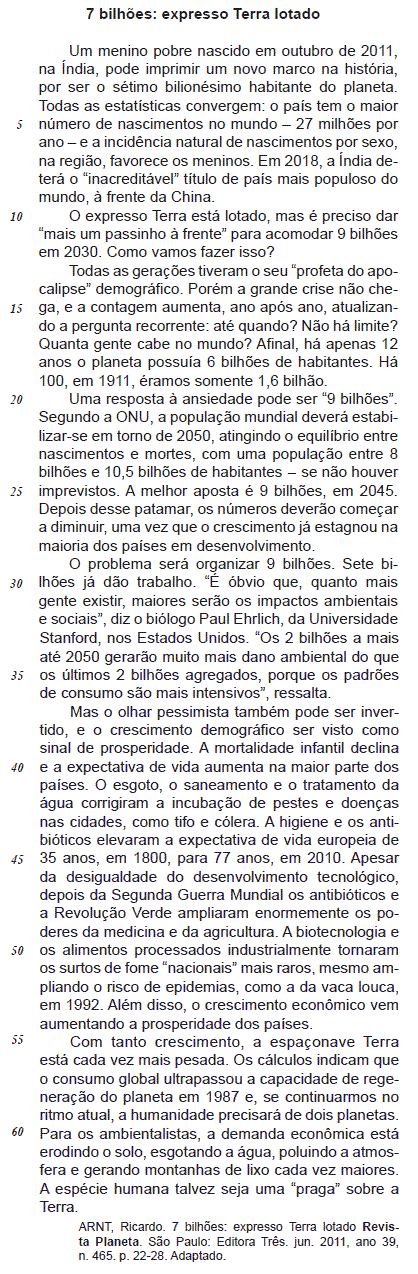
No trecho “Os 2 bilhões a mais até 2050 gerarão muito mais dano ambiental do que os últimos 2 bilhões agregados, porque os padrões de consumo são mais intensivos” (l. 33-36), o termo destacado estabelece uma relação de causalidade entre as duas ideias que o compõem.

Essa mesma relação é expressa pelo termo ou expressão destacados em:

Alternativas
Q2908075 Português

Na expressão destacada no trecho “os alimentos processados industrialmente tornaram os surtos de fome ‘nacionais’ mais raros” (l. 50-51), a concordância nominal está de acordo com a norma-padrão.

Nas frases a seguir, a concordância da palavra destacada está de acordo com a norma-padrão, EXCETO em:

Alternativas
Respostas
4321: D
4322: D
4323: A
4324: A
4325: E
4326: D
4327: A
4328: C
4329: E
4330: B
4331: C
4332: D
4333: C
4334: D
4335: B
4336: B
4337: E
4338: B
4339: C
4340: D