Questões de Concurso
Para fundep (gestão de concursos)
Foram encontradas 32.792 questões
Resolva questões gratuitamente!
Junte-se a mais de 4 milhões de concurseiros!


“(EF04ER07) Reconhecer e respeitar as ideias de divindades de diferentes manifestações e tradições religiosas.”
MONTES CLAROS. Secretaria Municipal de Educação. Referencial Curricular dos Anos Iniciais do Ensino Fundamental. 1º ao 5º ano. Disponível em https://anosiniciais.edu. montesclaros.mg.gov.br/. Acesso em: 26 jun. 2024.
Ao final do bimestre, a professora aplicou uma proposta avaliativa. Ela dividiu a sala em grupos, entregando a cada grupo duas plaquinhas: uma com a letra F – de falso e outra com a letra V – de verdadeiro. Em seguida, ela escreveu no quadro quatro afirmativas sobre as ideias de divindades nas diferentes tradições religiosas. Por fim, orientou aos grupos que, após a leitura de cada uma das afirmativas, eles deveriam conversar entre si e levantar uma das plaquinhas, de modo a responder se a afirmação é falsa ou verdadeira.
Analise as afirmativas que a professora escreveu no quadro sobre as ideias de divindades nas diferentes tradições religiosas e assinale com V as verdadeiras e com F as falsas.
( ) No Budismo não há uma ideia de um Deus Criador.
( ) No Hinduísmo um dos deuses é chamado de Zoroastro.
( ) No Islamismo a divindade é nomeada como Alá.
( ) No Judaísmo a divindade pode ser chamada de Javé.
Assinale a sequência correta.
Assinale a alternativa que apresenta a explicação correta dada pela professora quanto à relação entre Karma e Ciclo de Samsara.
Assinale a alternativa que apresenta a prática pela qual Mahatma Gandhi é reconhecido como um líder religioso que promoveu a paz.
Considerando esse contexto, assinale a alternativa que apresenta as diferenças e proximidades sobre os textos sagrados dessas tradições.

Muro das Lamentações. Foto: Slavamalai / Shutterstock.com.
De acordo com os conhecimentos religiosos acerca do Judaísmo, assinale a alternativa que apresenta a resposta que o professor deveria apresentar à turma sobre o Muro das Lamentações.
Dos modelos a seguir, assinale aquele que apresenta a quantidade de peças produzidas P, em função do tempo t (em horas), das duas máquinas produzindo, em que R é o conjunto dos reais e N é o conjunto dos naturais:

O volume desse sódio será de:
A probabilidade de os representantes serem um da turma 6ª A e um da turma 9ª B é de:
Quanto aos valores da nova média e mediana com as 24 notas, é correto afirmar:
Sendo esses números x, y e z os menores possíveis, o número total de barras de chocolate em cada caixa é:
I. O erro se constitui como um conhecimento e reflete um saber que o aluno possui. O professor deve, ao identificá‑lo, elaborar estratégias didáticas que levem o aluno a desestabilizá‑lo e rever suas respostas.
II. O professor, ao identificar um erro, deve deixar claro que está errado e mostrar a forma correta, e em seguida orientar o aluno a fazer uma série de exercícios semelhantes.
III. O professor, ao detectar um erro, deve verificar se ele é fruto de uma dificuldade individual ou coletiva, para determinar como será o atendimento e o melhor momento de realizá‑lo.
Estão corretas as afirmativas
Segundo esse autor, um dos principais motivos desse tipo de avaliação não ser adequado é porque ele
Acerca do que o professor deve fazer na aula de investigação, assinale a alternativa correta.
Acerca desses contextos e sua relação com o estudante, analise as afirmativas a seguir.
I. Para ser significativo, o contexto deve estar relacionado somente ao cotidiano do estudante.
II. Para ser significativo, o contexto pode estabelecer relação entre o conceito estudado e diferentes temas matemáticos.
III. Para ser significativo, o contexto pode estabelecer relação entre o conceito estudado e demais componentes curriculares.
Estão corretas as afirmativas
[…]
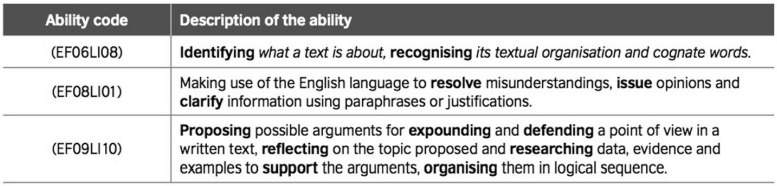
Available at: https://www.britishcouncil.org.br/sites/default/files/leitura_critica_bncc_-_en_-_v4_final.pdf. [Fragment]. Accessed on May 6, 2024.
To develop the BNCC ability of identifying what a text is about and recognising its textual organization and cognate words, English teachers are recommended to exploit different textual genres in the language classroom. Examples of such texts range from a menu, a text message or a poem to a book review.
To develop the BNCC ability EF06LI08, which includes identifying what a text is about, an English teacher should make use of
Read the following text to answer the question.
By Leo Selivan
In this article, informed by the Lexical Approach, I reflect on grammar instruction in the classroom […]. I consider the problems with ‘traditional’ grammar teaching before arguing that what we actually need is more grammar input as well as showing how lexis can provide necessary ‘crutches’ for the learner.
Lexis = vocabulary + grammar
The shift in ELT from grammar to lexis mirrors a similar change in the attitude of linguists. In the past linguists were preoccupied with the grammar of language; however the advances in corpus linguistics have pushed lexis to the forefront. The term ‘lexis’, which was traditionally used by linguists, is a common word these days and frequently used even in textbooks.
Why use a technical term borrowed from the realm of linguistics instead of the word ‘vocabulary’? Quite simply because vocabulary is typically seen as individual words (often presented in lists) whereas lexis is a somewhat wider concept and consists of collocations, chunks and formulaic expressions. It also includes certain patterns that were traditionally associated with the grammar of a language, e.g. If I were you…, I haven’t seen you for ages etc.
Recognising certain grammar structures as lexical
items means that they can be introduced much earlier,
without structural analysis or elaboration. Indeed, since the
concept of notions and functions made its way into language
teaching, particularly as Communicative Language Teaching
(CLT) gained prominence, some structures associated with
grammar started to be taught lexically (or functionally). I’d like
to is not taught as ‹the conditional› but as a chunk expressing
desire. Similarly many other ‹traditional› grammar items can
be introduced lexically relatively early on.
Less grammar or more grammar?
You are, no doubt, all familiar with students who on one hand seem to know the ‘rules’ of grammar but still fail to produce grammatically correct sentences when speaking or, on the other, sound unnatural and foreign-like even when their sentences are grammatically correct. Michael Lewis, who might be considered the founder of the Lexical Approach, once claimed that there was no direct relationship between the knowledge of grammar and speaking. In contrast, the knowledge of formulaic language has been shown by research to have a significant bearing on the natural language production.
Furthermore, certain grammar rules are practically impossible to learn. Dave Willis cites the grammar of orientation (which includes the notoriously difficult present perfect and the uses of certain modal verbs) as particularly resistant to teaching. The only way to grasp their meaning is through continuous exposure and use.
Finally, even the most authoritative English grammars never claim to provide a comprehensive description of all the grammar, hence the word ‘introduction’ often used in their titles (for instance, Huddleston & Pullum’s A Student’s Introduction to English Grammar or Halliday’s An Introduction to Functional Grammar).
If grammarians do not even attempt to address all areas of grammar, how can we, practitioners, cover all the aspects of grammar in our teaching, especially if all we seem to focus on is a limited selection of discrete items, comprised mostly of tenses and a handful of modal verbs? It would seem that we need to expose our students to a lot of naturally occurring language and frequently draw their attention to various grammar points as they arise.
For example, while teaching the expression fall asleep / be asleep you can ask your students:
• Don’t make any noise – she’s fallen asleep.
• Don’t make any noise – she’s asleep.
What does’s stand for in each of these cases (is or has)?
One of the fathers of the Communicative Language Teaching Henry Widdowson advocated using lexical items as a starting point and then ‘showing how they need to be grammatically modified to be communicatively effective’ (1990:95). For example, when exploring a text with your students, you may come across a sentence like this:
• They’ve been married for seven years.
You can ask your students: When did they get married? How should you change the sentence if the couple you are talking about is no longer married?
The above demonstrates how the teacher should be constantly on the ball and take every opportunity to draw students’ attention to grammar. Such short but frequent ‘grammar spots’ will help to slowly raise students’ awareness and build their understanding of the English grammar system.
[…]
Conclusion
So is there room for grammar instruction in the classroom? Certainly yes. But the grammar practice should always start with the exploitation of lexical items. Exposing students to a lot of natural and contextualised examples will offer a lexical way into the grammar of the language.
To sum up, grammar should play some role in language teaching but should not occupy a big part of class time. Instead grammar should be delivered in small but frequent portions. Students should be encouraged to collect a lot of examples of a particular structure before being invited to analyse it. Hence, analysis should be preceded by synthesis.
Lastly, language practitioners should bear in mind that grammar acquisition is an incremental process which requires frequent focus and refocus on the items already studied.
Available at: https://www.teachingenglish.org.uk/professionaldevelopment/teachers/knowing-subject/articles/grammar-vs-lexisor-grammar-through. Accessed on: April 29, 2024.
Read the following text to answer the question.
By Leo Selivan
In this article, informed by the Lexical Approach, I reflect on grammar instruction in the classroom […]. I consider the problems with ‘traditional’ grammar teaching before arguing that what we actually need is more grammar input as well as showing how lexis can provide necessary ‘crutches’ for the learner.
Lexis = vocabulary + grammar
The shift in ELT from grammar to lexis mirrors a similar change in the attitude of linguists. In the past linguists were preoccupied with the grammar of language; however the advances in corpus linguistics have pushed lexis to the forefront. The term ‘lexis’, which was traditionally used by linguists, is a common word these days and frequently used even in textbooks.
Why use a technical term borrowed from the realm of linguistics instead of the word ‘vocabulary’? Quite simply because vocabulary is typically seen as individual words (often presented in lists) whereas lexis is a somewhat wider concept and consists of collocations, chunks and formulaic expressions. It also includes certain patterns that were traditionally associated with the grammar of a language, e.g. If I were you…, I haven’t seen you for ages etc.
Recognising certain grammar structures as lexical
items means that they can be introduced much earlier,
without structural analysis or elaboration. Indeed, since the
concept of notions and functions made its way into language
teaching, particularly as Communicative Language Teaching
(CLT) gained prominence, some structures associated with
grammar started to be taught lexically (or functionally). I’d like
to is not taught as ‹the conditional› but as a chunk expressing
desire. Similarly many other ‹traditional› grammar items can
be introduced lexically relatively early on.
Less grammar or more grammar?
You are, no doubt, all familiar with students who on one hand seem to know the ‘rules’ of grammar but still fail to produce grammatically correct sentences when speaking or, on the other, sound unnatural and foreign-like even when their sentences are grammatically correct. Michael Lewis, who might be considered the founder of the Lexical Approach, once claimed that there was no direct relationship between the knowledge of grammar and speaking. In contrast, the knowledge of formulaic language has been shown by research to have a significant bearing on the natural language production.
Furthermore, certain grammar rules are practically impossible to learn. Dave Willis cites the grammar of orientation (which includes the notoriously difficult present perfect and the uses of certain modal verbs) as particularly resistant to teaching. The only way to grasp their meaning is through continuous exposure and use.
Finally, even the most authoritative English grammars never claim to provide a comprehensive description of all the grammar, hence the word ‘introduction’ often used in their titles (for instance, Huddleston & Pullum’s A Student’s Introduction to English Grammar or Halliday’s An Introduction to Functional Grammar).
If grammarians do not even attempt to address all areas of grammar, how can we, practitioners, cover all the aspects of grammar in our teaching, especially if all we seem to focus on is a limited selection of discrete items, comprised mostly of tenses and a handful of modal verbs? It would seem that we need to expose our students to a lot of naturally occurring language and frequently draw their attention to various grammar points as they arise.
For example, while teaching the expression fall asleep / be asleep you can ask your students:
• Don’t make any noise – she’s fallen asleep.
• Don’t make any noise – she’s asleep.
What does’s stand for in each of these cases (is or has)?
One of the fathers of the Communicative Language Teaching Henry Widdowson advocated using lexical items as a starting point and then ‘showing how they need to be grammatically modified to be communicatively effective’ (1990:95). For example, when exploring a text with your students, you may come across a sentence like this:
• They’ve been married for seven years.
You can ask your students: When did they get married? How should you change the sentence if the couple you are talking about is no longer married?
The above demonstrates how the teacher should be constantly on the ball and take every opportunity to draw students’ attention to grammar. Such short but frequent ‘grammar spots’ will help to slowly raise students’ awareness and build their understanding of the English grammar system.
[…]
Conclusion
So is there room for grammar instruction in the classroom? Certainly yes. But the grammar practice should always start with the exploitation of lexical items. Exposing students to a lot of natural and contextualised examples will offer a lexical way into the grammar of the language.
To sum up, grammar should play some role in language teaching but should not occupy a big part of class time. Instead grammar should be delivered in small but frequent portions. Students should be encouraged to collect a lot of examples of a particular structure before being invited to analyse it. Hence, analysis should be preceded by synthesis.
Lastly, language practitioners should bear in mind that grammar acquisition is an incremental process which requires frequent focus and refocus on the items already studied.
Available at: https://www.teachingenglish.org.uk/professionaldevelopment/teachers/knowing-subject/articles/grammar-vs-lexisor-grammar-through. Accessed on: April 29, 2024.
Read the following text to answer the question.
By Leo Selivan
In this article, informed by the Lexical Approach, I reflect on grammar instruction in the classroom […]. I consider the problems with ‘traditional’ grammar teaching before arguing that what we actually need is more grammar input as well as showing how lexis can provide necessary ‘crutches’ for the learner.
Lexis = vocabulary + grammar
The shift in ELT from grammar to lexis mirrors a similar change in the attitude of linguists. In the past linguists were preoccupied with the grammar of language; however the advances in corpus linguistics have pushed lexis to the forefront. The term ‘lexis’, which was traditionally used by linguists, is a common word these days and frequently used even in textbooks.
Why use a technical term borrowed from the realm of linguistics instead of the word ‘vocabulary’? Quite simply because vocabulary is typically seen as individual words (often presented in lists) whereas lexis is a somewhat wider concept and consists of collocations, chunks and formulaic expressions. It also includes certain patterns that were traditionally associated with the grammar of a language, e.g. If I were you…, I haven’t seen you for ages etc.
Recognising certain grammar structures as lexical
items means that they can be introduced much earlier,
without structural analysis or elaboration. Indeed, since the
concept of notions and functions made its way into language
teaching, particularly as Communicative Language Teaching
(CLT) gained prominence, some structures associated with
grammar started to be taught lexically (or functionally). I’d like
to is not taught as ‹the conditional› but as a chunk expressing
desire. Similarly many other ‹traditional› grammar items can
be introduced lexically relatively early on.
Less grammar or more grammar?
You are, no doubt, all familiar with students who on one hand seem to know the ‘rules’ of grammar but still fail to produce grammatically correct sentences when speaking or, on the other, sound unnatural and foreign-like even when their sentences are grammatically correct. Michael Lewis, who might be considered the founder of the Lexical Approach, once claimed that there was no direct relationship between the knowledge of grammar and speaking. In contrast, the knowledge of formulaic language has been shown by research to have a significant bearing on the natural language production.
Furthermore, certain grammar rules are practically impossible to learn. Dave Willis cites the grammar of orientation (which includes the notoriously difficult present perfect and the uses of certain modal verbs) as particularly resistant to teaching. The only way to grasp their meaning is through continuous exposure and use.
Finally, even the most authoritative English grammars never claim to provide a comprehensive description of all the grammar, hence the word ‘introduction’ often used in their titles (for instance, Huddleston & Pullum’s A Student’s Introduction to English Grammar or Halliday’s An Introduction to Functional Grammar).
If grammarians do not even attempt to address all areas of grammar, how can we, practitioners, cover all the aspects of grammar in our teaching, especially if all we seem to focus on is a limited selection of discrete items, comprised mostly of tenses and a handful of modal verbs? It would seem that we need to expose our students to a lot of naturally occurring language and frequently draw their attention to various grammar points as they arise.
For example, while teaching the expression fall asleep / be asleep you can ask your students:
• Don’t make any noise – she’s fallen asleep.
• Don’t make any noise – she’s asleep.
What does’s stand for in each of these cases (is or has)?
One of the fathers of the Communicative Language Teaching Henry Widdowson advocated using lexical items as a starting point and then ‘showing how they need to be grammatically modified to be communicatively effective’ (1990:95). For example, when exploring a text with your students, you may come across a sentence like this:
• They’ve been married for seven years.
You can ask your students: When did they get married? How should you change the sentence if the couple you are talking about is no longer married?
The above demonstrates how the teacher should be constantly on the ball and take every opportunity to draw students’ attention to grammar. Such short but frequent ‘grammar spots’ will help to slowly raise students’ awareness and build their understanding of the English grammar system.
[…]
Conclusion
So is there room for grammar instruction in the classroom? Certainly yes. But the grammar practice should always start with the exploitation of lexical items. Exposing students to a lot of natural and contextualised examples will offer a lexical way into the grammar of the language.
To sum up, grammar should play some role in language teaching but should not occupy a big part of class time. Instead grammar should be delivered in small but frequent portions. Students should be encouraged to collect a lot of examples of a particular structure before being invited to analyse it. Hence, analysis should be preceded by synthesis.
Lastly, language practitioners should bear in mind that grammar acquisition is an incremental process which requires frequent focus and refocus on the items already studied.
Available at: https://www.teachingenglish.org.uk/professionaldevelopment/teachers/knowing-subject/articles/grammar-vs-lexisor-grammar-through. Accessed on: April 29, 2024.

 Conheça nossos planos