Foram encontradas 56.489 questões
Resolva questões gratuitamente!
Junte-se a mais de 4 milhões de concurseiros!


A careful analysis of the teacher-student relationship at any level, inside or outside the school, reveals its fundamentally narrative character. This relationship involves a narrating Subject (the teacher) and patient, listening objects (the students). The contents, whether values or empirical dimensions of reality, tend in the process of being narrated to become lifeless and petrified. Education is suffering from narration sickness.
The teacher talks about reality as if it were motionless, static, compartmentalized, and predictable. Or else he expounds on a topic completely alien to the existential experience of the students. His task is to “fill” the students with the contents of his narration—contents which are detached from reality, disconnected from the totality that engendered them and could give them significance. Words are emptied of their concreteness and become a hollow, alienated, and alienating verbosity.
The outstanding characteristic of this narrative education, then, is the sonority of words, not their transforming power. “Four times four is sixteen; the capital of Pará is Belém.” The student records, memorizes, and repeats these phrases without perceiving what four times four really means, or realizing the true significance of “capital” in the affirmation “the capital of Para is Belém,” that is, what Belém means for Pará and what Pará means for Brazil.
Source: https://www.historyisaweapon.com/defcon2/pedagogy/pedago gychapter2.html
The author of this excerpt
Read the following excerpt of a book review:
Machado de Assis is one of Brazil’s most cherished writers. Born in 1839, he was the grandson of freed slaves. ________ was not abolished in Brazil until 1888, when Machado de Assis was already 49 years old, a fact I learned after being _____ surprised by the casual mention of slaves throughout this novel. In spite of his family’s poverty and lack of opportunity for education, Machado de Assis _____ through various bureaucratic positions until finally gaining prominence as a writer and poet. He taught himself French, English, German, and Greek, and eventually founded the Brazilian Academy of Letters. Nevertheless, he has never had a vast following among English-speaking readers, which is a shame.
Dom Casmurro is a simple tale about an aging man named Bento Santiago, who is one day moved to document the story of his life. His life is not all that extraordinary, to be honest. He falls in love with the girl next door, ______ with her and a close family friend to avoid being sent to the seminary, eventually marries and has a son, and then becomes jealous and suspicious. In his old age, where the novel begins, he has taken to living in a reproduction of his ________ home, suggesting a sort of Citizen Kane-type regret (rather, I guess Citizen Kane suggests a type of Dom Casmurrotype regret).
Source: https://cannonballread.com/2023/09/dom-casmurrokimmie/
Choose the option that best completes the gaps in the excerpt:
I remember being caught speaking Spanish at recess – that was good for three licks on the knuckles with a sharp ruler. I remember being sent to the comer of the classroom for “talking back” to the Anglo teacher when all I was trying to do was tell her how to pronounce my name. “If you want to be American, speak ‘American.’ If you don’t like it, go back to Mexico where you belong.”
(…) At Pan American University, I and all Chicano students were required to take two speech classes. Their purpose: to get rid of our accents. Attacks on one’s form of expression with the intent to censor are a violation of the First Amendment.
(…) Wild tongues can’t be tamed, they can only be cut out.
Reference: Anzaldúa, Gloria. Borderlands/La Frontera: The New Mestiza. 2nd ed. San Francisco: Aunt Lute Books, 1999. I
In this passage, Anzaldúa
Look at the comic strip below.
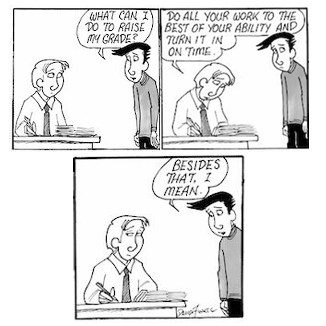
Source: https://www.middleweb.com/20394/daily-comic-strip-chronicles-teaching-life/
Choose the correct alternative according to the text.
It’s 12.33 am and I start to write in this dark and silent room. Outside through the open window I hear voices in the night and police sirens in the distance.
I’m 26 years and a few months old; most people would say that my life is ahead of me, that nothing has started yet, but for a long time now I’ve been living with the feeling that I’ve lived too much; I imagine that’s why the need to write is so deep, to fix the past in writing and, I suppose, to get rid of it, or maybe, conversely, the past is so anchored in me now that I’m forced to talk about it, at every moment, on every occasion, maybe it has won out, and by believing I’m getting rid of it I’m only bolstering its existence and its ascendency over my life, maybe I’m trapped – I don’t know.
When I was 21 it was already too late, I’d already lived too much – I’d known misery, poverty in my childhood, my mother asking me time and again to go and knock on the neighbours’ or my aunt’s door with an imploring voice so they’d give us a packet of pasta and a jar of tomato sauce because she had no more money and she knew that a child would be more easily pitied than an adult.
I’d known violence, my cousin who died in prison at 30, my older brother who was sick with alcoholism even as a teenager, who woke up drunk most mornings because his body was so steeped in alcohol, my mother who denied it with all her might to protect her son who swore to us every time he drank that it was the last time, that after that he’d never drink again. The fights in the village cafe, the obsessive racism of rural, isolated communities, underlying every sentence, or even every word.
Source: https://www.theguardian.com/books/2024/jan/28/edouard-louischange-book-extract
The narrator in this passage
Ain't got no home, ain't got no shoes Ain't got no money, ain't got no class Ain't got no skirts, ain't got no sweaters Ain't got no perfume, ain't got no love Ain't got no faith
Ain't got no culture, ain't got no mother Ain't got no father, ain't got no brother Ain't got no children, ain't got no aunts Ain't got no uncles, ain't got no love Ain't got no mind
Ain't got no country ain't got no schooling Ain't got no friends, ain't got no nothing Ain't got no water, ain't got no air Ain't got no smokes, ain't got no ticket
Ain't got no water, ain't got no love Ain't got no hair, ain't got no God Ain't got no wine, ain't got no money Ain't got no bed, ain't got no God Ain't got no love
What have I got? Why am I alive anyway? Yeah, what have I got? Nobody can take away
Source: https://www.letras.mus.br/nina-simone/aint-got-noigot-life/
As an English teacher, how would you explain the linguistic choices of the song based on the recommendations brought by the Brazilian National Common Core Curriculum (Base Nacional Comum Curricular)?
Teacher: There is a backpack on the table… repeat! Students: There is a backpack on the table. Teacher: Spoon. Students: There is a spoon on the table. Teacher: On the chair. Students: There is a spoon on the chair. Teacher: Bucket. Students: There is a bucket on the chair.
This dialogue can be understood as a representation of
CREATE TABLE Alunos ( id_aluno INT PRIMARY KEY, nome VARCHAR(100), sexo CHAR(1), cidade VARCHAR(100), estado CHAR(2), media DECIMAL(3,1), ano INT );
Ela orientou os estudantes a montarem uma consulta SQL que retornasse os nomes das alunas (sexo feminino) que:
• moram em Porto Alegre;
• moram no estado RS;
• foram aprovadas por média (média maior ou igual a 7,0);
• e cursaram o ano de 2024.
Após analisar as propostas dos alunos, a professora identificou que a consulta correta é
I. o desenvolvimento econômico e tecnológico e a inovação;
II. a livre iniciativa, a livre concorrência e a defesa do consumidor;
III. a promoção de políticas públicas de transporte coletivo;
IV. a obrigatoriedade de adoção de práticas agrícolas sustentáveis.
Estão corretos:
Preencha as lacunas e assinale a alternativa correta.
Na engenharia de requisitos, diferentes técnicas são utilizadas para identificar as necessidades dos usuários e do sistema. ______________ são uma técnica de descoberta de requisitos inicialmente introduzida no método Objectory e atualmente fazem parte da linguagem de modelagem unificada (UML). Eles(as) identificam os atores envolvidos em uma interação e nomeiam o tipo de interação, podendo ser complementados(as) com descrições textuais ou diagramas, como os de sequência ou estados. Já a técnica de _____________ envolve a observação direta do ambiente de trabalho dos usuários, permitindo identificar requisitos de forma contextualizada
( ) A camada de transporte está acima da camada de rede, sendo responsável pelo controle de fluxo e entrega confiável de dados.
( ) A camada de sessão está abaixo da camada de enlace de dados e trata da detecção de erros físicos na transmissão.
( ) A camada de aplicação é a mais próxima do usuário e está acima da camada de apresentação.
( ) A camada de enlace de dados está imediatamente abaixo da camada de rede e organiza os dados em quadros (frames).

 Conheça nossos planos