Questões de Concurso
Para inep
Foram encontradas 3.879 questões
Resolva questões gratuitamente!
Junte-se a mais de 4 milhões de concurseiros!


Q4147192
Inglês
Texto associado

Lesson Plan
Title: ____________________
Target Group: High School – 2nd or 3rd year
Duration: 2 classes (50 minutes each)
Learning objective: ____________________
Resources:
“Home” - by Warsan Shire
no one leaves home unless
home is the mouth of a shark
you only run for the border
when you see the whole city running as well
your neighbors running faster than you
breath bloody in their throats
the boy you went to school with
who kissed you dizzy behind the old tin factory
is holding a gun bigger than his body
you only leave home
when home won’t let you stay.
no one leaves home unless home chases you
fire under feet
hot blood in your belly
it’s not something you ever thought of doing
until the blade burnt threats into
your neck
and even then you carried the anthem under
your breath
only tearing up your passport in an airport toilets
sobbing as each mouthful of paper
made it clear that you wouldn’t be going back.
References:
ANISTIA INTERNACIONAL. www.diversified.com/
EL YAAFOURI , L. Available at: https://www.youtube.com. Acessed in 2019.
JOY, K. Available at: www.facebook.com
SHIRE, W. Home. Available at: https://www.therightsangle.wordpress.com. Acessed in 2018.
In the third class of this lesson plan based on Warsan Shire’s poem Home, the teacher wants to assess students’ ability to
recognize and interpret figures of speech. Therefore, which of the following classroom tasks best aligns with this objective?
Q4147191
Inglês
Texto associado
Lesson Plan
Title: ____________________
Target Group: High School – 2nd or 3rd year
Duration: 2 classes (50 minutes each)
Learning objective: ____________________
Resources:
“Home” - by Warsan Shire
no one leaves home unless
home is the mouth of a shark
you only run for the border
when you see the whole city running as well
your neighbors running faster than you
breath bloody in their throats
the boy you went to school with
who kissed you dizzy behind the old tin factory
is holding a gun bigger than his body
you only leave home
when home won’t let you stay.
no one leaves home unless home chases you
fire under feet
hot blood in your belly
it’s not something you ever thought of doing
until the blade burnt threats into
your neck
and even then you carried the anthem under
your breath
only tearing up your passport in an airport toilets
sobbing as each mouthful of paper
made it clear that you wouldn’t be going back.
References:
ANISTIA INTERNACIONAL. www.diversified.com/
EL YAAFOURI , L. Available at: https://www.youtube.com. Acessed in 2019.
JOY, K. Available at: www.facebook.com
SHIRE, W. Home. Available at: https://www.therightsangle.wordpress.com. Acessed in 2018.
In the second class of the presented lesson plan, the teacher wanted students to identify literary language features in the
poem. Considering this intention and the intertextual relationship with the images, which interpretation best reflects the use
of a conceptual metaphor as a literary aspect to be explored with students?
Q4147190
Inglês
Texto associado
Lesson Plan
Title: ____________________
Target Group: High School – 2nd or 3rd year
Duration: 2 classes (50 minutes each)
Learning objective: ____________________
Resources:
“Home” - by Warsan Shire
no one leaves home unless
home is the mouth of a shark
you only run for the border
when you see the whole city running as well
your neighbors running faster than you
breath bloody in their throats
the boy you went to school with
who kissed you dizzy behind the old tin factory
is holding a gun bigger than his body
you only leave home
when home won’t let you stay.
no one leaves home unless home chases you
fire under feet
hot blood in your belly
it’s not something you ever thought of doing
until the blade burnt threats into
your neck
and even then you carried the anthem under
your breath
only tearing up your passport in an airport toilets
sobbing as each mouthful of paper
made it clear that you wouldn’t be going back.
References:
ANISTIA INTERNACIONAL. www.diversified.com/
EL YAAFOURI , L. Available at: https://www.youtube.com. Acessed in 2019.
JOY, K. Available at: www.facebook.com
SHIRE, W. Home. Available at: https://www.therightsangle.wordpress.com. Acessed in 2018.
A high school teacher designed the lesson plan presented in the text, which consisted of a two-day sequence combining
reading, discussion, group analysis, and multimodal production. Which lesson title and learning objective complete the missing
information in the lesson plan?
Q4147189
Inglês
“Oh!” cried Anne eagerly, “I hope I do justice to all that is felt by you, and by those who resemble you. God forbid that I should
undervalue the warm and faithful feelings of any of my fellow-creatures! I should deserve utter contempt if I dared to suppose
that true attachment and constancy were known only by woman. No, I believe you capable of everything great and good in
your married lives. I believe you equal to every important exertion, and to every domestic forbearance, so long as — if I may
be allowed the expression — so long as you have an object. I mean while the woman you love lives, and lives for you. All the
privilege I claim for my own sex (it is not a very enviable one; you need not covet it), is that of loving longest, when existence
or when hope is gone”.
AUSTEN, J. Persuasion. Phoenix Edition, 2001.
In a public high school, an English teacher uses the excerpt from Jane Austen’s Persuasion to help students recognize and analyze literary language features such as irony, tone, and figurative expressions. This pedagogical approach meets Base Nacional Comum Curricular (BNCC) standards by promoting critical literacy and interpretive skills in English language learning. What is the primary focus of the teacher’s lesson using the Persuasion excerpt?
AUSTEN, J. Persuasion. Phoenix Edition, 2001.
In a public high school, an English teacher uses the excerpt from Jane Austen’s Persuasion to help students recognize and analyze literary language features such as irony, tone, and figurative expressions. This pedagogical approach meets Base Nacional Comum Curricular (BNCC) standards by promoting critical literacy and interpretive skills in English language learning. What is the primary focus of the teacher’s lesson using the Persuasion excerpt?
Q4147188
Pedagogia
Texto associado
During a writing activity in English, the teacher observes that more than half of the students struggle with the correct use of the
Past Simple and Present Perfect tenses, especially in distinguishing between the two in isolated sentences — e.g., “They have seen
that movie last week” instead of “They saw that movie last week” or “She worked here since 2020” instead of “She has worked
here since 2020”. The teacher notices that the students have no difficulty identifying the two tenses in reading comprehension
activities. This indicates a passive understanding of the structures, but a lack of practice and confidence in their active use. The
students, in late adolescence (16-17 years old), are in Piaget’s formal operations stage, with the ability to abstract, to analyze
critically, and to generalize rules, as long as they are presented clearly, so students have opportunities for practical application.
Their engagement is significantly higher in activities that connect the content to real-world contexts, such as discussions about
personal experiences or global issues. The teacher is then determined to find and implement a strategy to help her students.
Given this scenario, the teacher decides to rethink their assessment practices, adopting strategies that support the students’
learning through meaningful experiences, appropriate to their stage of development according to Piaget. The teacher then
reviews the content covered and decides to
Q4147187
Pedagogia
Texto associado
During a writing activity in English, the teacher observes that more than half of the students struggle with the correct use of the
Past Simple and Present Perfect tenses, especially in distinguishing between the two in isolated sentences — e.g., “They have seen
that movie last week” instead of “They saw that movie last week” or “She worked here since 2020” instead of “She has worked
here since 2020”. The teacher notices that the students have no difficulty identifying the two tenses in reading comprehension
activities. This indicates a passive understanding of the structures, but a lack of practice and confidence in their active use. The
students, in late adolescence (16-17 years old), are in Piaget’s formal operations stage, with the ability to abstract, to analyze
critically, and to generalize rules, as long as they are presented clearly, so students have opportunities for practical application.
Their engagement is significantly higher in activities that connect the content to real-world contexts, such as discussions about
personal experiences or global issues. The teacher is then determined to find and implement a strategy to help her students.
Which research methodology is appropriate to deal with students’ difficulties?
Q4147185
Inglês
Texto associado
TEXT 1
TEXT 2
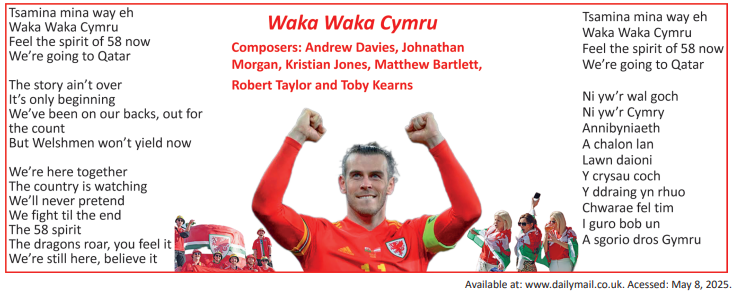
In 2022, Wales qualified for the FIFA World Cup for the first time since 1958. The nation responded with great enthusiasm, and the song Waka Waka Cymru became one of several cultural expressions of national pride. The lyrics feature multiple languages and references to both Welsh and African traditions, blending local identity with global influences.
Available at: www.dailymail.co.uk. Acessed: May 8, 2025.
The presented lyrics mix terms in English, Welsh, and Cameroonian Fang language. In the chorus, Tsamina mina and Waka Waka
are famously featured in the South Africa 2010 World Cup anthem, and Cymru is the Welsh name of the country, followed by
We’re going to Qatar. This hybrid composition reflects the multilingual and multicultural nature of global football culture. Which
quote from the Base Nacional Comum Curricular (BNCC) relates this idea to the concept of language use in such document?
Q4147183
Inglês
TEXTO 1
O letramento literário faz parte da expansão do uso do termo letramento, isto é, integra o plural dos letramentos, sendo um dos usos sociais da escrita. Em primeiro lugar, o letramento literário é diferente dos outros tipos de letramento porque a literatura ocupa um lugar único em relação à linguagem, ou seja, cabe à literatura tornar o mundo compreensível transformando a sua materialidade em palavras de cores, odores, sabores e formas intensamente humanas. Depois, o letramento feito com textos literários proporciona um modo privilegiado de inserção no mundo da escrita, posto que conduz ao domínio da palavra a partir dela mesma.
SOUZA, R.; COSSON, R. Letramento literário: uma proposta para sala de aula. Disponível em: https://acervodigital.unesp.br. Acesso em: 23 maio 2025 (adaptado).
TEXTO 2
(EF08LI18) Construir repertório cultural por meio do contato com manifestações artístico-culturais vinculadas à língua inglesa (artes plásticas e visuais, literatura, música, cinema, dança, festividades, entre outros), valorizando a diversidade entre culturas.
Base Nacional Comum Curricular: Ensino Fundamental. Disponível em: www.gov.br/mec. Acesso em: 28 maio 2025 (adaptado).
An English teacher decides to bring a poem to her students based on the assumptions of literary literacy and the Base Nacional Comum Curricular (BNCC). Which of the pedagogical proposals is aligned with these assumptions?
O letramento literário faz parte da expansão do uso do termo letramento, isto é, integra o plural dos letramentos, sendo um dos usos sociais da escrita. Em primeiro lugar, o letramento literário é diferente dos outros tipos de letramento porque a literatura ocupa um lugar único em relação à linguagem, ou seja, cabe à literatura tornar o mundo compreensível transformando a sua materialidade em palavras de cores, odores, sabores e formas intensamente humanas. Depois, o letramento feito com textos literários proporciona um modo privilegiado de inserção no mundo da escrita, posto que conduz ao domínio da palavra a partir dela mesma.
SOUZA, R.; COSSON, R. Letramento literário: uma proposta para sala de aula. Disponível em: https://acervodigital.unesp.br. Acesso em: 23 maio 2025 (adaptado).
TEXTO 2
(EF08LI18) Construir repertório cultural por meio do contato com manifestações artístico-culturais vinculadas à língua inglesa (artes plásticas e visuais, literatura, música, cinema, dança, festividades, entre outros), valorizando a diversidade entre culturas.
Base Nacional Comum Curricular: Ensino Fundamental. Disponível em: www.gov.br/mec. Acesso em: 28 maio 2025 (adaptado).
An English teacher decides to bring a poem to her students based on the assumptions of literary literacy and the Base Nacional Comum Curricular (BNCC). Which of the pedagogical proposals is aligned with these assumptions?
Q4147182
Inglês
A teacher uses excerpts from George Bernard Shaw’s play Pygmalion (1913) as a starting point to reflect on language use
and its social implications. Before reading, she facilitates a group discussion where students share expressions from their
heritage languages or regional dialects, drawing parallels with the Cockney dialect of the protagonist Eliza and sharing personal
experiences of linguistic discrimination. Next, the students engage in guided reading of selected excerpts from the play and
discuss Eliza’s transformation — a working-class woman who, after intensive phonetic training, is introduced into high society.
The activity continues with the screening of scenes from the musical My Fair Lady (1964), based on the play, followed by a
comparison between the two texts using film stills, focusing on syntactic and lexical differences. Finally, students are invited to
research contemporary productions that relate to these works, drawing on their linguistic repertoires, such as memes, fanfics,
videobooks, and video reviews.
Considering the teacher’s practice, identify the linguistic phenomena addressed as well as the pedagogical approach employed.
Considering the teacher’s practice, identify the linguistic phenomena addressed as well as the pedagogical approach employed.
Q4147181
Pedagogia
Texto associado
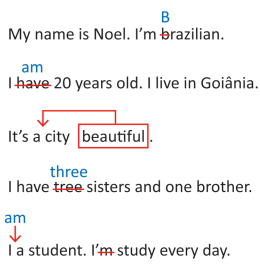
FIGUEIREDO, F. J. Q. Aprendendo com os erros: uma perspectiva comunicativa do ensino de línguas. São Paulo: Parábola, 2023 (adapted).
A student has a composition corrected by her high school teacher with markings as the ones in the text. In order to promote
autonomous learning and content mastery, the student should be able to
Q4147180
Pedagogia
Texto associado
FIGUEIREDO, F. J. Q. Aprendendo com os erros: uma perspectiva comunicativa do ensino de línguas. São Paulo: Parábola, 2023 (adapted).
To encourage students to reflect on their textual production and play an active role in their learning process, what is the
alternative for assessing the presented written activity?
Q4147179
Pedagogia
Texto associado
According to Rojo (2009), literacy involves social practices
of reading and writing that are historically and culturally
situated. Thus, it is understood as a set of practices that enables
individuals to effectively participate in society by interpreting
and producing texts in various social contexts. Additionally, the
Base Nacional Comum Curricular (BNCC) defines multiliteracies
as the practices of reading and producing texts that are
constructed through different languages or semioses.
Due to the alarming rise in hate speech on the internet over the
last years, a teacher wants to promote an opportunity for students
to reflect on hate speech incorporating the concepts of literacy and
multiliteracies. What is the appropriate activity to accomplish that?
Q4147178
Pedagogia
Texto associado
According to Rojo (2009), literacy involves social practices
of reading and writing that are historically and culturally
situated. Thus, it is understood as a set of practices that enables
individuals to effectively participate in society by interpreting
and producing texts in various social contexts. Additionally, the
Base Nacional Comum Curricular (BNCC) defines multiliteracies
as the practices of reading and producing texts that are
constructed through different languages or semioses.
Which of the activities takes into account the concept of
multiliteracies?
Q4147177
Pedagogia
Texto associado
During a 9th-grade English class, the teacher designs a
lesson around the theme Local Heroes. The students begin
by watching a short subtitled documentary about Mestre
João, a capoeira master who offers free classes to children
in the school’s neighborhood. Working in groups, they then
create posters and voice recordings in English to present
other individuals they know who make a difference in their
community. Some students choose sports figures, others
highlight musicians or teachers. In order to support the lesson,
the teacher prepares a didactic sequence that incorporates
elements of digital literacy. Throughout the activities, she
encourages students to express themselves meaningfully
in English, prioritizing authentic communication and social
relevance over grammatical perfection and form-focused drills.
Considering the linguistic orientation which supports the
teaching approach presented in the text, an adequate teaching
activity focuses on
Q4147176
Pedagogia
Texto associado
During a 9th-grade English class, the teacher designs a
lesson around the theme Local Heroes. The students begin
by watching a short subtitled documentary about Mestre
João, a capoeira master who offers free classes to children
in the school’s neighborhood. Working in groups, they then
create posters and voice recordings in English to present
other individuals they know who make a difference in their
community. Some students choose sports figures, others
highlight musicians or teachers. In order to support the lesson,
the teacher prepares a didactic sequence that incorporates
elements of digital literacy. Throughout the activities, she
encourages students to express themselves meaningfully
in English, prioritizing authentic communication and social
relevance over grammatical perfection and form-focused drills.
With reference to the lesson described, which of the following
activities is consistent with the pedagogical principles guiding
the teacher´s actions?
Q4147175
Linguística
Texto associado
During a 9th-grade English class, the teacher designs a
lesson around the theme Local Heroes. The students begin
by watching a short subtitled documentary about Mestre
João, a capoeira master who offers free classes to children
in the school’s neighborhood. Working in groups, they then
create posters and voice recordings in English to present
other individuals they know who make a difference in their
community. Some students choose sports figures, others
highlight musicians or teachers. In order to support the lesson,
the teacher prepares a didactic sequence that incorporates
elements of digital literacy. Throughout the activities, she
encourages students to express themselves meaningfully
in English, prioritizing authentic communication and social
relevance over grammatical perfection and form-focused drills.
Which linguistic theory supports the teaching approach
demonstrated in the text?
Q4147174
Pedagogia
Texto associado
Some authors deepen the understanding of scaffolding from the perspective of sociocultural learning theories, highlighting
it as a form of dialogic and adaptive mediation that emerges through interaction between learners and more experienced
interlocutors. Scaffolding is presented as an essential pedagogical tool that enables learners to perform linguistic tasks that are
not yet within their autonomous reach, as long as they fall within the Zone of Proximal Development (ZPD). The support provided
is responsive to the learner’s momentary needs and should be gradually withdrawn as the learner becomes more competent.
What distinguishes these authors’ approach is their view of scaffolding not as mere assisted instruction, but as a dynamic process
of co-constructing meaning in socially situated contexts. They emphasize that in order to foster genuine linguistic development,
teaching must go beyond the transmission of grammatical rules and actively create opportunities for authentic language use,
where error and negotiation are integral to the learning process. Thus, scaffolding becomes a link between participation,
interaction, and development, enabling learners to appropriate language as a cultural tool.
LANTOLF, J. P.; POEHNER, M. E.; THORNE, S. L. Sociocultural Theory and L2 Development. In: VANPATTEN, B.; KEATING, G.;
WULFF, S. (Eds.). Theories in Second Language Acquisition: An Introduction. New York: Routledge, 2020 (adapted).
Based on the concept of learning presented in the text, the pedagogical intervention which promotes curricular accessibility
for students with disabilities is the one that
Q4147173
Pedagogia
Texto associado
Some authors deepen the understanding of scaffolding from the perspective of sociocultural learning theories, highlighting
it as a form of dialogic and adaptive mediation that emerges through interaction between learners and more experienced
interlocutors. Scaffolding is presented as an essential pedagogical tool that enables learners to perform linguistic tasks that are
not yet within their autonomous reach, as long as they fall within the Zone of Proximal Development (ZPD). The support provided
is responsive to the learner’s momentary needs and should be gradually withdrawn as the learner becomes more competent.
What distinguishes these authors’ approach is their view of scaffolding not as mere assisted instruction, but as a dynamic process
of co-constructing meaning in socially situated contexts. They emphasize that in order to foster genuine linguistic development,
teaching must go beyond the transmission of grammatical rules and actively create opportunities for authentic language use,
where error and negotiation are integral to the learning process. Thus, scaffolding becomes a link between participation,
interaction, and development, enabling learners to appropriate language as a cultural tool.
LANTOLF, J. P.; POEHNER, M. E.; THORNE, S. L. Sociocultural Theory and L2 Development. In: VANPATTEN, B.; KEATING, G.;
WULFF, S. (Eds.). Theories in Second Language Acquisition: An Introduction. New York: Routledge, 2020 (adapted).
A teacher in middle school wishes to promote the linguistic development of their students based on the learning theory
underlying the text. In this sense, it is coherent for them to develop as a pedagogical practice
Q4147172
Pedagogia
Texto associado
Some authors deepen the understanding of scaffolding from the perspective of sociocultural learning theories, highlighting
it as a form of dialogic and adaptive mediation that emerges through interaction between learners and more experienced
interlocutors. Scaffolding is presented as an essential pedagogical tool that enables learners to perform linguistic tasks that are
not yet within their autonomous reach, as long as they fall within the Zone of Proximal Development (ZPD). The support provided
is responsive to the learner’s momentary needs and should be gradually withdrawn as the learner becomes more competent.
What distinguishes these authors’ approach is their view of scaffolding not as mere assisted instruction, but as a dynamic process
of co-constructing meaning in socially situated contexts. They emphasize that in order to foster genuine linguistic development,
teaching must go beyond the transmission of grammatical rules and actively create opportunities for authentic language use,
where error and negotiation are integral to the learning process. Thus, scaffolding becomes a link between participation,
interaction, and development, enabling learners to appropriate language as a cultural tool.
LANTOLF, J. P.; POEHNER, M. E.; THORNE, S. L. Sociocultural Theory and L2 Development. In: VANPATTEN, B.; KEATING, G.;
WULFF, S. (Eds.). Theories in Second Language Acquisition: An Introduction. New York: Routledge, 2020 (adapted).
Considering the learning theory presented in the text, a pedagogically grounded proposal for application in the school context
involves the
Q4147171
Inglês
Texto associado
One could imagine that using digital tools was an additional learning experience for the students in itself. Recent literature
has also shown that being able to recognize what can be improved requires being trained to do so. As such, students watching
themselves on video could not yield possible improvements that could be made, because noticing them also requires a learning
process. It could also be hypothesized that compared to university students, elementary school students are less able to seize
the benefit of video recording as a peer and self-evaluation tool. In addition, they had to manage their image, which was an
extra effort as well, due to intimidation and possible lack of confidence in front of the camera, although students may have a
positive attitude toward videos. One could therefore claim, but obviously without being certain, that a related form of learning
took place: the management of technologies for learning, and the management of one’s image.
BOBKINA, J.; DOMÍNGUEZ ROMERO, E. The Role of Video Technology in Supporting Young Learners’
Oral Skills in English as Foreign Language Classrooms. Computers and Education, 2023.
While completing a supervised practicum in a public school, a pre-service teacher reads the text and begins to consider the
pedagogical use of video in oral language development. What reflects an informed approach to using video in this context?

 Conheça nossos planos