Selecionar segmento
Estude com questões de diferentes segmentos
Atenção: Isso limpará todos os campos já preenchidos no filtro!
Foram encontradas 6.431 questões
Resolva questões gratuitamente!
Junte-se a mais de 4 milhões de concurseiros!


Ano: 2025
Banca:
FUVEST
Órgão:
HCFMUSP
Prova:
FUVEST - 2025 - HCFMUSP - Residência Médica - Anos Adicionais - Medicina Nuclear |
Q4212525
Radiologia
O PET/CT com 18F-Fluoreto de sódio na detecção de
metástases ósseas apresenta sensibilidade
Ano: 2025
Banca:
FUVEST
Órgão:
HCFMUSP
Prova:
FUVEST - 2025 - HCFMUSP - Residência Médica - Anos Adicionais - Medicina Nuclear |
Q4212524
Radiologia
Radiofármacos empregados com finalidade teranóstica são
pares de compostos com
Ano: 2025
Banca:
FUVEST
Órgão:
HCFMUSP
Prova:
FUVEST - 2025 - HCFMUSP - Residência Médica - Anos Adicionais - Medicina Nuclear |
Q4212523
Radiologia
São causas de estudos falsos positivos para carcinoma de
próstata no exame de PET-PSMA:
Ano: 2025
Banca:
FUVEST
Órgão:
HCFMUSP
Prova:
FUVEST - 2025 - HCFMUSP - Residência Médica - Anos Adicionais - Medicina Nuclear |
Q4212522
Radiologia
Paciente com linfoma de Hodgkin submetido a exame de
PET/CT com 18F-FDG para avaliação de resposta após término
de quimioterapia. Detectada linfonodomegalia inguinal com
grau de concentração do radiofármaco similar ao lobo
hepático direito. Qual escore de Deauville e interpretação pelo
critério de Lugano?
Ano: 2025
Banca:
FUVEST
Órgão:
HCFMUSP
Prova:
FUVEST - 2025 - HCFMUSP - Residência Médica - Anos Adicionais - Medicina Nuclear |
Q4212521
Medicina
O estadiamento linfonodal realizado com o exame de PET/CT
com 18F-FDG em paciente com câncer de mama
Ano: 2025
Banca:
FUVEST
Órgão:
HCFMUSP
Prova:
FUVEST - 2025 - HCFMUSP - Residência Médica - Anos Adicionais - Medicina Nuclear |
Q4212520
Medicina
A terapia de tumores neuroendócrinos com análogos da
somatostatina-lutécio-177 é mais bem indicada para tumores
Ano: 2025
Banca:
FUVEST
Órgão:
HCFMUSP
Prova:
FUVEST - 2025 - HCFMUSP - Residência Médica - Anos Adicionais - Medicina Nuclear |
Q4212519
Radiologia
O exame de PET/CT na avaliação do carcinoma de próstata é
feito com
Ano: 2025
Banca:
FUVEST
Órgão:
HCFMUSP
Prova:
FUVEST - 2025 - HCFMUSP - Residência Médica - Anos Adicionais - Medicina Nuclear |
Q4212518
Radiologia
Em relação ao estudo PET/CT com 18FDG em paciente com
câncer de pulmão, pode-se afirmar:
Ano: 2025
Banca:
FUVEST
Órgão:
HCFMUSP
Prova:
FUVEST - 2025 - HCFMUSP - Residência Médica - Anos Adicionais - Medicina Nuclear |
Q4212517
Medicina
Paciente com linfoma de Hodgkin estádio III submetido a
estudo PET/CT com FDG após término de quimioterapia. Em
relação ao estudo basal houve resolução do hipermetabolismo
glicolítico em todos linfonodos/linfonodomegalias, porém com
aparecimento de nova área de hipermetabolismo em foco de
consolidação pulmonar. Estudo interpretado como provável:
Ano: 2025
Banca:
FUVEST
Órgão:
HCFMUSP
Prova:
FUVEST - 2025 - HCFMUSP - Residência Médica - Anos Adicionais - Medicina Nuclear |
Q4212516
Radiologia
O exame de PET cerebral com 11C-PIB ou outros traçadores
amiloides permite:
Ano: 2025
Banca:
FUVEST
Órgão:
HCFMUSP
Prova:
FUVEST - 2025 - HCFMUSP - Residência Médica - Anos Adicionais - Medicina Nuclear |
Q4212515
Radiologia
É uma indicação para o exame de PET/CT com 18F-FDG no
câncer de mama:
Ano: 2025
Banca:
FUVEST
Órgão:
HCFMUSP
Prova:
FUVEST - 2025 - HCFMUSP - Residência Médica - Anos Adicionais - Medicina Nuclear |
Q4212514
Radiologia
No estudo de carcinoma de tireoide a PET com FDG é
indicada em casos de
Ano: 2025
Banca:
FUVEST
Órgão:
HCFMUSP
Prova:
FUVEST - 2025 - HCFMUSP - Residência Médica - Anos Adicionais - Medicina Nuclear |
Q4212513
Radiologia
Em relação ao transporte de FDG pelos GLUTs, pode-se
afirmar
Ano: 2025
Banca:
FUVEST
Órgão:
HCFMUSP
Prova:
FUVEST - 2025 - HCFMUSP - Residência Médica - Anos Adicionais - Patologia Clínica/Medicina Laboratorial |
Q4212512
Medicina
Homem, 25 anos de idade, apresentou sintomas de síndrome
infecciosa mononucleose-símile, e no 5º dia de febre realizou
teste para HIV de 4ª geração com resultado positivo, conforme
resultado a seguir:
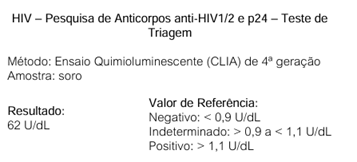
Obs.: Todo resultado positivo de teste HIV de triagem deve ser submetido ao teste confirmatório (complementares e coleta em uma nova amostra, segundo recomendações pelo Fluxo Min. Saúde (Manual Técnico para o Diagnóstico da Infecção pelo HIV em Adultos e Crianças / Min Saúde, ed. 2018).
O melhor teste para confirmar o resultado do teste de rastreio deste paciente é:
Obs.: Todo resultado positivo de teste HIV de triagem deve ser submetido ao teste confirmatório (complementares e coleta em uma nova amostra, segundo recomendações pelo Fluxo Min. Saúde (Manual Técnico para o Diagnóstico da Infecção pelo HIV em Adultos e Crianças / Min Saúde, ed. 2018).
O melhor teste para confirmar o resultado do teste de rastreio deste paciente é:
Ano: 2025
Banca:
FUVEST
Órgão:
HCFMUSP
Prova:
FUVEST - 2025 - HCFMUSP - Residência Médica - Anos Adicionais - Patologia Clínica/Medicina Laboratorial |
Q4212511
Patologia
Mulher, 35 anos de idade, previamente saudável, relata ganho
de peso progressivo nos últimos 12 meses, associado à
fraqueza muscular proximal, face arredondada, estrias
violáceas abdominais e equimoses frequentes em membros
inferiores e abdome. Refere também episódios de cefaleia
leve e irritabilidade. Ao exame físico: IMC de 31 kg/m2; PA de
150×100 mmHg Obesidade centrípeta; Face em lua cheia;
giba dorsal; Estrias violáceas largas no abdome; Equimoses
espontâneas em abdome e membros inferiores. Qual exame é
mais apropriado para iniciar a investigação da síndrome de
Cushing nessa paciente?
Ano: 2025
Banca:
FUVEST
Órgão:
HCFMUSP
Prova:
FUVEST - 2025 - HCFMUSP - Residência Médica - Anos Adicionais - Patologia Clínica/Medicina Laboratorial |
Q4212510
Medicina
Homem, 63 anos de idade, diabético e etilista crônico, é
admitido com febre alta (39,2 °C), cefaleia intensa, rigidez de
nuca, sonolência e vômitos. Ao exame físico, apresenta sinais
meníngeos positivos e rebaixamento do nível de consciência.
A tomografia de crânio não mostra contraindicações, e a
punção lombar é realizada imediatamente. A análise do líquor
é apresentado a seguir:
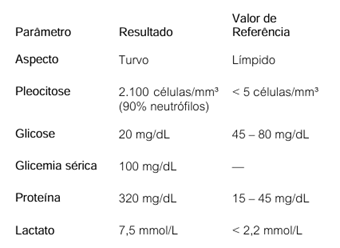
A hipótese clínica inicial é de meningite bacteriana aguda. Com base no conhecimento atual sobre o líquor nas meningites infecciosas, assinale a alternativa correta.
A hipótese clínica inicial é de meningite bacteriana aguda. Com base no conhecimento atual sobre o líquor nas meningites infecciosas, assinale a alternativa correta.
Ano: 2025
Banca:
FUVEST
Órgão:
HCFMUSP
Prova:
FUVEST - 2025 - HCFMUSP - Residência Médica - Anos Adicionais - Patologia Clínica/Medicina Laboratorial |
Q4212509
Medicina
Homem, 55 anos de idade, procura atendimento por fadiga
progressiva nas últimas semanas. Ao exame físico, apresenta
esplenomegalia palpável a 8 cm abaixo do rebordo costal
esquerdo. O hemograma revela:
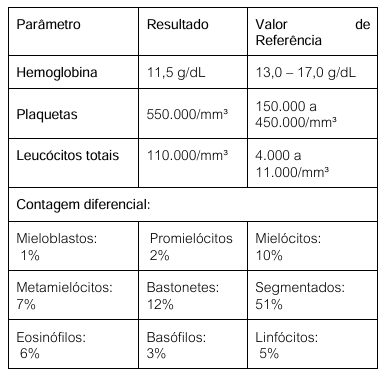
Com base nos achados clínicos e laboratoriais, qual a hipótese diagnóstica mais provável, assinale a alternativa correta.
Com base nos achados clínicos e laboratoriais, qual a hipótese diagnóstica mais provável, assinale a alternativa correta.
Ano: 2025
Banca:
FUVEST
Órgão:
HCFMUSP
Prova:
FUVEST - 2025 - HCFMUSP - Residência Médica - Anos Adicionais - Patologia Clínica/Medicina Laboratorial |
Q4212508
Medicina
Com relação ao padrão de anticorpos anticélulas HEp-2
(FAN), o padrão nuclear pontilhado fino é associado à
presença de qual anticorpo?
Ano: 2025
Banca:
FUVEST
Órgão:
HCFMUSP
Prova:
FUVEST - 2025 - HCFMUSP - Residência Médica - Anos Adicionais - Patologia Clínica/Medicina Laboratorial |
Q4212507
Medicina
Homem, 48 anos de idade, comparece ao pronto-socorro com
queixa de cansaço, adinamia, tosse seca e dificuldade para
respirar há cerca de 15 dias. Refere episódios vespertinos de
febre e discreta perda de peso, não mensurados. Ao exame
físico, encontra-se discretamente descorado e afebril. À
percussão, nota-se macicez no hemitórax esquerdo, com
murmúrio vesicular diminuído no mesmo lado. Não há
visceromegalias nem outros achados relevantes. A radiografia
de tórax revela velamento de metade do hemitórax esquerdo.
Realiza-se toracocentese diagnóstica, com retirada de 800 mL
de líquido pleural amarelado e turvo, enviado ao laboratório de
análises clínicas para avaliação complementar. Considerando
a principal hipótese diagnóstica e a abordagem inicial
laboratorial mais adequada, assinale a alternativa correta.
Ano: 2025
Banca:
FUVEST
Órgão:
HCFMUSP
Prova:
FUVEST - 2025 - HCFMUSP - Residência Médica - Anos Adicionais - Patologia Clínica/Medicina Laboratorial |
Q4212506
Medicina
Homem, 58 anos de idade, com histórico de gastrectomia total há 3 anos, procura atendimento com queixa de cansaço progressivo e parestesias em membros inferiores. O hemograma revela:
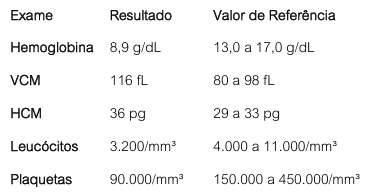
Diante do quadro clínico-laboratorial, qual o diagnóstico mais provável e o exame laboratorial inicial mais apropriado para confirmá-lo?

 Conheça nossos planos