Foram encontradas 2.149 questões
Resolva questões gratuitamente!
Junte-se a mais de 4 milhões de concurseiros!


Uma joalheria utiliza metais mais baratos e os recobre com metais preciosos, como o ouro, para deixá-los mais atraentes ao comprador e mais resistentes à corrosão. Em um processo de eletrodeposição, um colar de prata foi revestido com 2,364 g de ouro, proveniente de uma solução eletrolítica que contém íons Au3+ .
Se a intensidade da corrente elétrica utilizada foi de 19,3 A, quantos minutos, aproximadamente, durou a eletrodeposição?
Dados: massa atômica do Au = 197 u; F = 96.500 C/mol.
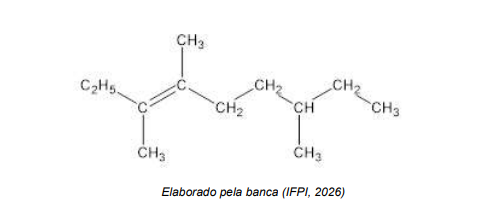 Para fins de registro técnico e comunicação científi ca, é necessário nomear corretamente o composto
segundo as regras ofi ciais da IUPAC.
Para fins de registro técnico e comunicação científi ca, é necessário nomear corretamente o composto
segundo as regras ofi ciais da IUPAC.
Indique o nome IUPAC do hidrocarboneto insaturado apresentado:
· X (Z = 8) · Y (Z = 9) · Z (Z = 11) · W (Z = 12)
Com base nas propriedades periódicas desses elementos, assinale a alternativa CORRETA:
Texts for question.
"The white man is very clever. He came quietly and peaceably with his religion.… He has put a knife on the things that held us together and we have fallen apart.”
ACHEBE, Chinua. The African Trilogy: Things Fall Apart; Arrow of God; No Longer at Ease. New York: Penguin Classics, 2017.
“No pedagogy which is truly liberating can remain distant from the oppressed; nor can it afford to impose the teacher’s cultural patterns upon them.”
FREIRE, Paulo. Pedagogy of the Oppressed. Translated by Myra Bergman Ramos. New York: Herder and Herder, 1970.
"Once critical pedagogues see schools as cultural arenas where distinct social and ideological forms find themselves in constant conflict, what they shall be seeking is society transformation through education, including language education."
SIQUEIRA, Sávio. Critical pedagogy and language education: Hearing the voices of Brazilian teachers of English. Education Sciences, Basel, v. 11, n. 5, p. 235, May 14, 2021.
Read the text and the quote below to answer question
Obama’s Speech- 2008
For when we have faced down impossible odds, when we've been told we're not ready or that we shouldn't try or that we can't, generations of Americans have responded with a simple creed that sums up the spirit of a people: Yes, we can. Yes, we can. Yes, we can.
It was a creed written into the founding documents that declared the destiny of a nation: Yes, we can.
It was whispered by slaves and abolitionists as they blazed a trail towards freedom through the darkest of nights: Yes, we can.
It was sung by immigrants as they struck out from distant shores and pioneers who pushed westward against an unforgiving wilderness: Yes, we can.
It was the call of workers who organized, women who reached for the ballot, a president who chose the moon as our new frontier, and a king who took us to the mountaintop and pointed the way to the promised land: Yes, we can, to justice and equality.
Yes, we can, to opportunity and prosperity. Yes, we can heal this nation. Yes, we can repair this world. Yes, we can.
https://www.vpro.nl/zomergasten/artikelen/new-hampshire-primary-2008. Acesso em 04 fev.2026.
“Meanings are not in words; they are in people, situated in social contexts.”
KRAMSCH, Claire. Language and Culture. Oxford: Oxford University Press, 1998
Text for question
When international companies and organizations developed, English was often chosen as a working language of European Central Bank, although the bank is in Germany. In Asia and the Pacific, nine out of ten international organizations work only in English.
English is important not because it has more first - language speakers than other languages (Chinese has more) but because it is used extremely widely. Will this situation continue?
VINEY, Brigit. Oxford Bookworms Factfiles: The History of the English Language: Level 4: 1400-Word Vocabulary. Oxford: Oxford University Press, 2008.
https://www.newyorker.com/magazine/2025/07/07/the-argentinean-comic-strip-that-galvanized-a-generation. Acesso em 04 fev.2026.
Text for question
At around 6:30 p.m., I decide I’m not going to sleep at the hospital tonight. I need to shower and eat real food. I call my best friend, Yara, and tell her I’m on my way to her house. Everything in Gaza is within walking distance, but I’m absolutely exhausted. I realize with dread that, if I’m not mistaken, I’ve left my wallet in mama’s bag, and I don’t have any money at all. So I do something embarrassing, and ask a taxi driver if he can drive me to Yara’s for free. He agrees on one condition: ‘When I get killed’, he says, ‘post a nice picture of me online, and ask people to pray for me.’
Everyone in Gaza knows that they’ll eventually die, and that it’s only a matter of time. I smile at the taxi driver and assent.
ALAQAD, Plestia. The Eyes of Gaza: A Diary of Resilience. New York: Little, Brown and Company, 2025.
Read the excerpt from News of a Kidnapping by García Márquez (1997), a Colombian Nobel Prize - winning novelist and journalist whose significant work includes this book, and identify the relationship established between genre and text types.
After waiting three hours, a man in a mask came in, welcomed them on behalf of high command, and announced that Father Pérez was expecting them but for reason of security the women should go first. This was the first time that Diana showed signs of uneasiness. Hero Buss took her aside and said that under no circumstances should she agree to break up their group. Because she could not prevent that from happening, Diana slipped him her identity card. She did not have time to explain why, but he understood it to be a piece of evidence in the event she disappeared.
GARCÍA MÁRQUEZ, Gabriel; GROSSMAN, Edith (trad.). News of a Kidnapping. 1. American ed. New York: Alfred A. Knopf, 1997
Text for question
“I always tried to be decent to the warders in my section; hostility was self-defeating. There was no point in having a permanent enemy among warders.
It was ANC policy to try to educate all people, even our enemies: we believed that all men, even prison service warders, were capable of change, and we did our utmost to try to sway them.
In general we treated the wanders as they treated us. If a man was considered, we were considerate in return. Not all of our warders were ogres. We noticed right from the start that there were some among them who believed in fairness.”
MANDELA, Nelson. Long Walk to Freedom. Boston; New York: Little, Brown and Company, 1994.
Text for question
The notion of Multiliteracies supplements traditional literacy pedagogy by addressing these two related aspects of textual multiplicity. What we might term ‘mere literacy’ remains centred on language only, and usually on a singular national form of language at that, being conceived as a stable system based on rules such as mastering sound-letter correspondence. This is based on the assumption that we can actually discern and describe correct usage. Such a view of language must characteristically translate into a more or less authoritarian kind of pedagogy. A pedagogy of Multi-literacies, by contrast, focuses on modes of representation much broader than language alone. These differ according to culture and context, and have specific cognitive, cultural, and social effects. In some cultural contexts – in an Aboriginal community or in a multimedia environment, for instance – the visual mode of representation may be much more powerful and closely related to language than ‘mere literacy’ would ever be able to allow. Multiliteracies also creates a different kind of pedagogy: one in which language and other modes of meaning are dynamic representational resources, constantly being remade by their users as they work to achieve their various cultural purposes.
COPE, Bill; KALANTZIS, Mary (org.). Multiliteracies: literacy learning and the design of social futures. Londres: Routledge, 2000.
Text for question.
I believe that on the first night I went to Gatsby’s house I was one of the few guests who had actually been invited. People were not invited – they went there. They got into automobiles which bore them out to Long Island, and somehow they ended up at Gatsby’s door. Once there they were introduced by somebody who knew Gatsby, and after that they conducted themselves according to the rules of behavior associated with amusement parks. Sometimes they came and went without having met Gatsby at all, came for the party with a simplicity of heart that was its own ticket of admission.
I had been actually invited. A chauffeur in a uniform of robin’s-egg blue crossed my lawn early that Saturday morning with a surprisingly formal note from his employer: the honor would be entirely Gatsby’s, it said, if I would attend his “little party” that night. He had seen me several times, and had intended to call on me long before, but a peculiar combination of circumstances had prevented it – signed Jay Gatsby, in a majestic hand.
Dressed up in white flannels I went over to his lawn a little after seven, and wandered around rather ill at ease among swirls and eddies of people I didn’t know – though here and there was a face I had noticed on the commuting train. I was immediately struck by the number of young Englishmen dotted about; all well dressed, all looking a little hungry, and all talking in low, earnest voices to solid and prosperous Americans. I was sure that they were selling something: bonds or insurance or automobiles. They were at least agonizingly aware of the easy money in the vicinity and convinced that it was theirs for a few words in the right key.
FITZGERALD, F. S. The Great Gatsby. Charles Scribner's Sons, 1925. p. 41-42

 Conheça nossos planos