Questões de Concurso
Sobre inglês
Foram encontradas 25.496 questões
Resolva questões gratuitamente!
Junte-se a mais de 4 milhões de concurseiros!


Ano: 2025
Banca:
VUNESP
Órgão:
SEDUC-SP
Prova:
VUNESP - 2025 - SEDUC-SP - Professor de Educação Básica II - Inglês - QM 2023 |
Q3529173
Inglês
Texto associado
Read the text to answer question.
Traditional EFL classrooms face several challenges,
including limited exposure to authentic language use, lack
of engagement, and varying learner proficiency levels.
Research indicates that reliance on non-authentic materials
can hinder listening comprehension and motivation among
students. For instance, substituting traditional listening inputs
with spontaneous teacher discourse and storytelling has been
proposed as a means to enhance engagement and provide
authentic language exposure (Ypsilanti, 2024). Additionally,
the integration of Content and Language Integrated Learning
(CLIL) approaches can bridge the gap between vocabulary
learning and meaningful text production, fostering a more
engaging learning environment (Balle & Olsen, 2023).
Moreover, varying proficiency levels among learners often lead
to common writing errors, such as grammatical mistakes and
vocabulary misuse, which necessitate targeted instructional
strategies to address these challenges effectively (Isma et al., 2023). Teachers also encounter difficulties in adapting
to curriculum reforms and integrating digital media due to
limited resources and training, which can further exacerbate
engagement issues (Alnasib & Alharbi, 2024; Syarifuddin &
Hz, 2023). Addressing these challenges requires innovative
teaching strategies and a supportive infrastructure to enhance
EFL learning outcomes.
(Sari, Nurhidayah. The Role of Technology in Facilitating EFL Learning:
A Case Study Approach. Journal of Education Research, v. 5, 2024)
Based on the text, which of the following pedagogical
strategies most comprehensively addresses the
interconnected challenges faced in traditional EFL
classrooms?
Ano: 2025
Banca:
VUNESP
Órgão:
SEDUC-SP
Prova:
VUNESP - 2025 - SEDUC-SP - Professor de Educação Básica II - Inglês - QM 2023 |
Q3529171
Inglês
Texto associado
Read the text to answer question:
Today, many of the pedagogical springs and rivers of
the last few decades are appropriately captured in the term
Communicative Language Teaching (CLT), now a catch
phrase for language teachers. CLT is an eclectic blend of
the contributions of previous methods into the best of what a
teacher can provide in authentic uses of the second language
in the classroom. Indeed, the single greatest challenge in
the profession is to move significantly beyond the teaching
of rules, patterns, definitions, and other knowledge “about”
language to the point that we are teaching our students to
communicate genuinely, spontaneously, and meaningfully in
the second language.
A significant difference between current language
teaching practices and those of, say, a half a century ago, is
the absence of proclaimed “orthodoxies” and “best” methods.
We are well aware that methods, as they were conceived of
40 or 50 years ago or so, are too narrow and too constrictive
to apply to a wide range of learners in an enormous number
of situational contexts. There are no instant recipes. No
quick and easy method is guaranteed to provide success.
As Bell (2003), Brown (2001), Kumaravadivelu (2001),
and others have appropriately shown, pedagogical trends
in language teaching now spur us to develop a principled
basis—sometimes called an approach (Richards & Rodgers,
2001)—upon which teachers can choose particular designs
and techniques for teaching a foreign language in a specific
context. Every learner is unique. Every teacher is unique.
Every learner-teacher relationship is unique, and every
context is unique. Your task as a teacher is to understand the
properties of those relationships and contexts.
(BROWN, H. Douglas. Principles of language learning and teaching. 5. ed.
Londres: Longman, 2006)
A noun phrase is a structure composed of a noun and
its modifiers. In the following noun phrase taken from the
second paragraph of the text “a wide range of learners in
an enormous number of situational contexts”, the nucleus
of the noun phrase – the noun being modified by the other
elements, is found in
Ano: 2025
Banca:
VUNESP
Órgão:
SEDUC-SP
Prova:
VUNESP - 2025 - SEDUC-SP - Professor de Educação Básica II - Inglês - QM 2023 |
Q3529170
Inglês
Texto associado
Read the text to answer question:
Today, many of the pedagogical springs and rivers of
the last few decades are appropriately captured in the term
Communicative Language Teaching (CLT), now a catch
phrase for language teachers. CLT is an eclectic blend of
the contributions of previous methods into the best of what a
teacher can provide in authentic uses of the second language
in the classroom. Indeed, the single greatest challenge in
the profession is to move significantly beyond the teaching
of rules, patterns, definitions, and other knowledge “about”
language to the point that we are teaching our students to
communicate genuinely, spontaneously, and meaningfully in
the second language.
A significant difference between current language
teaching practices and those of, say, a half a century ago, is
the absence of proclaimed “orthodoxies” and “best” methods.
We are well aware that methods, as they were conceived of
40 or 50 years ago or so, are too narrow and too constrictive
to apply to a wide range of learners in an enormous number
of situational contexts. There are no instant recipes. No
quick and easy method is guaranteed to provide success.
As Bell (2003), Brown (2001), Kumaravadivelu (2001),
and others have appropriately shown, pedagogical trends
in language teaching now spur us to develop a principled
basis—sometimes called an approach (Richards & Rodgers,
2001)—upon which teachers can choose particular designs
and techniques for teaching a foreign language in a specific
context. Every learner is unique. Every teacher is unique.
Every learner-teacher relationship is unique, and every
context is unique. Your task as a teacher is to understand the
properties of those relationships and contexts.
(BROWN, H. Douglas. Principles of language learning and teaching. 5. ed.
Londres: Longman, 2006)
In the sentence “pedagogical trends in language teaching
now spur us to develop a principled basis…”, the most
accurate meaning of the word “spur” in this context is
Ano: 2025
Banca:
VUNESP
Órgão:
SEDUC-SP
Prova:
VUNESP - 2025 - SEDUC-SP - Professor de Educação Básica II - Inglês - QM 2023 |
Q3529168
Inglês
Texto associado
Read the text to answer question:
Today, many of the pedagogical springs and rivers of
the last few decades are appropriately captured in the term
Communicative Language Teaching (CLT), now a catch
phrase for language teachers. CLT is an eclectic blend of
the contributions of previous methods into the best of what a
teacher can provide in authentic uses of the second language
in the classroom. Indeed, the single greatest challenge in
the profession is to move significantly beyond the teaching
of rules, patterns, definitions, and other knowledge “about”
language to the point that we are teaching our students to
communicate genuinely, spontaneously, and meaningfully in
the second language.
A significant difference between current language
teaching practices and those of, say, a half a century ago, is
the absence of proclaimed “orthodoxies” and “best” methods.
We are well aware that methods, as they were conceived of
40 or 50 years ago or so, are too narrow and too constrictive
to apply to a wide range of learners in an enormous number
of situational contexts. There are no instant recipes. No
quick and easy method is guaranteed to provide success.
As Bell (2003), Brown (2001), Kumaravadivelu (2001),
and others have appropriately shown, pedagogical trends
in language teaching now spur us to develop a principled
basis—sometimes called an approach (Richards & Rodgers,
2001)—upon which teachers can choose particular designs
and techniques for teaching a foreign language in a specific
context. Every learner is unique. Every teacher is unique.
Every learner-teacher relationship is unique, and every
context is unique. Your task as a teacher is to understand the
properties of those relationships and contexts.
(BROWN, H. Douglas. Principles of language learning and teaching. 5. ed.
Londres: Longman, 2006)
O sufixo -ing representa diferentes categorias gramaticais na língua inglesa.
Nos trechos retirados do texto, assinale a alternativa em que a palavra em negrito com esse sufixo seja um verbo.
Nos trechos retirados do texto, assinale a alternativa em que a palavra em negrito com esse sufixo seja um verbo.
Ano: 2025
Banca:
VUNESP
Órgão:
SEDUC-SP
Prova:
VUNESP - 2025 - SEDUC-SP - Professor de Educação Básica II - Inglês - QM 2023 |
Q3529165
Inglês
Texto associado
Leia a tirinha para responder à questão:
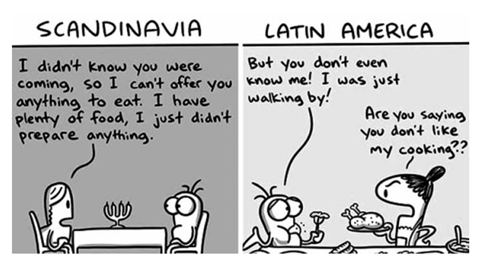
(https://www.boredpanda.com/languages-customs-comics-itchy-feet-comic-part-3/)
Um professor que queira aproveitar a tirinha para trabalhar interculturalidade proporá aos alunos a seguinte atividade:
Ano: 2025
Banca:
VUNESP
Órgão:
SEDUC-SP
Prova:
VUNESP - 2025 - SEDUC-SP - Professor de Educação Básica II - Inglês - QM 2023 |
Q3529164
Inglês
Texto associado
Leia a tirinha para responder à questão:
(https://www.boredpanda.com/languages-customs-comics-itchy-feet-comic-part-3/)
What cultural difference is most clearly illustrated in this comic showing Scandinavia and Latin America?
Ano: 2025
Banca:
VUNESP
Órgão:
SEDUC-SP
Prova:
VUNESP - 2025 - SEDUC-SP - Professor de Educação Básica II - Inglês - QM 2023 |
Q3529163
Inglês
Texto associado
Read the text to answer question:
In foreign language education, the teaching of culture
remains a hotly debated issue. What is culture? What is its
relation to language? Which and whose culture should be
taught? What role should the learners’ culture play in the
acquisition of knowledge of the target culture? How can
we avoid essentializing cultures and teaching stereotypes?
And how can we develop in the learners an intercultural
competence that would shortchange neither their own culture
nor the target culture, but would make them into cultural
mediators in a globalized world? This paper explores these
issues from the perspective of the large body of research
done in Australia, Europe and the U.S. in the last twenty
years. It links the study of culture to the study of discourse
(see, e.g., Kramsch 1993, 1998, 2004) and to the concept
of translingual and transcultural competence proposed by the Modern Language Association (e.g., Kramsch, 2010). Special
attention will be given to the unique role that the age-old
Persian culture can play in fostering the cultural mediators of
tomorrow.
(KRAMASCH, Claire. Cultura no ensino de língua estrangeira.
Bakhtiniana: Revista de Estudos do Discurso, São Paulo,
LAEL/PUC-SP, v. 19, n. 4, 2024)
No trecho “This paper explores these issues from
the perspective of the large body of research done in
Australia, Europe and the U.S. in the last twenty years.”,
qual análise gramatical está correta sobre a construção
“done in Australia, Europe and the U.S.”?
Ano: 2025
Banca:
VUNESP
Órgão:
SEDUC-SP
Prova:
VUNESP - 2025 - SEDUC-SP - Professor de Educação Básica II - Inglês - QM 2023 |
Q3529162
Inglês
Texto associado
Read the text to answer question:
In foreign language education, the teaching of culture
remains a hotly debated issue. What is culture? What is its
relation to language? Which and whose culture should be
taught? What role should the learners’ culture play in the
acquisition of knowledge of the target culture? How can
we avoid essentializing cultures and teaching stereotypes?
And how can we develop in the learners an intercultural
competence that would shortchange neither their own culture
nor the target culture, but would make them into cultural
mediators in a globalized world? This paper explores these
issues from the perspective of the large body of research
done in Australia, Europe and the U.S. in the last twenty
years. It links the study of culture to the study of discourse
(see, e.g., Kramsch 1993, 1998, 2004) and to the concept
of translingual and transcultural competence proposed by the Modern Language Association (e.g., Kramsch, 2010). Special
attention will be given to the unique role that the age-old
Persian culture can play in fostering the cultural mediators of
tomorrow.
(KRAMASCH, Claire. Cultura no ensino de língua estrangeira.
Bakhtiniana: Revista de Estudos do Discurso, São Paulo,
LAEL/PUC-SP, v. 19, n. 4, 2024)
No trecho “How can we develop in the learners an
intercultural competence that would shortchange neither
their own culture nor the target culture…”, há uso de
estrutura paralela, a qual tem regras específicas.
Nas sentenças a seguir, o exemplo de estrutura paralela usada corretamente é encontrado em:
Nas sentenças a seguir, o exemplo de estrutura paralela usada corretamente é encontrado em:
Ano: 2025
Banca:
VUNESP
Órgão:
SEDUC-SP
Prova:
VUNESP - 2025 - SEDUC-SP - Professor de Educação Básica II - Inglês - QM 2023 |
Q3529160
Inglês
Texto associado
Read the text to answer question:
In foreign language education, the teaching of culture
remains a hotly debated issue. What is culture? What is its
relation to language? Which and whose culture should be
taught? What role should the learners’ culture play in the
acquisition of knowledge of the target culture? How can
we avoid essentializing cultures and teaching stereotypes?
And how can we develop in the learners an intercultural
competence that would shortchange neither their own culture
nor the target culture, but would make them into cultural
mediators in a globalized world? This paper explores these
issues from the perspective of the large body of research
done in Australia, Europe and the U.S. in the last twenty
years. It links the study of culture to the study of discourse
(see, e.g., Kramsch 1993, 1998, 2004) and to the concept
of translingual and transcultural competence proposed by the Modern Language Association (e.g., Kramsch, 2010). Special
attention will be given to the unique role that the age-old
Persian culture can play in fostering the cultural mediators of
tomorrow.
(KRAMASCH, Claire. Cultura no ensino de língua estrangeira.
Bakhtiniana: Revista de Estudos do Discurso, São Paulo,
LAEL/PUC-SP, v. 19, n. 4, 2024)
De acordo com o trecho, uma questão importante da
discussão sobre o ensino de cultura em línguas estrangeiras é
Ano: 2025
Banca:
VUNESP
Órgão:
SEDUC-SP
Prova:
VUNESP - 2025 - SEDUC-SP - Professor de Educação Básica II - Inglês - QM 2023 |
Q3529159
Inglês
Texto associado
Read the text to answer question:
In foreign language education, the teaching of culture
remains a hotly debated issue. What is culture? What is its
relation to language? Which and whose culture should be
taught? What role should the learners’ culture play in the
acquisition of knowledge of the target culture? How can
we avoid essentializing cultures and teaching stereotypes?
And how can we develop in the learners an intercultural
competence that would shortchange neither their own culture
nor the target culture, but would make them into cultural
mediators in a globalized world? This paper explores these
issues from the perspective of the large body of research
done in Australia, Europe and the U.S. in the last twenty
years. It links the study of culture to the study of discourse
(see, e.g., Kramsch 1993, 1998, 2004) and to the concept
of translingual and transcultural competence proposed by the Modern Language Association (e.g., Kramsch, 2010). Special
attention will be given to the unique role that the age-old
Persian culture can play in fostering the cultural mediators of
tomorrow.
(KRAMASCH, Claire. Cultura no ensino de língua estrangeira.
Bakhtiniana: Revista de Estudos do Discurso, São Paulo,
LAEL/PUC-SP, v. 19, n. 4, 2024)
Considerando sua experiência no ensino de gêneros textuais em língua inglesa, incluindo o contexto acadêmico,
identifique a seção de um artigo científico cujas características linguísticas e discursivas correspondem ao texto
apresentado.
Ano: 2025
Banca:
VUNESP
Órgão:
SEDUC-SP
Prova:
VUNESP - 2025 - SEDUC-SP - Professor de Educação Básica II - Inglês - QM 2023 |
Q3529156
Inglês
Texto associado
Read the text to answer question:
Information and communication technology (ICT)
ICT uses language to develop and apply technical
computing skills. Learners practise how to find, develop,
analyse and present information, and they learn how to model
situations, solve problems and evaluate their solutions. There
are many opportunities for CLIL ICT teachers to support
their learners’ understanding of key ICT concepts and skills
through the use of physical objects, visuals, demonstrations
and hands-on practice. It is these visual elements of the
subject that makes ICT a good one for learners who are new
to CLIL. However, since ICT lessons may often concentrate
on technical skills or involve learners sitting silently behind
a computer, the challenge for ICT teachers is to create
opportunities for CLIL learners to think for themselves, to
speak and to practise communicating in writing. ICT is ideal
for cross-curricular work: learners can use the content of their subject lessons to carry out ICT tasks in another language. As
they develop ICT knowledge and skills, CLIL learners can be
taught how to think, talk and write like ICT specialists.
(DALE, Liz; TANNER, Rosie. CLIL activities: a resource for subjects and
language teachers. Cambridge: Cambridge University, 2012)
No trecho: “ICT uses language to develop and apply
technical computing skills. Learners practise how to find,
develop, analyse and present information, and they learn
how to model situations, solve problems and evaluate
their solutions”, há duas palavras que aceitam duas
grafias: “practise” e “analyse”, que também poderiam ser
escritas como “practice” e “analyze”.
Assinale a alternativa em que a palavra aceita dupla grafia.
Assinale a alternativa em que a palavra aceita dupla grafia.
Ano: 2025
Banca:
VUNESP
Órgão:
SEDUC-SP
Prova:
VUNESP - 2025 - SEDUC-SP - Professor de Educação Básica II - Inglês - QM 2023 |
Q3529155
Inglês
Texto associado
Read the text to answer question:
Information and communication technology (ICT)
ICT uses language to develop and apply technical
computing skills. Learners practise how to find, develop,
analyse and present information, and they learn how to model
situations, solve problems and evaluate their solutions. There
are many opportunities for CLIL ICT teachers to support
their learners’ understanding of key ICT concepts and skills
through the use of physical objects, visuals, demonstrations
and hands-on practice. It is these visual elements of the
subject that makes ICT a good one for learners who are new
to CLIL. However, since ICT lessons may often concentrate
on technical skills or involve learners sitting silently behind
a computer, the challenge for ICT teachers is to create
opportunities for CLIL learners to think for themselves, to
speak and to practise communicating in writing. ICT is ideal
for cross-curricular work: learners can use the content of their subject lessons to carry out ICT tasks in another language. As
they develop ICT knowledge and skills, CLIL learners can be
taught how to think, talk and write like ICT specialists.
(DALE, Liz; TANNER, Rosie. CLIL activities: a resource for subjects and
language teachers. Cambridge: Cambridge University, 2012)
In the following part of the text “However, since ICT
lessons may often concentrate on technical skills…,” the
word in bold
Ano: 2025
Banca:
VUNESP
Órgão:
SEDUC-SP
Prova:
VUNESP - 2025 - SEDUC-SP - Professor de Educação Básica II - Inglês - QM 2023 |
Q3529154
Inglês
Texto associado
Read the text to answer question:
Information and communication technology (ICT)
ICT uses language to develop and apply technical
computing skills. Learners practise how to find, develop,
analyse and present information, and they learn how to model
situations, solve problems and evaluate their solutions. There
are many opportunities for CLIL ICT teachers to support
their learners’ understanding of key ICT concepts and skills
through the use of physical objects, visuals, demonstrations
and hands-on practice. It is these visual elements of the
subject that makes ICT a good one for learners who are new
to CLIL. However, since ICT lessons may often concentrate
on technical skills or involve learners sitting silently behind
a computer, the challenge for ICT teachers is to create
opportunities for CLIL learners to think for themselves, to
speak and to practise communicating in writing. ICT is ideal
for cross-curricular work: learners can use the content of their subject lessons to carry out ICT tasks in another language. As
they develop ICT knowledge and skills, CLIL learners can be
taught how to think, talk and write like ICT specialists.
(DALE, Liz; TANNER, Rosie. CLIL activities: a resource for subjects and
language teachers. Cambridge: Cambridge University, 2012)
According to the paragraph, one of the challenges ICT
teachers face in CLIL lessons is
Ano: 2025
Banca:
VUNESP
Órgão:
SEDUC-SP
Prova:
VUNESP - 2025 - SEDUC-SP - Professor de Educação Básica II - Inglês - QM 2023 |
Q3529153
Inglês
Texto associado
Read the text to answer question:
Information and communication technology (ICT)
ICT uses language to develop and apply technical
computing skills. Learners practise how to find, develop,
analyse and present information, and they learn how to model
situations, solve problems and evaluate their solutions. There
are many opportunities for CLIL ICT teachers to support
their learners’ understanding of key ICT concepts and skills
through the use of physical objects, visuals, demonstrations
and hands-on practice. It is these visual elements of the
subject that makes ICT a good one for learners who are new
to CLIL. However, since ICT lessons may often concentrate
on technical skills or involve learners sitting silently behind
a computer, the challenge for ICT teachers is to create
opportunities for CLIL learners to think for themselves, to
speak and to practise communicating in writing. ICT is ideal
for cross-curricular work: learners can use the content of their subject lessons to carry out ICT tasks in another language. As
they develop ICT knowledge and skills, CLIL learners can be
taught how to think, talk and write like ICT specialists.
(DALE, Liz; TANNER, Rosie. CLIL activities: a resource for subjects and
language teachers. Cambridge: Cambridge University, 2012)
According to the extract, which of the following types of
materials can support learners in ICT CLIL lessons?
Ano: 2025
Banca:
VUNESP
Órgão:
SEDUC-SP
Prova:
VUNESP - 2025 - SEDUC-SP - Professor de Educação Básica II - Inglês - QM 2023 |
Q3529152
Inglês
Texto associado
Read the text to answer question:
Information and communication technology (ICT)
ICT uses language to develop and apply technical
computing skills. Learners practise how to find, develop,
analyse and present information, and they learn how to model
situations, solve problems and evaluate their solutions. There
are many opportunities for CLIL ICT teachers to support
their learners’ understanding of key ICT concepts and skills
through the use of physical objects, visuals, demonstrations
and hands-on practice. It is these visual elements of the
subject that makes ICT a good one for learners who are new
to CLIL. However, since ICT lessons may often concentrate
on technical skills or involve learners sitting silently behind
a computer, the challenge for ICT teachers is to create
opportunities for CLIL learners to think for themselves, to
speak and to practise communicating in writing. ICT is ideal
for cross-curricular work: learners can use the content of their subject lessons to carry out ICT tasks in another language. As
they develop ICT knowledge and skills, CLIL learners can be
taught how to think, talk and write like ICT specialists.
(DALE, Liz; TANNER, Rosie. CLIL activities: a resource for subjects and
language teachers. Cambridge: Cambridge University, 2012)
According to the extract, ICT is considered a good subject
for learners who are new to CLIL because
Ano: 2025
Banca:
VUNESP
Órgão:
SEDUC-SP
Prova:
VUNESP - 2025 - SEDUC-SP - Professor de Educação Básica II - Inglês - QM 2023 |
Q3529151
Inglês
Texto associado
Read the text to answer question:
CLIL is an approach or method which integrates the
teaching of content from the curriculum with the teaching
of a non-native language. It is increasingly important in our
global, technological society, where knowledge of another
language helps learners to develop skills in their first or home
language and also helps them develop skills to communicate
ideas about science, arts and technology to people around
the world. It gives learners a different learning experience
compared with most foreign language teaching because in
a CLIL classroom, the curricular subject and new language
are taught together. Thinking and learning skills are integrated
too. CLIL can involve many methodologies from both subject
and language teaching, so CLIL presents new challenges for
teachers and learners.
(BENTLEY, Kay. The TKT course CLIL module. Cambridge:
Cambridge University, 2010)
In the excerpt “CLIL can involve many methodologies
from both subject and language teaching”, the word
closest in meaning to the one in bold is
Ano: 2025
Banca:
VUNESP
Órgão:
SEDUC-SP
Prova:
VUNESP - 2025 - SEDUC-SP - Professor de Educação Básica II - Inglês - QM 2023 |
Q3529150
Inglês
Texto associado
Read the text to answer question:
CLIL is an approach or method which integrates the
teaching of content from the curriculum with the teaching
of a non-native language. It is increasingly important in our
global, technological society, where knowledge of another
language helps learners to develop skills in their first or home
language and also helps them develop skills to communicate
ideas about science, arts and technology to people around
the world. It gives learners a different learning experience
compared with most foreign language teaching because in
a CLIL classroom, the curricular subject and new language
are taught together. Thinking and learning skills are integrated
too. CLIL can involve many methodologies from both subject
and language teaching, so CLIL presents new challenges for
teachers and learners.
(BENTLEY, Kay. The TKT course CLIL module. Cambridge:
Cambridge University, 2010)
No trecho retirado do texto “It is increasingly important
in our global, technological society, where knowledge of
another language helps learners to develop skills in their
first or home language…”, a palavra, em negrito, pode ser
subtituída, sem alteração de significado ou estrutura, por
Ano: 2025
Banca:
VUNESP
Órgão:
SEDUC-SP
Prova:
VUNESP - 2025 - SEDUC-SP - Professor de Educação Básica II - Inglês - QM 2023 |
Q3529149
Inglês
Texto associado
Read the text to answer question:
CLIL is an approach or method which integrates the
teaching of content from the curriculum with the teaching
of a non-native language. It is increasingly important in our
global, technological society, where knowledge of another
language helps learners to develop skills in their first or home
language and also helps them develop skills to communicate
ideas about science, arts and technology to people around
the world. It gives learners a different learning experience
compared with most foreign language teaching because in
a CLIL classroom, the curricular subject and new language
are taught together. Thinking and learning skills are integrated
too. CLIL can involve many methodologies from both subject
and language teaching, so CLIL presents new challenges for
teachers and learners.
(BENTLEY, Kay. The TKT course CLIL module. Cambridge:
Cambridge University, 2010)
According to the text, what makes CLIL a unique and
valuable approach to language learning in today’s global
society is that it
Ano: 2025
Banca:
VUNESP
Órgão:
SEDUC-SP
Prova:
VUNESP - 2025 - SEDUC-SP - Professor de Educação Básica II - Inglês - QM 2020 |
Q3524727
Inglês
Leia a citação a seguir:
“Never make fun of someone who doesn’t speak English proper. They already be speaking another language.”
Anonymous
The teacher who praises this attempt at communication is one who follows the concepts of the
“Never make fun of someone who doesn’t speak English proper. They already be speaking another language.”
Anonymous
The teacher who praises this attempt at communication is one who follows the concepts of the
Ano: 2025
Banca:
VUNESP
Órgão:
SEDUC-SP
Prova:
VUNESP - 2025 - SEDUC-SP - Professor de Educação Básica II - Inglês - QM 2020 |
Q3524726
Inglês
This is the name of a site which discusses the post-method
era in language teaching and learning.
eNglIsh lANguAge TeAChINg IN The POsT-MeThOd erA
Its representation is consistent with the following comment:
eNglIsh lANguAge TeAChINg IN The POsT-MeThOd erA
Its representation is consistent with the following comment:

 Conheça nossos planos