Foram encontradas 1.460 questões
Resolva questões gratuitamente!
Junte-se a mais de 4 milhões de concurseiros!


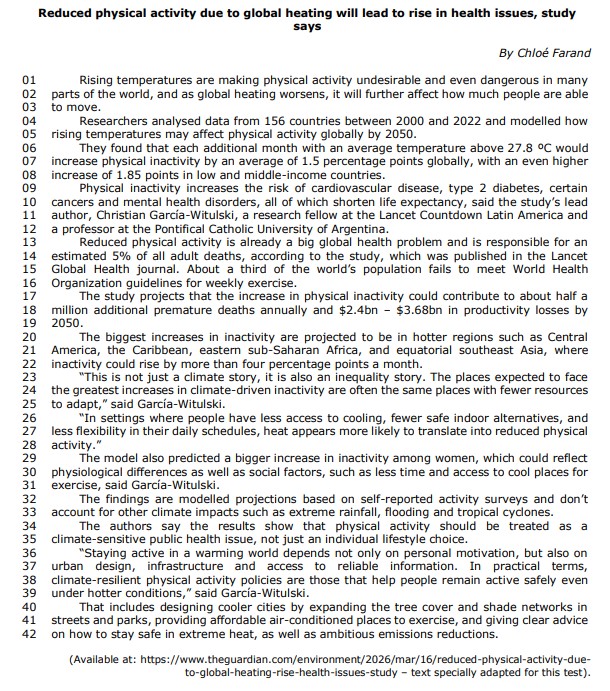
Identify the alternative that presents the informal equivalent of the formal expression purchase.
The changes to Earth’s natural patterns reveal an interconnected web of ecological systems that are undergoing profound changes beyond what many researchers have predicted. Scientists say the culprit is clear: Ever since the Industrial Revolution, the relentless burning of fossil fuels like coal, oil, and gas has been adding heat-trapping gases to the atmosphere, leading to a sharp rise in global temperatures. The hottest year in recorded history was 2024, and each of the 10 warmest years on record have come in the past decade.
Since 1997, when nations agreed to limit planet-warming gases as part of the landmark Kyoto Protocol, humanity has released more greenhouse gases than in all prior history. The temperature rise associated with the growing volume of heat trapping gas has kicked in, and it is continuing to rise. And at the same time, the ability of the planet’s natural systems to absorb planet-warming gases like carbon dioxide appears to be diminishing.
David Gelles. One thing’s for sure, the weather is getting wilder.
The New York Times International Edition, Nova York, 21-22 mar. 2026, p. 2 (adapted).
Considering the preceding text, judge the following item.
The word "culprit", in the fragment "Scientists say the culprit is clear" (first paragraph), could be correctly replaced with problem without this causing any change in the original meaning of the text, since the words are synonyms.
I.Hyponymy is a relationship of inclusion, where the meaning of a more specific term (the hyponym) is included within the meaning of a more general term (the hypernym).
II.Antonymy always involves absolute opposites, meaning that words like "hot" and "cold" cannot be placed on a scale or modified by adverbs of degree in formal registers.
III.Polysemy refers to a single lexical item that possesses multiple related meanings, often originating from the same etymological root or metaphorical extension.
Which of the statements above is/are CORRECT?
Considering the preceding text, judge the following item.
The word "culprit", in the fragment "Scientists say the culprit is clear" (first paragraph), could be correctly replaced with problem without this causing any change in the original meaning of the text, since the words are synonyms.
Read the following passage from Passing, by Nella Larsen, and answer the question.
Stepping out of the elevator that had brought her to the roof, she was led to a table just in front of a long window whose gently moving curtains suggested a cool breeze. It was, she thought, like being wafted upward on a magic carpet to another world, pleasant, quiet, and strangely remote from the sizzling one that she had left below.
LARSEN, Nella. Passing. In: The Complete Fiction of Nella Larsen – Passing, Quicksand and The Stories. New York: Anchor Books, 2001, p. 164.
“The data collected is analyzed by the LEOKA team and the results are incorporated into the officer safety awareness training the FBI provides for partner agencies.”
Culture is ordinary. Every human society has its own shape, its own purposes, its own meanings. Every human society expresses these, in institutions, and in arts and learning. The making of a society is the finding of common meanings and directions, and its growth is an active debate and amendment under the pressures of experience, contact, and discovery, writing themselves into the land. The growing society is there, yet it is also made and remade in every individual mind.
The making of a mind is, first, the slow learning of shapes, purposes, and meanings, so that work, observation and communication are possible. Then, second, but equal in importance, is the testing of these in experience, the making of new observations, comparisons, and meanings.
A culture has two aspects: the known meanings and directions, which its members are trained to; the new observations and meanings, which are offered and tested. These are the ordinary processes of human societies and human minds, and we see through them the nature of a culture: that it is always both traditional and creative; that it is both the most ordinary common meanings and the finest individual meanings.
We use the word culture in these two senses: to mean a whole way of life ⸺ the common meanings; to mean the arts and learning ⸺ the special processes of discovery and creative effort. Some writers reserve the word for one or other of these senses; I insist on both, and on the significance of their conjunction. The questions I ask about our culture are questions about our general and common purposes, yet also questions about deep personal meanings.
Culture is ordinary, in every society and in every mind.
Raymond Williams. Culture is Ordinary. In: R. Williams.
Resources of Hope: Culture, Democracy, Socialism.
London: Verso, 1989. p. 3-14 (adapted).
Based on the grammatical and semantic aspects of the preceding text, judge the item that follow.
In the last sentence of the text ⸺ "Culture is ordinary, in every society and in every mind" ⸺, "every" can be replaced with either each or all without compromising grammatical correctness or altering the overall meaning, but the change nonetheless alters the emphasis of the original wording.
Read the text to answer question.
The Tipping Point.
Last week at my neighborhood coffee shop, the barista flipped that dreaded tablet toward me. Three tip options glared back: 18%. 22%. 25%. For a $3.50 latte I was picking up. That took thirty seconds to make. I’ve hit my breaking point with tipping culture.
Growing up, tipping was simple: 15–20% for sitdown restaurants, maybe your hairdresser. Now it’s an expected tax on every transaction. The frozen yogurt shop where I serve myself wants 20%. Self-checkout kiosks are asking for tips. This is insane.
When I traveled Europe last summer, I paid exactly what was on the menu. No guilt, no calculations, no awkward pressure. Servers were paid living wages and the service was excellent.
Meanwhile, I’m expected to subsidize corporate America’s refusal to pay fair wages while their CEOs pocket millions in bonuses.
It’s 2025, and American tipping culture has spiraled out of control. It’s hurting workers, stressing customers, and letting profitable businesses guilt-trip their own customers into covering payroll. When I worked retail years ago, my employer paid my full wage. I didn’t expect customers to subsidize my paycheck because my boss decided to pocket the difference. Yet somehow in 2025, we’ve normalized corporations outsourcing their payroll responsibility to guilt-ridden customers. 72% of U.S. adults say tipping is expected in more places today than it was five years ago. But even as Americans say they’re being asked to tip more often, only about a third say it’s extremely or very easy to know whether (34%) or how much (33%) to tip for various services.
[...] The confusion is real and it’s intentional. Companies benefit from our uncertainty because confused customers tend to over-tip rather than risk social judgment.
Murdock, Jeff. Why Is Tipping Culture Out of Control in 2025? Medium. 16 Jun. 2025. Disponível em:<https://medium.com/@frat1309/why-is-tipping-cultureout-of-control-in-2025-im-done-subsidizing-corporategreed-76ba74887b82>
Text 10A2-I
Everyone ages, but, sometimes, people outlive all predictions. Previous research has uncovered an unlikely factor related to longevity: intelligence. However, intelligence isn‟t a simple characteristic. There are many traits that contribute to it that can be tested — from memory to mathematical logic. In a 2024 clinical psychological science study, Paolo Ghisletta, of the University of Geneva, linked longevity specifically to one of those traits: verbal fluency, the measure of one‟s vocabulary and their ability to use it. Ghisletta‟s research used samples from the Berlin Aging Study, which started collecting data shortly before the Berlin Wall came down in 1989. It tracked 516 people aged 70 to 105 from enrollment to their death, over as long as 18 years in some cases. The study measured factors like dental health, stress levels, and economic well-being, as well as cognition. This makes it a “rich and rare data set,” said Ghisletta in an interview.
Internet: http://www.sciencedaily.com/
Atenção: Considere o texto abaixo para responder à questão.
Artificial Intelligence in Accounting and Auditing
Federica De Santis
27 October 2024
The labor-intensive and repetitive nature of auditing tasks, combined with strict compliance requirements, make auditing an ideal area for the integration of digital technologies like artificial intelligence (Al). Al offers significant potential for auditors, enabling them to accelerate auditing tasks, minimize human errors and bias, overcome sampling limitations, examine entire transaction populations, and lower audit costs. Nonetheless. similar to any innovation in professional practices, the adoption of Al in auditing poses unique challenges for both professionals and policymakers. These challenges mainly pertain to auditors' readiness for technological advancements, their willingness to adapt their approach to audit tasks, and the ethical considerations of utilizing Al in their work.
(Adapted from https://link.springer.com/chapter/10.1007/978-3-031-71371-2_9)
Atenção: Considere o texto abaixo para responder à questão.
Defining the Role of a Tax Auditor
The core function of a tax auditor is to examine financial records and supporting documentation against the figures reported on official returns, whether for individuals or corporations. This examination seeks to verify every line item, from gross receipts and reported income to specific deductions claimed for ordinary and necessary business expenses. A primary goal is to confirm that the taxpayer's stated liability aligns precisely with the relevant federal or state tax law.
The auditor works to identify discrepancies or misapplications of the law that may lead to an underpayment of taxes due. They scrutinize documentation that supports deductions, such as receipts for depreciation claimed or substantiation for charitable contributions. The auditor ultimately determines if the taxpayer owes additional tax, is duea refund, or if the return is accurate as filed.
(Adapted from https://egalclarity.org/what-is-a-tax-auditor-and-what-do-they-do/)
 Conheça nossos planos