Questões de Concurso
Sobre inglês para instituto aocp
Foram encontradas 181 questões
Resolva questões gratuitamente!
Junte-se a mais de 4 milhões de concurseiros!


Ano: 2023
Banca:
INSTITUTO AOCP
Órgão:
IF-MA
Prova:
INSTITUTO AOCP - 2023 - IF-MA - Professor EBTT - Letras - Português - Inglês |
Q2238768
Inglês
All the alternatives below accurately describe the
textual genres, EXCEPT
Ano: 2023
Banca:
INSTITUTO AOCP
Órgão:
IF-MA
Prova:
INSTITUTO AOCP - 2023 - IF-MA - Professor EBTT - Letras - Português - Inglês |
Q2238767
Inglês
An English language professor is working with the
genre “scientific article”. They have asked
students to read a number of articles and identify
the different parts that are usually part of the
genre. The professor is
Ano: 2023
Banca:
INSTITUTO AOCP
Órgão:
IF-MA
Prova:
INSTITUTO AOCP - 2023 - IF-MA - Professor EBTT - Letras - Português - Inglês |
Q2238766
Inglês
Consider the following situation: you are
discussing the topic ‘Work’ with your English
language students and now you are going to read
a magazine article about a type of job interview
called ‘extreme interviews’. The heading of the
article is: Extreme interviews: what kind of
dinosaur are you? If you answered Tyrannosaurus
rex, then the bad news is that you probably won’t
get the job you’re applying for.
The tasks below are adapted versions of the activities, from the textbook, to work with the text. Match Tasks 1 – 6 with their main aim A – I. There are three extra aims which you do not need to use.
Tasks
Task 1 Discuss the questions in small groups.
1 Have you ever been to a job interview? How was the experience? What kind of questions did they ask you? Did you get the job?
2 What kind of questions do you expect to have in a job interview?
3 How can people get better prepared for a job interview?
Task 2 Look at the photo with the article. What do you think is happening? Do you think the question is one that someone might really ask in this situation? Why (not)?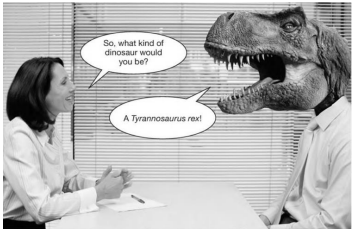
Task 3 Read the article once and find out. How would you answer the question?
Task 4 Look at the highlighted words and phrases in the text. With a partner, try to figure out what they might mean and how you think they are pronounced.
Task 5 Read the article again. Using your own words, answer the questions.
1 What are extreme interviews? 2 What kind of companies first started using them? 3 Why do some people think that they are better than normal interviews?
Task 6 Do you think extreme interviews are a good way of choosing candidates? Which of the questions below (used in real interviews) do you think would work well? Why?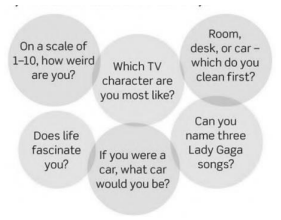
Adapted from: Face2Face Intermediate. Cris Redston and Gillie Cunningham. Cambridge University Press.
Main Aim
A. Integrating skills and personalizing the topic. B. Analyzing text organization. C. Inferring meaning of lexis from context. D. Predicting. E. Teaching grammar inductively using the text. F. Skimming. G. Activating schemata. H. Reading for details. I. Scanning.
The tasks below are adapted versions of the activities, from the textbook, to work with the text. Match Tasks 1 – 6 with their main aim A – I. There are three extra aims which you do not need to use.
Tasks
Task 1 Discuss the questions in small groups.
1 Have you ever been to a job interview? How was the experience? What kind of questions did they ask you? Did you get the job?
2 What kind of questions do you expect to have in a job interview?
3 How can people get better prepared for a job interview?
Task 2 Look at the photo with the article. What do you think is happening? Do you think the question is one that someone might really ask in this situation? Why (not)?
Task 3 Read the article once and find out. How would you answer the question?
Task 4 Look at the highlighted words and phrases in the text. With a partner, try to figure out what they might mean and how you think they are pronounced.
Task 5 Read the article again. Using your own words, answer the questions.
1 What are extreme interviews? 2 What kind of companies first started using them? 3 Why do some people think that they are better than normal interviews?
Task 6 Do you think extreme interviews are a good way of choosing candidates? Which of the questions below (used in real interviews) do you think would work well? Why?
Adapted from: Face2Face Intermediate. Cris Redston and Gillie Cunningham. Cambridge University Press.
Main Aim
A. Integrating skills and personalizing the topic. B. Analyzing text organization. C. Inferring meaning of lexis from context. D. Predicting. E. Teaching grammar inductively using the text. F. Skimming. G. Activating schemata. H. Reading for details. I. Scanning.
Ano: 2023
Banca:
INSTITUTO AOCP
Órgão:
IF-MA
Prova:
INSTITUTO AOCP - 2023 - IF-MA - Professor EBTT - Letras - Português - Inglês |
Q2238765
Inglês
When it comes to reading subskills, all the
alternatives below are correct, EXCEPT
Ano: 2022
Banca:
INSTITUTO AOCP
Órgão:
BANESE
Provas:
INSTITUTO AOCP - 2022 - BANESE - Técnico Bancário III - Área de Informática - Desenvolvimento
|
INSTITUTO AOCP - 2022 - BANESE - Técnico Bancário III - Área de Informática - Suporte |
Q2073398
Inglês
Texto associado
What is the Difference Between Checking and Savings Accounts?
The main difference between checking and savings accounts is that checking accounts are primarily for accessing your money for daily use while savings accounts are primarily for saving money. Checking accounts are considered “transactional,” meaning that they allow you to access your money when and where you need it. While both allow you to access your money, you may consider it easier to do so with checking accounts. Since these accounts are designed to give you easy access to your cash, they often come with debit cards, checks, and even offer digital payment options. In contrast, savings accounts have a limit on the number of withdrawals you can make each month.
While checking accounts are convenient for daily cash needs, it’s important to remember that they may be age restricted. Most banks won’t allow people under the age of 18 to open a checking account without a parent or legal guardian as a co-owner of the account. Before opening a checking account, make sure that its terms fit your financial needs and your lifestyle.
When it comes to setting aside money for a longterm need or goal, you should consider a savings account. Savings accounts are designed to hold money over a long period of time to help you save for larger goals (rather than everyday purchases). As your money stays in the account, it will accrue interest and grow over time. This means that you will need to visit your bank, set up a transfer online, or make an ATM withdrawal to access your money.
Keeping some of your money in a savings account is a great way to set it aside for emergencies or large purchases – its limited access will keep you from spending it on day-to-day necessities. There are also dedicated savings accounts for kids, though a parent or guardian is usually required as a joint owner.
(Adapted from: https://www.santanderbank.com/personal/resources/checkingsavings/difference-between-checking
savings#:~:text=The%20main%20difference%20between%20check
ing,and%20where%20you%20need%20it)
According to the text, checking accounts are
considered ‘transactional’. This feature points to
the specific ways in which this type of account is
meant to be used by clients. In practice, what
does the term ‘transactional’ mean in this
context?
Ano: 2022
Banca:
INSTITUTO AOCP
Órgão:
BANESE
Provas:
INSTITUTO AOCP - 2022 - BANESE - Técnico Bancário III - Área de Informática - Desenvolvimento
|
INSTITUTO AOCP - 2022 - BANESE - Técnico Bancário III - Área de Informática - Suporte |
Q2073397
Inglês
Texto associado
What is the Difference Between Checking and Savings Accounts?
The main difference between checking and savings accounts is that checking accounts are primarily for accessing your money for daily use while savings accounts are primarily for saving money. Checking accounts are considered “transactional,” meaning that they allow you to access your money when and where you need it. While both allow you to access your money, you may consider it easier to do so with checking accounts. Since these accounts are designed to give you easy access to your cash, they often come with debit cards, checks, and even offer digital payment options. In contrast, savings accounts have a limit on the number of withdrawals you can make each month.
While checking accounts are convenient for daily cash needs, it’s important to remember that they may be age restricted. Most banks won’t allow people under the age of 18 to open a checking account without a parent or legal guardian as a co-owner of the account. Before opening a checking account, make sure that its terms fit your financial needs and your lifestyle.
When it comes to setting aside money for a longterm need or goal, you should consider a savings account. Savings accounts are designed to hold money over a long period of time to help you save for larger goals (rather than everyday purchases). As your money stays in the account, it will accrue interest and grow over time. This means that you will need to visit your bank, set up a transfer online, or make an ATM withdrawal to access your money.
Keeping some of your money in a savings account is a great way to set it aside for emergencies or large purchases – its limited access will keep you from spending it on day-to-day necessities. There are also dedicated savings accounts for kids, though a parent or guardian is usually required as a joint owner.
(Adapted from: https://www.santanderbank.com/personal/resources/checkingsavings/difference-between-checking
savings#:~:text=The%20main%20difference%20between%20check
ing,and%20where%20you%20need%20it)
Read the excerpt below and choose the only
alternative with a plausible interpretation of its
content:
“Savings accounts are designed to hold money over a long period of time to help you save for larger goals (rather than everyday purchases). As your money stays in the account, it will accrue interest and grow over time. This means that you will need to visit your bank, set up a transfer online, or make an ATM withdrawal to access your money.”
“Savings accounts are designed to hold money over a long period of time to help you save for larger goals (rather than everyday purchases). As your money stays in the account, it will accrue interest and grow over time. This means that you will need to visit your bank, set up a transfer online, or make an ATM withdrawal to access your money.”
Ano: 2022
Banca:
INSTITUTO AOCP
Órgão:
BANESE
Provas:
INSTITUTO AOCP - 2022 - BANESE - Técnico Bancário III - Área de Informática - Desenvolvimento
|
INSTITUTO AOCP - 2022 - BANESE - Técnico Bancário III - Área de Informática - Suporte |
Q2073396
Inglês
Texto associado
What is the Difference Between Checking and Savings Accounts?
The main difference between checking and savings accounts is that checking accounts are primarily for accessing your money for daily use while savings accounts are primarily for saving money. Checking accounts are considered “transactional,” meaning that they allow you to access your money when and where you need it. While both allow you to access your money, you may consider it easier to do so with checking accounts. Since these accounts are designed to give you easy access to your cash, they often come with debit cards, checks, and even offer digital payment options. In contrast, savings accounts have a limit on the number of withdrawals you can make each month.
While checking accounts are convenient for daily cash needs, it’s important to remember that they may be age restricted. Most banks won’t allow people under the age of 18 to open a checking account without a parent or legal guardian as a co-owner of the account. Before opening a checking account, make sure that its terms fit your financial needs and your lifestyle.
When it comes to setting aside money for a longterm need or goal, you should consider a savings account. Savings accounts are designed to hold money over a long period of time to help you save for larger goals (rather than everyday purchases). As your money stays in the account, it will accrue interest and grow over time. This means that you will need to visit your bank, set up a transfer online, or make an ATM withdrawal to access your money.
Keeping some of your money in a savings account is a great way to set it aside for emergencies or large purchases – its limited access will keep you from spending it on day-to-day necessities. There are also dedicated savings accounts for kids, though a parent or guardian is usually required as a joint owner.
(Adapted from: https://www.santanderbank.com/personal/resources/checkingsavings/difference-between-checking
savings#:~:text=The%20main%20difference%20between%20check
ing,and%20where%20you%20need%20it)
Pay close attention to the terms/idioms that are
underlined in the five following sentences:
I. While both allow you to access your money, you may consider it easier to do so with checking accounts (1st paragraph). II. In contrast, savings accounts have a limit on the number of withdrawals you can make each month (1st paragraph). III. Most banks won’t allow people under the age of 18 to open a checking account without a parent or legal guardian as a co-owner of the account (2nd paragraph). IV. When it comes to setting aside money for a long-term need or goal, you should consider a savings account (3rd paragraph). V. There are also dedicated savings accounts for kids, though a parent or guardian is usually required as a joint owner (4th paragraph).
Now, choose the alternative that classifies these terms correctly and matches them with an appropriate synonym.
I. While both allow you to access your money, you may consider it easier to do so with checking accounts (1st paragraph). II. In contrast, savings accounts have a limit on the number of withdrawals you can make each month (1st paragraph). III. Most banks won’t allow people under the age of 18 to open a checking account without a parent or legal guardian as a co-owner of the account (2nd paragraph). IV. When it comes to setting aside money for a long-term need or goal, you should consider a savings account (3rd paragraph). V. There are also dedicated savings accounts for kids, though a parent or guardian is usually required as a joint owner (4th paragraph).
Now, choose the alternative that classifies these terms correctly and matches them with an appropriate synonym.
Ano: 2022
Banca:
INSTITUTO AOCP
Órgão:
BANESE
Provas:
INSTITUTO AOCP - 2022 - BANESE - Técnico Bancário III - Área de Informática - Desenvolvimento
|
INSTITUTO AOCP - 2022 - BANESE - Técnico Bancário III - Área de Informática - Suporte |
Q2073395
Inglês
Texto associado
What is the Difference Between Checking and Savings Accounts?
The main difference between checking and savings accounts is that checking accounts are primarily for accessing your money for daily use while savings accounts are primarily for saving money. Checking accounts are considered “transactional,” meaning that they allow you to access your money when and where you need it. While both allow you to access your money, you may consider it easier to do so with checking accounts. Since these accounts are designed to give you easy access to your cash, they often come with debit cards, checks, and even offer digital payment options. In contrast, savings accounts have a limit on the number of withdrawals you can make each month.
While checking accounts are convenient for daily cash needs, it’s important to remember that they may be age restricted. Most banks won’t allow people under the age of 18 to open a checking account without a parent or legal guardian as a co-owner of the account. Before opening a checking account, make sure that its terms fit your financial needs and your lifestyle.
When it comes to setting aside money for a longterm need or goal, you should consider a savings account. Savings accounts are designed to hold money over a long period of time to help you save for larger goals (rather than everyday purchases). As your money stays in the account, it will accrue interest and grow over time. This means that you will need to visit your bank, set up a transfer online, or make an ATM withdrawal to access your money.
Keeping some of your money in a savings account is a great way to set it aside for emergencies or large purchases – its limited access will keep you from spending it on day-to-day necessities. There are also dedicated savings accounts for kids, though a parent or guardian is usually required as a joint owner.
(Adapted from: https://www.santanderbank.com/personal/resources/checkingsavings/difference-between-checking
savings#:~:text=The%20main%20difference%20between%20check
ing,and%20where%20you%20need%20it)
Choose the alternative that correctly describes the
meaning of one of the following words which were
taken from the text.
Ano: 2021
Banca:
INSTITUTO AOCP
Órgão:
FUNPRESP-JUD
Prova:
INSTITUTO AOCP - 2021 - FUNPRESP-JUD - Analista de Tecnologia da Informação - Desenvolvimento de Sistemas |
Q1855674
Inglês
Texto associado
Taking into account the following text, judge
the subsequent item.
Perspectives on modern data analytics
By Eric Knorr - Editor in Chief, CIO | APR 12,
2021 3:00 AM PDT
Some things don't change, even during a
pandemic. Consistent with previous years, in
CIO’s 2021 State of the CIO survey, a plurality of
the 1,062 IT leaders surveyed chose
“data/business analytics” as the No.1 tech
initiative expected to drive IT investment.
Unfortunately, analytics initiatives seldom do
nearly as well when it comes to stakeholder
satisfaction.
Last year, CIO contributor Mary K. Pratt offered
an excellent analysis of why data analytics
initiatives still fail, including poor-quality or siloed
data, vague rather than targeted business
objectives, and clunky one-size-fits-all feature
sets. But a number of fresh approaches and
technologies are making these pratfalls less
likely.
(...)
New technology invariably incurs new risks. No
advancement has had more momentous impact
on analytics than machine learning – from
automating data prep to detecting meaningful
patterns in data – but it also adds an unforeseen
hazard. As CSO Senior Writer Lucian Constantin
explains in "How data poisoning attacks corrupt
machine learning models," deliberately skewed
data injected by malicious hackers can tilt models toward some nefarious goal. The result could be,
say, manipulated product recommendations, or
even the ability for hackers to infer confidential
underlying data.
(...)
In the end, the secret to successful analytics is
not in choosing and implementing the perfect
technology, but in cultivating a broad
understanding that pervasive analytics yields
better decisions and superior outcomes. Usually,
you can iron out technology kinks or
requirements misunderstandings. But if you can't
change the mindset, few will use the beautiful
analytics machine you just built.
Disponível em: https://www.cio.com/article/3614692/5-perspectiveson-modern-data-analytics.html.
Acesso em: 15 out. 2021.
The adjective “pervasive” in pervasive
analytics could be replaced by the adjective
“extensive” without a change in meaning in
the aforementioned context.
Ano: 2021
Banca:
INSTITUTO AOCP
Órgão:
FUNPRESP-JUD
Prova:
INSTITUTO AOCP - 2021 - FUNPRESP-JUD - Analista de Tecnologia da Informação - Desenvolvimento de Sistemas |
Q1855673
Inglês
Texto associado
Taking into account the following text, judge
the subsequent item.
Perspectives on modern data analytics
By Eric Knorr - Editor in Chief, CIO | APR 12,
2021 3:00 AM PDT
Some things don't change, even during a
pandemic. Consistent with previous years, in
CIO’s 2021 State of the CIO survey, a plurality of
the 1,062 IT leaders surveyed chose
“data/business analytics” as the No.1 tech
initiative expected to drive IT investment.
Unfortunately, analytics initiatives seldom do
nearly as well when it comes to stakeholder
satisfaction.
Last year, CIO contributor Mary K. Pratt offered
an excellent analysis of why data analytics
initiatives still fail, including poor-quality or siloed
data, vague rather than targeted business
objectives, and clunky one-size-fits-all feature
sets. But a number of fresh approaches and
technologies are making these pratfalls less
likely.
(...)
New technology invariably incurs new risks. No
advancement has had more momentous impact
on analytics than machine learning – from
automating data prep to detecting meaningful
patterns in data – but it also adds an unforeseen
hazard. As CSO Senior Writer Lucian Constantin
explains in "How data poisoning attacks corrupt
machine learning models," deliberately skewed
data injected by malicious hackers can tilt models toward some nefarious goal. The result could be,
say, manipulated product recommendations, or
even the ability for hackers to infer confidential
underlying data.
(...)
In the end, the secret to successful analytics is
not in choosing and implementing the perfect
technology, but in cultivating a broad
understanding that pervasive analytics yields
better decisions and superior outcomes. Usually,
you can iron out technology kinks or
requirements misunderstandings. But if you can't
change the mindset, few will use the beautiful
analytics machine you just built.
Disponível em: https://www.cio.com/article/3614692/5-perspectiveson-modern-data-analytics.html.
Acesso em: 15 out. 2021.
The advancements on machine learning
have always been preventing hackers from
inferring confidential data or manipulating
product recommendations when it comes
to business analytics.
Ano: 2021
Banca:
INSTITUTO AOCP
Órgão:
FUNPRESP-JUD
Prova:
INSTITUTO AOCP - 2021 - FUNPRESP-JUD - Analista de Tecnologia da Informação - Desenvolvimento de Sistemas |
Q1855672
Inglês
Texto associado
Taking into account the following text, judge
the subsequent item.
Perspectives on modern data analytics
By Eric Knorr - Editor in Chief, CIO | APR 12,
2021 3:00 AM PDT
Some things don't change, even during a
pandemic. Consistent with previous years, in
CIO’s 2021 State of the CIO survey, a plurality of
the 1,062 IT leaders surveyed chose
“data/business analytics” as the No.1 tech
initiative expected to drive IT investment.
Unfortunately, analytics initiatives seldom do
nearly as well when it comes to stakeholder
satisfaction.
Last year, CIO contributor Mary K. Pratt offered
an excellent analysis of why data analytics
initiatives still fail, including poor-quality or siloed
data, vague rather than targeted business
objectives, and clunky one-size-fits-all feature
sets. But a number of fresh approaches and
technologies are making these pratfalls less
likely.
(...)
New technology invariably incurs new risks. No
advancement has had more momentous impact
on analytics than machine learning – from
automating data prep to detecting meaningful
patterns in data – but it also adds an unforeseen
hazard. As CSO Senior Writer Lucian Constantin
explains in "How data poisoning attacks corrupt
machine learning models," deliberately skewed
data injected by malicious hackers can tilt models toward some nefarious goal. The result could be,
say, manipulated product recommendations, or
even the ability for hackers to infer confidential
underlying data.
(...)
In the end, the secret to successful analytics is
not in choosing and implementing the perfect
technology, but in cultivating a broad
understanding that pervasive analytics yields
better decisions and superior outcomes. Usually,
you can iron out technology kinks or
requirements misunderstandings. But if you can't
change the mindset, few will use the beautiful
analytics machine you just built.
Disponível em: https://www.cio.com/article/3614692/5-perspectiveson-modern-data-analytics.html.
Acesso em: 15 out. 2021.
According to the CIO’s 2021 State of the
CIO survey, the technology enterprise
which will probably demand IT investment
in the near future will be business analytics.
Ano: 2020
Banca:
INSTITUTO AOCP
Órgão:
MJSP
Provas:
INSTITUTO AOCP - 2020 - MJSP - Cientista de Dados - Big Data
|
INSTITUTO AOCP - 2020 - MJSP - Engenheiro de Dados - Big Data |
Q1610896
Inglês
Articles frequently accompany nouns.
Choose the alternative that presents a
general and a specific article, respectively.
Ano: 2020
Banca:
INSTITUTO AOCP
Órgão:
MJSP
Provas:
INSTITUTO AOCP - 2020 - MJSP - Cientista de Dados - Big Data
|
INSTITUTO AOCP - 2020 - MJSP - Engenheiro de Dados - Big Data |
Q1610894
Inglês
A compound subject is a sentence that has
two or more nouns used as subjects which
are joined by the conjunction "and." Choose
the correct alternative that presents a
sentence containing a compound subject.
Ano: 2020
Banca:
INSTITUTO AOCP
Órgão:
MJSP
Provas:
INSTITUTO AOCP - 2020 - MJSP - Cientista de Dados - Big Data
|
INSTITUTO AOCP - 2020 - MJSP - Engenheiro de Dados - Big Data |
Q1610892
Inglês
A lot of common verbs have irregular simple
past forms. In this sense, choose the right
alternative that presents the irregular simple
past form of the verbs: know, bring, begin,
and do, respectively.
Ano: 2020
Banca:
INSTITUTO AOCP
Órgão:
MJSP
Prova:
INSTITUTO AOCP - 2020 - MJSP - Analista de Governança de Dados - Big Data |
Q1610696
Inglês
Choose the right preposition to fill up the
following sentence: “I’m data scientist ____
MJSP.”
Ano: 2020
Banca:
INSTITUTO AOCP
Órgão:
MJSP
Prova:
INSTITUTO AOCP - 2020 - MJSP - Analista de Governança de Dados - Big Data |
Q1610695
Inglês
A data scientist obtained the following error
message: “session attached to some other
process; cannot switch session.” The word
‘attached’ in this message means
Ano: 2020
Banca:
INSTITUTO AOCP
Órgão:
MJSP
Prova:
INSTITUTO AOCP - 2020 - MJSP - Analista de Governança de Dados - Big Data |
Q1610694
Inglês
Analyze the following phrase: "I'm afraid
you're right." Afraid in this sense means
feeling
Ano: 2020
Banca:
INSTITUTO AOCP
Órgão:
MJSP
Prova:
INSTITUTO AOCP - 2020 - MJSP - Analista de Governança de Dados - Big Data |
Q1610692
Inglês
In English, a noun is a word used to name a
person, place, thing, or idea. In this sense,
choose the alternative that shows the right
definition of abstract nouns.
Ano: 2020
Banca:
INSTITUTO AOCP
Órgão:
Prefeitura de Betim - MG
Prova:
INSTITUTO AOCP - 2020 - Prefeitura de Betim - MG - Professor - Inglês |
Q1254869
Inglês
According to the Parâmetros Curriculares
Nacionais (1998), the learning of a foreign
language depends on the “(…)
engajamento discursivo do aluno, ou
seja, em sua capacidade de se engajar e
engajar outros no discurso, de modo a
poder agir no mundo social.” Taking into
account the language teaching
methodologies, which one best aligns
with the PCN proposal for teaching a
foreign language?
Ano: 2020
Banca:
INSTITUTO AOCP
Órgão:
Prefeitura de Betim - MG
Prova:
INSTITUTO AOCP - 2020 - Prefeitura de Betim - MG - Professor - Inglês |
Q1254868
Inglês
Texto associado
TEXT V
I happily advertise the fact I breastfed – it’s
high time that brands embraced it too
by Nell Frizzell
New ads by Aldi, Adidas and Sainsbury’s all
feature breastfeeding mothers. Hopefully this will
normalize the process to help new parents feed
with ease
It may be some time yet until we see a mother
in an advert precariously balancing her
child/bag/shopping/pets before pushing a nipple
into the mouth of a howling, jam-smeared toddler.
But when they do, oh boy, are my days as a model
really going to get going.
In recent weeks, a series of adverts have
appeared from Tu at Sainsbury’s, Adidas and Aldi,
all featuring breastfeeding mothers. Some are
wearing flowery blouses and have tattoos, others
are holding a naked baby between the zips of a
sports top. Of course the women are good-looking,
of course they are slim, of course we cannot
actually see anything as erotically charged or as
morally unsettling as an areola – this is still
advertising, after all. But it is, surely, a start.
As someone who breastfed her son for 21 shirtlifting, bra-soaking, carefree months, I am of
course pleased to see breastfeeding being held up
as something both everyday and aspirational. It is
as prosaic as a trip to the supermarket yet as
physically impressive as professional sport. It
belongs on billboards and screens as much as
beds and sofas.
here is no such thing as “normal” when it
comes to babies or bodies. But to normalize
something that, in the words of UNICEF, has a
profoundly positive impact on child health, is of
course to be celebrated. You might find yourself
whipping out a boob on a train full of football fans;
you might squirt milk across somebody else’s coat
on the bus; you might find yourself answering the
door with your full breast outside your clothes
without noticing. And if the presence of big brands
behind your bra straps encourage you to keep
feeding, then all power to your elbow. It is a shame
that this hasn’t happened sooner, but it’s better late
than never – and there’s no use crying over spilled
(breast) milk.
(Source:
https://www.theguardian.com/lifeandstyle/shortcuts/2019/oct/02/adve
rts-breastfeeding-mothers-aldi-adidas-sainsburys.Access:
08/01/2020)
Consider the following excerpt taken
from the article: “It is a shame that this
hasn’t happened sooner, but it’s better
late than never (…)”. Mark the option
which best describes the relationship
between the two clauses presented in the
sentence.
 Conheça nossos planos