Questões de Concurso Público Câmara Legislativa do Distrito Federal 2018 para Analista de Sistemas - Área 4
Foram encontradas 60 questões


Ano: 2018
Banca:
FCC
Órgão:
Câmara Legislativa do Distrito Federal
Prova:
FCC - 2018 - Câmara Legislativa do Distrito Federal - Analista de Sistemas - Área 4 |
Q2028728
Legislação Estadual
A Lei Complementar no 13, de 3 de setembro de 1996, que disciplina a redação, alteração e consolidação das leis n⁰ Distrito Federal, dispõe, a respeito da estruturação das leis, que
Ano: 2018
Banca:
FCC
Órgão:
Câmara Legislativa do Distrito Federal
Prova:
FCC - 2018 - Câmara Legislativa do Distrito Federal - Analista de Sistemas - Área 4 |
Q2028729
Legislação Estadual
Nos termos da Lei Orgânica do Distrito Federal, constitui matéria que pode ser objeto de lei ordinária
Ano: 2018
Banca:
FCC
Órgão:
Câmara Legislativa do Distrito Federal
Prova:
FCC - 2018 - Câmara Legislativa do Distrito Federal - Analista de Sistemas - Área 4 |
Q2028730
Regimento Interno
O Regimento Interno da Câmara Legislativa do Distrito Federal dispõe, a respeito das proposições no processo legislativo, que:
Ano: 2018
Banca:
FCC
Órgão:
Câmara Legislativa do Distrito Federal
Prova:
FCC - 2018 - Câmara Legislativa do Distrito Federal - Analista de Sistemas - Área 4 |
Q2028731
História e Geografia de Estados e Municípios
Na crise hídrica enfrentada pelo Distrito Federal em 2017, Planaltina e Sobradinho sofreram interrupção no fornecimento de
água por alguns dias. A área foi considerada a mais crítica nos períodos de estiagem, pelo presidente da Companhia de
Saneamento do Distrito Federal, porque
Ano: 2018
Banca:
FCC
Órgão:
Câmara Legislativa do Distrito Federal
Prova:
FCC - 2018 - Câmara Legislativa do Distrito Federal - Analista de Sistemas - Área 4 |
Q2028732
História e Geografia de Estados e Municípios
O bioma Cerrado, característico da região do Distrito Federal, ocupa, em relação à área total do Brasil, cerca de
Ano: 2018
Banca:
FCC
Órgão:
Câmara Legislativa do Distrito Federal
Prova:
FCC - 2018 - Câmara Legislativa do Distrito Federal - Analista de Sistemas - Área 4 |
Q2028733
Inglês
Texto associado
Legislative Management and Information System
In May 2001, the Sangguniang Panlalawigan (SP − Provincial Council in English) under the leadership of Vice-Governor Loreto Leo S. Ocampos embarked on the computerization of its legislative function through the acquisition of the “Legislative Management and Tracking System”. The “Legislative Management and Tracking System” or “Legtrack” as it is commonly called, is a software program developed as a tool to track, monitor and store communications, requests, proposed resolutions and ordinances, communications, Sangguniang Bayan Resolutions and ordinances from different municipalities and cities to be acted upon.
The Provincial Government only spent sixty-six thousand pesos (P 66,000.00) for the cost of installation, airfare and accommodation of two Philippine Business for Social Progress (PBSP) consultants and the training of five SP personnel on its operation and application. Now, over a million worth of software program was given to the Sangguniang Panlalawigan for free.
The SP’s “Legtrack” can be considered as one of the most updated versions of the Tracking System used by different Local Government Units in the country. It also holds the distinction of being the first “Legtrack” to be synced to a Paperless Legislation Program.
The actual performance of the Sangguniang Panlalawigan and its individual members can also be gauged through statistics on session attendance; committee meeting attendance; committee reports made, number of resolutions and ordinances authored, sponsored and passed.
Furthermore, the System upgrade(s) enhances not only the intellectual capability of the Secretariat but also its technical competence in support to the Sanggunian’s Office vows to be responsive, active and sensitive to the needs of the people. It has undergone a total of seven upgrades over the years.
(Adapted from http://sp.misocc.gov.ph/legislative-management-and-information-system)
Segundo o texto, o Legtrack
Ano: 2018
Banca:
FCC
Órgão:
Câmara Legislativa do Distrito Federal
Prova:
FCC - 2018 - Câmara Legislativa do Distrito Federal - Analista de Sistemas - Área 4 |
Q2028734
Inglês
Texto associado
Legislative Management and Information System
In May 2001, the Sangguniang Panlalawigan (SP − Provincial Council in English) under the leadership of Vice-Governor Loreto Leo S. Ocampos embarked on the computerization of its legislative function through the acquisition of the “Legislative Management and Tracking System”. The “Legislative Management and Tracking System” or “Legtrack” as it is commonly called, is a software program developed as a tool to track, monitor and store communications, requests, proposed resolutions and ordinances, communications, Sangguniang Bayan Resolutions and ordinances from different municipalities and cities to be acted upon.
The Provincial Government only spent sixty-six thousand pesos (P 66,000.00) for the cost of installation, airfare and accommodation of two Philippine Business for Social Progress (PBSP) consultants and the training of five SP personnel on its operation and application. Now, over a million worth of software program was given to the Sangguniang Panlalawigan for free.
The SP’s “Legtrack” can be considered as one of the most updated versions of the Tracking System used by different Local Government Units in the country. It also holds the distinction of being the first “Legtrack” to be synced to a Paperless Legislation Program.
The actual performance of the Sangguniang Panlalawigan and its individual members can also be gauged through statistics on session attendance; committee meeting attendance; committee reports made, number of resolutions and ordinances authored, sponsored and passed.
Furthermore, the System upgrade(s) enhances not only the intellectual capability of the Secretariat but also its technical competence in support to the Sanggunian’s Office vows to be responsive, active and sensitive to the needs of the people. It has undergone a total of seven upgrades over the years.
(Adapted from http://sp.misocc.gov.ph/legislative-management-and-information-system)
De acordo com o texto, o Legtrack
Ano: 2018
Banca:
FCC
Órgão:
Câmara Legislativa do Distrito Federal
Prova:
FCC - 2018 - Câmara Legislativa do Distrito Federal - Analista de Sistemas - Área 4 |
Q2028735
Inglês
Texto associado
One of the things Jaime appreciates about Accela is that “they believe in their product so much, you don’t have to sign on for a year. With Accela, we didn’t feel they were trying to get the most money they could from the agency. We felt they truly were a company that wanted to work with us and were understanding of all the different requirements we had.”
Reno, Nevada, Improves Efficiency while Complying with Stringent Open Meeting Law Requirements
ADAMANT ABOUT TRANSPARENCY
The Reno City Council meets regularly to set priorities, approve the budget and address issues facing the community. These meetings are guided by incredibly stringent open meeting law requirements. Staff must post the agenda, along with all supporting materials, on their website at least three days prior to a meeting. Additionally, if any documents are presented during a Council meeting to help make a decision, it must be uploaded within 24 hours after the meeting.
As a Senior Management Analyst, Jaime Schroeder has been responsible for all staff reports, supporting materials and the agendas for the Reno City Council and the Reno Redevelopment Agency Board since early 2012. Back then, the agency was using a government shareware product. “We realized we had quickly outgrown that system,” recalls Jaime.
The City’s communications and technology departments conducted a thorough search of alternatives and narrowed the list down to three contenders. “We looked at Accela Legislative Management and realized it was the full package,” says Jaime. “It was something we felt we could implement and get comfortable with quickly.”
HOW ACCELA EMPOWERS RENO
One of the things Jaime appreciates about Accela is that “they believe in their product so much, you don’t have to sign on for a year. With Accela, we didn’t feel they were trying to get the most money they could from the agency. We felt they truly were a company that wanted to work with us and were understanding of all the different requirements we had.”
City Council meetings are on average four to six hours long. In the past, citizens had to fast forward and rewind through an entire meeting online in order to find what they were looking for. “The great thing about this product and why we chose it is that the video of each meeting is integrated with the meeting documents and it also has time-stamp features, making it easy for staff and citizens to quickly find what they’re interested in. I love that transparency.”
THE BOTTOM LINE
Once a document is posted online, staff and citizens alike can access it through a meeting portal 24/7. When citizens request a Council or staff report, employees can simply direct them to the portal, where they can click on the meeting date, see the agenda and then click on the item that interests them. When the media requests information, the Communications department can send links to staff reports online, saving time, paper and money and helping to ensure accurate media coverage.
In the future, the City of Reno is looking forward to using the electronic voting feature available within Accela Digital Boardroom that shows meeting participants’ votes on a screen during the meeting in real time.
(Adapted from https://www.accela.com/company/customers/sucess-stories/reno)
De acordo com o texto,
Ano: 2018
Banca:
FCC
Órgão:
Câmara Legislativa do Distrito Federal
Prova:
FCC - 2018 - Câmara Legislativa do Distrito Federal - Analista de Sistemas - Área 4 |
Q2028736
Inglês
Texto associado
One of the things Jaime appreciates about Accela is that “they believe in their product so much, you don’t have to sign on for a year. With Accela, we didn’t feel they were trying to get the most money they could from the agency. We felt they truly were a company that wanted to work with us and were understanding of all the different requirements we had.”
Reno, Nevada, Improves Efficiency while Complying with Stringent Open Meeting Law Requirements
ADAMANT ABOUT TRANSPARENCY
The Reno City Council meets regularly to set priorities, approve the budget and address issues facing the community. These meetings are guided by incredibly stringent open meeting law requirements. Staff must post the agenda, along with all supporting materials, on their website at least three days prior to a meeting. Additionally, if any documents are presented during a Council meeting to help make a decision, it must be uploaded within 24 hours after the meeting.
As a Senior Management Analyst, Jaime Schroeder has been responsible for all staff reports, supporting materials and the agendas for the Reno City Council and the Reno Redevelopment Agency Board since early 2012. Back then, the agency was using a government shareware product. “We realized we had quickly outgrown that system,” recalls Jaime.
The City’s communications and technology departments conducted a thorough search of alternatives and narrowed the list down to three contenders. “We looked at Accela Legislative Management and realized it was the full package,” says Jaime. “It was something we felt we could implement and get comfortable with quickly.”
HOW ACCELA EMPOWERS RENO
One of the things Jaime appreciates about Accela is that “they believe in their product so much, you don’t have to sign on for a year. With Accela, we didn’t feel they were trying to get the most money they could from the agency. We felt they truly were a company that wanted to work with us and were understanding of all the different requirements we had.”
City Council meetings are on average four to six hours long. In the past, citizens had to fast forward and rewind through an entire meeting online in order to find what they were looking for. “The great thing about this product and why we chose it is that the video of each meeting is integrated with the meeting documents and it also has time-stamp features, making it easy for staff and citizens to quickly find what they’re interested in. I love that transparency.”
THE BOTTOM LINE
Once a document is posted online, staff and citizens alike can access it through a meeting portal 24/7. When citizens request a Council or staff report, employees can simply direct them to the portal, where they can click on the meeting date, see the agenda and then click on the item that interests them. When the media requests information, the Communications department can send links to staff reports online, saving time, paper and money and helping to ensure accurate media coverage.
In the future, the City of Reno is looking forward to using the electronic voting feature available within Accela Digital Boardroom that shows meeting participants’ votes on a screen during the meeting in real time.
(Adapted from https://www.accela.com/company/customers/sucess-stories/reno)
Segundo o texto,
Ano: 2018
Banca:
FCC
Órgão:
Câmara Legislativa do Distrito Federal
Prova:
FCC - 2018 - Câmara Legislativa do Distrito Federal - Analista de Sistemas - Área 4 |
Q2028737
Inglês
Texto associado
One of the things Jaime appreciates about Accela is that “they believe in their product so much, you don’t have to sign on for a year. With Accela, we didn’t feel they were trying to get the most money they could from the agency. We felt they truly were a company that wanted to work with us and were understanding of all the different requirements we had.”
Reno, Nevada, Improves Efficiency while Complying with Stringent Open Meeting Law Requirements
ADAMANT ABOUT TRANSPARENCY
The Reno City Council meets regularly to set priorities, approve the budget and address issues facing the community. These meetings are guided by incredibly stringent open meeting law requirements. Staff must post the agenda, along with all supporting materials, on their website at least three days prior to a meeting. Additionally, if any documents are presented during a Council meeting to help make a decision, it must be uploaded within 24 hours after the meeting.
As a Senior Management Analyst, Jaime Schroeder has been responsible for all staff reports, supporting materials and the agendas for the Reno City Council and the Reno Redevelopment Agency Board since early 2012. Back then, the agency was using a government shareware product. “We realized we had quickly outgrown that system,” recalls Jaime.
The City’s communications and technology departments conducted a thorough search of alternatives and narrowed the list down to three contenders. “We looked at Accela Legislative Management and realized it was the full package,” says Jaime. “It was something we felt we could implement and get comfortable with quickly.”
HOW ACCELA EMPOWERS RENO
One of the things Jaime appreciates about Accela is that “they believe in their product so much, you don’t have to sign on for a year. With Accela, we didn’t feel they were trying to get the most money they could from the agency. We felt they truly were a company that wanted to work with us and were understanding of all the different requirements we had.”
City Council meetings are on average four to six hours long. In the past, citizens had to fast forward and rewind through an entire meeting online in order to find what they were looking for. “The great thing about this product and why we chose it is that the video of each meeting is integrated with the meeting documents and it also has time-stamp features, making it easy for staff and citizens to quickly find what they’re interested in. I love that transparency.”
THE BOTTOM LINE
Once a document is posted online, staff and citizens alike can access it through a meeting portal 24/7. When citizens request a Council or staff report, employees can simply direct them to the portal, where they can click on the meeting date, see the agenda and then click on the item that interests them. When the media requests information, the Communications department can send links to staff reports online, saving time, paper and money and helping to ensure accurate media coverage.
In the future, the City of Reno is looking forward to using the electronic voting feature available within Accela Digital Boardroom that shows meeting participants’ votes on a screen during the meeting in real time.
(Adapted from https://www.accela.com/company/customers/sucess-stories/reno)
De acordo com o texto,
Ano: 2018
Banca:
FCC
Órgão:
Câmara Legislativa do Distrito Federal
Prova:
FCC - 2018 - Câmara Legislativa do Distrito Federal - Analista de Sistemas - Área 4 |
Q2028738
Governança de TI
Em uma organização orientada por processos que utiliza o BPM CBoK para identificar e fornecer uma visão geral das áreas de
conhecimento necessárias para a prática de gerenciamento de processos de negócio, o papel responsável por garantir e prestar
contas pelo sucesso do desenho, do desenvolvimento, da execução e da realização de um processo de negócio completo, de
ponta a ponta, prestando contas acerca do desempenho do processo e atuando como um defensor do seu processo junto às
demais áreas é o
Ano: 2018
Banca:
FCC
Órgão:
Câmara Legislativa do Distrito Federal
Prova:
FCC - 2018 - Câmara Legislativa do Distrito Federal - Analista de Sistemas - Área 4 |
Q2028739
Modelagem de Processos de Negócio (BPM)
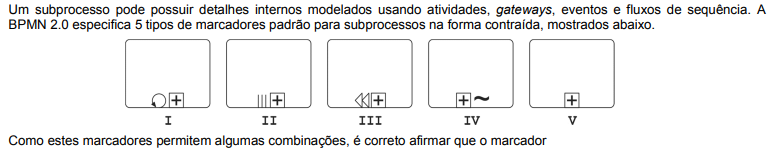
Ano: 2018
Banca:
FCC
Órgão:
Câmara Legislativa do Distrito Federal
Prova:
FCC - 2018 - Câmara Legislativa do Distrito Federal - Analista de Sistemas - Área 4 |
Q2028740
Governança de TI
Considere, por hipótese, que a equipe de Analistas de Sistemas da Câmara Legislativa do DF decidiu que certas frustrações de
curto prazo seriam aceitas para se obterem compensações de médio e longo prazos. Com base nesta filosofia foram
determinados, a partir dos objetivos estratégicos, indicadores, métricas e medidas de desempenho de processo, assim como o
gerenciamento de desempenho de processos interfuncionais. Considerando que a instituição segue as recomendações do
BPM CBoK versão 3, usando um modelo de maturidade com escala de 1 a 5 (sendo 1 o nível de maturidade mais baixo e 5 o
nível de mais alta maturidade), a Câmara Legislativa encontra-se no nível maturidade
Ano: 2018
Banca:
FCC
Órgão:
Câmara Legislativa do Distrito Federal
Prova:
FCC - 2018 - Câmara Legislativa do Distrito Federal - Analista de Sistemas - Área 4 |
Q2028741
Governança de TI
Considere, por hipótese, que na CLDF os gestores tradicionais estão se mostrando incapazes de adaptar sua forma de pensar
baseada em silo organizacional (cada área de trabalho preocupada somente com seus fluxos de trabalho) para uma forma de
gerenciamento de processos de negócio ponta a ponta, com medo de perderem influência. Como a instituição já amadureceu no
gerenciamento de processos de negócio, discutem-se maneiras de fazer com que vários processos operem juntos para
assegurar uma entrega efetiva de valor. Nesse contexto, uma solução proposta no BPM CBoK versão 3 para fornecer
direcionamento e esclarecer os limites de alçada de decisão para habilitar a transformação de processos interfuncionais e
intrafuncionais ou programas de gerenciamento bem-sucedidos é
Ano: 2018
Banca:
FCC
Órgão:
Câmara Legislativa do Distrito Federal
Prova:
FCC - 2018 - Câmara Legislativa do Distrito Federal - Analista de Sistemas - Área 4 |
Q2028742
Governança de TI
Para acelerar a criação de uma arquitetura de processos, a equipe de Analistas de Sistemas optou por adotar um modelo de
referência para a definição dos principais processos interfuncionais da organização. Este modelo, usado para dar apoio ao
gerenciamento corporativo de processos para diferentes tipos de organizações, proposto pela American Productivity & Quality
Center e indicado pelo BPM CBoK versão 3, representa uma série de processos inter-relacionados que são considerados de
missão crítica, podendo ser utilizado para permitir a compreensão do funcionamento interno da organização a partir de um ponto
de vista de processo horizontal, em vez de um ponto de vista funcional vertical. O modelo de referência adotado foi
Ano: 2018
Banca:
FCC
Órgão:
Câmara Legislativa do Distrito Federal
Prova:
FCC - 2018 - Câmara Legislativa do Distrito Federal - Analista de Sistemas - Área 4 |
Q2028743
Engenharia de Software
O Gerenciamento do escopo do projeto inclui o processo Coletar Requisitos, que faz parte do grupo de processos de planejamento. Um Analista de Sistemas, trabalhando neste processo, recebeu um conjunto de documentos que inclui os planos de
gerenciamento do projeto e das partes interessadas, o termo de abertura do projeto e o registro das partes interessadas. Em
seguida, utilizou algumas técnicas para coletar os requisitos, que incluem entrevistas, oficinas, grupos de discussão,
questionários, pesquisas, protótipos, benchmarking, diagramas de contexto, atividades em grupo e análise de documentos.
Seguindo as recomendações do Guia PMBoK 5ᵃ
edição, o Analista deverá gerar como saída
Ano: 2018
Banca:
FCC
Órgão:
Câmara Legislativa do Distrito Federal
Prova:
FCC - 2018 - Câmara Legislativa do Distrito Federal - Analista de Sistemas - Área 4 |
Q2028744
Engenharia de Software
Para que possa utilizar as ferramentas e técnicas necessárias para estimar os custos e determinar o orçamento de um projeto
utilizando o PMBoK 5ᵃ
edição, um Analista de Sistemas precisa definir as entradas dos processos “Estimar os custos” e
“Determinar o orçamento”, do grupo de processos de planejamento do projeto. Dentre as entradas comuns a estes processos
estão
Ano: 2018
Banca:
FCC
Órgão:
Câmara Legislativa do Distrito Federal
Prova:
FCC - 2018 - Câmara Legislativa do Distrito Federal - Analista de Sistemas - Área 4 |
Q2028745
Engenharia de Software
Uma Analista de Sistemas está trabalhando no processo de identificação das pessoas, grupos ou organizações que podem ter
impacto ou serem impactados por uma decisão, atividade ou resultado do projeto. Nesse processo de identificação das partes
interessadas, segundo o PMBoK 5ᵃ
edição,
Ano: 2018
Banca:
FCC
Órgão:
Câmara Legislativa do Distrito Federal
Prova:
FCC - 2018 - Câmara Legislativa do Distrito Federal - Analista de Sistemas - Área 4 |
Q2028746
Administração Pública
Para atender à dimensão Público Alvo do Modelo de Excelência em Gestão Pública, um Gestor Público deve adotar, dentre
outras, práticas direcionadas
Ano: 2018
Banca:
FCC
Órgão:
Câmara Legislativa do Distrito Federal
Prova:
FCC - 2018 - Câmara Legislativa do Distrito Federal - Analista de Sistemas - Área 4 |
Q2028747
Administração Pública
Na Avaliação Continuada da Gestão Pública, o Instrumento de Avaliação da Gestão Pública utiliza uma escala de pontuação de
0 a 1000 pontos. Para uma organização ser considerada “classe mundial”, ou seja, detentora de práticas empreendedoras caracterizadas pela inovação, criatividade, pelo alto grau de resolutividade em relação às necessidades e expectativas dos seus cidadãos e pela capacidade de otimizar a aplicação dos seus recursos, ela precisa obter resultados muito próximos ou superiores a

 Conheça nossos planos