Questões de Concurso Público SEDU-ES 2008 para Professor - Inglês
Foram encontradas 120 questões


translation of words in different languages is a difficult task.
even when it comes to material objects, the one-to-one relation of words in two languages may raise arguments.
"along with" (l.1) means together with.
"them all" (l.11) refers to "meaning of a word" (l.10-11).
"rarely" (l.14) is the same as seldom.
This text refers to items 106 through 111.
1 Some may wish to argue that the integration of the
four skills diminishes the importance of the rules of listening,
of speaking, of reading, and of writing that are unique to
4 each separate skill. Such an argument rarely holds up under
careful scrutiny of integrated-skill courses. If anything, the
added richness of the latter gives students greater motivation
7 that converts to better retention of principles of effective
speaking, listening, reading, and writing. Rather than being
forced to plod along* through a course that limits itself to
10 one mode of performance, they are given a chance to
diversify their efforts in more meaningful tasks. Such
integration can, of course, still utilize a strong, principled
13 approach to the separate, unique characteristics of each
separate skill.
* plod along – to work slowly and continuously, but without imagination,
enthusiasm or interest.
Teaching by Principles. H. Douglas Brown. Prentice Hall. 3rd edition, p. 218 (adapted).
According to the text, it can be inferred that
the four skills should be taught separately.
This text refers to items 106 through 111.
1 Some may wish to argue that the integration of the
four skills diminishes the importance of the rules of listening,
of speaking, of reading, and of writing that are unique to
4 each separate skill. Such an argument rarely holds up under
careful scrutiny of integrated-skill courses. If anything, the
added richness of the latter gives students greater motivation
7 that converts to better retention of principles of effective
speaking, listening, reading, and writing. Rather than being
forced to plod along* through a course that limits itself to
10 one mode of performance, they are given a chance to
diversify their efforts in more meaningful tasks. Such
integration can, of course, still utilize a strong, principled
13 approach to the separate, unique characteristics of each
separate skill.
* plod along – to work slowly and continuously, but without imagination,
enthusiasm or interest.
Teaching by Principles. H. Douglas Brown. Prentice Hall. 3rd edition, p. 218 (adapted).
According to the text, it can be inferred that
listening must be taught with speaking, whereas reading has to be taught together with writing.
This text refers to items 106 through 111.
1 Some may wish to argue that the integration of the
four skills diminishes the importance of the rules of listening,
of speaking, of reading, and of writing that are unique to
4 each separate skill. Such an argument rarely holds up under
careful scrutiny of integrated-skill courses. If anything, the
added richness of the latter gives students greater motivation
7 that converts to better retention of principles of effective
speaking, listening, reading, and writing. Rather than being
forced to plod along* through a course that limits itself to
10 one mode of performance, they are given a chance to
diversify their efforts in more meaningful tasks. Such
integration can, of course, still utilize a strong, principled
13 approach to the separate, unique characteristics of each
separate skill.
* plod along – to work slowly and continuously, but without imagination,
enthusiasm or interest.
Teaching by Principles. H. Douglas Brown. Prentice Hall. 3rd edition, p. 218 (adapted).
According to the text, it can be inferred that
the integrated teaching/learning of the four skills provides the students with more motivation.
This text refers to items 106 through 111.
1 Some may wish to argue that the integration of the
four skills diminishes the importance of the rules of listening,
of speaking, of reading, and of writing that are unique to
4 each separate skill. Such an argument rarely holds up under
careful scrutiny of integrated-skill courses. If anything, the
added richness of the latter gives students greater motivation
7 that converts to better retention of principles of effective
speaking, listening, reading, and writing. Rather than being
forced to plod along* through a course that limits itself to
10 one mode of performance, they are given a chance to
diversify their efforts in more meaningful tasks. Such
integration can, of course, still utilize a strong, principled
13 approach to the separate, unique characteristics of each
separate skill.
* plod along – to work slowly and continuously, but without imagination,
enthusiasm or interest.
Teaching by Principles. H. Douglas Brown. Prentice Hall. 3rd edition, p. 218 (adapted).
According to the text, it can be inferred that
teaching skills in isolation is not so rich as teaching them in an integrated way.
This text refers to items 106 through 111.
1 Some may wish to argue that the integration of the
four skills diminishes the importance of the rules of listening,
of speaking, of reading, and of writing that are unique to
4 each separate skill. Such an argument rarely holds up under
careful scrutiny of integrated-skill courses. If anything, the
added richness of the latter gives students greater motivation
7 that converts to better retention of principles of effective
speaking, listening, reading, and writing. Rather than being
forced to plod along* through a course that limits itself to
10 one mode of performance, they are given a chance to
diversify their efforts in more meaningful tasks. Such
integration can, of course, still utilize a strong, principled
13 approach to the separate, unique characteristics of each
separate skill.
* plod along – to work slowly and continuously, but without imagination,
enthusiasm or interest.
Teaching by Principles. H. Douglas Brown. Prentice Hall. 3rd edition, p. 218 (adapted).
In the text,
"latter" (l.6) is a comparative of superiority.
This text refers to items 106 through 111.
1 Some may wish to argue that the integration of the
four skills diminishes the importance of the rules of listening,
of speaking, of reading, and of writing that are unique to
4 each separate skill. Such an argument rarely holds up under
careful scrutiny of integrated-skill courses. If anything, the
added richness of the latter gives students greater motivation
7 that converts to better retention of principles of effective
speaking, listening, reading, and writing. Rather than being
forced to plod along* through a course that limits itself to
10 one mode of performance, they are given a chance to
diversify their efforts in more meaningful tasks. Such
integration can, of course, still utilize a strong, principled
13 approach to the separate, unique characteristics of each
separate skill.
* plod along – to work slowly and continuously, but without imagination,
enthusiasm or interest.
Teaching by Principles. H. Douglas Brown. Prentice Hall. 3rd edition, p. 218 (adapted).
In the text,
"better" (l.7) is the opposite of worse.
teachers usually make no difference between second and foreign language.
even when we are preparing our curriculum or a lesson, the difference between a second and a foreign language is not relevant.
a second language is that one you learn in a foreign country where this language is the native language.
if you are English and you are learning Portuguese in Brazil, Portuguese will be a second language for you.
English learned in Australia can be considered a foreign language.
a foreign language environment is that one found by a Brazilian learning English in the USA.
"much" (l.1) can be replaced by many.
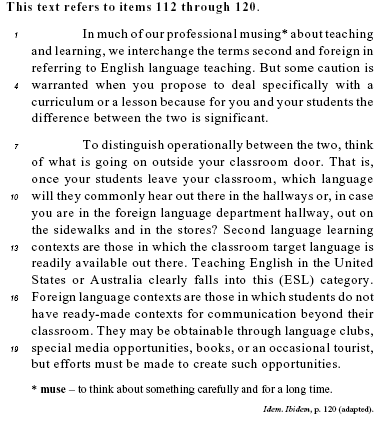
"readily" (l.14) is synonymous with promptly.
"those" (l.13) refers to "contexts" (l.13).

 Conheça nossos planos