Questões de Concurso Sobre não definido
Foram encontradas 25.117 questões


Ano: 2019
Banca:
OBJETIVA
Órgão:
Prefeitura de Carazinho - RS
Prova:
OBJETIVA - 2019 - Prefeitura de Carazinho - RS - Auxiliar de Topógrafo |
Q4429987
Não definido
Os levantamentos topográficos se desenvolvem
através de uma sucessão de etapas. Algumas podem ser
suprimidas conforme o tipo de levantamento. Em relação
a essas etapas, assinalar a alternativa CORRETA:
Ano: 2019
Banca:
FEPESE
Órgão:
Prefeitura de São José - SC
Prova:
FEPESE - 2019 - Prefeitura de São José - SC - Professor - Informática |
Q4426175
Não definido
Qual o acrônimo do nome do programa do Ministério da Educação que visa conectar todas as escolas públicas urbanas à internet?
Ano: 2019
Banca:
CETAP
Órgão:
Prefeitura de Tailândia - PA
Prova:
CETAP - 2019 - Prefeitura de Tailândia - PA - Professor de Matemática |
Q4426166
Não definido
Sabemos que um time de vôlei é formado por 6 jogadores. Para o campeonato estadual, o técnico selecionou 12 jogadores, mas já escalou 2 para o 1º jogo. De quantos modos o time pode ser formado para a 1ª partida?
Ano: 2019
Banca:
CETAP
Órgão:
Prefeitura de Tailândia - PA
Prova:
CETAP - 2019 - Prefeitura de Tailândia - PA - Professor de Matemática |
Q4426165
Não definido
A solução da equação (log8 x)2 - 4 log8 x + 4 = 0 é o valor da área de um quadrado em m2. Qual a medida do perímetro desse quadrado?
Ano: 2019
Banca:
CETAP
Órgão:
Prefeitura de Tailândia - PA
Prova:
CETAP - 2019 - Prefeitura de Tailândia - PA - Professor de Matemática |
Q4426164
Não definido
Texto associado

O tonel cilíndrico, representado a seguir, contém água em 50% de sua capacidade. Sabendo que o diâmetro da base do cilindro em metros é a solução da equação exponencial 2x+1 + 2x+2 + 2x+3 = 56 e que sua altura é de 500cm, responda a questão.
Qual a quantidade de água contida no tonel?
Ano: 2019
Banca:
CETAP
Órgão:
Prefeitura de Tailândia - PA
Prova:
CETAP - 2019 - Prefeitura de Tailândia - PA - Professor de Matemática |
Q4426163
Não definido
Texto associado
O tonel cilíndrico, representado a seguir, contém água em 50% de sua capacidade. Sabendo que o diâmetro da base do cilindro em metros é a solução da equação exponencial 2x+1 + 2x+2 + 2x+3 = 56 e que sua altura é de 500cm, responda a questão.
Qual o valor do raio da base do cilindro?
Ano: 2019
Banca:
CETAP
Órgão:
Prefeitura de Tailândia - PA
Prova:
CETAP - 2019 - Prefeitura de Tailândia - PA - Professor de Matemática |
Q4426162
Não definido
Uma pesquisa foi feita com seguinte pergunta: Que esporte você gosta de assistir?
As respostas obtidas foram registradas na tabela seguinte:
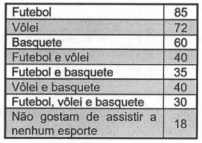
Quantas pessoas participaram dessa pesquisa?
As respostas obtidas foram registradas na tabela seguinte:
Quantas pessoas participaram dessa pesquisa?
Ano: 2019
Banca:
CETAP
Órgão:
Prefeitura de Tailândia - PA
Prova:
CETAP - 2019 - Prefeitura de Tailândia - PA - Professor de Matemática |
Q4426161
Não definido
Lançado do solo, um míssil descreveu um movimento parabólico regido pela função: h = -5t2 + 20t + 25
(DADOS: h = altura em metros e t = tempo em minutos)
Com os dados, assinale a alternativa que contém a altura máxima atingida pelo míssil e o tempo que o míssil atingiu a altura máxima:
(DADOS: h = altura em metros e t = tempo em minutos)
Com os dados, assinale a alternativa que contém a altura máxima atingida pelo míssil e o tempo que o míssil atingiu a altura máxima:
Ano: 2019
Banca:
CETAP
Órgão:
Prefeitura de Tailândia - PA
Prova:
CETAP - 2019 - Prefeitura de Tailândia - PA - Professor de Matemática |
Q4426160
Não definido
Texto associado
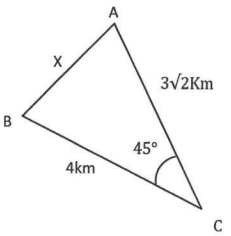
Leia as informações seguintes e responda a questão
Para o estudo de uma área agrícola, um topógrafo recebeu a seguinte informação: a área é triangular como a figura a seguir.
Qual o valor de "x" em Km?
Ano: 2019
Banca:
CETAP
Órgão:
Prefeitura de Tailândia - PA
Prova:
CETAP - 2019 - Prefeitura de Tailândia - PA - Professor de Matemática |
Q4426159
Não definido
Texto associado
Leia as informações seguintes e responda a questão
Para o estudo de uma área agrícola, um topógrafo recebeu a seguinte informação: a área é triangular como a figura a seguir.
Qual a área do terreno em Km2?
Ano: 2019
Banca:
CETAP
Órgão:
Prefeitura de Tailândia - PA
Prova:
CETAP - 2019 - Prefeitura de Tailândia - PA - Professor de Matemática |
Q4426158
Não definido
O gráfico seguinte representa um depósito. Ao resolver a equação matricial, encontra-se o valor x ∈ N
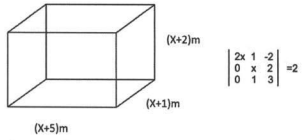
Qual a capacidade desse depósito?
Ano: 2019
Banca:
CETAP
Órgão:
Prefeitura de Tailândia - PA
Prova:
CETAP - 2019 - Prefeitura de Tailândia - PA - Professor de Matemática |
Q4426157
Não definido
Uma sequência com 10 termos forma uma Progressão Aritmética. O maior valor é 38 e o menor é 2. Qual a mediana dessa sequência?
Ano: 2019
Banca:
CETAP
Órgão:
Prefeitura de Tailândia - PA
Prova:
CETAP - 2019 - Prefeitura de Tailândia - PA - Professor de Matemática |
Q4426156
Não definido
A educação para a diversidade não é compatível com:
Ano: 2019
Banca:
CETAP
Órgão:
Prefeitura de Tailândia - PA
Prova:
CETAP - 2019 - Prefeitura de Tailândia - PA - Professor de Matemática |
Q4426155
Não definido
Na construção do projeto político-pedagógico, deve-se considerar que ele:
I- é um documento que deve ser produzido na escola;
II- envolve parte da comunidade escolar em sua elaboração;
III- estipula os objetivos da instituição e os meios para seu alcance;
IV- deve observar tanto a realidade da escola quanto da comunidade escolar.
Assinale a alternativa correta:
Ano: 2019
Banca:
CETAP
Órgão:
Prefeitura de Tailândia - PA
Prova:
CETAP - 2019 - Prefeitura de Tailândia - PA - Professor de Matemática |
Q4426154
Não definido
A interdisciplinaridade se refere a uma concepção de currículo baseada na:
Ano: 2019
Banca:
CETAP
Órgão:
Prefeitura de Tailândia - PA
Prova:
CETAP - 2019 - Prefeitura de Tailândia - PA - Professor de Matemática |
Q4426153
Não definido
De acordo com Luckesi (2011), o ato pedagógico inicia com o estabelecimento de metas no planejamento; sob sua guia, segue a execução a qual soma-se à avaliação, para que se produza o resultado esperado. Neste sentido, a avaliação que subsidia o sucesso na obtenção dos resultados de uma ação planejada se caracteriza como:
Ano: 2019
Banca:
CETAP
Órgão:
Prefeitura de Tailândia - PA
Prova:
CETAP - 2019 - Prefeitura de Tailândia - PA - Professor de Matemática |
Q4426152
Não definido
Do ponto de vista da gestão democrática, "o processo educativo é a passagem da desigualdade à igualdade" (SAVIANI, 1995, p.87). A concretização desse pressuposto no contexto escolar indica que:
Ano: 2019
Banca:
CETAP
Órgão:
Prefeitura de Tailândia - PA
Prova:
CETAP - 2019 - Prefeitura de Tailândia - PA - Professor de Inglês |
Q4425969
Não definido
Texto associado
A pergunta deve ser respondida baseada no texto "The cautionary political tale of Iceland's last McDonald's burger that simply won't rot, even after 10 years".
The cautionary political tale of Iceland's last McDonald's burger that simply won't rot, even after 10 years
(The Washington Post)
By Rick Noack
(2 de novembro de 2019 09:00:32 BRT)
One of Northern Europe's arguably most distinctive exports is "slow TV": real-time recordings of train journeys, ferry crossings or the migration of reindeer, which regularly draw record audiences.
Among perhaps the most successful — and least exciting — examples of that genre is the 'live stream of a McDonalds cheeseburger with fries . At its peak, it drew 2 million viewers a month. The only element on the screen that moves, however, is the time display.
The burger looks the same way, hour after hour.
As of this week, it has looked like that for 10 years.
Purchased hours before the corporation pulled out of the country in 2009, in the wake of Iceland's devastating financial crisis, the last surviving McDonald's burger has become much more than a burger. To some, it stands for the greed and excessive capitalism that "created an economic collapse that was so bad that even McDonald's had to close down," said Hjörtur Smárason, 43, who purchased the fateful burger in 2009. To others, the eerily fresh look of the 10-year-old meal has served as a warning against the excessive consumption of fast food.
McDonald's has attempted to debunk the myth that its burgers do not decompose, arguing there is a scientific explanation for Iceland's never-rotting burger.
"Without sufficient moisture — either in the food itself or the environment — bacteria and mold may not grow and therefore, decomposition is unlikely," a company statement read. (McDonald's did not respond to a request for comment.)
The company may have debunked the myths surrounding the burger's fresh look, but 10 years on, the political symbolism of the corporation's withdrawal from Iceland and the last remnant of its past there appear more relevant than ever.
Clouds over Iceland's economy
After a painful recovery, Iceland's economy once again was thrown into turmoil this year when the nation's budget WOW airline went bankrupt. Overnight, a crucial factor in Iceland's recovery — the tourism industry, which now accounts for about 10 percent of Iceland's gross domestic product — faced a sudden drop in visitors. About a third of them had traveled to Iceland with WOW Air. At the same time, the China-U.S. trade war began to weigh more heavily on the country.
Ten years after a devastating crisis, some Icelanders had deja vu, throwing them back to the days when the nation of around 300,000 witnessed all of its major private banks default.
But in the months since, Iceland's economy has surprisingly rebounded; tourism bookings have remained largely steady, as other airlines have filled WOW Air's gap.
"The economy is doing much better than expected," said Erna Björg Sverrisdóttir, chief economist of Iceland's Arion Bank, who credited larger central bank reserves and low debt, among other factors.
The long-sought arrival of a fast-food giant
Iceland was in a very different position in 1993, when McDonald's opened its first restaurant in the country. Rather than focusing on resilience and government intervention — as has been the case since 2008 — Iceland was then laying the groundwork for what would cause the system's collapse two decades on.
It embraced free market ideals like few other countries. The economy boomed.
As free market capitalism produced stunning growth around the world, the sight of world leaders opening McDonald's restaurants became somewhat of a symbol for the victory of capitalism over socialism, just years after the fall of the Berlin Wall.
In Britain, then-Prime Minister Margaret Thatcher became known as an outspoken fan of the corporation.
Meanwhile, in Iceland, images from that time show the country's prime minister, Davíð Oddsson, biting into a burger on the day the company celebrated its first Iceland opening.
"It was a very cheerful moment," said anthropologist Kristín Loftsdóttir, who has studied the history of the company in Iceland. The reasons for the country's enthusiasm were deeply rooted, she said.
"Iceland had for a long time been very anxious about its role within the community of nations," Loftsdóttir said. With a population the size of a small U.S. city, Iceland was afraid there wouldn't be a place for it on the table of mature nations in the post-Soviet world. The arrival of McDonald's, she said, appeared to indicate a new chapter: Iceland was modernizing and had become "part of a global community," Loftsdóttir said.
That success story started to unravel as the financial crisis began in 2007\. Within months, Iceland was on the brink of economic disaster. But it took two subsequent collapses — the breakdown of the country's banking system, and the pullout of McDonald's — for Icelanders to realize just how deep they had sunk into crisis.
Operating in Iceland had become too costly for McDonald's in the aftermath of the crisis: The currency collapsed, and inflation skyrocketed. McDonald's was far from the only company to abandon the embattled country, but to some, it felt like being thrown out of the international community they had worked so hard to be part of, Loftsdóttir said.
For her book "Crisis and Coloniality at Europe's Margins: Creating Exotic Iceland," Loftsdóttir interviewed a number of individuals who witnessed the 2008 crisis. To many of them, the closure of the restaurants was not so much a story about a company laying off its employees, but rather of the collective failure of a nation.
"We cannot even operate a McDonald's," Loftsdóttir recalled one exasperated source summarizing a widely shared sentiment at the time.
A burger forgotten on a garage shelf
On Oct. 31, 2009, marketing consultant Hjörtur Smárason was among the last customers at the McDonald's in Iceland's capital, Reykjavik. He waited in line in front of the restaurant with other Icelanders who wanted to purchase their last McDonald's meal.
But Smárason had not come to eat. He had read about online rumors of never-rotting McDonald's burgers and wanted to put the myth to the test. He bought a cheeseburger with fries, drove home and left the box on a shelf in his garage.
Three years went by, in which Smárason forgot about the souvenir of a bygone era. He had other problems to worry about.
The financial crisis had hit him hard. "I lost all my savings," he recalled. "My clients were going bankrupt. I was trying to hang on to my house."
Three years on, as he was preparing to move to Copenhagen, he came across the McDonald's meal in his garage.
"I was worried about what I would find," Smarason said.
When he opened the box, he was shocked — but not for the reason he expected. Contrary to the rotten remnants he was prepared for, he found what appeared to be a fully intact meal.
Smarason sensed he was holding a historical artifact. He reached out to Iceland's National Museum, where the meal was put on prominent display soon after.
Iceland's national broadcasting service picked up the story, which soon circulated around the world.
In the years since, some visitors appear to have mistaken it for a fresh meal. Some fries are missing.
The remnants are now on display in a small hotel in southern Iceland, where they continue to attract tourists, Smarason said.
He still visits the burger regularly. The last time he saw it, he said, it looked "as fresh as always."
Only the paper it is wrapped in has started to look a little yellow.
Na oração "It was a very cheerful moment", "cheerful" significa:
Ano: 2019
Banca:
CETAP
Órgão:
Prefeitura de Tailândia - PA
Prova:
CETAP - 2019 - Prefeitura de Tailândia - PA - Professor de Inglês |
Q4425968
Não definido
Texto associado
A pergunta deve ser respondida baseada no texto "The cautionary political tale of Iceland's last McDonald's burger that simply won't rot, even after 10 years".
The cautionary political tale of Iceland's last McDonald's burger that simply won't rot, even after 10 years
(The Washington Post)
By Rick Noack
(2 de novembro de 2019 09:00:32 BRT)
One of Northern Europe's arguably most distinctive exports is "slow TV": real-time recordings of train journeys, ferry crossings or the migration of reindeer, which regularly draw record audiences.
Among perhaps the most successful — and least exciting — examples of that genre is the 'live stream of a McDonalds cheeseburger with fries . At its peak, it drew 2 million viewers a month. The only element on the screen that moves, however, is the time display.
The burger looks the same way, hour after hour.
As of this week, it has looked like that for 10 years.
Purchased hours before the corporation pulled out of the country in 2009, in the wake of Iceland's devastating financial crisis, the last surviving McDonald's burger has become much more than a burger. To some, it stands for the greed and excessive capitalism that "created an economic collapse that was so bad that even McDonald's had to close down," said Hjörtur Smárason, 43, who purchased the fateful burger in 2009. To others, the eerily fresh look of the 10-year-old meal has served as a warning against the excessive consumption of fast food.
McDonald's has attempted to debunk the myth that its burgers do not decompose, arguing there is a scientific explanation for Iceland's never-rotting burger.
"Without sufficient moisture — either in the food itself or the environment — bacteria and mold may not grow and therefore, decomposition is unlikely," a company statement read. (McDonald's did not respond to a request for comment.)
The company may have debunked the myths surrounding the burger's fresh look, but 10 years on, the political symbolism of the corporation's withdrawal from Iceland and the last remnant of its past there appear more relevant than ever.
Clouds over Iceland's economy
After a painful recovery, Iceland's economy once again was thrown into turmoil this year when the nation's budget WOW airline went bankrupt. Overnight, a crucial factor in Iceland's recovery — the tourism industry, which now accounts for about 10 percent of Iceland's gross domestic product — faced a sudden drop in visitors. About a third of them had traveled to Iceland with WOW Air. At the same time, the China-U.S. trade war began to weigh more heavily on the country.
Ten years after a devastating crisis, some Icelanders had deja vu, throwing them back to the days when the nation of around 300,000 witnessed all of its major private banks default.
But in the months since, Iceland's economy has surprisingly rebounded; tourism bookings have remained largely steady, as other airlines have filled WOW Air's gap.
"The economy is doing much better than expected," said Erna Björg Sverrisdóttir, chief economist of Iceland's Arion Bank, who credited larger central bank reserves and low debt, among other factors.
The long-sought arrival of a fast-food giant
Iceland was in a very different position in 1993, when McDonald's opened its first restaurant in the country. Rather than focusing on resilience and government intervention — as has been the case since 2008 — Iceland was then laying the groundwork for what would cause the system's collapse two decades on.
It embraced free market ideals like few other countries. The economy boomed.
As free market capitalism produced stunning growth around the world, the sight of world leaders opening McDonald's restaurants became somewhat of a symbol for the victory of capitalism over socialism, just years after the fall of the Berlin Wall.
In Britain, then-Prime Minister Margaret Thatcher became known as an outspoken fan of the corporation.
Meanwhile, in Iceland, images from that time show the country's prime minister, Davíð Oddsson, biting into a burger on the day the company celebrated its first Iceland opening.
"It was a very cheerful moment," said anthropologist Kristín Loftsdóttir, who has studied the history of the company in Iceland. The reasons for the country's enthusiasm were deeply rooted, she said.
"Iceland had for a long time been very anxious about its role within the community of nations," Loftsdóttir said. With a population the size of a small U.S. city, Iceland was afraid there wouldn't be a place for it on the table of mature nations in the post-Soviet world. The arrival of McDonald's, she said, appeared to indicate a new chapter: Iceland was modernizing and had become "part of a global community," Loftsdóttir said.
That success story started to unravel as the financial crisis began in 2007\. Within months, Iceland was on the brink of economic disaster. But it took two subsequent collapses — the breakdown of the country's banking system, and the pullout of McDonald's — for Icelanders to realize just how deep they had sunk into crisis.
Operating in Iceland had become too costly for McDonald's in the aftermath of the crisis: The currency collapsed, and inflation skyrocketed. McDonald's was far from the only company to abandon the embattled country, but to some, it felt like being thrown out of the international community they had worked so hard to be part of, Loftsdóttir said.
For her book "Crisis and Coloniality at Europe's Margins: Creating Exotic Iceland," Loftsdóttir interviewed a number of individuals who witnessed the 2008 crisis. To many of them, the closure of the restaurants was not so much a story about a company laying off its employees, but rather of the collective failure of a nation.
"We cannot even operate a McDonald's," Loftsdóttir recalled one exasperated source summarizing a widely shared sentiment at the time.
A burger forgotten on a garage shelf
On Oct. 31, 2009, marketing consultant Hjörtur Smárason was among the last customers at the McDonald's in Iceland's capital, Reykjavik. He waited in line in front of the restaurant with other Icelanders who wanted to purchase their last McDonald's meal.
But Smárason had not come to eat. He had read about online rumors of never-rotting McDonald's burgers and wanted to put the myth to the test. He bought a cheeseburger with fries, drove home and left the box on a shelf in his garage.
Three years went by, in which Smárason forgot about the souvenir of a bygone era. He had other problems to worry about.
The financial crisis had hit him hard. "I lost all my savings," he recalled. "My clients were going bankrupt. I was trying to hang on to my house."
Three years on, as he was preparing to move to Copenhagen, he came across the McDonald's meal in his garage.
"I was worried about what I would find," Smarason said.
When he opened the box, he was shocked — but not for the reason he expected. Contrary to the rotten remnants he was prepared for, he found what appeared to be a fully intact meal.
Smarason sensed he was holding a historical artifact. He reached out to Iceland's National Museum, where the meal was put on prominent display soon after.
Iceland's national broadcasting service picked up the story, which soon circulated around the world.
In the years since, some visitors appear to have mistaken it for a fresh meal. Some fries are missing.
The remnants are now on display in a small hotel in southern Iceland, where they continue to attract tourists, Smarason said.
He still visits the burger regularly. The last time he saw it, he said, it looked "as fresh as always."
Only the paper it is wrapped in has started to look a little yellow.
Na oração "The only element on the screen that moves, however, is the time display.", a palavra "however" é:
Ano: 2019
Banca:
CETAP
Órgão:
Prefeitura de Tailândia - PA
Prova:
CETAP - 2019 - Prefeitura de Tailândia - PA - Professor de Inglês |
Q4425967
Não definido
Texto associado
A pergunta deve ser respondida baseada no texto "The cautionary political tale of Iceland's last McDonald's burger that simply won't rot, even after 10 years".
The cautionary political tale of Iceland's last McDonald's burger that simply won't rot, even after 10 years
(The Washington Post)
By Rick Noack
(2 de novembro de 2019 09:00:32 BRT)
One of Northern Europe's arguably most distinctive exports is "slow TV": real-time recordings of train journeys, ferry crossings or the migration of reindeer, which regularly draw record audiences.
Among perhaps the most successful — and least exciting — examples of that genre is the 'live stream of a McDonalds cheeseburger with fries . At its peak, it drew 2 million viewers a month. The only element on the screen that moves, however, is the time display.
The burger looks the same way, hour after hour.
As of this week, it has looked like that for 10 years.
Purchased hours before the corporation pulled out of the country in 2009, in the wake of Iceland's devastating financial crisis, the last surviving McDonald's burger has become much more than a burger. To some, it stands for the greed and excessive capitalism that "created an economic collapse that was so bad that even McDonald's had to close down," said Hjörtur Smárason, 43, who purchased the fateful burger in 2009. To others, the eerily fresh look of the 10-year-old meal has served as a warning against the excessive consumption of fast food.
McDonald's has attempted to debunk the myth that its burgers do not decompose, arguing there is a scientific explanation for Iceland's never-rotting burger.
"Without sufficient moisture — either in the food itself or the environment — bacteria and mold may not grow and therefore, decomposition is unlikely," a company statement read. (McDonald's did not respond to a request for comment.)
The company may have debunked the myths surrounding the burger's fresh look, but 10 years on, the political symbolism of the corporation's withdrawal from Iceland and the last remnant of its past there appear more relevant than ever.
Clouds over Iceland's economy
After a painful recovery, Iceland's economy once again was thrown into turmoil this year when the nation's budget WOW airline went bankrupt. Overnight, a crucial factor in Iceland's recovery — the tourism industry, which now accounts for about 10 percent of Iceland's gross domestic product — faced a sudden drop in visitors. About a third of them had traveled to Iceland with WOW Air. At the same time, the China-U.S. trade war began to weigh more heavily on the country.
Ten years after a devastating crisis, some Icelanders had deja vu, throwing them back to the days when the nation of around 300,000 witnessed all of its major private banks default.
But in the months since, Iceland's economy has surprisingly rebounded; tourism bookings have remained largely steady, as other airlines have filled WOW Air's gap.
"The economy is doing much better than expected," said Erna Björg Sverrisdóttir, chief economist of Iceland's Arion Bank, who credited larger central bank reserves and low debt, among other factors.
The long-sought arrival of a fast-food giant
Iceland was in a very different position in 1993, when McDonald's opened its first restaurant in the country. Rather than focusing on resilience and government intervention — as has been the case since 2008 — Iceland was then laying the groundwork for what would cause the system's collapse two decades on.
It embraced free market ideals like few other countries. The economy boomed.
As free market capitalism produced stunning growth around the world, the sight of world leaders opening McDonald's restaurants became somewhat of a symbol for the victory of capitalism over socialism, just years after the fall of the Berlin Wall.
In Britain, then-Prime Minister Margaret Thatcher became known as an outspoken fan of the corporation.
Meanwhile, in Iceland, images from that time show the country's prime minister, Davíð Oddsson, biting into a burger on the day the company celebrated its first Iceland opening.
"It was a very cheerful moment," said anthropologist Kristín Loftsdóttir, who has studied the history of the company in Iceland. The reasons for the country's enthusiasm were deeply rooted, she said.
"Iceland had for a long time been very anxious about its role within the community of nations," Loftsdóttir said. With a population the size of a small U.S. city, Iceland was afraid there wouldn't be a place for it on the table of mature nations in the post-Soviet world. The arrival of McDonald's, she said, appeared to indicate a new chapter: Iceland was modernizing and had become "part of a global community," Loftsdóttir said.
That success story started to unravel as the financial crisis began in 2007\. Within months, Iceland was on the brink of economic disaster. But it took two subsequent collapses — the breakdown of the country's banking system, and the pullout of McDonald's — for Icelanders to realize just how deep they had sunk into crisis.
Operating in Iceland had become too costly for McDonald's in the aftermath of the crisis: The currency collapsed, and inflation skyrocketed. McDonald's was far from the only company to abandon the embattled country, but to some, it felt like being thrown out of the international community they had worked so hard to be part of, Loftsdóttir said.
For her book "Crisis and Coloniality at Europe's Margins: Creating Exotic Iceland," Loftsdóttir interviewed a number of individuals who witnessed the 2008 crisis. To many of them, the closure of the restaurants was not so much a story about a company laying off its employees, but rather of the collective failure of a nation.
"We cannot even operate a McDonald's," Loftsdóttir recalled one exasperated source summarizing a widely shared sentiment at the time.
A burger forgotten on a garage shelf
On Oct. 31, 2009, marketing consultant Hjörtur Smárason was among the last customers at the McDonald's in Iceland's capital, Reykjavik. He waited in line in front of the restaurant with other Icelanders who wanted to purchase their last McDonald's meal.
But Smárason had not come to eat. He had read about online rumors of never-rotting McDonald's burgers and wanted to put the myth to the test. He bought a cheeseburger with fries, drove home and left the box on a shelf in his garage.
Three years went by, in which Smárason forgot about the souvenir of a bygone era. He had other problems to worry about.
The financial crisis had hit him hard. "I lost all my savings," he recalled. "My clients were going bankrupt. I was trying to hang on to my house."
Three years on, as he was preparing to move to Copenhagen, he came across the McDonald's meal in his garage.
"I was worried about what I would find," Smarason said.
When he opened the box, he was shocked — but not for the reason he expected. Contrary to the rotten remnants he was prepared for, he found what appeared to be a fully intact meal.
Smarason sensed he was holding a historical artifact. He reached out to Iceland's National Museum, where the meal was put on prominent display soon after.
Iceland's national broadcasting service picked up the story, which soon circulated around the world.
In the years since, some visitors appear to have mistaken it for a fresh meal. Some fries are missing.
The remnants are now on display in a small hotel in southern Iceland, where they continue to attract tourists, Smarason said.
He still visits the burger regularly. The last time he saw it, he said, it looked "as fresh as always."
Only the paper it is wrapped in has started to look a little yellow.
Na trecho "its past there appear more relevant than ever", observa-se:

 Conheça nossos planos