Questões de Concurso
Comentadas sobre vocabulário | vocabulary em inglês
Foram encontradas 2.365 questões


Text for the items from.
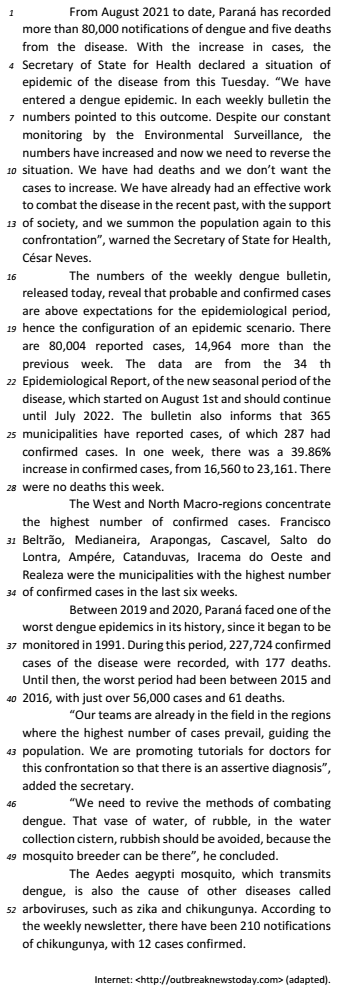
It would be grammatically correct and it would not change the meaning of the sentence if the preposition “above” was replaced by the preposition below in the sentence: The numbers of the weekly dengue bulletin, released today, reveal that probable and confirmed cases are below expectations for the epidemiological period.
The controversial future of nuclear power in the U.S.
Lois Parshley
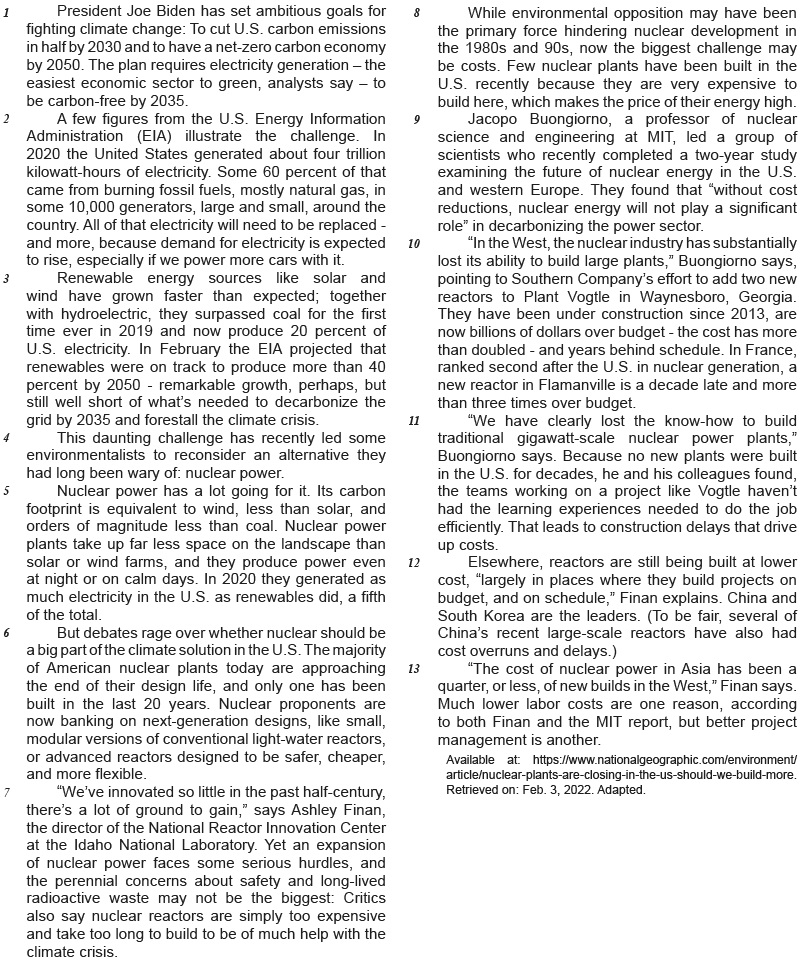
The controversial future of nuclear power in the U.S.
Lois Parshley
The controversial future of nuclear power in the U.S.
Lois Parshley
“Teaching of reading skills is an important aspect of language . The learning of this skill is especially essential for a second language. This is also so because most of the teachinglearning is in the written form, either in the form of books or computer based material. Reading and literacy are thus interdependent.”
Choose the alternative which contains the correct words to complete the sentence.

Judge the item from.
The tittle “Pet well soon” is a wordplay with the
expression Get well soon.
Judge the item from.
In the sentence “Mingming is less energetic than
usual” (lines 3 and 4), the opposite of “less energetic” is
more energetic.
Based on the text above and the vocabulary used in it, judge the following item.
In “State and local governments regularly disclose financial
information” the verb “disclose” is close in meaning to
make something known publicly.
Based on the text above and the vocabulary used in it, judge the following item.
The word “Despite” (in the third sentence) is synonymous
with In spite of.
Leaders at tech companies around the world could face up to two years in prison in the United Kingdom if they do not comply with new online safety laws.
Draft legislation aims to crack down on social media and other online entities to ensure safety and privacy for users, particularly children. The laws were drafted to prevent uploading and spreading of harmful content such as racism, bullying, fraud and sexual abuse.
While the legislation has been criticized by Parliament members in the past, the new draft has received bipartisan support.
The bill has to be voted on by British lawmakers.
The legislation has been updated several times since its inception. Among the changes are hefty fines or blockages if networks fail to remove harmful content after being notified of its existence, as well as the labeling of sending unsolicited nudes as a criminal offense.
The fines could be up to 10 percent of the affected company’s annual global income. The Office of Communications (Ofcom), the bill’s regulator, has been granted legal grounds to request information from companies they suspect of not following the bill’s rules.
If Ofcom is able to prove that the companies withheld information or have not responded properly to notifications of inappropriate or illegal content, the executives would be held criminally liable. This part of the law will be enforced two months after the law itself is enacted, meaning companies and websites will have time to crack down on their content before facing legal consequences.
Some U.K. residents have pushed back against the new version of the bill, including memes from the Open Rights Group. The organization claims that, despite good intentions, the regulations could result in a slippery slope that could end up violating free speech.
Internet:
Considering the text presented above and the vocabulary used in it, judge the following item.
The word “liable” (at the end of the first sentence of the
seventh paragraph) could be correctly replaced by liar
without changing the meaning of the text.
Leaders at tech companies around the world could face up to two years in prison in the United Kingdom if they do not comply with new online safety laws.
Draft legislation aims to crack down on social media and other online entities to ensure safety and privacy for users, particularly children. The laws were drafted to prevent uploading and spreading of harmful content such as racism, bullying, fraud and sexual abuse.
While the legislation has been criticized by Parliament members in the past, the new draft has received bipartisan support.
The bill has to be voted on by British lawmakers.
The legislation has been updated several times since its inception. Among the changes are hefty fines or blockages if networks fail to remove harmful content after being notified of its existence, as well as the labeling of sending unsolicited nudes as a criminal offense.
The fines could be up to 10 percent of the affected company’s annual global income. The Office of Communications (Ofcom), the bill’s regulator, has been granted legal grounds to request information from companies they suspect of not following the bill’s rules.
If Ofcom is able to prove that the companies withheld information or have not responded properly to notifications of inappropriate or illegal content, the executives would be held criminally liable. This part of the law will be enforced two months after the law itself is enacted, meaning companies and websites will have time to crack down on their content before facing legal consequences.
Some U.K. residents have pushed back against the new version of the bill, including memes from the Open Rights Group. The organization claims that, despite good intentions, the regulations could result in a slippery slope that could end up violating free speech.
Internet:
Considering the text presented above and the vocabulary used in it, judge the following item.
The expression “Draft legislation” (second paragraph) means
that the laws are not in their final form.
Judge the following item considering the text above and the vocabulary used in it.
The word “Therefore” (in the fourth sentence of the second
paragraph) could be correctly replaced by Henceforth
without any change in the meaning of the text.
Judge the following item considering the text above and the vocabulary used in it.
The word “reliant” (in the second sentence of the first
paragraph) could be correctly replaced by dependent
without any change in the meaning of the text.
During a ransomware hack, attackers infiltrate a target’s computer system and encrypt its data. They then demand a payment before they will release the decryption key to free the system. This type of extortion has existed for decades, but in the 2010s it exploded in popularity, with online gangs holding local governments, infrastructure and even hospitals hostage. Ransomware is a collective problem—and solving it will require collaborative action from companies, the government and international partners.
As long as victims keep paying, hackers will keep profiting from this type of attack. But cybersecurity experts are divided on whether the government should prohibit the paying of ransoms. Such a ban would disincentivize hackers, but it would also place some organizations in a moral quandary. For, say, a hospital, unlocking the computer systems as quickly as possible could be a matter of life or death for patients, and the fastest option may be to pay up.
Collective action can help. If all organizations that fall victim to ransomware report their attacks, they will contribute to a trove of valuable data, which can be used to strike back against attackers. For example, certain ransomware gangs may use the exact same type of encryption in all their attacks. “White hat” hackers can and do study these trends, which allows them to retrieve and publish the decryption keys for specific types of ransomware. Many companies, however, remain reluctant to admit they have experienced a breach, wishing to avoid potential bad press. Overcoming that reluctance may require legislation, such as a bill introduced in the Senate last year that would require companies to report having paid a ransom within 24 hours of the transaction.
Internet:<www.scientificamerican.com>
In the second paragraph of the text,
the word “disincentivize” could be correctly replaced by
deter without any change in the meaning of the sentence.
In the second sentence of the first paragraph, the word “Likely” means the same as Probably.

Consider on the text, judge the item.
The sentence “including the right to possess, sell, lease,
and enjoy the land” (lines 11 and 12) can be correctly
rewritten as including the right of possessing, selling,
leasing, and enjoying the land without changes in the
meaning.
Consider on the text, judge the item.
In terms of meaning, the sentence “Broadly
speaking” (line 8) can be correctly replaced by Generally
speaking.
Concerning the previous text and its linguistic aspects, judge the following item.
In the fifth paragraph, the word “stuntman” means a man
who performs a dangerous action which needs to be done by
someone skilled, especially instead of an actor in a film or
television programme.
Leia o texto para responder à questão.
When using technology to provide services, practitioner competence and the well-being of the client remain primary. Social workers who use technology to provide services should evaluate their ability to assess the relative benefits and risks of providing social work services using technology (for example, in-person services may be necessary when clients pose a significant risk of self-harm or injurious behavior, are cognitively impaired, require sustained support by a social worker with whom they have an ongoing professional relationship, or are in crisis).
These professionals should also ensure that electronic social work services can be kept confidential. For example, the information provided by the client should only be accessible by those who require access and that the host of the server used for electronic communication agrees to abide by the privacy policies of the social worker. It is important to respect clear professional boundaries – for example, social workers should be mindful of boundary confusion that may result if they disclose personal information about themselves or others in an online setting to which clients have access.
Besides, they should confirm the identity of the client to whom services are provided electronically at the beginning of each contact with the client (examples include confirming a client’s online consent with a telephone call; providing the client with a password, passcode, or image that is specifically for the client’s use when providing consent electronically).
(NASW, ASWB, CSWE, & CS WA Standards for Technology in Social Work
Parctice. www.socialworkers.org, 2017. Pp 11-12. Adaptado)
Considering the text above, judge the following item.
The verb “removed” (third sentence) can be adequately replaced with taken out.

 Conheça nossos planos