Questões de Concurso Comentadas sobre verbos | verbs em inglês

Foram encontradas 2.558 questões

Q2064501 Inglês

Leia o texto 1 para responder a questão que se segue.
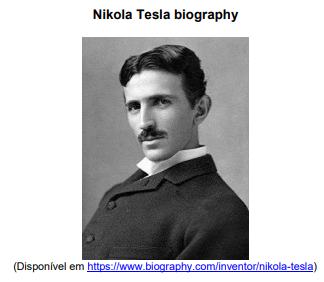


               Nikola Tesla was an engineer and scientist known for designing the alternating-current (AC) electric system, which is the predominant electrical system used across the world today. He also created the "Tesla coil," which is still used in radio technology.

              Born (01) ______ modern day Croatia, Tesla came to the United States in 1884 and briefly worked with Thomas Edison before the two parted ways. He sold several patent rights, including those to his AC machinery, to George Westinghouse.

                   Early Life
                   Tesla was born in Smiljan, Croatia, on July 10, 1856.

                  Tesla was one of five children, including (02) ______ Dane, Angelina, Milka and Marica. Tesla's interest in electrical invention was spurred by his mother, Djuka Mandic, who (03) ______ small household appliances in her spare time while her son was growing up.

Observe a sentença: “Tesla's interest in electrical invention was spurred by his mother”. Diante das assertivas, assinale a alternativa correta em referência ao apóstrofo ‘s:
I. É a contração do verbo to be na 3ª pessoa do singular (he is = he’s). II. Faz parte do caso genitivo ou caso possessivo, ele indica que algo pertence (está associado) a alguém ou a uma coisa. III. É a contração do verbo to have na 3ª pessoa do singular (he has = he’s). 
Alternativas
Q2064496 Inglês
A gramática da língua inglesa define o Simple Past Tense (Tempo Passado Simples) como um “tempo verbal que é usado para falar sobre coisas que aconteceram ou existiram antes do presente”. Assinale a alternativa em que o Simple Past Tense esteja correto.
Alternativas
Q2064495 Inglês
Analise a sentença: “It will be raining tomorrow morning”. Essa expressão marca o “tempo futuro”. É CORRETO afirmar que a estrutura usada expressa: 
Alternativas
Q2064494 Inglês
Leia a definição: “Este tempo verbal é usado para indicar a ação que foi completada antes de outra ação ocorrer”. Assinale a qual tempo verbal esta ação se refere.
Alternativas
Q2064493 Inglês
Um dos usos do tempo verbal presente contínuo/progressivo é o de indicador de ação temporária em progresso no momento presente. Assinale a alternativa que responda corretamente a questão “What is Mary doing?”
Alternativas
Q2064484 Inglês
Considere o diálogo a seguir e as regras do tempo verbal Presente Perfeito em inglês. Assinale a alternativa que preencha o diálogo correta e respectivamente.
A: ______ you ever ______ a famous person? B: Yes, I ______ I already ______ Marcos Mion. 
Alternativas
Q2064483 Inglês
Analise a sentença: “We will have finished our new book by the end of the year”. Ela expressa o “tempo futuro”. Assinale a alternativa correta em relação à estrutura.
Alternativas
Q2064481 Inglês

Text V


Language Assessment and the new Literacy Studies

Some Final Remarks


    Planning language assessment from a structuralist view of language has been a fairly easy task, since it aims at testing the correct use of grammar and lexical structures. This has been a very comfortable way to evaluate students’ performance in many regular schools or language institutes due to the stability of standardized answers. From the perspective of the new literacy studies, the comfort of teaching and assessing objective and homogeneous linguistic contents is replaced by a wider spectrum of language teaching and assessing possibilities, whose key elements turn to be difference and critique. Typical activities based on this new approach would enable students to make and negotiate meanings in a much more flexible way, corroborating the novel notion of unstable, dynamic, collaborative and distributed knowledge.

    The inclusion of contents of such nature in language assessments may be, at a first glance, a very laborious process due to the fact we are simply not accustomed to that. Actually, we sometimes find ourselves deprived from the teaching skills necessary to apply a more critical teaching approach, a fact that is much the results of our positivist educational background.

    Nonetheless, since the emergent digital epistemology will require subject more capable of designing and redesigning meaning critically towards a great deal of representational modes, we need to reconsider our teaching approaches, go further and seek theories that take such issues into account. By redefining the notions of language and knowledge, we, thus, assume that the new literacy studies from the last decades may offer very good insights to the field of foreign language teaching.

    The re-conceptualization of language assessment according to the new literacies project presented in this paper does not intend to suggest prompt fixed answers, but it takes the risk of outlining possible activities, signaling certain changes regarding its characteristics and contents, as previously shared.

    The increasing importance of the new literacy and multiliteracies studies and their fruitful theoretical insight for the rethinking of pedagogical issues invite us to review our foreign language teaching practices in a different perspective. By sharing some of our local findings, we attempt to corroborate the collaborative and distributed knowledge discussed by the literacies theory itself and hope to be contributing to the new educational demands of the emerging epistemological basis.


From: DUBOC, A.P.M. Language Assessment and the new Literacy Studies. Lenguaje 37 (1), 2009. pp. 159-178, p. 175-176.

The verb in “seek theories”(3rd paragraph) is the same as
Alternativas
Q2064456 Inglês

Text I

Nurturing Multimodalism


    […]

   New learning collaborations call on the teacher as learner, and the learner as teacher. The teacher is a lifelong learner; this is simply more apparent in the Information Age. In instances of best practice, collaborative learning partnerships are forged between and among teachers for strategic, bottom-up, in-house professional development. This allows teachers to share in reflective, on-going, contextualized learning, tailored to their collective knowledge. This sharing also includes the learner as teacher. ELT typically employs learner-centered activities: these can include learners sharing their knowledge of strategic digital literacies with others in the classrooms.

   The digital universe, so threatening to adult notions of socially sanctioned literacies, is intuitive to children, who have been socialized into it, and for whom digital literacies are exploratory play. Adults may find new ways of communicating digitally to be quite baffling and confronting of our communicative expertise; children do not. Instant messaging systems, such as MSN, AOL, ICQ, for example, provide as natural a medium for communicating to them as telephones did for the baby-boomer generation. It is not fair for the teacher to treat Information and Communication Technologies as auxiliary communication with learners for whom it is mainstream and primary.

    Learning spaces are important. Although teachers seldom have much individual say in the layout of teaching spaces, collaborative relationships may help to encourage integrated digitization, where computers are not segregated in laboratories but are interspersed throughout the school environment. In digitally infused curricula, postmodern literacies do not supplant but complement modern literacies, so that access to information is driven by purpose and content rather than by the media available.


Adapted from: LOTHERINGTON, H. From literacy to multiliteracies in ELT. In: CUMMINS, J.; DAVISON, C. (Eds.) International Handbook of English Language Teaching. New York: Springer, 2007, p. 820. Available at: https://www.researchgate.net/publication/226802846_From_Literacy_to_Multiliter acies_in_ELT 

In the phrase “collaborative learning partnerships” (1st paragraph), the word “learning” is a(n) 
Alternativas
Q2037154 Inglês

Text 4 (for questions 42, 43, 44, 45, and 46)


                                                                       Social networks


Going into the small room at the end of the corridor, Roberta sat down _______ 1 the computer. It was the computer she had bought when her old one’s hard disk had started to go wrong. Her new computer was a laptop with a lot of extra features and she needed it for her online work _______ 2 her students. Roberta had started to worry that her students would be bored unless she used modern technology in her teaching.

She turned_______ 3 the switch at the back of her computer. She looked at the email messages waiting for her answer, but she ignored them. Then she looked at the homework posted on a special site she created for the students, but she didn’t feel like correcting it. Instead she went to her favorite social network site and looked at the news about her friends. She sent messages to her favorite people and she had many online conversations _______ 4 teaching and other things. She posted some new messages on her own web page and then watched a film clip on a video site which her friend had told her about.

_______ 5 now, it was late and she realized that she had spent too much time talking to her friends online. She was very tired. She would have to do all her work in the morning.


(HARMER, J. Essential Teacher Knowledge: core concepts in English language teaching, p. 42. Harlow: Pearson Education Limited, 2012. Adaptado.)

Read the excerpt and choose the CORRECT alternative.

“Then she looked at the homework posted on a special site she created for the students, but she didn’t feel like correcting it.”

The phrasal verb underlined in the excerpt can be translated into Portuguese as 

Alternativas
Q2037145 Inglês
Read the text 1 to answer question.

Text 1

Worldwide changes in food and eating habits

American fast food has certainly affected Korea. You can find American fast food restaurants everywhere and many young people don’t appreciate traditional Korean food anymore. Koreans are now using western ingredients such as ketchup, mayonnaise and butter to cook regular meals. Salad dressing, something we never used before, is also popular now.

The problem is that American companies sell their food along with American culture. Manners in restaurants are not the same before. I can give you two examples of this. Traditionally Koreans don’t use individual plates for eating main dishes. We have always eaten from one bowl, but now some people think that this habit is unsanitary.

Tipping is also new for us. Before, we had never rewarded good service with money, but now we are supposed to give a tip to waiter in some restaurants. I fear our traditional way of doing things will soon be forgotten.

By Jeong Kim, from Korea.

(PLATERO, Luciana & DONNINI, Lívia. All Set, vol. 2, student book. Boston, USA: Thompson Heinle, 2008. Adaptado.)


Observe a análise linguística abaixo e responda ao que se pede.


I. Em “Salad dressing, something we never used before, is also popular now. ”, o termo dressing, na expressão sublinhada, é um substantivo e significa, em português, molho.


II. No trecho “I fear our traditional way of doing things will soon be forgotten.”, o termo sublinhado é uma expressão idiomática que corresponde a “Eu confio”.


III. No 1º parágrafo, as palavras affected, restaurants, traditional e ingredients são palavras cognatas, mas popular é falsa cognata.


IV. No trecho “Traditionally Koreans don’t use individual plates for eating main dishes.”, as palavras plates e dishes são substantivos e têm significados semelhantes.


V. Em “Before, we had never rewarded good service with money”, foi empregado o past perfect, e o verbo destacado significa recompensar.


Estão CORRETAS apenas

Alternativas
Q4406848 Inglês
Assinale a alternativa que completa CORRETAMENTE as lacunas no texto abaixo:

I __________ my favorite TV show when you __________ me last night. I ___________ yet, but I ___________do my research about it.
Alternativas
Q4406843 Inglês
A questão se refere ao texto a seguir:


Muscular in its action sequences, sweeping in scope; a big, flexing, show-off spectacle of a movie. The Woman King is the kind of historical epic that just doesn’t get made any more. And with a superb cast predominantly composed of Black women, it’s also a film that ______________________. Gina Prince-Bythewood may not exactly rewrite the cinematic language of the action movie – there’s plenty in her approach that will seem familiar – but she does reclaim and revitalise it.


Fonte: Adaptado de https://www.theguardian.com/film/2022/oct/01/the-woman-king-review-a-thunderously-cinematic-goodtime-viola-davis-gina-prince-bythewood-sheila-atim 
Após a leitura da avaliação do filme The Woman King, assinale a alternativa que completa CORRETAMENTE a lacuna presente no texto:
Alternativas
Q4367324 Inglês
Roman mosaic and villa complex found in Rutland farmer's field


(1º§) The mosaic, found in Rutland, has been described as the first example of its kind in the UK. It was discovered by the landowner's son and investigated by archaeologists from the University of Leicester. Historic England described the mosaic as "one of the most remarkable and significant... ever found in Britain".

(2º§) The mosaic and surrounding villa complex have now been protected as a Scheduled Monument by the Department for Digital, Culture, Media and Sport (DCMS) on the advice of Historic England. The complex is thought to have been occupied by a wealthy individual from the late Roman period.

(3º§) Jim Irvine, son of landowner Brian Naylor, made the initial discovery after spotting "unusual pottery" on a walk during the 2020 lockdown, and contacted the archaeological team at Leicestershire County Council. He said: "My family have been farming this land for 50 or 60 years. "During lockdown last year, I noticed some pottery on the ground which didn't look like any pottery I'd seen before. "We came down here with a spade and I dug a shallow trench and I was in exactly the right place. "To see something that has been undisturbed for 1700 years or so has been amazing. "The thing that has been keeping me interested is what's the state of the next thing to come out of the site because it's all been amazing so far." Historic England funded urgent excavation work at the site by the University of Leicester.

(4º§) The mosaic, which forms the floor of what was thought to be a dining or entertaining area of the villa, measures 11m x 7m (36ft x 23ft). Mosaics were regularly used in private and public buildings across the Roman Empire, and often featured famous figures from mythology. However, the Rutland mosaic is thought to be unique in the UK as it features Achilles and his battle with Hector at the conclusion of the Trojan War.

Analysis - By Phil Mackie, BBC Midlands correspondent at the scene

(5º§) I know where the villa was found but I'm not allowed to give away too many details. It's because they don't want anyone coming along and trying to carry out their own investigations and disturbing the site.

(6º§) For now, the mosaic has been covered back up. It's been well protected for more than a millennium and a half beneath a 2ft (0.6m) layer of soil, and it won't come to any further harm now it's back underground. Jim Irvine really hopes that people will be able to come to visit in situ one day but decisions about its long-term future haven't been made yet. The site is so big that only a tiny part of the complex has been excavated. There are likely to be more discoveries in the digging seasons to come.

(7º§) Investigations have revealed the large villa is surrounded by barns, circular structures and possibly a bath house. The complex is likely to have been occupied by someone with a knowledge of classical literature, between the 3rd and 4th Century AD. John Thomas, deputy director of the University of Leicester Archaeological Services and project manager on the excavations, said: "This is certainly the most exciting Roman mosaic discovery in the UK in the last century. "It gives us fresh perspectives on the attitudes of people at the time, their links to classical literature, and it also tells us an enormous amount about the individual who commissioned this piece. "This is someone with a knowledge of the classics, who had the money to commission a piece of such detail, and it's the very first depiction of these stories that we've ever found in Britain."

(8º§) Duncan Wilson, chief executive of Historic England, added: "To have uncovered such a rare mosaic of this size, as well as a surrounding villa, is remarkable. "Discoveries like this are so important in helping us piece together our shared history. By protecting this site we are able to continue learning from it, and look forward to what future excavations may teach us about the people who lived there over 1,500 years ago." The site is on private land and not accessible to the public but discussions are ongoing with Rutland County Council to set up an off-site display of the villa complex and its finds, Historic England said. Further excavations are planned on the site in 2022. Mr Irvine said the field will no longer be used for farming so the area can be protected.


(adapted) https://www.bbc.com/news/uk-england-leicestershire-59391650

"It gives us fresh perspectives on the attitudes of people at the time." (7º§)

In which verbal tense the excerpt above be categorized?

Alternativas
Q4303216 Inglês
Read the sentences and choose the option that is NOT grammatically correct:
Alternativas
Q4303215 Inglês
Read the sentences and choose the option that is NOT grammatically correct: 
Alternativas
Q4303214 Inglês
Read the following sentences and match each one to the correct option:
I. Arthur has asked me to help him at the store. II. I was planning to get married in the autumn. III. On May 4th I arrived at a little town called Bistritz. IV. She had just left the room when the police arrived..
( ) Past Simple ( ) Past Continuous ( ) Past Perfect ( ) Present Perfect
Alternativas
Q4303212 Inglês
Read the following sentences and match each one to the correct option:
I. I had read at least 50 books by the end of the semester. II. Jhon was looking for his wallet everywhere this morning. III. I have worked in this area for about 7 years now. IV. Last night she called me like a thousand times, that’s crazy.
( ) Past Simple ( ) Past Continuous ( ) Past Perfect ( ) Present Perfect
Alternativas
Q4301868 Inglês

Complete the sentence below with the correct verbs. Choose the CORRECT answer.


“I _________ when the power _________ o

Alternativas
Q4301867 Inglês

Complete the sentence below with the correct verbs. Choose the CORRECT answer.


“The tournament _________ when we _________ at the venue.”

Alternativas
Respostas
1441: B
1442: C
1443: E
1444: A
1445: D
1446: B
1447: E
1448: C
1449: E
1450: E
1451: B
1452: A
1453: C
1454: E
1455: E
1456: A
1457: E
1458: C
1459: C
1460: D