Questões de Concurso
Sobre sinônimos | synonyms em inglês
Foram encontradas 1.586 questões


During a ransomware hack, attackers infiltrate a target’s computer system and encrypt its data. They then demand a payment before they will release the decryption key to free the system. This type of extortion has existed for decades, but in the 2010s it exploded in popularity, with online gangs holding local governments, infrastructure and even hospitals hostage. Ransomware is a collective problem—and solving it will require collaborative action from companies, the government and international partners.
As long as victims keep paying, hackers will keep profiting from this type of attack. But cybersecurity experts are divided on whether the government should prohibit the paying of ransoms. Such a ban would disincentivize hackers, but it would also place some organizations in a moral quandary. For, say, a hospital, unlocking the computer systems as quickly as possible could be a matter of life or death for patients, and the fastest option may be to pay up.
Collective action can help. If all organizations that fall victim to ransomware report their attacks, they will contribute to a trove of valuable data, which can be used to strike back against attackers. For example, certain ransomware gangs may use the exact same type of encryption in all their attacks. “White hat” hackers can and do study these trends, which allows them to retrieve and publish the decryption keys for specific types of ransomware. Many companies, however, remain reluctant to admit they have experienced a breach, wishing to avoid potential bad press. Overcoming that reluctance may require legislation, such as a bill introduced in the Senate last year that would require companies to report having paid a ransom within 24 hours of the transaction.
Internet:<www.scientificamerican.com>
In the second paragraph of the text,
the word “disincentivize” could be correctly replaced by
deter without any change in the meaning of the sentence.
In the second sentence of the first paragraph, the word “Likely” means the same as Probably.
Judge the following item, based on the previous text.
In the last sentence of the last paragraph, the word “prickly”
means peaceful.
Concerning the previous text and its linguistic aspects, judge the following item.
In the fragment ‘The good guy only has to keep things in
order’, the word ‘has’ could be correctly replaced with must,
without changing the meaning of the text.
Considering the text above, judge the following item.
The verb “removed” (third sentence) can be adequately replaced with taken out.
Read text 3 and answer the question.
Text 3
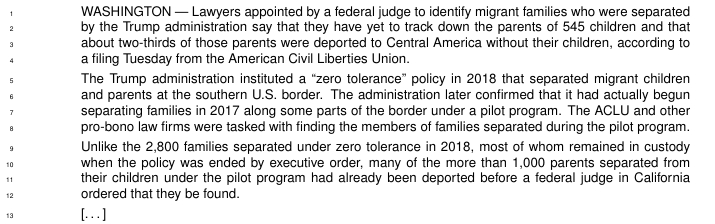
Lawyers say they can’t find the parents of 545 migrant children separated by Trump administration By Julia Ainsley and Jacob Soboroff
(Retrived from: <https://www.nbcnews.com/politics/immigration/lawyers-say-they-can-t-find-parents-545-migrant-children-n1244066>
Read text 2 and answer the question.
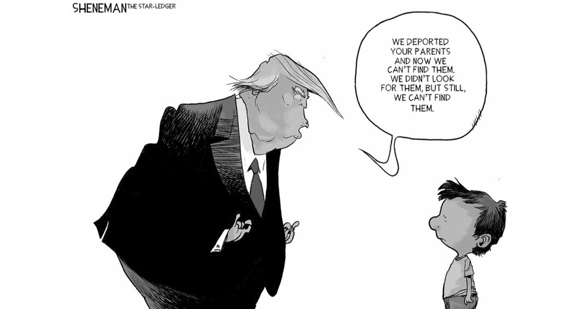
Text 2
(Retrived from: <https://www.usnews.com/cartoons/immigration-cartoons>
Read text 1 and answer the question.
Text 1
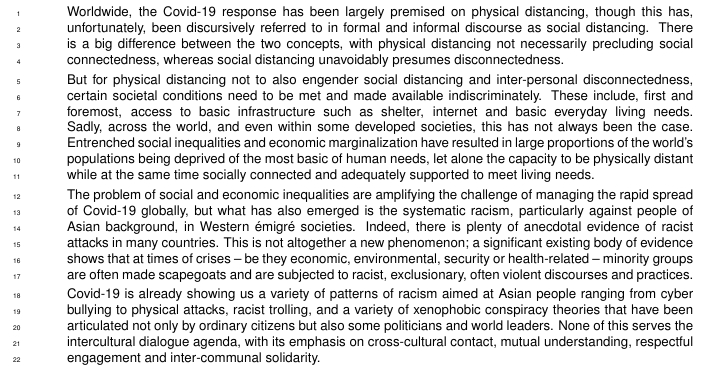
The socio-cultural implications of Covid-19
By Professor Fethi Mansouri
(Retrived from:<https://en.unesco.org/news/socio-cultural-implications-covid-19>)
The word can in “I can write this letter if you need” expresses:
British troops move black rhinos to Malawi
British troops have helped to move a group of critically endangered black rhinos from South Africa to Malawi to protect them against poaching. Soldiers from the 2nd Battalion Royal Gurkha Rifles moved 17 of the animals, which are hunted for their horns, in the hope they can be better protected. They were transported by air and road from KwaZulu-Natal in South Africa to Liwonde National Park in Malawi.
The troops then spent three months training rangers to keep them safe. Major Jez England, the officer commanding the British Army counter-poaching team in Liwonde, said the operation had been “hugely successful”. “Not only do we share skills with the rangers, improving their efficiency and ability to patrol larger areas, but it also provides a unique opportunity for our soldiers to train in a challenging environment”, he said.
The UK government says it has committed more than £36m to tackle the illegal wildlife trade between 2014 and 2021. Part of this is to help support trans-boundary work to allow animals to move more safely between areas and across national borders.
(Site: BBC - adaptado.)
The synonym of “work” is NOT:
U.S. Thaws Relations With “Europe’s Last Dictatorship”
As ties between the West and Russia wallow at the worst point since the end of the Cold War, the Trump administration has been forging closer ties with one of the last countries fully in Moscow’s orbit. President Donald Trump’s then-national security advisor, John Bolton, visited Belarus earlier this year, and U.S. officials say Secretary of State Mike Pompeo is expected to follow suit and travel to Minsk in January. Belarus, which has been referred to as “Europe’s last dictatorship,” expelled the U.S. ambassador in 2008 after Washington slapped sanctions on it over human rights abuses. But now, the United States is expected to revive diplomatic ties with Belarus—sending an ambassador to Minsk for the first time in over a decade—even as Russian President Vladimir Putin tries to subdue it.
https://foreignpolicy.com/2019/12/25/10-important... - adaptado
A synonym for “ties” in the context of the text is:
Read the text below and answer questions 35 to 40
- A new study from archaeologists at University of Sydney and Simon
- Fraser University in Vancouver, has provided important new evidence
- to answer the question "Who exactly were the Anglo‐Saxons?" New
- findings based on studying skeletal remains clearly indicate the Anglo‐
- Saxons were a melting pot of people from both migrant and local
- cultural groups and not one homogenous group from Western Europe.
- Professor Keith Dobney said the team’s results indicate that "the
- Anglo‐Saxon kingdoms of early Medieval Britain were strikingly similar
- to contemporary Britain ‐‐ full of people of different ancestries sharing
- a common language and culture." The collaborative study looked at the
- three‐dimensional shape of the base of the skull. "Baased on this, we
- collected 3D data from suitably dated skeletal collections from Britain
- and Denmark, and then analysed the data to estimate the ancestry of
- the Anglo‐Saxon individuals in the sample."
- The researchers found that between two‐thirds and three‐quarters of
- early Anglo‐Saxon individuals were of continental European ancestry,
- while between a quarter and one‐third were of local ancestry. When
- they looked at skeletons dated to the Middle Anglo‐Saxon period
- (several hundred years after the original migrants arrived), they found
- that 50 to 70 percent of the individuals were of local ancestry, while
- 30 to 50 percent were of continental European ancestry, which
- probably indicates a change in the rate of migration and/or local
- adoption of culture over time. "These findings tell us that being Anglo‐
- Saxon was more likely a matter of language and culture, not genetics."
- Although Anglo‐Saxon origins can clearly be traced to a migration of
- Germanic‐speaking people from mainland Europe between the 5th
- and 7th centuries AD, the number of individuals who settled in Britain
- is still contested, as is the nature of their relationship with the pre-
- existing inhabitants of the British Isles, who were Romano‐Celts.
- The ongoing and unresolved argument is whether hordes of European
- invaders largely replaced the existing Romano‐British inhabitants, or
- did smaller numbers of migrants settle and interact with the locals,
- who then rapidly adopted the new language and culture of the Anglo‐
- Saxons? "The reason for the ongoing confusion is the apparent
- contradiction between early historical texts (written sometime after
- the events that imply that the newcomers were both numerous and
- replaced the Romano‐British population) and some recent
- biomolecular markers directly recovered from Anglo‐Saxon skeletons
- that appears to suggest numbers of immigrants were few," said
- Professor Dobney. "Our new data sits at the interface of this debate
- and implies that early Anglo‐Saxon society was a mix of both
- newcomers and immigrants and, instead of wholesale population
- replacement, a process of acculturation resulted in Anglo‐Saxon
- language and culture being adopted wholesale by the local
- population." "It could be this new cultural package was attractive,
- filling a vacuum left at the end of the Roman occupation of Britain.
- Whatever the reason, it lit the fuse for the English nation we have today
- ‐‐ still comprised of people of different origins who share the same
- language," Professor Dobney said.
Adapted from article available at:
https://www.sciencedaily.com/releases/2021/06/210623144901.htm
Accessed on: July 13, 2021.
The words “Although” (l. 25) and “whether” (l. 30) could be replaced, with little or no change of meaning or structure, by the words:
Giving Blood = Giving Life
Giving blood is an amazing thing a person can do. Why? Because people who have anaemia, cancer, blood disorders, sickle cell, and other illnesses need blood transfusion. Some people even need regular blood transfusion to live.
Think about it: giving blood as part ............ everyone’s life; something they done .............. a regular basis, like eating ........... a favourite restaurant. What kind of difference does that make? Well, a donation might make the difference between life and death for nearly five million people who receive blood transfusions every year.
Giving blood is simple and convenient. It only takes about an hour and you can make the donation at a donor center. Afterwards, you will feel good about yourself.
Most people don’t think they’ll never need a blood transfusion, but many do. Blood is something money can’t buy. One may give a newborn, a child, a mother or a father, a brother, or a sister another chance at life. In fact, this simple action may help to save lives.
The blood donation process is much quicker and easier than you think. Giving blood will not decrease your strength and it’s certainly the right thing to do.
The word decrease (last paragraph), has its synonym in which alternative?
Mark the alternative that does have a synonym for the word "stuck".
TEXTO 01
O texto seguinte servirá de base para responder às questões de 01 a 08.
HEALTH CHECK
TAKE THIS CANCER QUIZ TO DETERMINE YOUR RISK OF DEVELOPING DISEASE - AS 1 IN 2 FACE DIAGNOSIS
(1º§) Around one in three cases of the most common cancers could be prevented by eating a healthy diet, keeping to a healthy weight and being more active, according to Macmillan Cancer Support.
(2º§) The following factors are asked about in the quiz.
Smoking
(3º§) At the top of the risk factor list, the WCRF says "not smoking is the best way to protect yourself from cancer".
Weight
(4º§) "Being a healthy weight is one of the most important ways ____ protect yourself against 12 types of cancer," the WCRF says. This includes bowel, kidney, womb and oesophagus cancer.
Exercise
(5º§) There is a reason exercise is encouraged - and not to just look fit.
(6º§) The WCRF says: "Being moderately active for at least 150 minutes or vigorously active for at least 75 minutes a week helps protect against three types of cancer. "Doing 45-60 minutes of moderate activity a day increases the benefit even more."
Fruit and veg
(7º§) You should aim to eat five portions of fruit and five of veg every day. "Fruit and vegetables can protect against cancers of the mouth and throat and digestive tract," WCRF says.
Wholegrains
(8º§) Wholegrain versions of carbohydrates not only help you keep a healthy weight, but have also been shown to reduce the risk of bowel cancer, the WCRF says. Generally it's important to eat a balanced diet as a way to prevent cancer.
Sugary drinks
(9º§) How many sugary drinks do you drink a week? This includes fizzy drinks, sugar-sweetened tea and coffee and squash. "Limiting sugar-sweetened drinks helps to prevent weight gain, which reduces your cancer risk," the WCRF says.
High fat and sugar foods
(10º§) Similarly to sugary drinks, consuming too much junk food will lead to weight gain - and weight gain is an independent cancer risk factor.
(11º§) It doesn't mean you can never have your favourite chocolate bar, cake or crisps. But it's about simple daily swaps. The WCRF suggests swapping a whole chocolate bar for a small piece of chocolate and a piece of fruit, for example.
Red and processed meats
(12º§) A diet abundant in red meat, like beef, lamb and pork, should be avoided. Similarly processed meats, such as bacon, sausages and ham, shouldn't be consumed ____ much. Both are linked to bowel cancer risk.
(13º§) "Limiting your intake [of red meat] to no more than three portions a week (350-500g cooked weight) can protect against bowel cancer," the WCRF says.
Alcohol
(14º§) The best way to avoid this risk would be to stop drinking at all.
(15º§) But if you do like a tipple, stick to the guidelines of no more than 14 units a week - equivalent to around four to five pints of beer or large glasses of wine.
Sun exposure
(16º§) Do you go the extra measure to protect yourself ____ the sun?
(17º§) We're talking suncream used regularly, avoiding the sun between 11am and 3pm, wearing a hat and sunglasses and avoiding sunbeds. "By not using sun beds and protecting yourself from sun exposure, you'll reduce your risk of skin cancers," the WCRF says.
https://www.thesun.co.uk/health/15912985/cancer-quiz-determine-risk/
Mark the alternative that does NOT have a synonym to the word "swapping" (11º§).

 Conheça nossos planos