Questões de Concurso Sobre inglês
Foram encontradas 26.019 questões


Ano: 2023
Banca:
AMEOSC
Órgão:
Prefeitura de São João do Oeste - SC
Prova:
AMEOSC - 2023 - Prefeitura de São João do Oeste - SC - Professor de Inglês |
Q2189335
Inglês
Texto associado
La Mer lip balm is touted __ many celebs as a bit of a handbag necessity. But according to Mia, nothing beats a pot of good-old Vaseline. And while La Mer balm can set you back £58 ($75), Vaseline can be as cheap as a couple of pounds.
HOLY GRAIL I'm a dermatologist - here's how you get
can get rid of forehead wrinkles without Botox and
for under £10
(1º§)EACH passing day brings many moments that
cause you to furrow your brow. And the more face
scrunching you do, the more dreaded lines are likely to
emerge __ your forehead. But before you devote time
(and a decent amount of money) to fading those pesky
wrinkles, it's good idea to try and figure out what's really
causing your lines. If you're under 30, chances are your
forehead 'wrinkles' are in fact just dehydrated skin,
according to one medic.
(2º§)Dr Ivy Lee, a board-certified dermatologist practicing
in southern California, US, said dehydration lines can be
easily improved without splashing the cash on Botox.
She told Insider that unlike wrinkles caused by repetitive
muscle movement dehydration lines are finer and have a
"crepe paper-like texture when the affected skin is not
well hydrated." And while we may associate dehydration
with drinking water, the expert said drinking more water
does not have any added skin benefits. Instead, she
urges young people to use topical skin treatments.
What product should I use?
(3º§)Dr Ivy said you should look for moisturisers that
contain the following three ingredients:
Humectants, which attract water into the skin (eg:
hyaluronic acid)
Emollients, which repair the skin barrier and soften the
skin (ex: squalene and plant-derived oils).
Occlusives, which "trap moisture into the skin by creating
a seal," the expert said (ex: hydrated petroleum or
mineral oil).
(4º§) She recommended using CeraVe Moisturising
Cream - a 177ml tube from Boots costs will set up back
just £10.
Other cheap skincare products under £10
(5º§) There's no denying that luxury products contain
some premium ingredients and look pretty aesthetic, but
given the cost __ living crisis, affordable skincare is just
as important, especially when the products work just as
well. Some dermatologists have shared their favourite
skincare swaps for luxury products that they say work as
effectively as expensive versions.
(6º§)Vaseline vs La Mer lip balm
La Mer lip balm is touted __ many celebs as a bit of a handbag necessity. But according to Mia, nothing beats a pot of good-old Vaseline. And while La Mer balm can set you back £58 ($75), Vaseline can be as cheap as a couple of pounds.
(7º§)The INKEY List Vitamin C serum vs SkinCeuticals
Vitamin C creams and serums can brighten your skin
and, according to some studies, can reduce the signs of
ageing. But these products can be expensive, because
they can be tricky to make, Rebecca explained.
SkinCeuticals' C E ferulic vitamin C antioxidant serum is
an excellent product, she said - but it will set you back a
whopping £165 ($182). Instead, why not give the INKEY
List's own vitamin C a whirl, Mia suggested, which only
costs £9.99 ($15.99).
xwwwinkkesforehead/
co.uk/health/22190687/dermatologist-skincare-botox-wrinkles-forehead/
The sentence "Instead, she urges young people to use
topical skin treatments" (2º§) can be correctly translated
by:
Ano: 2023
Banca:
AMEOSC
Órgão:
Prefeitura de São João do Oeste - SC
Prova:
AMEOSC - 2023 - Prefeitura de São João do Oeste - SC - Professor de Inglês |
Q2189334
Inglês
Texto associado
La Mer lip balm is touted __ many celebs as a bit of a handbag necessity. But according to Mia, nothing beats a pot of good-old Vaseline. And while La Mer balm can set you back £58 ($75), Vaseline can be as cheap as a couple of pounds.
HOLY GRAIL I'm a dermatologist - here's how you get
can get rid of forehead wrinkles without Botox and
for under £10
(1º§)EACH passing day brings many moments that
cause you to furrow your brow. And the more face
scrunching you do, the more dreaded lines are likely to
emerge __ your forehead. But before you devote time
(and a decent amount of money) to fading those pesky
wrinkles, it's good idea to try and figure out what's really
causing your lines. If you're under 30, chances are your
forehead 'wrinkles' are in fact just dehydrated skin,
according to one medic.
(2º§)Dr Ivy Lee, a board-certified dermatologist practicing
in southern California, US, said dehydration lines can be
easily improved without splashing the cash on Botox.
She told Insider that unlike wrinkles caused by repetitive
muscle movement dehydration lines are finer and have a
"crepe paper-like texture when the affected skin is not
well hydrated." And while we may associate dehydration
with drinking water, the expert said drinking more water
does not have any added skin benefits. Instead, she
urges young people to use topical skin treatments.
What product should I use?
(3º§)Dr Ivy said you should look for moisturisers that
contain the following three ingredients:
Humectants, which attract water into the skin (eg:
hyaluronic acid)
Emollients, which repair the skin barrier and soften the
skin (ex: squalene and plant-derived oils).
Occlusives, which "trap moisture into the skin by creating
a seal," the expert said (ex: hydrated petroleum or
mineral oil).
(4º§) She recommended using CeraVe Moisturising
Cream - a 177ml tube from Boots costs will set up back
just £10.
Other cheap skincare products under £10
(5º§) There's no denying that luxury products contain
some premium ingredients and look pretty aesthetic, but
given the cost __ living crisis, affordable skincare is just
as important, especially when the products work just as
well. Some dermatologists have shared their favourite
skincare swaps for luxury products that they say work as
effectively as expensive versions.
(6º§)Vaseline vs La Mer lip balm
La Mer lip balm is touted __ many celebs as a bit of a handbag necessity. But according to Mia, nothing beats a pot of good-old Vaseline. And while La Mer balm can set you back £58 ($75), Vaseline can be as cheap as a couple of pounds.
(7º§)The INKEY List Vitamin C serum vs SkinCeuticals
Vitamin C creams and serums can brighten your skin
and, according to some studies, can reduce the signs of
ageing. But these products can be expensive, because
they can be tricky to make, Rebecca explained.
SkinCeuticals' C E ferulic vitamin C antioxidant serum is
an excellent product, she said - but it will set you back a
whopping £165 ($182). Instead, why not give the INKEY
List's own vitamin C a whirl, Mia suggested, which only
costs £9.99 ($15.99).
xwwwinkkesforehead/
co.uk/health/22190687/dermatologist-skincare-botox-wrinkles-forehead/
According to the text, it is correct to say that:
Ano: 2023
Banca:
AMEOSC
Órgão:
Prefeitura de São João do Oeste - SC
Prova:
AMEOSC - 2023 - Prefeitura de São João do Oeste - SC - Professor de Inglês |
Q2189333
Inglês
Texto associado
La Mer lip balm is touted __ many celebs as a bit of a handbag necessity. But according to Mia, nothing beats a pot of good-old Vaseline. And while La Mer balm can set you back £58 ($75), Vaseline can be as cheap as a couple of pounds.
HOLY GRAIL I'm a dermatologist - here's how you get
can get rid of forehead wrinkles without Botox and
for under £10
(1º§)EACH passing day brings many moments that
cause you to furrow your brow. And the more face
scrunching you do, the more dreaded lines are likely to
emerge __ your forehead. But before you devote time
(and a decent amount of money) to fading those pesky
wrinkles, it's good idea to try and figure out what's really
causing your lines. If you're under 30, chances are your
forehead 'wrinkles' are in fact just dehydrated skin,
according to one medic.
(2º§)Dr Ivy Lee, a board-certified dermatologist practicing
in southern California, US, said dehydration lines can be
easily improved without splashing the cash on Botox.
She told Insider that unlike wrinkles caused by repetitive
muscle movement dehydration lines are finer and have a
"crepe paper-like texture when the affected skin is not
well hydrated." And while we may associate dehydration
with drinking water, the expert said drinking more water
does not have any added skin benefits. Instead, she
urges young people to use topical skin treatments.
What product should I use?
(3º§)Dr Ivy said you should look for moisturisers that
contain the following three ingredients:
Humectants, which attract water into the skin (eg:
hyaluronic acid)
Emollients, which repair the skin barrier and soften the
skin (ex: squalene and plant-derived oils).
Occlusives, which "trap moisture into the skin by creating
a seal," the expert said (ex: hydrated petroleum or
mineral oil).
(4º§) She recommended using CeraVe Moisturising
Cream - a 177ml tube from Boots costs will set up back
just £10.
Other cheap skincare products under £10
(5º§) There's no denying that luxury products contain
some premium ingredients and look pretty aesthetic, but
given the cost __ living crisis, affordable skincare is just
as important, especially when the products work just as
well. Some dermatologists have shared their favourite
skincare swaps for luxury products that they say work as
effectively as expensive versions.
(6º§)Vaseline vs La Mer lip balm
La Mer lip balm is touted __ many celebs as a bit of a handbag necessity. But according to Mia, nothing beats a pot of good-old Vaseline. And while La Mer balm can set you back £58 ($75), Vaseline can be as cheap as a couple of pounds.
(7º§)The INKEY List Vitamin C serum vs SkinCeuticals
Vitamin C creams and serums can brighten your skin
and, according to some studies, can reduce the signs of
ageing. But these products can be expensive, because
they can be tricky to make, Rebecca explained.
SkinCeuticals' C E ferulic vitamin C antioxidant serum is
an excellent product, she said - but it will set you back a
whopping £165 ($182). Instead, why not give the INKEY
List's own vitamin C a whirl, Mia suggested, which only
costs £9.99 ($15.99).
xwwwinkkesforehead/
co.uk/health/22190687/dermatologist-skincare-botox-wrinkles-forehead/
Choose the alternative that presents the correct
translation of the word according to the context of the
text.
Ano: 2023
Banca:
AMEOSC
Órgão:
Prefeitura de São João do Oeste - SC
Prova:
AMEOSC - 2023 - Prefeitura de São João do Oeste - SC - Professor de Inglês |
Q2189332
Inglês
Texto associado
La Mer lip balm is touted __ many celebs as a bit of a handbag necessity. But according to Mia, nothing beats a pot of good-old Vaseline. And while La Mer balm can set you back £58 ($75), Vaseline can be as cheap as a couple of pounds.
HOLY GRAIL I'm a dermatologist - here's how you get
can get rid of forehead wrinkles without Botox and
for under £10
(1º§)EACH passing day brings many moments that
cause you to furrow your brow. And the more face
scrunching you do, the more dreaded lines are likely to
emerge __ your forehead. But before you devote time
(and a decent amount of money) to fading those pesky
wrinkles, it's good idea to try and figure out what's really
causing your lines. If you're under 30, chances are your
forehead 'wrinkles' are in fact just dehydrated skin,
according to one medic.
(2º§)Dr Ivy Lee, a board-certified dermatologist practicing
in southern California, US, said dehydration lines can be
easily improved without splashing the cash on Botox.
She told Insider that unlike wrinkles caused by repetitive
muscle movement dehydration lines are finer and have a
"crepe paper-like texture when the affected skin is not
well hydrated." And while we may associate dehydration
with drinking water, the expert said drinking more water
does not have any added skin benefits. Instead, she
urges young people to use topical skin treatments.
What product should I use?
(3º§)Dr Ivy said you should look for moisturisers that
contain the following three ingredients:
Humectants, which attract water into the skin (eg:
hyaluronic acid)
Emollients, which repair the skin barrier and soften the
skin (ex: squalene and plant-derived oils).
Occlusives, which "trap moisture into the skin by creating
a seal," the expert said (ex: hydrated petroleum or
mineral oil).
(4º§) She recommended using CeraVe Moisturising
Cream - a 177ml tube from Boots costs will set up back
just £10.
Other cheap skincare products under £10
(5º§) There's no denying that luxury products contain
some premium ingredients and look pretty aesthetic, but
given the cost __ living crisis, affordable skincare is just
as important, especially when the products work just as
well. Some dermatologists have shared their favourite
skincare swaps for luxury products that they say work as
effectively as expensive versions.
(6º§)Vaseline vs La Mer lip balm
La Mer lip balm is touted __ many celebs as a bit of a handbag necessity. But according to Mia, nothing beats a pot of good-old Vaseline. And while La Mer balm can set you back £58 ($75), Vaseline can be as cheap as a couple of pounds.
(7º§)The INKEY List Vitamin C serum vs SkinCeuticals
Vitamin C creams and serums can brighten your skin
and, according to some studies, can reduce the signs of
ageing. But these products can be expensive, because
they can be tricky to make, Rebecca explained.
SkinCeuticals' C E ferulic vitamin C antioxidant serum is
an excellent product, she said - but it will set you back a
whopping £165 ($182). Instead, why not give the INKEY
List's own vitamin C a whirl, Mia suggested, which only
costs £9.99 ($15.99).
xwwwinkkesforehead/
co.uk/health/22190687/dermatologist-skincare-botox-wrinkles-forehead/
According to the text, the products that are expensive
because they are hard to make would be:
Ano: 2023
Banca:
OBJETIVA
Órgão:
Prefeitura de Lavras do Sul - RS
Prova:
OBJETIVA - 2023 - Prefeitura de Lavras do Sul - RS - Professor - Inglês |
Q2189260
Inglês
Concerning the simple past, analyze the sentences
below:
I went to the theatre last week (1st part). We see a good opera last week (2nd part).
The sentence is:
I went to the theatre last week (1st part). We see a good opera last week (2nd part).
The sentence is:
Ano: 2023
Banca:
OBJETIVA
Órgão:
Prefeitura de Lavras do Sul - RS
Prova:
OBJETIVA - 2023 - Prefeitura de Lavras do Sul - RS - Professor - Inglês |
Q2189259
Inglês
Considering the English Literature movements and their
history, Jane Austen’s work was written during which one of
the periods below?
Ano: 2023
Banca:
OBJETIVA
Órgão:
Prefeitura de Lavras do Sul - RS
Prova:
OBJETIVA - 2023 - Prefeitura de Lavras do Sul - RS - Professor - Inglês |
Q2189258
Inglês
Analyze the sentences below according ONLY to the
simple past. Which of the parts contains this verb tense?
Carol lived in New York back in 2020 during the pandemic (1st part). She left her parents’ apartment earlier this year (2nd part).
The sentence is:
Carol lived in New York back in 2020 during the pandemic (1st part). She left her parents’ apartment earlier this year (2nd part).
The sentence is:
Ano: 2023
Banca:
OBJETIVA
Órgão:
Prefeitura de Lavras do Sul - RS
Prova:
OBJETIVA - 2023 - Prefeitura de Lavras do Sul - RS - Professor - Inglês |
Q2189257
Inglês
Concerning the English language vocabulary, mark the
CORRECT alternative:
How ________ — to be— _____________! (Emily Dickinson).
How ________ — to be— _____________! (Emily Dickinson).
Ano: 2023
Banca:
OBJETIVA
Órgão:
Prefeitura de Lavras do Sul - RS
Prova:
OBJETIVA - 2023 - Prefeitura de Lavras do Sul - RS - Professor - Inglês |
Q2189256
Inglês
Em relação à teoria de tradução, assinalar a alternativa
CORRETA:
Ano: 2023
Banca:
OBJETIVA
Órgão:
Prefeitura de Lavras do Sul - RS
Prova:
OBJETIVA - 2023 - Prefeitura de Lavras do Sul - RS - Professor - Inglês |
Q2189255
Inglês
Texto associado
Asteroids vs. comets: How do they differ, and do they pose a
threat to Earth?
Asteroids are _______________ chunks of rock that
measure in size from a few feet to hundreds of miles in
diameter. NASA has identified more than a million asteroids,
and more than 150 of them have their own moons. In 2022,
astronomers published evidence that the asteroid Elektra
has as many as _______ chunks of rock orbiting it—making it
the first known quadruple asteroid.
For many years, astronomers considered Ceres to
be the largest asteroid at about 590 miles wide. In 2006,
however, the International Astronomical Union reclassified
Ceres as a dwarf planet—making Vesta the largest asteroid
at 329 miles wide. Yet this remains a point of contention
among some astronomers, and the U.S. Geological Survey’s
Gazetteer of Planetary Nomenclature defines Ceres as both
an asteroid and a dwarf planet.
Comets are balls of ice and rock whose glowing tails
can sometimes be seen from Earth as they streak through
the night sky. Comets grow those tails whenever their orbits
bring them close to the sun, causing the icy objects to heat
up and _________ a trail of gas and dust. The sun
illuminates the tail, giving it a majestic glow.
Compared to asteroids, comets tend to have more
elliptical, or oval-shaped, orbits. They also contain more
chemical compounds that vaporize when heated, such as
water. And when observed through a telescope, comets
appear fuzzier than asteroids.
(Fonte: National Geographic – adaptado.)
Check the alternative that CORRECTLY fills the gaps in
the text:
Ano: 2023
Banca:
OBJETIVA
Órgão:
Prefeitura de Lavras do Sul - RS
Prova:
OBJETIVA - 2023 - Prefeitura de Lavras do Sul - RS - Professor - Inglês |
Q2189254
Inglês
Texto associado
Asteroids vs. comets: How do they differ, and do they pose a
threat to Earth?
Asteroids are _______________ chunks of rock that
measure in size from a few feet to hundreds of miles in
diameter. NASA has identified more than a million asteroids,
and more than 150 of them have their own moons. In 2022,
astronomers published evidence that the asteroid Elektra
has as many as _______ chunks of rock orbiting it—making it
the first known quadruple asteroid.
For many years, astronomers considered Ceres to
be the largest asteroid at about 590 miles wide. In 2006,
however, the International Astronomical Union reclassified
Ceres as a dwarf planet—making Vesta the largest asteroid
at 329 miles wide. Yet this remains a point of contention
among some astronomers, and the U.S. Geological Survey’s
Gazetteer of Planetary Nomenclature defines Ceres as both
an asteroid and a dwarf planet.
Comets are balls of ice and rock whose glowing tails
can sometimes be seen from Earth as they streak through
the night sky. Comets grow those tails whenever their orbits
bring them close to the sun, causing the icy objects to heat
up and _________ a trail of gas and dust. The sun
illuminates the tail, giving it a majestic glow.
Compared to asteroids, comets tend to have more
elliptical, or oval-shaped, orbits. They also contain more
chemical compounds that vaporize when heated, such as
water. And when observed through a telescope, comets
appear fuzzier than asteroids.
(Fonte: National Geographic – adaptado.)
According to the text, mark the CORRECT alternative:
Ano: 2023
Banca:
OBJETIVA
Órgão:
Prefeitura de Lavras do Sul - RS
Prova:
OBJETIVA - 2023 - Prefeitura de Lavras do Sul - RS - Professor - Inglês |
Q2189253
Inglês
Em relação ao ensino-aprendizagem de língua
estrangeira, assinalar a alternativa CORRETA:
Ano: 2023
Banca:
IF-MT
Órgão:
IF-MT
Prova:
IF-MT - 2023 - IF-MT - Professor do Ensino Básico, Técnico e Tecnológico - Português-Inglês |
Q2188982
Inglês
“A lesson plan is a set of notes that helps us think through what we are going to teach and how we are going
to teach. It also guides us during and after the lesson. We can identify the most important components of a
lesson plan by thinking carefully about what we want our learners to do and how we want them to do it. So,
it helps the teacher before the lesson (writing down the aims and procedures for each stage of the lesson),
during the lesson (timing each stage) and after the lesson (using the plan and notes to help plan the next
lesson)”.
(THORNBURY, 2005, p. 91-92)
Considering Thornbury’s (a very famous applied linguistics in the early 2000s) quotation, put the numbers 1 – 5 in the correct place in the following lesson plan: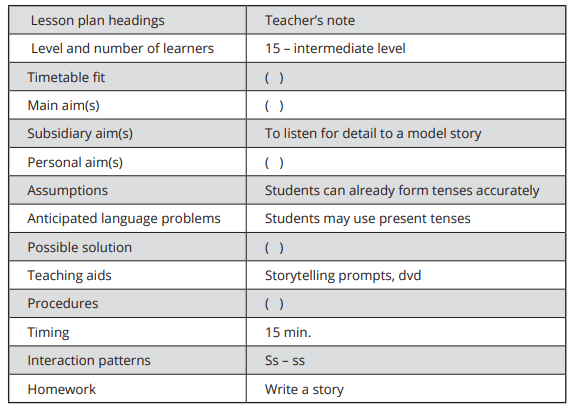
1. To enable students to use past tenses accurately and put events in order in simple narratives.
2. Students listen to the model story, then, in groups, plan and write their own stories.
3. Use gestures to remind students to use past tenses.
4. To follow on from work on past tenses and to prepare for the storytelling project.
5. To make sure that board writing is clear and readable.
Choose the CORRECT sequence.
(THORNBURY, 2005, p. 91-92)
Considering Thornbury’s (a very famous applied linguistics in the early 2000s) quotation, put the numbers 1 – 5 in the correct place in the following lesson plan:
1. To enable students to use past tenses accurately and put events in order in simple narratives.
2. Students listen to the model story, then, in groups, plan and write their own stories.
3. Use gestures to remind students to use past tenses.
4. To follow on from work on past tenses and to prepare for the storytelling project.
5. To make sure that board writing is clear and readable.
Choose the CORRECT sequence.
Ano: 2023
Banca:
IF-MT
Órgão:
IF-MT
Prova:
IF-MT - 2023 - IF-MT - Professor do Ensino Básico, Técnico e Tecnológico - Português-Inglês |
Q2188981
Inglês
“Communicative activities are classroom activities designed to get learners to speak and listen to one
another. We normally communicate when one of us has information (facts, opinions, ideas, etc.) that
another does not have. This is known as an ‘information gap’. The aim of a communicative activity in class
is to get learners to use the language they are learning to interact in realistic and meaningful ways, usually
involving exchanges of information”.
(SCRIVINER, 2003, p. 62)
Consider the definition above, choose the item that is a proposal for a communicative activity.
(SCRIVINER, 2003, p. 62)
Consider the definition above, choose the item that is a proposal for a communicative activity.
Ano: 2023
Banca:
IF-MT
Órgão:
IF-MT
Prova:
IF-MT - 2023 - IF-MT - Professor do Ensino Básico, Técnico e Tecnológico - Português-Inglês |
Q2188980
Inglês
Read the quote about error to get familiarized with the topic.
“Mistakes are often divided into errors and slips. Errors happen when learners try to say something that is beyond their current level of language processing. Usually, learners cannot correct errors themselves because they don’t understand what is wrong. Errors play a necessary and important part in language learning. Slips are the result of tiredness, worry or other temporary emotions or circumstances. These kinds of mistakes can be corrected by learners once they realize they have made them.”
(SPRATT; PULLVERNESS; WILLIAMS, 2005, p. 44)
Judge the items below as (T) True or (F) False.
1. There are two main reasons why learners make errors. The first reason is influence from the learner’s first language (L1) on the second language. This is called interference or transfer. Learners may use sound patterns, lexis or grammatical structures from their own language in English. The second reason is because they are unconsciously working out or organizing language, but this process is not yet complete. This kind of error is called a developmental error.
2. Errors in which learners wrongly apply a rule for one item of the language to another item are known as overgeneralization, and as a second language learners’ language ability increases, these kinds of errors also reduce.
3. Errors are part of learner’s interlanguage, which develops and progresses as they learn more. Experts think that interlanguage is an essential and unavoidable stage in language learning. In other words, interlanguage and errors are necessary to language learning.
4. Errors are a natural part of learning. They usually show that learners are learning and that their internal mental processes are working on experimenting with language.
5. Sometimes errors do not disappear, but get fossilized. These fossilized errors may be the result of lack of exposure to the second language and/or of a learner’s lack of motivation to improve their level of accuracy.
Choose the CORRECT sequence.
“Mistakes are often divided into errors and slips. Errors happen when learners try to say something that is beyond their current level of language processing. Usually, learners cannot correct errors themselves because they don’t understand what is wrong. Errors play a necessary and important part in language learning. Slips are the result of tiredness, worry or other temporary emotions or circumstances. These kinds of mistakes can be corrected by learners once they realize they have made them.”
(SPRATT; PULLVERNESS; WILLIAMS, 2005, p. 44)
Judge the items below as (T) True or (F) False.
1. There are two main reasons why learners make errors. The first reason is influence from the learner’s first language (L1) on the second language. This is called interference or transfer. Learners may use sound patterns, lexis or grammatical structures from their own language in English. The second reason is because they are unconsciously working out or organizing language, but this process is not yet complete. This kind of error is called a developmental error.
2. Errors in which learners wrongly apply a rule for one item of the language to another item are known as overgeneralization, and as a second language learners’ language ability increases, these kinds of errors also reduce.
3. Errors are part of learner’s interlanguage, which develops and progresses as they learn more. Experts think that interlanguage is an essential and unavoidable stage in language learning. In other words, interlanguage and errors are necessary to language learning.
4. Errors are a natural part of learning. They usually show that learners are learning and that their internal mental processes are working on experimenting with language.
5. Sometimes errors do not disappear, but get fossilized. These fossilized errors may be the result of lack of exposure to the second language and/or of a learner’s lack of motivation to improve their level of accuracy.
Choose the CORRECT sequence.
Ano: 2023
Banca:
IF-MT
Órgão:
IF-MT
Prova:
IF-MT - 2023 - IF-MT - Professor do Ensino Básico, Técnico e Tecnológico - Português-Inglês |
Q2188979
Inglês
Read the following exchange between two people having breakfast together.
A – Coffee?
B – Please.
A – Milk? Sugar?
B – No milk. One sugar, thanks.
A – Toast?
B – No thanks.
A – Juice?
B – Mmm.
(Thornbury, 2005, p. 3)
After reading the dialogue, choose the item that DOES NOT describe a correct reflection about grammar.
Ano: 2023
Banca:
IF-MT
Órgão:
IF-MT
Prova:
IF-MT - 2023 - IF-MT - Professor do Ensino Básico, Técnico e Tecnológico - Português-Inglês |
Q2188978
Inglês
Applied linguists for a long time have been publishing many books and materials on teaching and learning English
as a second and a foreign language. So, in this question, we provoke some reflections about these studies and
how they could affect practice in our English classes.
Considering language and background to language learning and teaching, match the topic to its definition.
( 1 ) Grammar ( 2 ) Lexis ( 3 ) Phonology ( 4 ) Function
( ) is the study of the sound features used in a language to communicate meaning. ( ) is a reason why we communicate. ( ) describes how we combine, organize and change words and parts of words to make meaning. ( ) is individual words or sets of words that have a specific meaning.
Choose the item with the CORRECT sequence.
Considering language and background to language learning and teaching, match the topic to its definition.
( 1 ) Grammar ( 2 ) Lexis ( 3 ) Phonology ( 4 ) Function
( ) is the study of the sound features used in a language to communicate meaning. ( ) is a reason why we communicate. ( ) describes how we combine, organize and change words and parts of words to make meaning. ( ) is individual words or sets of words that have a specific meaning.
Choose the item with the CORRECT sequence.
Ano: 2023
Banca:
IF-MT
Órgão:
IF-MT
Prova:
IF-MT - 2023 - IF-MT - Professor do Ensino Básico, Técnico e Tecnológico - Português-Inglês |
Q2188977
Inglês
“In recent years Content-Based Instruction (CBI) has become increasingly popular as a means of developing
linguistic ability. It has strong connections to project work, task-based learning and a holistic approach to language
instruction and has become particularly popular within the state school secondary (11 - 16 years old) education
sector. It is a kind of approach in which lesson focuses on the topic or subject matter. During the lesson students
are focused on learning about something that interests them, from a serious science subject to their favorite pop
star or even a topical news story or film”.
Peachey, N. (2021), disponível em: https://www.teachingenglish.org.uk/article/content-based-instruction, accessed on 15h December 2022.
According to Peachey, judge the items as (T) True or (F) False concerning CBI ADVANTAGES.
I. It can make learning a language more interesting and motivating. Students can use the language to fulfill a real purpose, which can make them both more independent and confident.
II. Taking information from different sources, re-evaluating and restructuring that information can help students to develop very valuable thinking skills that can then be transferred to other subjects. So students can also develop a much wider knowledge of the world through CBI, which can feed back into improving and supporting their general educational needs.
III. CBI is very popular among EAP (English for Academic Purposes) teachers as it helps students to develop valuable study skills such as note taking, summarizing and extracting key information from texts.
IV. The inclusion of a group work element within the framework given can also help students to develop their collaborative skills, which can have great social value. V. Particularly in monolingual classes, the overuse of the students' native language during parts of the lesson can be a problem. Because the lesson isn't explicitly focused on language practice, students find it much easier and quicker to use their mother tongue.
VI. It can be hard to find information sources and texts that lower levels can understand. Also the sharing of information in the target language may cause great difficulties.
Choose the CORRECT sequence.
Peachey, N. (2021), disponível em: https://www.teachingenglish.org.uk/article/content-based-instruction, accessed on 15h December 2022.
According to Peachey, judge the items as (T) True or (F) False concerning CBI ADVANTAGES.
I. It can make learning a language more interesting and motivating. Students can use the language to fulfill a real purpose, which can make them both more independent and confident.
II. Taking information from different sources, re-evaluating and restructuring that information can help students to develop very valuable thinking skills that can then be transferred to other subjects. So students can also develop a much wider knowledge of the world through CBI, which can feed back into improving and supporting their general educational needs.
III. CBI is very popular among EAP (English for Academic Purposes) teachers as it helps students to develop valuable study skills such as note taking, summarizing and extracting key information from texts.
IV. The inclusion of a group work element within the framework given can also help students to develop their collaborative skills, which can have great social value. V. Particularly in monolingual classes, the overuse of the students' native language during parts of the lesson can be a problem. Because the lesson isn't explicitly focused on language practice, students find it much easier and quicker to use their mother tongue.
VI. It can be hard to find information sources and texts that lower levels can understand. Also the sharing of information in the target language may cause great difficulties.
Choose the CORRECT sequence.
Ano: 2023
Banca:
IF-MT
Órgão:
IF-MT
Prova:
IF-MT - 2023 - IF-MT - Professor do Ensino Básico, Técnico e Tecnológico - Português-Inglês |
Q2188976
Inglês
Teachers in the history of language learning and teaching have faced several methods that have been employed
to the course of language teaching and learning, among them, we have faced Communicative Language Teaching
(CLT).
Choose the CORRECT item that points the basic premises of this approach.
Choose the CORRECT item that points the basic premises of this approach.
Ano: 2023
Banca:
IF-MT
Órgão:
IF-MT
Prova:
IF-MT - 2023 - IF-MT - Professor do Ensino Básico, Técnico e Tecnológico - Português-Inglês |
Q2188975
Inglês
In teachers’ training programs, many methods and approaches are presented, among them, the audio-lingual
method that grew into prominence in the 1950s in the USA. During the Second World War, US officials felt the
need for translators and interpreters who were fluent in major foreign languages. In 1942, a special training
program was organized to train fluent foreign speakers in a short time which is why this method is also referred
to as the Army Method. According to the discouraged audio-lingual method, it is NOT CORRECT to say that:

 Conheça nossos planos