Questões de Concurso Sobre inglês
Foram encontradas 25.999 questões


Ano: 2025
Banca:
Instituto IBED
Órgão:
Prefeitura de Cristalândia do Piauí - PI
Prova:
Instituto IBED - 2025 - Prefeitura de Cristalândia do Piauí - PI - Professor de Língua Inglesa |
Q3788881
Inglês
Texto associado
Text: (Excerpt about sugar consumption and
health implications)
Sugar has never been considered a health food,
but lately, the science against it keeps growing
stronger. New evidence shows going overboard on
the sweet stuff can lead to high cholesterol and blood
pressure […] not to mention excess weight gain.
Problem is most people are eating more sugar
now than they ever have. The average person
consumes about 20 teaspoons of added sugar a day —
300 calories worth! — which is four times more than
the amount recommended by most health experts,
including the American Heart Association. Annually,
all those teaspoons add up to 170 pounds of sugar.
So why are we so addicted to sugar? First off, it
is literally addicting. When you eat something sweet,
you get a surge of dopamine, the chemical in your
brain that brings you pleasure. Added sugar is also
tough to dodge. Sweetener hides in foods that don’t even taste sugary, like breads, sauces and condiments.
What’s more, it’s so hard to decipher the difference
between added sugars and the kinds found naturally
in whole foods. Eating naturally occurring sugars —
like fructose in fruit and lactose in dairy — is
generally considered healthy because they contain
nutrients with metabolic benefits, such as fiber and
antioxidants. Added sugars (sweeteners put into food
for flavor) have no such perks. […]
HEALTH. How to Eliminate Added Sugar From Your Diet in 1 Month.
2020. Disponível em:https://www.health.com/nutrition/sugar-detox. Acesso
em: 17 fev. 2022. Fragmento.
The use of informal expressions like “sweet stuff”
indicates a scientific and technical approach tailored
to a specialist audience in the field of nutrition and
dietetics.
Ano: 2025
Banca:
Instituto IBED
Órgão:
Prefeitura de Cristalândia do Piauí - PI
Prova:
Instituto IBED - 2025 - Prefeitura de Cristalândia do Piauí - PI - Professor de Língua Inglesa |
Q3788880
Inglês
Texto associado
Text: (Excerpt about sugar consumption and
health implications)
Sugar has never been considered a health food,
but lately, the science against it keeps growing
stronger. New evidence shows going overboard on
the sweet stuff can lead to high cholesterol and blood
pressure […] not to mention excess weight gain.
Problem is most people are eating more sugar
now than they ever have. The average person
consumes about 20 teaspoons of added sugar a day —
300 calories worth! — which is four times more than
the amount recommended by most health experts,
including the American Heart Association. Annually,
all those teaspoons add up to 170 pounds of sugar.
So why are we so addicted to sugar? First off, it
is literally addicting. When you eat something sweet,
you get a surge of dopamine, the chemical in your
brain that brings you pleasure. Added sugar is also
tough to dodge. Sweetener hides in foods that don’t even taste sugary, like breads, sauces and condiments.
What’s more, it’s so hard to decipher the difference
between added sugars and the kinds found naturally
in whole foods. Eating naturally occurring sugars —
like fructose in fruit and lactose in dairy — is
generally considered healthy because they contain
nutrients with metabolic benefits, such as fiber and
antioxidants. Added sugars (sweeteners put into food
for flavor) have no such perks. […]
HEALTH. How to Eliminate Added Sugar From Your Diet in 1 Month.
2020. Disponível em:https://www.health.com/nutrition/sugar-detox. Acesso
em: 17 fev. 2022. Fragmento.
Interpreting the verb choice in the clause “sugar
is also tough to dodge”, one can infer a metaphorical
construction that equates sugar to a pervasive and
elusive threat in modern diets.
Ano: 2025
Banca:
Instituto IBED
Órgão:
Prefeitura de Cristalândia do Piauí - PI
Prova:
Instituto IBED - 2025 - Prefeitura de Cristalândia do Piauí - PI - Professor de Língua Inglesa |
Q3788878
Inglês
Texto associado
Text: (Excerpt about sugar consumption and
health implications)
Sugar has never been considered a health food,
but lately, the science against it keeps growing
stronger. New evidence shows going overboard on
the sweet stuff can lead to high cholesterol and blood
pressure […] not to mention excess weight gain.
Problem is most people are eating more sugar
now than they ever have. The average person
consumes about 20 teaspoons of added sugar a day —
300 calories worth! — which is four times more than
the amount recommended by most health experts,
including the American Heart Association. Annually,
all those teaspoons add up to 170 pounds of sugar.
So why are we so addicted to sugar? First off, it
is literally addicting. When you eat something sweet,
you get a surge of dopamine, the chemical in your
brain that brings you pleasure. Added sugar is also
tough to dodge. Sweetener hides in foods that don’t even taste sugary, like breads, sauces and condiments.
What’s more, it’s so hard to decipher the difference
between added sugars and the kinds found naturally
in whole foods. Eating naturally occurring sugars —
like fructose in fruit and lactose in dairy — is
generally considered healthy because they contain
nutrients with metabolic benefits, such as fiber and
antioxidants. Added sugars (sweeteners put into food
for flavor) have no such perks. […]
HEALTH. How to Eliminate Added Sugar From Your Diet in 1 Month.
2020. Disponível em:https://www.health.com/nutrition/sugar-detox. Acesso
em: 17 fev. 2022. Fragmento.
The reference to the American Heart Association
acts as an appeal to authority, a rhetorical strategy
often used in persuasive texts that are subtly
opinionated rather than strictly informational.
Ano: 2025
Banca:
Instituto IBED
Órgão:
Prefeitura de Cristalândia do Piauí - PI
Prova:
Instituto IBED - 2025 - Prefeitura de Cristalândia do Piauí - PI - Professor de Língua Inglesa |
Q3788877
Inglês
Texto associado
Text: (Excerpt about sugar consumption and
health implications)
Sugar has never been considered a health food,
but lately, the science against it keeps growing
stronger. New evidence shows going overboard on
the sweet stuff can lead to high cholesterol and blood
pressure […] not to mention excess weight gain.
Problem is most people are eating more sugar
now than they ever have. The average person
consumes about 20 teaspoons of added sugar a day —
300 calories worth! — which is four times more than
the amount recommended by most health experts,
including the American Heart Association. Annually,
all those teaspoons add up to 170 pounds of sugar.
So why are we so addicted to sugar? First off, it
is literally addicting. When you eat something sweet,
you get a surge of dopamine, the chemical in your
brain that brings you pleasure. Added sugar is also
tough to dodge. Sweetener hides in foods that don’t even taste sugary, like breads, sauces and condiments.
What’s more, it’s so hard to decipher the difference
between added sugars and the kinds found naturally
in whole foods. Eating naturally occurring sugars —
like fructose in fruit and lactose in dairy — is
generally considered healthy because they contain
nutrients with metabolic benefits, such as fiber and
antioxidants. Added sugars (sweeteners put into food
for flavor) have no such perks. […]
HEALTH. How to Eliminate Added Sugar From Your Diet in 1 Month.
2020. Disponível em:https://www.health.com/nutrition/sugar-detox. Acesso
em: 17 fev. 2022. Fragmento.
Informal connectors such as “Problem is…” and
“What’s more…” create a conversational tone that
makes the text more accessible without
compromising its argumentative strength.
Ano: 2025
Banca:
Instituto IBED
Órgão:
Prefeitura de Cristalândia do Piauí - PI
Prova:
Instituto IBED - 2025 - Prefeitura de Cristalândia do Piauí - PI - Professor de Língua Inglesa |
Q3788876
Inglês
Texto associado
Text: (Excerpt about sugar consumption and
health implications)
Sugar has never been considered a health food,
but lately, the science against it keeps growing
stronger. New evidence shows going overboard on
the sweet stuff can lead to high cholesterol and blood
pressure […] not to mention excess weight gain.
Problem is most people are eating more sugar
now than they ever have. The average person
consumes about 20 teaspoons of added sugar a day —
300 calories worth! — which is four times more than
the amount recommended by most health experts,
including the American Heart Association. Annually,
all those teaspoons add up to 170 pounds of sugar.
So why are we so addicted to sugar? First off, it
is literally addicting. When you eat something sweet,
you get a surge of dopamine, the chemical in your
brain that brings you pleasure. Added sugar is also
tough to dodge. Sweetener hides in foods that don’t even taste sugary, like breads, sauces and condiments.
What’s more, it’s so hard to decipher the difference
between added sugars and the kinds found naturally
in whole foods. Eating naturally occurring sugars —
like fructose in fruit and lactose in dairy — is
generally considered healthy because they contain
nutrients with metabolic benefits, such as fiber and
antioxidants. Added sugars (sweeteners put into food
for flavor) have no such perks. […]
HEALTH. How to Eliminate Added Sugar From Your Diet in 1 Month.
2020. Disponível em:https://www.health.com/nutrition/sugar-detox. Acesso
em: 17 fev. 2022. Fragmento.
The mention of “20 teaspoons of added sugar a
day” serves as a rhetorical device to shock the reader
through quantitative exaggeration, reinforcing the
warning tone of the passage.
Ano: 2025
Banca:
Instituto IBED
Órgão:
Prefeitura de Cristalândia do Piauí - PI
Prova:
Instituto IBED - 2025 - Prefeitura de Cristalândia do Piauí - PI - Professor de Língua Inglesa |
Q3788875
Inglês
Texto associado
Text: (Excerpt about sugar consumption and
health implications)
Sugar has never been considered a health food,
but lately, the science against it keeps growing
stronger. New evidence shows going overboard on
the sweet stuff can lead to high cholesterol and blood
pressure […] not to mention excess weight gain.
Problem is most people are eating more sugar
now than they ever have. The average person
consumes about 20 teaspoons of added sugar a day —
300 calories worth! — which is four times more than
the amount recommended by most health experts,
including the American Heart Association. Annually,
all those teaspoons add up to 170 pounds of sugar.
So why are we so addicted to sugar? First off, it
is literally addicting. When you eat something sweet,
you get a surge of dopamine, the chemical in your
brain that brings you pleasure. Added sugar is also
tough to dodge. Sweetener hides in foods that don’t even taste sugary, like breads, sauces and condiments.
What’s more, it’s so hard to decipher the difference
between added sugars and the kinds found naturally
in whole foods. Eating naturally occurring sugars —
like fructose in fruit and lactose in dairy — is
generally considered healthy because they contain
nutrients with metabolic benefits, such as fiber and
antioxidants. Added sugars (sweeteners put into food
for flavor) have no such perks. […]
HEALTH. How to Eliminate Added Sugar From Your Diet in 1 Month.
2020. Disponível em:https://www.health.com/nutrition/sugar-detox. Acesso
em: 17 fev. 2022. Fragmento.
From a linguistic standpoint, the intensifier
“literally” in the phrase “it is literally addicting”
carries weight beyond stylistic function, reinforcing
the factual nature of the addiction mechanism
attributed to sugar.
Ano: 2025
Banca:
Instituto IBED
Órgão:
Prefeitura de Cristalândia do Piauí - PI
Prova:
Instituto IBED - 2025 - Prefeitura de Cristalândia do Piauí - PI - Professor de Língua Inglesa |
Q3788874
Inglês
Texto associado
Text: (Excerpt about sugar consumption and
health implications)
Sugar has never been considered a health food,
but lately, the science against it keeps growing
stronger. New evidence shows going overboard on
the sweet stuff can lead to high cholesterol and blood
pressure […] not to mention excess weight gain.
Problem is most people are eating more sugar
now than they ever have. The average person
consumes about 20 teaspoons of added sugar a day —
300 calories worth! — which is four times more than
the amount recommended by most health experts,
including the American Heart Association. Annually,
all those teaspoons add up to 170 pounds of sugar.
So why are we so addicted to sugar? First off, it
is literally addicting. When you eat something sweet,
you get a surge of dopamine, the chemical in your
brain that brings you pleasure. Added sugar is also
tough to dodge. Sweetener hides in foods that don’t even taste sugary, like breads, sauces and condiments.
What’s more, it’s so hard to decipher the difference
between added sugars and the kinds found naturally
in whole foods. Eating naturally occurring sugars —
like fructose in fruit and lactose in dairy — is
generally considered healthy because they contain
nutrients with metabolic benefits, such as fiber and
antioxidants. Added sugars (sweeteners put into food
for flavor) have no such perks. […]
HEALTH. How to Eliminate Added Sugar From Your Diet in 1 Month.
2020. Disponível em:https://www.health.com/nutrition/sugar-detox. Acesso
em: 17 fev. 2022. Fragmento.
The phrase “not to mention excess weight gain”
introduces a contrastive element that minimizes the
previous health risks related to sugar, functioning
rhetorically to downplay its consequences.
Ano: 2025
Banca:
IGEDUC
Órgão:
Prefeitura de Craíbas - AL
Prova:
IGEDUC - 2025 - Prefeitura de Craíbas - AL - Intérprete de Libras |
Q3788262
Inglês
Em uma interpretação em contexto médico ou jurídico, o
intérprete de Libras pode se deparar com termos
técnicos para os quais não existe um sinal
convencionado ou padronizado na comunidade surda
local. Diante dessa lacuna lexical, assinale a alternativa
CORRETA.
Q3787308
Inglês
Texto associado
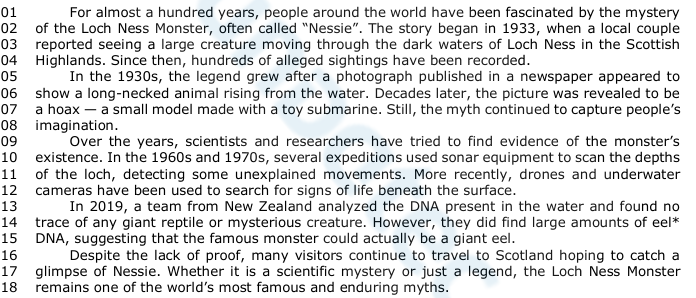
The Century-Long Search for the Loch* Ness Monster
(Available at: www.bbc.com/culture/article/20251002-the-century-long-search-for-the-loch-ness-monster –
text specially adapted for this test).
*Loch: in Scotland, a lake or inlet of the sea or ocean.
(Available at: https://dictionary.cambridge.org/dictionary/english-portuguese/loch)
*Eel: a snake-like water creature.
(Available at: https://dictionary.cambridge.org/dictionary/english-portuguese/eel)
According to the text, what do the results of the 2019 DNA analysis suggest about
the legend of the Loch Ness Monster?
Q3787307
Inglês
Texto associado
The Century-Long Search for the Loch* Ness Monster
(Available at: www.bbc.com/culture/article/20251002-the-century-long-search-for-the-loch-ness-monster –
text specially adapted for this test).
*Loch: in Scotland, a lake or inlet of the sea or ocean.
(Available at: https://dictionary.cambridge.org/dictionary/english-portuguese/loch)
*Eel: a snake-like water creature.
(Available at: https://dictionary.cambridge.org/dictionary/english-portuguese/eel)
Based on the excerpt below, taken from the text, analyze the following statements:
“In 2019, a team from New Zealand analyzed the DNA present in the water and found no trace of any giant reptile or mysterious creature”.
I. The verbs “analyzed” and “found” are both in the simple past tense, expressing completed actions.
II. The word “any” emphasizes the absence of something.
III. The sentence refers to an investigation that started in the past and is still in progress.
Which ones are correct?
“In 2019, a team from New Zealand analyzed the DNA present in the water and found no trace of any giant reptile or mysterious creature”.
I. The verbs “analyzed” and “found” are both in the simple past tense, expressing completed actions.
II. The word “any” emphasizes the absence of something.
III. The sentence refers to an investigation that started in the past and is still in progress.
Which ones are correct?
Q3787306
Inglês
Texto associado
The Century-Long Search for the Loch* Ness Monster
(Available at: www.bbc.com/culture/article/20251002-the-century-long-search-for-the-loch-ness-monster –
text specially adapted for this test).
*Loch: in Scotland, a lake or inlet of the sea or ocean.
(Available at: https://dictionary.cambridge.org/dictionary/english-portuguese/loch)
*Eel: a snake-like water creature.
(Available at: https://dictionary.cambridge.org/dictionary/english-portuguese/eel)
In the text, the word ‘hoax’ (l. 07) is closest in meaning to:
Q3787305
Inglês
Texto associado
The Century-Long Search for the Loch* Ness Monster
(Available at: www.bbc.com/culture/article/20251002-the-century-long-search-for-the-loch-ness-monster –
text specially adapted for this test).
*Loch: in Scotland, a lake or inlet of the sea or ocean.
(Available at: https://dictionary.cambridge.org/dictionary/english-portuguese/loch)
*Eel: a snake-like water creature.
(Available at: https://dictionary.cambridge.org/dictionary/english-portuguese/eel)
Which of the following statements best summarizes the author’s attitude toward the
Loch Ness Monster?
Q3787304
Inglês
Texto associado
The Century-Long Search for the Loch* Ness Monster
(Available at: www.bbc.com/culture/article/20251002-the-century-long-search-for-the-loch-ness-monster –
text specially adapted for this test).
*Loch: in Scotland, a lake or inlet of the sea or ocean.
(Available at: https://dictionary.cambridge.org/dictionary/english-portuguese/loch)
*Eel: a snake-like water creature.
(Available at: https://dictionary.cambridge.org/dictionary/english-portuguese/eel)
What helped to keep the legend of the Loch Ness Monster alive for so many decades?
Ano: 2025
Banca:
FRONTE
Órgão:
Prefeitura de Pouso Redondo - SC
Prova:
FRONTE - 2025 - Prefeitura de Pouso Redondo - SC - Professor de Língua Inglesa - Não Habilitado |
Q3787168
Inglês
O uso correto das preposições IN, ON e
AT costuma gerar dúvidas, mas segue regras específicas.
Para dias da semana (ex: Monday, Friday), a preposição
correta a ser utilizada é:
"We have English classes _______ Tuesdays."
"We have English classes _______ Tuesdays."
Ano: 2025
Banca:
FRONTE
Órgão:
Prefeitura de Pouso Redondo - SC
Prova:
FRONTE - 2025 - Prefeitura de Pouso Redondo - SC - Professor de Língua Inglesa - Não Habilitado |
Q3787167
Inglês
Ao compararmos dois objetos ou pessoas
utilizando adjetivos longos (com mais de duas sílabas), a
regra gramatical exige o uso de uma estrutura específica.
Escolha a opção que completa corretamente a comparação
abaixo:
"This computer is _______ than that old one." (Adjective: expensive)
"This computer is _______ than that old one." (Adjective: expensive)
Ano: 2025
Banca:
FRONTE
Órgão:
Prefeitura de Pouso Redondo - SC
Prova:
FRONTE - 2025 - Prefeitura de Pouso Redondo - SC - Professor de Língua Inglesa - Não Habilitado |
Q3787166
Inglês
No inglês, a distinção entre substantivos
contáveis e incontáveis altera o uso dos quantificadores
(quantifiers). Sabendo que a palavra "water" (água) é um
substantivo incontável, qual a forma correta de perguntar
a quantidade?
Ano: 2025
Banca:
FRONTE
Órgão:
Prefeitura de Pouso Redondo - SC
Prova:
FRONTE - 2025 - Prefeitura de Pouso Redondo - SC - Professor de Língua Inglesa - Não Habilitado |
Q3787165
Inglês
O Simple Present é utilizado para
descrever rotinas, fatos e verdades universais. De acordo
com as regras gramaticais para a terceira pessoa do
singular (He/She/It), assinale a alternativa que completa
corretamente a frase a seguir:
"My brother _______ soccer every Saturday morning."
"My brother _______ soccer every Saturday morning."
Ano: 2025
Banca:
FRONTE
Órgão:
Prefeitura de Pouso Redondo - SC
Prova:
FRONTE - 2025 - Prefeitura de Pouso Redondo - SC - Professor de Língua Inglesa - Não Habilitado |
Q3787164
Inglês
No inglês, é essencial distinguir o uso de
numerais cardinais (para quantidade) e ordinais (para
ordem, posição e datas). Analise a frase a seguir e assinale
a alternativa que completa corretamente a lacuna
indicando a posição do sujeito:
"This is the _______ time I visit Brazil."
"This is the _______ time I visit Brazil."
Q3785477
Inglês
Texto associado
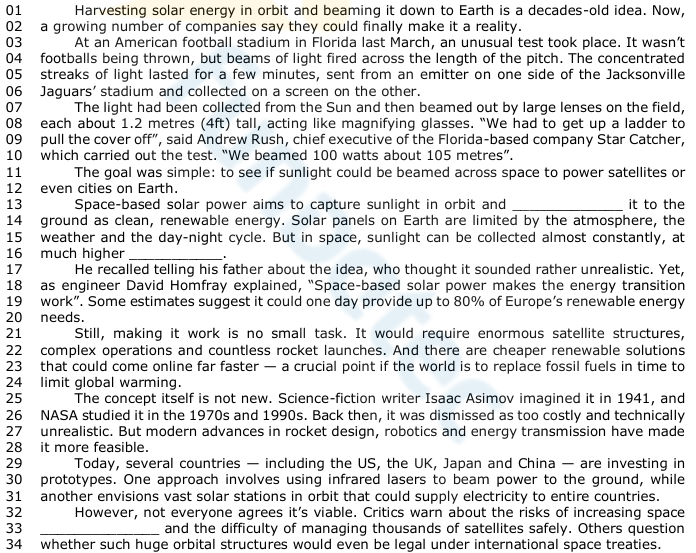

Space power: The dream of beaming solar energy from orbit
(Available at: www.bbc.com/future/article/20251029-the-beam-dream-should-we-build-solar-farms-in-space –
text specially adapted for this test).
Analyse the statements below according to the vocabulary used in the text, and
mark T, if true, or F, if false.
( ) The word “feasible” (l. 28) could be replaced by “achievable” without changing the meaning.
( ) The prefix un– in “uncertain” (l. 38) and “unrealistic” (l. 17) indicates reversal of action, similar to the verb “undo”.
( ) The word “viable” (l. 32) refers to something that can function successfully.
( ) The term “renewable” (l. 14) is formed by the addition of the prefix re- and the suffix -able, which mean, respectively, “not” and “capability/possibility”.
The correct order of filling in the parentheses, from top to bottom, is:
( ) The word “feasible” (l. 28) could be replaced by “achievable” without changing the meaning.
( ) The prefix un– in “uncertain” (l. 38) and “unrealistic” (l. 17) indicates reversal of action, similar to the verb “undo”.
( ) The word “viable” (l. 32) refers to something that can function successfully.
( ) The term “renewable” (l. 14) is formed by the addition of the prefix re- and the suffix -able, which mean, respectively, “not” and “capability/possibility”.
The correct order of filling in the parentheses, from top to bottom, is:
Q3785476
Inglês
Texto associado
Space power: The dream of beaming solar energy from orbit
(Available at: www.bbc.com/future/article/20251029-the-beam-dream-should-we-build-solar-farms-in-space –
text specially adapted for this test).
Mark the alternative that fills in, correctly and respectively, the blanks in the text in
lines 13, 16 and 33 according to standard spelling rules.

 Conheça nossos planos