Questões de Concurso Comentadas sobre inglês
Foram encontradas 19.377 questões


Ano: 2011
Banca:
CESGRANRIO
Órgão:
FINEP
Provas:
CESGRANRIO - 2011 - FINEP - Analista - Biblioteconomia
|
CESGRANRIO - 2011 - FINEP - Analista - Desenvolvimento de Sistemas |
CESGRANRIO - 2011 - FINEP - Analista - Comunicação Social |
CESGRANRIO - 2011 - FINEP - Analista - Contabilidade |
Q202104
Inglês
Texto associado
Don't spend all your time at the office. Take a break.
By Kim Painter, USA TODAY, April 7th, 2011
Remember the lunch hour? In a more relaxed, less plugged-in era, office workers would rise up midday to eat food at tables, gossip with co-workers, enjoy a book on a park bench or take a walk in the sun. Can it still be done, without invoking the scorn of desk-bound colleagues or enduring constant electronic interruptions? It can and should. Here are five ways to break free: 1. Give yourself permission. As the hair-color ads say, “You're worth it." Taking a break in the workday is more than an indulgence, though: It's a way of taking care of your body and mind, says Laura Stack, a time-management expert and author who blogs at theproductivitypro.com. “You have to eliminate the guilt and remind yourself that the more you take care of yourself, the better you are able to take care of others," she says. “We have to recharge our batteries. We have to refresh. It's OK." 2. Get a posse. “Indeed, many people are wishing they could just peel themselves away, but they don't have the discipline," Stack says. Thus, invite a co-worker to take daily walks with you or a group to gather for Friday lunches. Pretty soon, you'll be working in a happier place (and feeling less like a shirker and more like a leader). 3. Schedule it. Put it on your calendar and on any electronic schedule visible to co-workers. “Code yourself as 'unavailable.' Nobody has to know why," says Laura Vanderkam, author of 168 Hours: You Have More Time Than You Think. And, if a daily hour of “me time" seems impossible right now, then commit to just one or two big breaks a week. Or schedule several 15-minute leg-stretching, mind-freeing breaks each day. Keep those appointments, and spend them in “a cone of silence," without electronic devices, Vanderkam says. 4. Apply deadline pressure. The promise of a lunch break could make for a more productive morning: “Treat it as a deadline or a game," Stack says. Pick a meaty task or two that must be finished before lunch and dive in. Plan what you'll finish in the afternoon, too. That will free your mind to enjoy the break, Vanderkam says. 5. Eat at your desk. That's right: If you can't beat them, seem to join them. If you really don't care about eating elsewhere, “pack your lunch and eat it at your desk, and save the time for something you'd rather do," whether it's going to the gym or sneaking out to your car to read, Vanderkam says. (But remember, you still have to schedule this break.) While most co-workers care less about your habits than you think they do, she says, “this has the extra advantage that you can be seen eating at your desk." . Access on April 7th, 2011. Adapted.
By Kim Painter, USA TODAY, April 7th, 2011
Remember the lunch hour? In a more relaxed, less plugged-in era, office workers would rise up midday to eat food at tables, gossip with co-workers, enjoy a book on a park bench or take a walk in the sun. Can it still be done, without invoking the scorn of desk-bound colleagues or enduring constant electronic interruptions? It can and should. Here are five ways to break free: 1. Give yourself permission. As the hair-color ads say, “You're worth it." Taking a break in the workday is more than an indulgence, though: It's a way of taking care of your body and mind, says Laura Stack, a time-management expert and author who blogs at theproductivitypro.com. “You have to eliminate the guilt and remind yourself that the more you take care of yourself, the better you are able to take care of others," she says. “We have to recharge our batteries. We have to refresh. It's OK." 2. Get a posse. “Indeed, many people are wishing they could just peel themselves away, but they don't have the discipline," Stack says. Thus, invite a co-worker to take daily walks with you or a group to gather for Friday lunches. Pretty soon, you'll be working in a happier place (and feeling less like a shirker and more like a leader). 3. Schedule it. Put it on your calendar and on any electronic schedule visible to co-workers. “Code yourself as 'unavailable.' Nobody has to know why," says Laura Vanderkam, author of 168 Hours: You Have More Time Than You Think. And, if a daily hour of “me time" seems impossible right now, then commit to just one or two big breaks a week. Or schedule several 15-minute leg-stretching, mind-freeing breaks each day. Keep those appointments, and spend them in “a cone of silence," without electronic devices, Vanderkam says. 4. Apply deadline pressure. The promise of a lunch break could make for a more productive morning: “Treat it as a deadline or a game," Stack says. Pick a meaty task or two that must be finished before lunch and dive in. Plan what you'll finish in the afternoon, too. That will free your mind to enjoy the break, Vanderkam says. 5. Eat at your desk. That's right: If you can't beat them, seem to join them. If you really don't care about eating elsewhere, “pack your lunch and eat it at your desk, and save the time for something you'd rather do," whether it's going to the gym or sneaking out to your car to read, Vanderkam says. (But remember, you still have to schedule this break.) While most co-workers care less about your habits than you think they do, she says, “this has the extra advantage that you can be seen eating at your desk." . Access on April 7th, 2011. Adapted.
The author's main purpose in this text is to
Ano: 2011
Banca:
CESGRANRIO
Órgão:
FINEP
Provas:
CESGRANRIO - 2011 - FINEP - Analista - Jurídica
|
CESGRANRIO - 2011 - FINEP - Analista de Suporte |
Q201091
Inglês
The boldfaced item can be replaced by the word in parentheses, without change in meaning, in
Ano: 2011
Banca:
CESGRANRIO
Órgão:
FINEP
Provas:
CESGRANRIO - 2011 - FINEP - Analista - Jurídica
|
CESGRANRIO - 2011 - FINEP - Analista - Biblioteconomia |
CESGRANRIO - 2011 - FINEP - Analista - Serviço Social |
CESGRANRIO - 2011 - FINEP - Analista de Suporte |
CESGRANRIO - 2011 - FINEP - Analista - Desenvolvimento de Sistemas |
CESGRANRIO - 2011 - FINEP - Analista - Comunicação Social |
CESGRANRIO - 2011 - FINEP - Analista - Contabilidade |
Q201089
Inglês
Texto associado
Don't spend all your time at the office. Take a break.
By Kim Painter, USA TODAY, April 7th, 2011
Remember the lunch hour? In a more relaxed, less plugged-in era, office workers would rise up midday to eat food at tables, gossip with co-workers, enjoy a book on a park bench or take a walk in the sun. Can it still be done, without invoking the scorn of desk-bound colleagues or enduring constant electronic interruptions? It can and should. Here are five ways to break free: 1. Give yourself permission. As the hair-color ads say, “You're worth it." Taking a break in the workday is more than an indulgence, though: It's a way of taking care of your body and mind, says Laura Stack, a time-management expert and author who blogs at theproductivitypro.com. “You have to eliminate the guilt and remind yourself that the more you take care of yourself, the better you are able to take care of others," she says. “We have to recharge our batteries. We have to refresh. It's OK." 2. Get a posse. “Indeed, many people are wishing they could just peel themselves away, but they don't have the discipline," Stack says. Thus, invite a co-worker to take daily walks with you or a group to gather for Friday lunches. Pretty soon, you'll be working in a happier place (and feeling less like a shirker and more like a leader). 3. Schedule it. Put it on your calendar and on any electronic schedule visible to co-workers. “Code yourself as 'unavailable.' Nobody has to know why," says Laura Vanderkam, author of 168 Hours: You Have More Time Than You Think. And, if a daily hour of “me time" seems impossible right now, then commit to just one or two big breaks a week. Or schedule several 15-minute leg-stretching, mind-freeing breaks each day. Keep those appointments, and spend them in “a cone of silence," without electronic devices, Vanderkam says. 4. Apply deadline pressure. The promise of a lunch break could make for a more productive morning: “Treat it as a deadline or a game," Stack says. Pick a meaty task or two that must be finished before lunch and dive in. Plan what you'll finish in the afternoon, too. That will free your mind to enjoy the break, Vanderkam says. 5. Eat at your desk. That's right: If you can't beat them, seem to join them. If you really don't care about eating elsewhere, “pack your lunch and eat it at your desk, and save the time for something you'd rather do," whether it's going to the gym or sneaking out to your car to read, Vanderkam says. (But remember, you still have to schedule this break.) While most co-workers care less about your habits than you think they do, she says, “this has the extra advantage that you can be seen eating at your desk." . Access on April 7th, 2011. Adapted.
By Kim Painter, USA TODAY, April 7th, 2011
Remember the lunch hour? In a more relaxed, less plugged-in era, office workers would rise up midday to eat food at tables, gossip with co-workers, enjoy a book on a park bench or take a walk in the sun. Can it still be done, without invoking the scorn of desk-bound colleagues or enduring constant electronic interruptions? It can and should. Here are five ways to break free: 1. Give yourself permission. As the hair-color ads say, “You're worth it." Taking a break in the workday is more than an indulgence, though: It's a way of taking care of your body and mind, says Laura Stack, a time-management expert and author who blogs at theproductivitypro.com. “You have to eliminate the guilt and remind yourself that the more you take care of yourself, the better you are able to take care of others," she says. “We have to recharge our batteries. We have to refresh. It's OK." 2. Get a posse. “Indeed, many people are wishing they could just peel themselves away, but they don't have the discipline," Stack says. Thus, invite a co-worker to take daily walks with you or a group to gather for Friday lunches. Pretty soon, you'll be working in a happier place (and feeling less like a shirker and more like a leader). 3. Schedule it. Put it on your calendar and on any electronic schedule visible to co-workers. “Code yourself as 'unavailable.' Nobody has to know why," says Laura Vanderkam, author of 168 Hours: You Have More Time Than You Think. And, if a daily hour of “me time" seems impossible right now, then commit to just one or two big breaks a week. Or schedule several 15-minute leg-stretching, mind-freeing breaks each day. Keep those appointments, and spend them in “a cone of silence," without electronic devices, Vanderkam says. 4. Apply deadline pressure. The promise of a lunch break could make for a more productive morning: “Treat it as a deadline or a game," Stack says. Pick a meaty task or two that must be finished before lunch and dive in. Plan what you'll finish in the afternoon, too. That will free your mind to enjoy the break, Vanderkam says. 5. Eat at your desk. That's right: If you can't beat them, seem to join them. If you really don't care about eating elsewhere, “pack your lunch and eat it at your desk, and save the time for something you'd rather do," whether it's going to the gym or sneaking out to your car to read, Vanderkam says. (But remember, you still have to schedule this break.) While most co-workers care less about your habits than you think they do, she says, “this has the extra advantage that you can be seen eating at your desk." . Access on April 7th, 2011. Adapted.
The author uses the fragment “Code yourself as 'unavailable.' " (lines 29-30) to mean that
Ano: 2011
Banca:
CESGRANRIO
Órgão:
FINEP
Provas:
CESGRANRIO - 2011 - FINEP - Analista - Jurídica
|
CESGRANRIO - 2011 - FINEP - Analista - Biblioteconomia |
CESGRANRIO - 2011 - FINEP - Analista - Serviço Social |
CESGRANRIO - 2011 - FINEP - Analista de Suporte |
CESGRANRIO - 2011 - FINEP - Analista - Desenvolvimento de Sistemas |
CESGRANRIO - 2011 - FINEP - Analista - Comunicação Social |
CESGRANRIO - 2011 - FINEP - Analista - Contabilidade |
Q201088
Inglês
Texto associado
Don't spend all your time at the office. Take a break.
By Kim Painter, USA TODAY, April 7th, 2011
Remember the lunch hour? In a more relaxed, less plugged-in era, office workers would rise up midday to eat food at tables, gossip with co-workers, enjoy a book on a park bench or take a walk in the sun. Can it still be done, without invoking the scorn of desk-bound colleagues or enduring constant electronic interruptions? It can and should. Here are five ways to break free: 1. Give yourself permission. As the hair-color ads say, “You're worth it." Taking a break in the workday is more than an indulgence, though: It's a way of taking care of your body and mind, says Laura Stack, a time-management expert and author who blogs at theproductivitypro.com. “You have to eliminate the guilt and remind yourself that the more you take care of yourself, the better you are able to take care of others," she says. “We have to recharge our batteries. We have to refresh. It's OK." 2. Get a posse. “Indeed, many people are wishing they could just peel themselves away, but they don't have the discipline," Stack says. Thus, invite a co-worker to take daily walks with you or a group to gather for Friday lunches. Pretty soon, you'll be working in a happier place (and feeling less like a shirker and more like a leader). 3. Schedule it. Put it on your calendar and on any electronic schedule visible to co-workers. “Code yourself as 'unavailable.' Nobody has to know why," says Laura Vanderkam, author of 168 Hours: You Have More Time Than You Think. And, if a daily hour of “me time" seems impossible right now, then commit to just one or two big breaks a week. Or schedule several 15-minute leg-stretching, mind-freeing breaks each day. Keep those appointments, and spend them in “a cone of silence," without electronic devices, Vanderkam says. 4. Apply deadline pressure. The promise of a lunch break could make for a more productive morning: “Treat it as a deadline or a game," Stack says. Pick a meaty task or two that must be finished before lunch and dive in. Plan what you'll finish in the afternoon, too. That will free your mind to enjoy the break, Vanderkam says. 5. Eat at your desk. That's right: If you can't beat them, seem to join them. If you really don't care about eating elsewhere, “pack your lunch and eat it at your desk, and save the time for something you'd rather do," whether it's going to the gym or sneaking out to your car to read, Vanderkam says. (But remember, you still have to schedule this break.) While most co-workers care less about your habits than you think they do, she says, “this has the extra advantage that you can be seen eating at your desk." . Access on April 7th, 2011. Adapted.
By Kim Painter, USA TODAY, April 7th, 2011
Remember the lunch hour? In a more relaxed, less plugged-in era, office workers would rise up midday to eat food at tables, gossip with co-workers, enjoy a book on a park bench or take a walk in the sun. Can it still be done, without invoking the scorn of desk-bound colleagues or enduring constant electronic interruptions? It can and should. Here are five ways to break free: 1. Give yourself permission. As the hair-color ads say, “You're worth it." Taking a break in the workday is more than an indulgence, though: It's a way of taking care of your body and mind, says Laura Stack, a time-management expert and author who blogs at theproductivitypro.com. “You have to eliminate the guilt and remind yourself that the more you take care of yourself, the better you are able to take care of others," she says. “We have to recharge our batteries. We have to refresh. It's OK." 2. Get a posse. “Indeed, many people are wishing they could just peel themselves away, but they don't have the discipline," Stack says. Thus, invite a co-worker to take daily walks with you or a group to gather for Friday lunches. Pretty soon, you'll be working in a happier place (and feeling less like a shirker and more like a leader). 3. Schedule it. Put it on your calendar and on any electronic schedule visible to co-workers. “Code yourself as 'unavailable.' Nobody has to know why," says Laura Vanderkam, author of 168 Hours: You Have More Time Than You Think. And, if a daily hour of “me time" seems impossible right now, then commit to just one or two big breaks a week. Or schedule several 15-minute leg-stretching, mind-freeing breaks each day. Keep those appointments, and spend them in “a cone of silence," without electronic devices, Vanderkam says. 4. Apply deadline pressure. The promise of a lunch break could make for a more productive morning: “Treat it as a deadline or a game," Stack says. Pick a meaty task or two that must be finished before lunch and dive in. Plan what you'll finish in the afternoon, too. That will free your mind to enjoy the break, Vanderkam says. 5. Eat at your desk. That's right: If you can't beat them, seem to join them. If you really don't care about eating elsewhere, “pack your lunch and eat it at your desk, and save the time for something you'd rather do," whether it's going to the gym or sneaking out to your car to read, Vanderkam says. (But remember, you still have to schedule this break.) While most co-workers care less about your habits than you think they do, she says, “this has the extra advantage that you can be seen eating at your desk." . Access on April 7th, 2011. Adapted.
In the fragments, “office workers
would rise up midday…" (lines 2-3) and “ 'You have to eliminate the guilt…' " (lines 14- 15), the verb forms in bold express the ideas, respectively, of
Ano: 2011
Banca:
CESGRANRIO
Órgão:
Petrobras
Provas:
CESGRANRIO - 2011 - Petrobras - Analista de Sistemas Júnior - Engenharia de Software
|
CESGRANRIO - 2011 - Petrobras - Assistente Social Júnior - 2011 |
CESGRANRIO - 2011 - Petrobrás - Contador Júnior - 2011 |
CESGRANRIO - 2011 - Petrobras - Advogado |
CESGRANRIO - 2011 - Petrobras - Analista de Sistemas Júnior - Processos de Negócios - 2011 |
CESGRANRIO - 2011 - Petrobras - Analista de Sistemas Júnior - Infra-Estrutura - 2011 |
CESGRANRIO - 2011 - Petrobras - Engenheiro de Equipamento Júnior - Elétrica 2011 |
CESGRANRIO - 2011 - Petrobras - Arquiteto |
CESGRANRIO - 2011 - Petrobras - Engenheiro de Equipamento Júnior - Eletrônica - 2011 |
CESGRANRIO - 2011 - Petrobras - Engenheiro de Produção Júnior - 2011 |
CESGRANRIO - 2011 - Petrobras - Geofísico Júnior - Geologia - 2011 |
CESGRANRIO - 2011 - Petrobras - Geólogo Júnior - 2011 |
Q200993
Inglês
Texto associado
Off the Deep End in Brazil
Gerald Herbert
With crude still hemorrhaging into the Gulf of Mexico, deep-water drilling might seem taboo just now. In fact, extreme oil will likely be the new normal. Despite the gulf tragedy, the quest for oil and gas in the most difficult places on the planet is just getting underway. Prospecting proceeds apace in the ultradeepwater reserves off the coasts of Ghana and Nigeria, the sulfur-laden depths of the Black Sea, and the tar sands of Venezuela’s Orinoco Basin. Brazil’s Petrobras, which already controls a quarter of global deepwater operations, is just starting to plumb its 9 to 15 billion barrels of proven reserves buried some four miles below the Atlantic. The reason is simple: after a century and a half of breakneck oil prospecting, the easy stuff is history. Blistering growth in emerging nations has turned the power grid upside down. India and China will consume 28 percent of global energy by 2030, triple the juice they required in 1990. China is set to overtake the U.S. in energy consumption by 2014. And now that the Great Recession is easing, the earth’s hoard of conventional oil is waning even faster. The International Energy Agency reckons the world will need to find 65 million additional barrels a day by 2030. If the U.S. offshore-drilling moratorium drags on, look for idled rigs heading to other shores. Available in: Retrieved on: June 19, 2011.
Gerald Herbert
With crude still hemorrhaging into the Gulf of Mexico, deep-water drilling might seem taboo just now. In fact, extreme oil will likely be the new normal. Despite the gulf tragedy, the quest for oil and gas in the most difficult places on the planet is just getting underway. Prospecting proceeds apace in the ultradeepwater reserves off the coasts of Ghana and Nigeria, the sulfur-laden depths of the Black Sea, and the tar sands of Venezuela’s Orinoco Basin. Brazil’s Petrobras, which already controls a quarter of global deepwater operations, is just starting to plumb its 9 to 15 billion barrels of proven reserves buried some four miles below the Atlantic. The reason is simple: after a century and a half of breakneck oil prospecting, the easy stuff is history. Blistering growth in emerging nations has turned the power grid upside down. India and China will consume 28 percent of global energy by 2030, triple the juice they required in 1990. China is set to overtake the U.S. in energy consumption by 2014. And now that the Great Recession is easing, the earth’s hoard of conventional oil is waning even faster. The International Energy Agency reckons the world will need to find 65 million additional barrels a day by 2030. If the U.S. offshore-drilling moratorium drags on, look for idled rigs heading to other shores. Available in: Retrieved on: June 19, 2011.
According to Text II, in spite of the oil spill disaster in the Gulf of Mexico,
Q200120
Inglês


Based on the meanings in the text,
Q200117
Inglês
In terms of reference,
Q200115
Inglês
In the fragments “…this will inspire people to come up with new ideas that will revolutionize the long-term strategic and financial prospects of the company.” (lines 19-22) and “…customers can’t rely on what they’re going to get.” (lines 52-53), “come up with” and “rely on” could be replaced in the text with, respectively,
Ano: 2011
Banca:
CESGRANRIO
Órgão:
Petrobras
Provas:
CESGRANRIO - 2011 - Petrobras - Assistente Social Júnior - 2011
|
CESGRANRIO - 2011 - Petrobras - Advogado |
CESGRANRIO - 2011 - Petrobras - Analista de Sistemas Júnior - Processos de Negócios - 2011 |
CESGRANRIO - 2011 - Petrobras - Analista de Sistemas Júnior - Infra-Estrutura - 2011 |
CESGRANRIO - 2011 - Petrobras - Engenheiro de Equipamento Júnior - Elétrica 2011 |
Q199943
Inglês
Texto associado
Off the Deep End in Brazil
Gerald Herbert
With crude still hemorrhaging into the Gulf of Mexico, deep-water drilling might seem taboo just now. In fact, extreme oil will likely be the new normal. Despite the gulf tragedy, the quest for oil and gas in the most difficult places on the planet is just getting underway. Prospecting proceeds apace in the ultradeepwater reserves off the coasts of Ghana and Nigeria, the sulfur-laden depths of the Black Sea, and the tar sands of Venezuela’s Orinoco Basin. Brazil’s Petrobras, which already controls a quarter of global deepwater operations, is just starting to plumb its 9 to 15 billion barrels of proven reserves buried some four miles below the Atlantic. The reason is simple: after a century and a half of breakneck oil prospecting, the easy stuff is history. Blistering growth in emerging nations has turned the power grid upside down. India and China will consume 28 percent of global energy by 2030, triple the juice they required in 1990. China is set to overtake the U.S. in energy consumption by 2014. And now that the Great Recession is easing, the earth’s hoard of conventional oil is waning even faster. The International Energy Agency reckons the world will need to find 65 million additional barrels a day by 2030. If the U.S. offshore-drilling moratorium drags on, look for idled rigs heading to other shores. Available in: Retrieved on: June 19, 2011.
Gerald Herbert
With crude still hemorrhaging into the Gulf of Mexico, deep-water drilling might seem taboo just now. In fact, extreme oil will likely be the new normal. Despite the gulf tragedy, the quest for oil and gas in the most difficult places on the planet is just getting underway. Prospecting proceeds apace in the ultradeepwater reserves off the coasts of Ghana and Nigeria, the sulfur-laden depths of the Black Sea, and the tar sands of Venezuela’s Orinoco Basin. Brazil’s Petrobras, which already controls a quarter of global deepwater operations, is just starting to plumb its 9 to 15 billion barrels of proven reserves buried some four miles below the Atlantic. The reason is simple: after a century and a half of breakneck oil prospecting, the easy stuff is history. Blistering growth in emerging nations has turned the power grid upside down. India and China will consume 28 percent of global energy by 2030, triple the juice they required in 1990. China is set to overtake the U.S. in energy consumption by 2014. And now that the Great Recession is easing, the earth’s hoard of conventional oil is waning even faster. The International Energy Agency reckons the world will need to find 65 million additional barrels a day by 2030. If the U.S. offshore-drilling moratorium drags on, look for idled rigs heading to other shores. Available in: Retrieved on: June 19, 2011.
In Text II, Herbert illustrates the possibility of “...idled rigs heading to other shores." (line 26) EXCEPT when he mentions
Ano: 2011
Banca:
CESGRANRIO
Órgão:
Petrobras
Provas:
CESGRANRIO - 2011 - Petrobras - Analista de Sistemas Júnior - Engenharia de Software
|
CESGRANRIO - 2011 - Petrobras - Assistente Social Júnior - 2011 |
CESGRANRIO - 2011 - Petrobrás - Contador Júnior - 2011 |
CESGRANRIO - 2011 - Petrobras - Advogado |
CESGRANRIO - 2011 - Petrobras - Analista de Sistemas Júnior - Processos de Negócios - 2011 |
CESGRANRIO - 2011 - Petrobras - Analista de Sistemas Júnior - Infra-Estrutura - 2011 |
CESGRANRIO - 2011 - Petrobras - Engenheiro de Equipamento Júnior - Elétrica 2011 |
CESGRANRIO - 2011 - Petrobras - Arquiteto |
CESGRANRIO - 2011 - Petrobras - Engenheiro de Equipamento Júnior - Eletrônica - 2011 |
CESGRANRIO - 2011 - Petrobras - Engenheiro de Produção Júnior - 2011 |
CESGRANRIO - 2011 - Petrobras - Geofísico Júnior - Geologia - 2011 |
CESGRANRIO - 2011 - Petrobras - Geólogo Júnior - 2011 |
Q199885
Inglês
Texto associado
Off the Deep End in Brazil
Gerald Herbert
With crude still hemorrhaging into the Gulf of Mexico, deep-water drilling might seem taboo just now. In fact, extreme oil will likely be the new normal. Despite the gulf tragedy, the quest for oil and gas in the most difficult places on the planet is just getting underway. Prospecting proceeds apace in the ultradeepwater reserves off the coasts of Ghana and Nigeria, the sulfur-laden depths of the Black Sea, and the tar sands of Venezuela’s Orinoco Basin. Brazil’s Petrobras, which already controls a quarter of global deepwater operations, is just starting to plumb its 9 to 15 billion barrels of proven reserves buried some four miles below the Atlantic. The reason is simple: after a century and a half of breakneck oil prospecting, the easy stuff is history. Blistering growth in emerging nations has turned the power grid upside down. India and China will consume 28 percent of global energy by 2030, triple the juice they required in 1990. China is set to overtake the U.S. in energy consumption by 2014. And now that the Great Recession is easing, the earth’s hoard of conventional oil is waning even faster. The International Energy Agency reckons the world will need to find 65 million additional barrels a day by 2030. If the U.S. offshore-drilling moratorium drags on, look for idled rigs heading to other shores. Available in: Retrieved on: June 19, 2011.
Gerald Herbert
With crude still hemorrhaging into the Gulf of Mexico, deep-water drilling might seem taboo just now. In fact, extreme oil will likely be the new normal. Despite the gulf tragedy, the quest for oil and gas in the most difficult places on the planet is just getting underway. Prospecting proceeds apace in the ultradeepwater reserves off the coasts of Ghana and Nigeria, the sulfur-laden depths of the Black Sea, and the tar sands of Venezuela’s Orinoco Basin. Brazil’s Petrobras, which already controls a quarter of global deepwater operations, is just starting to plumb its 9 to 15 billion barrels of proven reserves buried some four miles below the Atlantic. The reason is simple: after a century and a half of breakneck oil prospecting, the easy stuff is history. Blistering growth in emerging nations has turned the power grid upside down. India and China will consume 28 percent of global energy by 2030, triple the juice they required in 1990. China is set to overtake the U.S. in energy consumption by 2014. And now that the Great Recession is easing, the earth’s hoard of conventional oil is waning even faster. The International Energy Agency reckons the world will need to find 65 million additional barrels a day by 2030. If the U.S. offshore-drilling moratorium drags on, look for idled rigs heading to other shores. Available in: Retrieved on: June 19, 2011.
Comparing Texts I and II,
Ano: 2011
Banca:
CESGRANRIO
Órgão:
Petrobras
Provas:
CESGRANRIO - 2011 - Petrobras - Analista de Sistemas Júnior - Engenharia de Software
|
CESGRANRIO - 2011 - Petrobras - Assistente Social Júnior - 2011 |
CESGRANRIO - 2011 - Petrobrás - Contador Júnior - 2011 |
CESGRANRIO - 2011 - Petrobras - Advogado |
CESGRANRIO - 2011 - Petrobras - Analista de Sistemas Júnior - Processos de Negócios - 2011 |
CESGRANRIO - 2011 - Petrobras - Analista de Sistemas Júnior - Infra-Estrutura - 2011 |
CESGRANRIO - 2011 - Petrobras - Engenheiro de Equipamento Júnior - Elétrica 2011 |
CESGRANRIO - 2011 - Petrobras - Arquiteto |
CESGRANRIO - 2011 - Petrobras - Engenheiro de Equipamento Júnior - Eletrônica - 2011 |
CESGRANRIO - 2011 - Petrobras - Engenheiro de Produção Júnior - 2011 |
CESGRANRIO - 2011 - Petrobras - Geofísico Júnior - Geologia - 2011 |
CESGRANRIO - 2011 - Petrobras - Geólogo Júnior - 2011 |
Q199881
Inglês
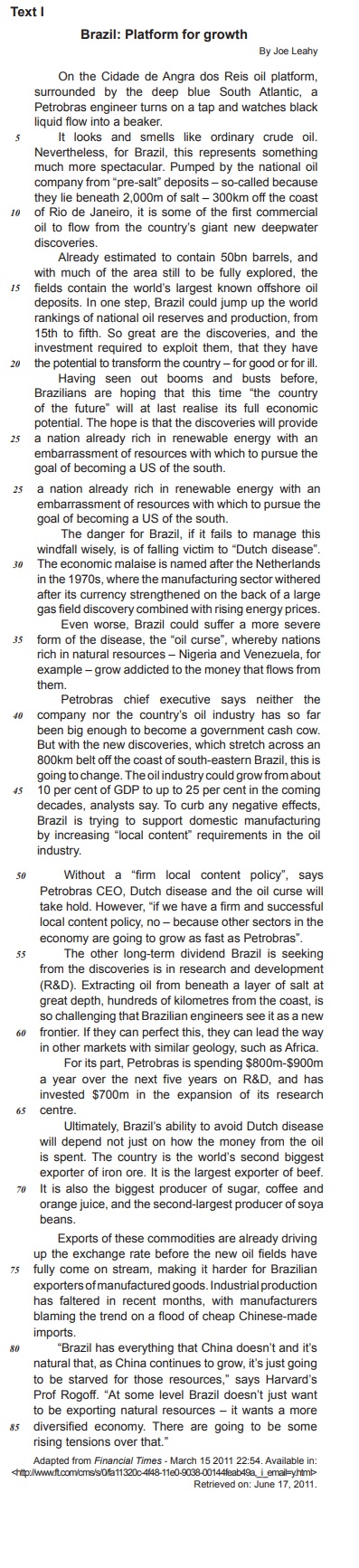
Based on the meanings in Text I, the two words are antonymous in
Ano: 2011
Banca:
CESPE / CEBRASPE
Órgão:
EBC
Prova:
CESPE - 2011 - EBC - Gestor de Atividade Jornalística - Conhecimentos Básicos |
Q199066
Inglês

Based on the text above, judge the following items.
Notorious specialists will take part in field events.
Notorious specialists will take part in field events.
Ano: 2011
Banca:
CESPE / CEBRASPE
Órgão:
EBC
Prova:
CESPE - 2011 - EBC - Jornalista - Jornalismo - Conhecimentos Básicos |
Q198862
Inglês
Texto associado


Based on the text above, judge the items below.
Based on the text above, judge the items below.
In the text, “left out” (L.30) is the same as given up.
Ano: 2011
Banca:
CESPE / CEBRASPE
Órgão:
SAEB-BA
Prova:
CESPE - 2011 - SAEB-BA - Todos os Cargos - Ed. Física, Arte, Português, Inglês e Espanhol |
Q196352
Inglês

A placa acima objetiva
Ano: 2011
Banca:
CESPE / CEBRASPE
Órgão:
SAEB-BA
Prova:
CESPE - 2011 - SAEB-BA - Todos os Cargos - Ed. Física, Arte, Português, Inglês e Espanhol |
Q196351
Inglês
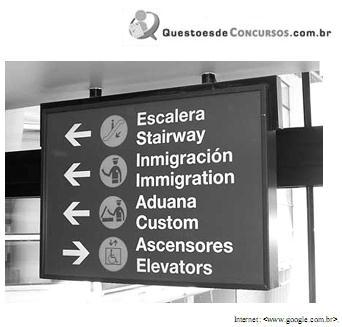
Um turista que esteja em frente à placa ilustrada acima deve observar que
Ano: 2011
Banca:
CESPE / CEBRASPE
Órgão:
SAEB-BA
Prova:
CESPE - 2011 - SAEB-BA - Todos os Cargos - Ed. Física, Arte, Português, Inglês e Espanhol |
Q196349
Inglês

A propaganda acima tem como objetivo
Ano: 2011
Banca:
CESPE / CEBRASPE
Órgão:
SAEB-BA
Prova:
CESPE - 2011 - SAEB-BA - Professor - Inglês |
Q196264
Inglês

The verb “depends” (l.23) can also be collocated with
Ano: 2011
Banca:
CESPE / CEBRASPE
Órgão:
SAEB-BA
Prova:
CESPE - 2011 - SAEB-BA - Professor - Inglês |
Q196261
Inglês

The conjunction “even though” (l.13) is synonymous with
Ano: 2011
Banca:
CESGRANRIO
Órgão:
PETROQUÍMICA SUAPE
Provas:
CESGRANRIO - 2011 - PETROQUÍMICA SUAPE - Engenheiro de Processamento Júnior
|
CESGRANRIO - 2011 - PETROQUÍMICA SUAPE - Engenheiro de Manutenção Pleno - Mecânica |
CESGRANRIO - 2011 - PETROQUÍMICA SUAPE - Engenheiro de Manutenção Pleno - Elétrica |
Q181781
Inglês
Texto associado
Cleaning up a spill
Written by Laura Hill
Water and oil don’t mix. We see this every day; just try washing olive oil off your hands without soap or washing your face in the morning with only water. It just doesn’t work!
When an oil spill occurs in the ocean, like the catastrophe in the Gulf of Mexico, what do scientists do to clean up the toxic mess? There are a number of options for an oil spill cleanup and most efforts use a combination of many techniques. The fact that oil and water don’t mix is a blessing and a curse. If oil mixed with water, it would be difficult to divide the two.
Crude oil is less dense than water; it spreads out to make a very thin layer (about one millimetre thick) that floats on top of the water. This is good because we can tell what is water and what is oil. It is also bad, because it means the oil can spread really quickly and cover a very large area, which becomes difficult to manage. Combined with wind, ocean currents and waves, oil spill cleanup starts to get really tricky.
Chemical dispersants can be used to break up big oil slicks into small oil droplets. They work like soaps by emulsifying the hydrophobic (waterrepelling) oil in the water. These small droplets can degrade in the ecosystem quicker than the big oil slick. But unfortunately, this means that marine life of all sizes ingest these toxic, broken-down particles and chemicals.
If the oil is thick enough, it could be set fire, a process called “in situ burning”. Because the oil is highly flammable and floats on top of the water, it is very easy to set it alight. It’s not environmentallyfriendly though; the combustion of oil releases thick smoke that contains greenhouse gases and other dangerous air pollutants.
Some techniques can contain and recapture spilled oil without changing its chemical composition. Booms float on top of the water and act as barriers to the movement of oil. Once the oil is controlled, it can be gathered using sorbents. “Sorbent” is a fancy word for sponge. These sponges absorb the oil and allow it to be collected by siphoning it off the water.
However, weather and sea conditions can prevent and obstruct the use of booms, sorbents and in situ burning. Imagine trying to perform these operations on the open sea with wind, waves and water currents moving the oil (and your boat!) around on the water.
What about the plants and animals? It’s easy to forget about the organisms in the sea that are under water. Out of sight, out of mind! There is not much we can do to help them. But when oil reaches the shore it impacts sensitive coastal environments including the many fish, bird, amphibian, reptilian, and crustaceanspecies that live there. We have easy access to these areas and there are some things we can do to clean up. For the plants, it is often a matter of setting them on fire, or leaving them to degrade the oil naturally. Sometimes, we can spray the oil with nutrients (phosphorus and nitrogen) that can encourage the growth of specialized microorganisms. For species that can tolerate our soaps, manpower is needed to wash every affected animal. Yet, if the animal has tried to lick itself clean, it can die from ingesting the toxic oil.
Unfortunately, there can be many negative economic and social impacts, in addition to the environmental impacts of oil spills and, as you’ve just read, the clean up techniques are far from perfect. Prevention is the very best cleanup technique we have. http://www.curiocity.ca/everyday-science/environme... -cleaning-up-a-spill.html, retrieved on Dec 10, 2010
Written by Laura Hill
Water and oil don’t mix. We see this every day; just try washing olive oil off your hands without soap or washing your face in the morning with only water. It just doesn’t work!
When an oil spill occurs in the ocean, like the catastrophe in the Gulf of Mexico, what do scientists do to clean up the toxic mess? There are a number of options for an oil spill cleanup and most efforts use a combination of many techniques. The fact that oil and water don’t mix is a blessing and a curse. If oil mixed with water, it would be difficult to divide the two.
Crude oil is less dense than water; it spreads out to make a very thin layer (about one millimetre thick) that floats on top of the water. This is good because we can tell what is water and what is oil. It is also bad, because it means the oil can spread really quickly and cover a very large area, which becomes difficult to manage. Combined with wind, ocean currents and waves, oil spill cleanup starts to get really tricky.
Chemical dispersants can be used to break up big oil slicks into small oil droplets. They work like soaps by emulsifying the hydrophobic (waterrepelling) oil in the water. These small droplets can degrade in the ecosystem quicker than the big oil slick. But unfortunately, this means that marine life of all sizes ingest these toxic, broken-down particles and chemicals.
If the oil is thick enough, it could be set fire, a process called “in situ burning”. Because the oil is highly flammable and floats on top of the water, it is very easy to set it alight. It’s not environmentallyfriendly though; the combustion of oil releases thick smoke that contains greenhouse gases and other dangerous air pollutants.
Some techniques can contain and recapture spilled oil without changing its chemical composition. Booms float on top of the water and act as barriers to the movement of oil. Once the oil is controlled, it can be gathered using sorbents. “Sorbent” is a fancy word for sponge. These sponges absorb the oil and allow it to be collected by siphoning it off the water.
However, weather and sea conditions can prevent and obstruct the use of booms, sorbents and in situ burning. Imagine trying to perform these operations on the open sea with wind, waves and water currents moving the oil (and your boat!) around on the water.
What about the plants and animals? It’s easy to forget about the organisms in the sea that are under water. Out of sight, out of mind! There is not much we can do to help them. But when oil reaches the shore it impacts sensitive coastal environments including the many fish, bird, amphibian, reptilian, and crustaceanspecies that live there. We have easy access to these areas and there are some things we can do to clean up. For the plants, it is often a matter of setting them on fire, or leaving them to degrade the oil naturally. Sometimes, we can spray the oil with nutrients (phosphorus and nitrogen) that can encourage the growth of specialized microorganisms. For species that can tolerate our soaps, manpower is needed to wash every affected animal. Yet, if the animal has tried to lick itself clean, it can die from ingesting the toxic oil.
Unfortunately, there can be many negative economic and social impacts, in addition to the environmental impacts of oil spills and, as you’ve just read, the clean up techniques are far from perfect. Prevention is the very best cleanup technique we have. http://www.curiocity.ca/everyday-science/environme... -cleaning-up-a-spill.html, retrieved on Dec 10, 2010
In “They work like soaps by emulsifying the hydrophobic (water-repelling) oil in the water." (lines 21-23), they refers to
Ano: 2011
Banca:
CESGRANRIO
Órgão:
PETROQUÍMICA SUAPE
Provas:
CESGRANRIO - 2011 - PETROQUÍMICA SUAPE - Engenheiro de Processamento Júnior
|
CESGRANRIO - 2011 - PETROQUÍMICA SUAPE - Engenheiro de Manutenção Pleno - Mecânica |
CESGRANRIO - 2011 - PETROQUÍMICA SUAPE - Engenheiro de Manutenção Pleno - Elétrica |
Q181780
Inglês
Texto associado
Cleaning up a spill
Written by Laura Hill
Water and oil don’t mix. We see this every day; just try washing olive oil off your hands without soap or washing your face in the morning with only water. It just doesn’t work!
When an oil spill occurs in the ocean, like the catastrophe in the Gulf of Mexico, what do scientists do to clean up the toxic mess? There are a number of options for an oil spill cleanup and most efforts use a combination of many techniques. The fact that oil and water don’t mix is a blessing and a curse. If oil mixed with water, it would be difficult to divide the two.
Crude oil is less dense than water; it spreads out to make a very thin layer (about one millimetre thick) that floats on top of the water. This is good because we can tell what is water and what is oil. It is also bad, because it means the oil can spread really quickly and cover a very large area, which becomes difficult to manage. Combined with wind, ocean currents and waves, oil spill cleanup starts to get really tricky.
Chemical dispersants can be used to break up big oil slicks into small oil droplets. They work like soaps by emulsifying the hydrophobic (waterrepelling) oil in the water. These small droplets can degrade in the ecosystem quicker than the big oil slick. But unfortunately, this means that marine life of all sizes ingest these toxic, broken-down particles and chemicals.
If the oil is thick enough, it could be set fire, a process called “in situ burning”. Because the oil is highly flammable and floats on top of the water, it is very easy to set it alight. It’s not environmentallyfriendly though; the combustion of oil releases thick smoke that contains greenhouse gases and other dangerous air pollutants.
Some techniques can contain and recapture spilled oil without changing its chemical composition. Booms float on top of the water and act as barriers to the movement of oil. Once the oil is controlled, it can be gathered using sorbents. “Sorbent” is a fancy word for sponge. These sponges absorb the oil and allow it to be collected by siphoning it off the water.
However, weather and sea conditions can prevent and obstruct the use of booms, sorbents and in situ burning. Imagine trying to perform these operations on the open sea with wind, waves and water currents moving the oil (and your boat!) around on the water.
What about the plants and animals? It’s easy to forget about the organisms in the sea that are under water. Out of sight, out of mind! There is not much we can do to help them. But when oil reaches the shore it impacts sensitive coastal environments including the many fish, bird, amphibian, reptilian, and crustaceanspecies that live there. We have easy access to these areas and there are some things we can do to clean up. For the plants, it is often a matter of setting them on fire, or leaving them to degrade the oil naturally. Sometimes, we can spray the oil with nutrients (phosphorus and nitrogen) that can encourage the growth of specialized microorganisms. For species that can tolerate our soaps, manpower is needed to wash every affected animal. Yet, if the animal has tried to lick itself clean, it can die from ingesting the toxic oil.
Unfortunately, there can be many negative economic and social impacts, in addition to the environmental impacts of oil spills and, as you’ve just read, the clean up techniques are far from perfect. Prevention is the very best cleanup technique we have. http://www.curiocity.ca/everyday-science/environme... -cleaning-up-a-spill.html, retrieved on Dec 10, 2010
Written by Laura Hill
Water and oil don’t mix. We see this every day; just try washing olive oil off your hands without soap or washing your face in the morning with only water. It just doesn’t work!
When an oil spill occurs in the ocean, like the catastrophe in the Gulf of Mexico, what do scientists do to clean up the toxic mess? There are a number of options for an oil spill cleanup and most efforts use a combination of many techniques. The fact that oil and water don’t mix is a blessing and a curse. If oil mixed with water, it would be difficult to divide the two.
Crude oil is less dense than water; it spreads out to make a very thin layer (about one millimetre thick) that floats on top of the water. This is good because we can tell what is water and what is oil. It is also bad, because it means the oil can spread really quickly and cover a very large area, which becomes difficult to manage. Combined with wind, ocean currents and waves, oil spill cleanup starts to get really tricky.
Chemical dispersants can be used to break up big oil slicks into small oil droplets. They work like soaps by emulsifying the hydrophobic (waterrepelling) oil in the water. These small droplets can degrade in the ecosystem quicker than the big oil slick. But unfortunately, this means that marine life of all sizes ingest these toxic, broken-down particles and chemicals.
If the oil is thick enough, it could be set fire, a process called “in situ burning”. Because the oil is highly flammable and floats on top of the water, it is very easy to set it alight. It’s not environmentallyfriendly though; the combustion of oil releases thick smoke that contains greenhouse gases and other dangerous air pollutants.
Some techniques can contain and recapture spilled oil without changing its chemical composition. Booms float on top of the water and act as barriers to the movement of oil. Once the oil is controlled, it can be gathered using sorbents. “Sorbent” is a fancy word for sponge. These sponges absorb the oil and allow it to be collected by siphoning it off the water.
However, weather and sea conditions can prevent and obstruct the use of booms, sorbents and in situ burning. Imagine trying to perform these operations on the open sea with wind, waves and water currents moving the oil (and your boat!) around on the water.
What about the plants and animals? It’s easy to forget about the organisms in the sea that are under water. Out of sight, out of mind! There is not much we can do to help them. But when oil reaches the shore it impacts sensitive coastal environments including the many fish, bird, amphibian, reptilian, and crustaceanspecies that live there. We have easy access to these areas and there are some things we can do to clean up. For the plants, it is often a matter of setting them on fire, or leaving them to degrade the oil naturally. Sometimes, we can spray the oil with nutrients (phosphorus and nitrogen) that can encourage the growth of specialized microorganisms. For species that can tolerate our soaps, manpower is needed to wash every affected animal. Yet, if the animal has tried to lick itself clean, it can die from ingesting the toxic oil.
Unfortunately, there can be many negative economic and social impacts, in addition to the environmental impacts of oil spills and, as you’ve just read, the clean up techniques are far from perfect. Prevention is the very best cleanup technique we have. http://www.curiocity.ca/everyday-science/environme... -cleaning-up-a-spill.html, retrieved on Dec 10, 2010
The only sentence where the boldfaced word DOES NOT express an idea of contrast is

 Conheça nossos planos