Questões de Concurso Comentadas sobre inglês
Foram encontradas 19.377 questões


Ano: 2014
Banca:
CESPE / CEBRASPE
Órgão:
Câmara dos Deputados
Prova:
CESPE - 2014 - Câmara dos Deputados - Analista Legislativo - Consultor de Orçamento e Fiscalização Financeira |
Q420825
Inglês
Texto associado


Judge the items below, based on the text above.
Judge the items below, based on the text above.
The idea expressed in the second paragraph can be correctly explained by the following sentence: In 2002 a draft bill was voted by the American Congress proposing the setting of enhanced standard for all US state-owned-company boards, management and public accounting firms.
Ano: 2014
Banca:
CESPE / CEBRASPE
Órgão:
Câmara dos Deputados
Prova:
CESPE - 2014 - Câmara dos Deputados - Analista Legislativo - Consultor de Orçamento e Fiscalização Financeira |
Q420824
Inglês
Texto associado


According to the text above, judge the following item.
According to the text above, judge the following item.
Without changing the meaning of the text, the fragment “explains the basic rationale for instituting controls rather straightforwardly” (L.16-17) could be correctly replaced with explains a common-sense approach to retain control instead of simply handing it over.
Ano: 2014
Banca:
CESPE / CEBRASPE
Órgão:
Câmara dos Deputados
Prova:
CESPE - 2014 - Câmara dos Deputados - Analista Legislativo - Consultor de Orçamento e Fiscalização Financeira |
Q420823
Inglês
Texto associado
According to the text above, judge the following item.
According to the text above, judge the following item.
People have inherited from the Bible the notion that auditing is necessary because of the inherently dishonest nature of human beings.
Ano: 2014
Banca:
CESPE / CEBRASPE
Órgão:
Câmara dos Deputados
Prova:
CESPE - 2014 - Câmara dos Deputados - Analista Legislativo - Consultor de Orçamento e Fiscalização Financeira |
Q420821
Inglês
Texto associado
According to the text above, judge the following item.
According to the text above, judge the following item.
The author points to a discontinuity in the history of financial bookkeeping from the end of the 15th century to the 18th century.
Q418808
Inglês
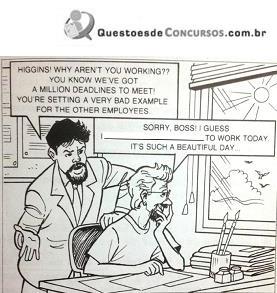
Read the dialogue in the picture. Choose the option to fill in the blank.
Q418807
Inglês
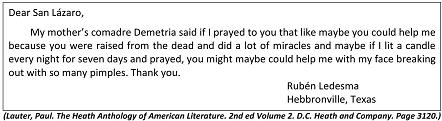
It is true about the message that
Q418806
Inglês
Texto associado
This (Illegal) American Life
By Maria E. Andreu
My parents came to New York City to make their fortune when I was a baby. Irresponsible and dreamy and in their early 20s, they didn't think things through when their visa expired; they decided to stay just a bit longer to build up a nest egg.
But our stay got progressively longer, until, when I was 6, my grandfather died in South America. My father decided my mother and I should go to the funeral and, with assurances that he would handle everything, sat me down and told me I'd have a nice visit in his boyhood home in Argentina, then be back in America in a month.
I didn't see him for two years.
We couldn't get a visa to return. My father sent us money from New Jersey, as the months of our absence stretched into years. Finally, he met someone who knew "coyotes" - people who smuggled others into the U.S. via Mexico. He paid them what they asked for, and we flew to Mexico City.
They drove us to the Mexican side of the border, and left us at a beach. Another from their operation picked us up there and drove us across as his family. We passed Disneyland on our way to the airport, where we boarded the plane to finally rejoin my father.
As a child, I had thought coming back home would be the magical end to our troubles, but in many ways it was the beginning. I chafed at the strictures of undocumented life: no social security number meant no public school (instead I attended a Catholic school my parents could scarcely afford); no driver's license, no after-school job. My parents had made their choices, and I had to live with those, seeing off my classmates as they left on a class trip to Canada, or packing to go off to college, where 1 could not go.
The year before I graduated from high school, Congress passed the amnesty law of 1987. A few months after my 18th birthday, I became legal and what had always seemed a blank future of no hope suddenly turned dazzling with possibility.
When I went for my interview at the Immigration and Naturalization Service, the caseworker looked at me quizzically when he heard me talk in unaccented English and joke about current events. Surely this American teenager did not fit in with the crowd of illegals looking to make things right.
At the time, I was flattered. His confusion meant I could pass as an American.
(Newsweek, October 2f 2008. Page 12.)
In "Finally, he met someone who knew 'coyotes' - people who smuggled others into the United States via Mexico." the relative pronouns can
Q418805
Inglês
Texto associado
This (Illegal) American Life
By Maria E. Andreu
My parents came to New York City to make their fortune when I was a baby. Irresponsible and dreamy and in their early 20s, they didn't think things through when their visa expired; they decided to stay just a bit longer to build up a nest egg.
But our stay got progressively longer, until, when I was 6, my grandfather died in South America. My father decided my mother and I should go to the funeral and, with assurances that he would handle everything, sat me down and told me I'd have a nice visit in his boyhood home in Argentina, then be back in America in a month.
I didn't see him for two years.
We couldn't get a visa to return. My father sent us money from New Jersey, as the months of our absence stretched into years. Finally, he met someone who knew "coyotes" - people who smuggled others into the U.S. via Mexico. He paid them what they asked for, and we flew to Mexico City.
They drove us to the Mexican side of the border, and left us at a beach. Another from their operation picked us up there and drove us across as his family. We passed Disneyland on our way to the airport, where we boarded the plane to finally rejoin my father.
As a child, I had thought coming back home would be the magical end to our troubles, but in many ways it was the beginning. I chafed at the strictures of undocumented life: no social security number meant no public school (instead I attended a Catholic school my parents could scarcely afford); no driver's license, no after-school job. My parents had made their choices, and I had to live with those, seeing off my classmates as they left on a class trip to Canada, or packing to go off to college, where 1 could not go.
The year before I graduated from high school, Congress passed the amnesty law of 1987. A few months after my 18th birthday, I became legal and what had always seemed a blank future of no hope suddenly turned dazzling with possibility.
When I went for my interview at the Immigration and Naturalization Service, the caseworker looked at me quizzically when he heard me talk in unaccented English and joke about current events. Surely this American teenager did not fit in with the crowd of illegals looking to make things right.
At the time, I was flattered. His confusion meant I could pass as an American.
(Newsweek, October 2f 2008. Page 12.)
In "My father decided my mother and I should go to the funeral" the modal can be replaced by
Q418804
Inglês
Texto associado
This (Illegal) American Life
By Maria E. Andreu
My parents came to New York City to make their fortune when I was a baby. Irresponsible and dreamy and in their early 20s, they didn't think things through when their visa expired; they decided to stay just a bit longer to build up a nest egg.
But our stay got progressively longer, until, when I was 6, my grandfather died in South America. My father decided my mother and I should go to the funeral and, with assurances that he would handle everything, sat me down and told me I'd have a nice visit in his boyhood home in Argentina, then be back in America in a month.
I didn't see him for two years.
We couldn't get a visa to return. My father sent us money from New Jersey, as the months of our absence stretched into years. Finally, he met someone who knew "coyotes" - people who smuggled others into the U.S. via Mexico. He paid them what they asked for, and we flew to Mexico City.
They drove us to the Mexican side of the border, and left us at a beach. Another from their operation picked us up there and drove us across as his family. We passed Disneyland on our way to the airport, where we boarded the plane to finally rejoin my father.
As a child, I had thought coming back home would be the magical end to our troubles, but in many ways it was the beginning. I chafed at the strictures of undocumented life: no social security number meant no public school (instead I attended a Catholic school my parents could scarcely afford); no driver's license, no after-school job. My parents had made their choices, and I had to live with those, seeing off my classmates as they left on a class trip to Canada, or packing to go off to college, where 1 could not go.
The year before I graduated from high school, Congress passed the amnesty law of 1987. A few months after my 18th birthday, I became legal and what had always seemed a blank future of no hope suddenly turned dazzling with possibility.
When I went for my interview at the Immigration and Naturalization Service, the caseworker looked at me quizzically when he heard me talk in unaccented English and joke about current events. Surely this American teenager did not fit in with the crowd of illegals looking to make things right.
At the time, I was flattered. His confusion meant I could pass as an American.
(Newsweek, October 2f 2008. Page 12.)
In "They decided to stay a bit longer to build up a nest egg" NESTEGG is a/an
Q418803
Inglês
Texto associado
This (Illegal) American Life
By Maria E. Andreu
My parents came to New York City to make their fortune when I was a baby. Irresponsible and dreamy and in their early 20s, they didn't think things through when their visa expired; they decided to stay just a bit longer to build up a nest egg.
But our stay got progressively longer, until, when I was 6, my grandfather died in South America. My father decided my mother and I should go to the funeral and, with assurances that he would handle everything, sat me down and told me I'd have a nice visit in his boyhood home in Argentina, then be back in America in a month.
I didn't see him for two years.
We couldn't get a visa to return. My father sent us money from New Jersey, as the months of our absence stretched into years. Finally, he met someone who knew "coyotes" - people who smuggled others into the U.S. via Mexico. He paid them what they asked for, and we flew to Mexico City.
They drove us to the Mexican side of the border, and left us at a beach. Another from their operation picked us up there and drove us across as his family. We passed Disneyland on our way to the airport, where we boarded the plane to finally rejoin my father.
As a child, I had thought coming back home would be the magical end to our troubles, but in many ways it was the beginning. I chafed at the strictures of undocumented life: no social security number meant no public school (instead I attended a Catholic school my parents could scarcely afford); no driver's license, no after-school job. My parents had made their choices, and I had to live with those, seeing off my classmates as they left on a class trip to Canada, or packing to go off to college, where 1 could not go.
The year before I graduated from high school, Congress passed the amnesty law of 1987. A few months after my 18th birthday, I became legal and what had always seemed a blank future of no hope suddenly turned dazzling with possibility.
When I went for my interview at the Immigration and Naturalization Service, the caseworker looked at me quizzically when he heard me talk in unaccented English and joke about current events. Surely this American teenager did not fit in with the crowd of illegals looking to make things right.
At the time, I was flattered. His confusion meant I could pass as an American.
(Newsweek, October 2f 2008. Page 12.)
I n "I was flattered. His confusion meant I could pass as an American." FLATTERED is
Q418802
Inglês
Texto associado
This (Illegal) American Life
By Maria E. Andreu
My parents came to New York City to make their fortune when I was a baby. Irresponsible and dreamy and in their early 20s, they didn't think things through when their visa expired; they decided to stay just a bit longer to build up a nest egg.
But our stay got progressively longer, until, when I was 6, my grandfather died in South America. My father decided my mother and I should go to the funeral and, with assurances that he would handle everything, sat me down and told me I'd have a nice visit in his boyhood home in Argentina, then be back in America in a month.
I didn't see him for two years.
We couldn't get a visa to return. My father sent us money from New Jersey, as the months of our absence stretched into years. Finally, he met someone who knew "coyotes" - people who smuggled others into the U.S. via Mexico. He paid them what they asked for, and we flew to Mexico City.
They drove us to the Mexican side of the border, and left us at a beach. Another from their operation picked us up there and drove us across as his family. We passed Disneyland on our way to the airport, where we boarded the plane to finally rejoin my father.
As a child, I had thought coming back home would be the magical end to our troubles, but in many ways it was the beginning. I chafed at the strictures of undocumented life: no social security number meant no public school (instead I attended a Catholic school my parents could scarcely afford); no driver's license, no after-school job. My parents had made their choices, and I had to live with those, seeing off my classmates as they left on a class trip to Canada, or packing to go off to college, where 1 could not go.
The year before I graduated from high school, Congress passed the amnesty law of 1987. A few months after my 18th birthday, I became legal and what had always seemed a blank future of no hope suddenly turned dazzling with possibility.
When I went for my interview at the Immigration and Naturalization Service, the caseworker looked at me quizzically when he heard me talk in unaccented English and joke about current events. Surely this American teenager did not fit in with the crowd of illegals looking to make things right.
At the time, I was flattered. His confusion meant I could pass as an American.
(Newsweek, October 2f 2008. Page 12.)
Some of the author's hassles were
Q418801
Inglês
Texto associado
This (Illegal) American Life
By Maria E. Andreu
My parents came to New York City to make their fortune when I was a baby. Irresponsible and dreamy and in their early 20s, they didn't think things through when their visa expired; they decided to stay just a bit longer to build up a nest egg.
But our stay got progressively longer, until, when I was 6, my grandfather died in South America. My father decided my mother and I should go to the funeral and, with assurances that he would handle everything, sat me down and told me I'd have a nice visit in his boyhood home in Argentina, then be back in America in a month.
I didn't see him for two years.
We couldn't get a visa to return. My father sent us money from New Jersey, as the months of our absence stretched into years. Finally, he met someone who knew "coyotes" - people who smuggled others into the U.S. via Mexico. He paid them what they asked for, and we flew to Mexico City.
They drove us to the Mexican side of the border, and left us at a beach. Another from their operation picked us up there and drove us across as his family. We passed Disneyland on our way to the airport, where we boarded the plane to finally rejoin my father.
As a child, I had thought coming back home would be the magical end to our troubles, but in many ways it was the beginning. I chafed at the strictures of undocumented life: no social security number meant no public school (instead I attended a Catholic school my parents could scarcely afford); no driver's license, no after-school job. My parents had made their choices, and I had to live with those, seeing off my classmates as they left on a class trip to Canada, or packing to go off to college, where 1 could not go.
The year before I graduated from high school, Congress passed the amnesty law of 1987. A few months after my 18th birthday, I became legal and what had always seemed a blank future of no hope suddenly turned dazzling with possibility.
When I went for my interview at the Immigration and Naturalization Service, the caseworker looked at me quizzically when he heard me talk in unaccented English and joke about current events. Surely this American teenager did not fit in with the crowd of illegals looking to make things right.
At the time, I was flattered. His confusion meant I could pass as an American.
(Newsweek, October 2f 2008. Page 12.)
The author and her mother
Q418800
Inglês

The ad contains a/an
Ano: 2014
Banca:
FUNIVERSA
Órgão:
SEAP-DF
Prova:
FUNIVERSA - 2014 - SEAP-DF - Auditor de Controle Interno - Planejamento e Orçamento |
Q418461
Inglês
Among the words listed below, the only one which forms the plural by adding an “s” is
Ano: 2014
Banca:
CESPE / CEBRASPE
Órgão:
SEDF
Prova:
CESPE / CEBRASPE - 2014 - SEDF - Estudantes Universitários |
Q417571
Inglês

Judge if the translation suggested in each of the following items is grammatically correct and maintains the meaning of the original text.
“On June 6, the Guardian and the Washington Post broke the first stories in a series that would expose extraordinary surveillance at home and abroad by the U.S. National Security Agency in arguably the most important leak of classified intelligence ever” (l.1 to 5) = Em 6 de junho, o Guardian e o Washington Post quebraram os primeiros casos de uma série que exporia a extraordinária vigilância doméstica e internacional pela Agência de Segurança Nacional dos E.U.A. no mais importante vazamento de inteligência já visto.
“On June 6, the Guardian and the Washington Post broke the first stories in a series that would expose extraordinary surveillance at home and abroad by the U.S. National Security Agency in arguably the most important leak of classified intelligence ever” (l.1 to 5) = Em 6 de junho, o Guardian e o Washington Post quebraram os primeiros casos de uma série que exporia a extraordinária vigilância doméstica e internacional pela Agência de Segurança Nacional dos E.U.A. no mais importante vazamento de inteligência já visto.
Ano: 2014
Banca:
CESPE / CEBRASPE
Órgão:
SEDF
Prova:
CESPE / CEBRASPE - 2014 - SEDF - Estudantes Universitários |
Q417567
Inglês

According to the text, judge the following items.
In the sentence “the infants overheard a conversation” (l.7), the prefix “over” is added to the verb form “heard” to emphasize the act of hearing.
In the sentence “the infants overheard a conversation” (l.7), the prefix “over” is added to the verb form “heard” to emphasize the act of hearing.
Ano: 2014
Banca:
CESPE / CEBRASPE
Órgão:
SEDF
Prova:
CESPE / CEBRASPE - 2014 - SEDF - Estudantes Universitários |
Q417555
Inglês
Texto associado
Crossing the street while listening to an MP3 player may soon be illegal in New York. A law has been proposed in response to several deaths apparently caused by pedestrians stepping into traffic listening to iPods. The ban would also extend to other electronic devices including cell phones, video games and handheld email devices, and offenders would face a $ 100 fine.
Pedestrians are getting so involved with what they are listening on their iPods that they don’t pay enough attention to the traffic, often with tragic consequences. According to some official information, many people are being killed as a result of stepping off the sidewalk in front of fast-moving vehicles. And most of the accidents can’t be avoided because the victims couldn’t even hear the warning because of the use of MP3.
Mark Hancock & Annie McDonald. English result upper-intermediate. Oxford University Press. p. 103 (adapted).
Pedestrians are getting so involved with what they are listening on their iPods that they don’t pay enough attention to the traffic, often with tragic consequences. According to some official information, many people are being killed as a result of stepping off the sidewalk in front of fast-moving vehicles. And most of the accidents can’t be avoided because the victims couldn’t even hear the warning because of the use of MP3.
Mark Hancock & Annie McDonald. English result upper-intermediate. Oxford University Press. p. 103 (adapted).
Judge the following items according to the text.
It is correct to infer from the text that, if people didn’t use electronic devices outside their homes, accidents wouldn’t happen.
It is correct to infer from the text that, if people didn’t use electronic devices outside their homes, accidents wouldn’t happen.
Ano: 2014
Banca:
CESPE / CEBRASPE
Órgão:
SEDF
Prova:
CESPE / CEBRASPE - 2014 - SEDF - Estudantes Universitários |
Q417554
Inglês
Texto associado
Crossing the street while listening to an MP3 player may soon be illegal in New York. A law has been proposed in response to several deaths apparently caused by pedestrians stepping into traffic listening to iPods. The ban would also extend to other electronic devices including cell phones, video games and handheld email devices, and offenders would face a $ 100 fine.
Pedestrians are getting so involved with what they are listening on their iPods that they don’t pay enough attention to the traffic, often with tragic consequences. According to some official information, many people are being killed as a result of stepping off the sidewalk in front of fast-moving vehicles. And most of the accidents can’t be avoided because the victims couldn’t even hear the warning because of the use of MP3.
Mark Hancock & Annie McDonald. English result upper-intermediate. Oxford University Press. p. 103 (adapted).
Pedestrians are getting so involved with what they are listening on their iPods that they don’t pay enough attention to the traffic, often with tragic consequences. According to some official information, many people are being killed as a result of stepping off the sidewalk in front of fast-moving vehicles. And most of the accidents can’t be avoided because the victims couldn’t even hear the warning because of the use of MP3.
Mark Hancock & Annie McDonald. English result upper-intermediate. Oxford University Press. p. 103 (adapted).
Judge the following items according to the text.
In New York, a law was proposed to forbid the use of MP3 outdoors.
In New York, a law was proposed to forbid the use of MP3 outdoors.
Ano: 2014
Banca:
CESPE / CEBRASPE
Órgão:
SEDF
Prova:
CESPE / CEBRASPE - 2014 - SEDF - Estudantes Universitários |
Q417553
Inglês
Texto associado
Crossing the street while listening to an MP3 player may soon be illegal in New York. A law has been proposed in response to several deaths apparently caused by pedestrians stepping into traffic listening to iPods. The ban would also extend to other electronic devices including cell phones, video games and handheld email devices, and offenders would face a $ 100 fine.
Pedestrians are getting so involved with what they are listening on their iPods that they don’t pay enough attention to the traffic, often with tragic consequences. According to some official information, many people are being killed as a result of stepping off the sidewalk in front of fast-moving vehicles. And most of the accidents can’t be avoided because the victims couldn’t even hear the warning because of the use of MP3.
Mark Hancock & Annie McDonald. English result upper-intermediate. Oxford University Press. p. 103 (adapted).
Pedestrians are getting so involved with what they are listening on their iPods that they don’t pay enough attention to the traffic, often with tragic consequences. According to some official information, many people are being killed as a result of stepping off the sidewalk in front of fast-moving vehicles. And most of the accidents can’t be avoided because the victims couldn’t even hear the warning because of the use of MP3.
Mark Hancock & Annie McDonald. English result upper-intermediate. Oxford University Press. p. 103 (adapted).
Judge the following items according to the text.
Most of the people who were involved in the accidents mentioned in the text couldn’t hear the vehicles approaching because they were distracted by their MP3 players.
Most of the people who were involved in the accidents mentioned in the text couldn’t hear the vehicles approaching because they were distracted by their MP3 players.
Ano: 2014
Banca:
CESPE / CEBRASPE
Órgão:
SEDF
Prova:
CESPE / CEBRASPE - 2014 - SEDF - Estudantes Universitários |
Q417545
Inglês
Texto associado
There are people who are latecomers wherever they go. Lateness is their way of life.
Chronic lateness has spoilt friendships, and it’s a habit that has caused people to lose their jobs. Why, then, are so many people late?
According to some specialists, not arriving on time can be a form of avoidance. You are late for a party, or coming home from work because you don’t want to be where you’re supposed to be. It can also be a habit learned on childhood from a parent or an old brother or sister who also ran late. For others, it’s a result of an inability to judge time.
Whatever reason people have, lateness almost always annoys those of us who are always prompt to attend our commitments.
Diane Washawsky. Spectrum book 4. Ana Veltford. Prentice Hall Regents. p.156 (adapted).
Chronic lateness has spoilt friendships, and it’s a habit that has caused people to lose their jobs. Why, then, are so many people late?
According to some specialists, not arriving on time can be a form of avoidance. You are late for a party, or coming home from work because you don’t want to be where you’re supposed to be. It can also be a habit learned on childhood from a parent or an old brother or sister who also ran late. For others, it’s a result of an inability to judge time.
Whatever reason people have, lateness almost always annoys those of us who are always prompt to attend our commitments.
Diane Washawsky. Spectrum book 4. Ana Veltford. Prentice Hall Regents. p.156 (adapted).
Based on the text, judge the following items.
Latecomers are people who hardly ever are on time for their appointments.
Latecomers are people who hardly ever are on time for their appointments.

 Conheça nossos planos