Questões de Concurso Comentadas sobre inglês
Foram encontradas 19.377 questões


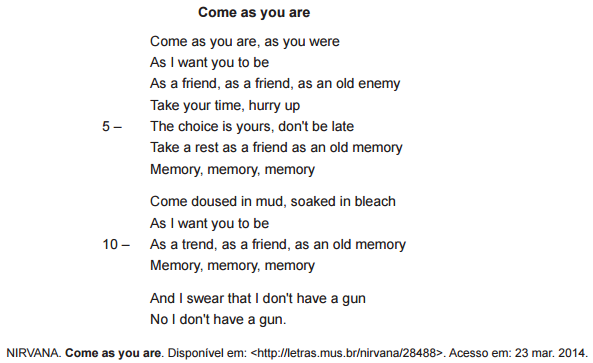
Marque C,se a proposição é verdadeira; E,se a proposição é falsa.
O autor dessa canção dirige-se às pessoas em geral, enfatizando que elas se apresentem e sejam aceitas como realmente são, sem quaisquer restrições.
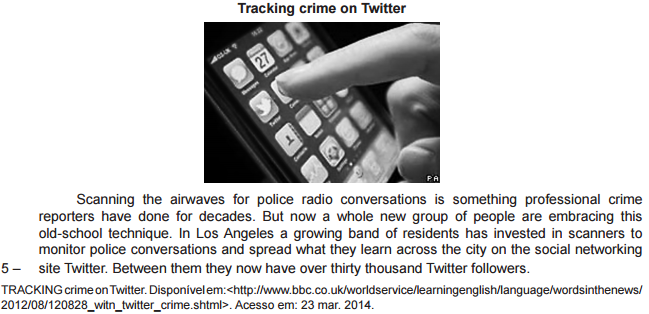
Repórteres profissionais da área criminal, após os relatos dos moradores, começaram a fazer o rastreamento de crimes através da escuta de conversas de rádio entre os policiais.
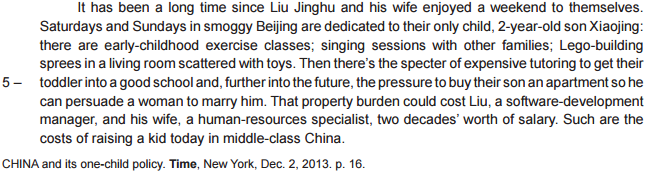
Marque C,se a proposição é verdadeira; E,se a proposição é falsa.
Liu Jinghu e sua esposa costumam divertir-se apenas nos fins de semana, quando seu único filho, Xiaojing, fica aos cuidados de amigos.
How Telecommuting Works
Telecommuting, which is growing in popularity, allows
employees to avoid long commutes.
“Brring,” the alarm startles you out of a deep sleep. It’s
8 a.m. on Monday morning. Time to head to the office.
You roll out of bed, brush your teeth and stumble your
way to the kitchen to grab some coffee.
Moments later, you head to the office, still wearing
your pajamas and fluffy slippers. Luckily for you, you
don’t have to go far – you work at home.
Telecommuting, or working at home, has grown in
popularity over the last 20 years.
On an increasing basis, workers are saying “no” to
long commutes and opting to work at home. In fact,
the U.S. Census Bureau reports that the number of
employees working from home grew by 23 percent
from 1990 to 2000.
Telecommuting workers revel in making their own
schedule – allowing them to schedule work around
family and personal commitments. With the ready
availability of technology tools, like the Internet and
home computers, companies are more willing to let
employees work from home.
( Adaptedfrom : < http: //home.howstuffworks.com/telecommuting.htm>Access on 18th January, 2014)
Everyone keeps data. Big organizations spend millions to look after their payroll, customer and transaction data. The penalties for getting it wrong are severe: businesses may collapse, shareholders and customers lose money, and for many organizations (airlines, health boards, energy companies), it is not exaggerating to say that even personal safety may be put at risk. And then there are the lawsuits. The problems in successfully designing, installing, and maintaining such large databases are the subject of numerous books on data management and software engineering. However, many small databases are used within large organizations and also for small businesses, clubs, and private concerns. When these go wrong, it doesn't make the front page of the papers; but the costs, often hidden, can be just as serious.
Where do we find these smaller electronic databases? Sports clubs will have membership information and match results; small businesses might maintain their own customer data. Within large organizations, there will also be a number of small projects to maintain data information that isn't easily or conveniently managed by the large system-wide databases. Researchers may keep their own experiment and survey results; groups will want to manage their own rosters or keep track of equipment; departments may keep their own detailed accounts and submit just a summary to the organization's financial software.
Most of these small databases are set up by end users. These are people whose main job is something other than that of a Computer professional. They will typically be scientists, administrators, technicians, accountants, or teachers, and many will have only modest skills when it comes to spreadsheet or database software.
The resulting databases often do not live up to expectations. Time and energy is expended to set up a few tables in a database product such as Microsoft Access, or in setting up a spreadsheet in a product such as Excel. Even more time is spent collecting and keying in data. But invariably (often within a short time frame) there is a problem producing what seems to be a quite simple report or query. Often this is because the way the tables have been set up makes the required result very awkward, if not impossible, to achieve.
A database that does not fulfill expectations becomes a
costly exercise in more ways than one. We clearly have the
cost of the time and effort expended on setting up an
unsatisfactory application. However, a much more serious
problem is the unability to make the best use of valuable
data. This is especially so for research data. Scientific and
social researchers may spend considerable money and many
years designing experiments, hiring assistants and collecting
and analyzing data, but often very little thought goes into
storing it in an appropriately designed database.
Unfortunately, some quite simple mistakes in design can mean that much of the potential information is lost. The
immediate objective may be satisfied, but unforeseen uses
of the data may be seriously compromised. Next year's grant
opportunities are lost.
Please write your name _____ block capitals.
The train was travelling _____ 120 miles an hour.
Look! That car is _____ fire.
The correct sequence is:
I don't remember ____________ about the accident.
Read text III and answer the question:
Text III

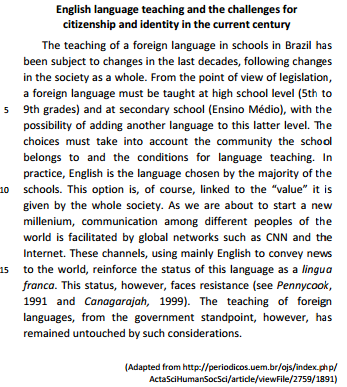
I. Discussing gender issues.
II. Emphasizing oral drilling.
III. Translating famous poets.
IV. Practicing critical literacy.
According to Text III, the strategies in line with the Brazilian National Parameters are
Read text III and answer the question:
Text III
Read text II and answer the question:

Read text II and answer the question:
Read text I and answer the question.
Read text I and answer the question.
Read text I and answer the question.
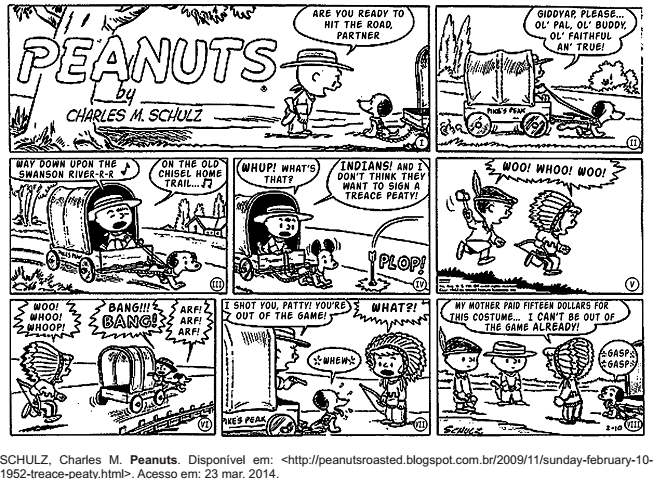
Com base no texto, julgue o item.
Nessa história em quadrinhos, o garoto, dirigindo a carroça, argumenta com Patty que ela foi baleada e que, portanto, está eliminada da brincadeira.
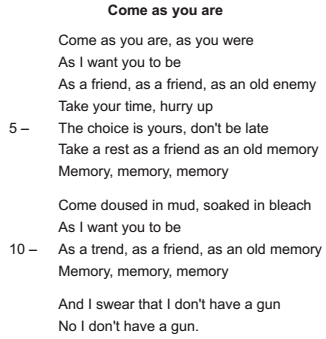
NIRVANA. Come as you are. Disponível em:<http://letras.mus.br/nirvana/28488> . Acesso em: 23 mar. 2014.
Com base no texto, julgue o item.
Nos dois últimos versos da canção – “And I swear that I don’t have a gun / No I don’t have a gun”–, o
autor lamenta o fato de não possuir uma arma.

 Conheça nossos planos