Questões de Concurso Comentadas sobre inglês
Foram encontradas 19.378 questões


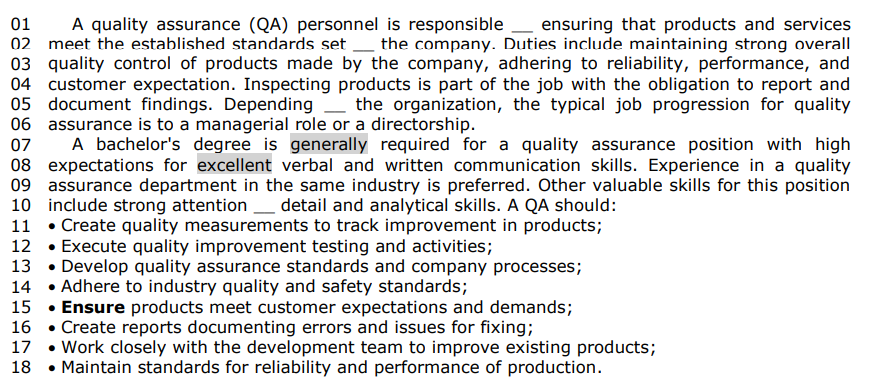
( ) The text is an advertisement for people to apply for this job position.
( ) The text is a description of what this kind of professional is expected to do at work.
( ) A QA can be promoted to a management position.
( ) To be a QA, you need an Information Technology degree.
The correct order of filling the parentheses, from top to bottom, is:
Dear Madam:
I have been shown in the files of the War Department a statement of the Adjutant-General of Massachusetts that you are the mother of five sons who have died gloriously on the field of battle. I feel how weak and fruitless must be any words of mine which should attempt to beguile you from the grief of a loss so overwhelming. But I cannot refrain from tendering to you the consolation that may be found in the thanks of the Republic they died to save. Hence, I pray that our Heavenly Father may assuage the anguish of your bereavement, and the solemn pride that must be yours to have laid so costly a sacrifice upon the altar of freedom.
Your very sincerely and respectfully,
Abraham Lincoln.
(Lederer, Richard. The miracle of language. Pocket Books, New York, NY.)

(Available: https://www.dreamstime.com.)
As we embrace more and more new technology, troublesome new trends – such as cyberbullying – have emerged that may have more widespread effects than traditional bullying alone. Choose the item which describes one sort of cyberbullying correctly.

(Maya Angelou.) I’ve got the children to tend The clothes to mend The floor to mop The food to shop Then the chicken to fry The baby to dry I got company to feed The garden to weed I've got shirts to press The tots to dress The cane to be cut I gotta clean up this hut Then see about the sick And the cotton to pick. Shine on me, sunshine Rain on me, rain Fall softly, dewdrops And cool my brow again. Storm, blow me from here with your fiercest wind Let me float across the sky ‘til I can rest again, fall gently, snowflakes, Cover me with white cold icy kisses and let me rest tonight. Sun, rain, curving sky, mountain, oceans, leaf and stone You're all that I can call my own. (Available: http://www.aquaculturewithoutfrontiers.org.)
In “Fall softly, dewdrops” and “Let me float across the sky ‘til I can rest again, fall gently, snowflakes” the words GENTLY and SOFTLY convey the concept of:
The Story Behind TIME’s ‘Resilience of Ukraine’ Cover
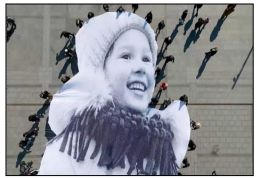
(Artwork by JR; Photograph by Artem Iurchenko. A drone was used to capture the cover image on March 14 in Lviv.)
Since Russia’s invasion began, dozens of Ukraine’s 7.5 million children have been killed and thousands of others have fled in search of safety. Among those thousands is 5-year-old Valeriia from Kryvyi Rih, President Volodymyr Zelensky’s hometown in central Ukraine. Her image – a smiling child – appears on one of this issue’s covers.
If you met Valeriia, you might think she’s shy, her mother Taisiia told TIME, but don’t be fooled; at home, she commands attention. She loves the same things as many little girls – her stuffed bunny; her Elsa doll fromCold Heart(which English speakers know as Frozen); and her pink backpack, which she had to leave behind as she ran off her country. Valeriia also has big dreams: in particular, starting her first year of school on Sept. 1. Now, it’s hard to say when and where Valeriia will be able to do so. On March 9, mother and daughter fled to Poland; for safety, they asked that TIME use only their first names. In an interview, Taisiia explained her decision to leave home to keep her child safe. “She is my sunshine, my joy.”
According to Taisiia they woke up early in the morning of Feb. 24 to learn the occupying army had started bombing military bases. “I thought about my daughter, Valeriia; for her safety, I knew we had to go. We left Ukraine before we were bombarded, so we had a chance.” Even though Valeriia is with her now, husband and son stayed in Ukraine and therefore, it was very hard to leave. The day they left, the lines for buses and trainsstretched 3 km, mostly women and children, she says, “We were packed together and had to stand for 18 hours on the train to Lviv”.
The Russians still haven’t come to their city. The people from Kryvyi Rih have fought them off. But they are closer and closer, and you can see them approaching. In the media, Russia says they aren’t at war in Ukraine. But the war is real. People are dying for real. “And here I am, with my sister, my nephew, and my mother in Poland, in a hotel near Warsaw. They take care of us and even in this difficult situation, it was a warm reception. I cannot find the words to express how grateful I am to everyone who has helped”, ends up a crying Taisiia.
(Available: https://time.com/magazine/europe. Adapted.)
Jane! I shouted... Where are you dear?
I am here, near the gas station… she replied.
The verbs “shouted” and “replied” underlined in the text refer to:
Complete the sentence with the correct form of the verb.
I always ________________ tired in the morning.
Ten critical actions needed to address four major cybersecurity challenges:
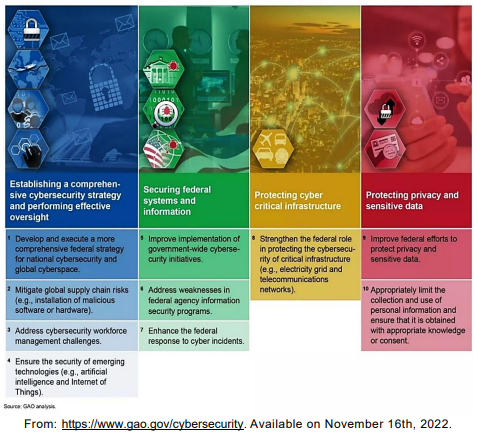
Ten critical actions needed to address four major cybersecurity challenges:
The use of the preposition for in “1. Develop and execute a more comprehensive
federal strategy for national cybersecurity…” indicates
Cybersecurity: An overview of cyber challenges facing the nation, and actions needed
Federal agencies and the nation’s critical infrastructure — such as energy, transportation systems, communications, and financial services — depend on Information Technology (IT) systems to carry out operations and process essential data. However, the risks to these IT systems are increasing—including insider threats from witting or unwitting employees, escalating and emerging threats from around the globe, and the emergence of new and more destructive attacks. Rapid developments in new technologies, such as artificial intelligence, the Internet of Things, and ubiquitous Internet and cellular connectivity, can also introduce security issues. Over 28,000 security incidents were reported by federal civilian agencies to the Department of Homeland Security in FY 2019.
Additionally, since many government IT systems contain vast amounts of personally identifiable information (PII), federal agencies must protect the confidentiality, integrity, and availability of this information—and effectively respond to data breaches and security incidents. Likewise, the trend in the private sector of collecting extensive and detailed information about individuals needs appropriate limits.
To highlight the importance of these issues, Government Accountability Office (GAO) has designated information security as a government-wide high-risk area since 1997. This high-risk area was expanded in 2003 to include the protection of critical cyber infrastructure and, in 2015, to include protecting the privacy of PII.
GAO has made about 3,300 recommendations to federal agencies to address cybersecurity shortcomings—and we reported that more than 750 of these had not been fully implemented as of December 2020. We designated 67 as priority, meaning that we believe they warrant priority attention from heads of key departments and agencies.
Adapted from: https://www.gao.gov/cybersecurity. Available on November 16th, 2022
What is the best alternative to fill the gaps to complete this conditional sentence?
“Until cybersecurity shortcoming ______ addressed, federal and critical infrastructure IT systems _______ increasingly susceptible to cyber threats.”
What is the BEST alternative to fill the gaps to complete this conditional sentence?
Cybersecurity: An overview of cyber challenges facing the nation, and actions needed
Federal agencies and the nation’s critical infrastructure — such as energy, transportation systems, communications, and financial services — depend on Information Technology (IT) systems to carry out operations and process essential data. However, the risks to these IT systems are increasing—including insider threats from witting or unwitting employees, escalating and emerging threats from around the globe, and the emergence of new and more destructive attacks. Rapid developments in new technologies, such as artificial intelligence, the Internet of Things, and ubiquitous Internet and cellular connectivity, can also introduce security issues. Over 28,000 security incidents were reported by federal civilian agencies to the Department of Homeland Security in FY 2019.
Additionally, since many government IT systems contain vast amounts of personally identifiable information (PII), federal agencies must protect the confidentiality, integrity, and availability of this information—and effectively respond to data breaches and security incidents. Likewise, the trend in the private sector of collecting extensive and detailed information about individuals needs appropriate limits.
To highlight the importance of these issues, Government Accountability Office (GAO) has designated information security as a government-wide high-risk area since 1997. This high-risk area was expanded in 2003 to include the protection of critical cyber infrastructure and, in 2015, to include protecting the privacy of PII.
GAO has made about 3,300 recommendations to federal agencies to address cybersecurity shortcomings—and we reported that more than 750 of these had not been fully implemented as of December 2020. We designated 67 as priority, meaning that we believe they warrant priority attention from heads of key departments and agencies.
Adapted from: https://www.gao.gov/cybersecurity. Available on November 16th, 2022
Cybersecurity: An overview of cyber challenges facing the nation, and actions needed
Federal agencies and the nation’s critical infrastructure — such as energy, transportation systems, communications, and financial services — depend on Information Technology (IT) systems to carry out operations and process essential data. However, the risks to these IT systems are increasing—including insider threats from witting or unwitting employees, escalating and emerging threats from around the globe, and the emergence of new and more destructive attacks. Rapid developments in new technologies, such as artificial intelligence, the Internet of Things, and ubiquitous Internet and cellular connectivity, can also introduce security issues. Over 28,000 security incidents were reported by federal civilian agencies to the Department of Homeland Security in FY 2019.
Additionally, since many government IT systems contain vast amounts of personally identifiable information (PII), federal agencies must protect the confidentiality, integrity, and availability of this information—and effectively respond to data breaches and security incidents. Likewise, the trend in the private sector of collecting extensive and detailed information about individuals needs appropriate limits.
To highlight the importance of these issues, Government Accountability Office (GAO) has designated information security as a government-wide high-risk area since 1997. This high-risk area was expanded in 2003 to include the protection of critical cyber infrastructure and, in 2015, to include protecting the privacy of PII.
GAO has made about 3,300 recommendations to federal agencies to address cybersecurity shortcomings—and we reported that more than 750 of these had not been fully implemented as of December 2020. We designated 67 as priority, meaning that we believe they warrant priority attention from heads of key departments and agencies.
Adapted from: https://www.gao.gov/cybersecurity. Available on November 16th, 2022
Cybersecurity: An overview of cyber challenges facing the nation, and actions needed
Federal agencies and the nation’s critical infrastructure — such as energy, transportation systems, communications, and financial services — depend on Information Technology (IT) systems to carry out operations and process essential data. However, the risks to these IT systems are increasing—including insider threats from witting or unwitting employees, escalating and emerging threats from around the globe, and the emergence of new and more destructive attacks. Rapid developments in new technologies, such as artificial intelligence, the Internet of Things, and ubiquitous Internet and cellular connectivity, can also introduce security issues. Over 28,000 security incidents were reported by federal civilian agencies to the Department of Homeland Security in FY 2019.
Additionally, since many government IT systems contain vast amounts of personally identifiable information (PII), federal agencies must protect the confidentiality, integrity, and availability of this information—and effectively respond to data breaches and security incidents. Likewise, the trend in the private sector of collecting extensive and detailed information about individuals needs appropriate limits.
To highlight the importance of these issues, Government Accountability Office (GAO) has designated information security as a government-wide high-risk area since 1997. This high-risk area was expanded in 2003 to include the protection of critical cyber infrastructure and, in 2015, to include protecting the privacy of PII.
GAO has made about 3,300 recommendations to federal agencies to address cybersecurity shortcomings—and we reported that more than 750 of these had not been fully implemented as of December 2020. We designated 67 as priority, meaning that we believe they warrant priority attention from heads of key departments and agencies.
Adapted from: https://www.gao.gov/cybersecurity. Available on November 16th, 2022
Cybersecurity: An overview of cyber challenges facing the nation, and actions needed
Federal agencies and the nation’s critical infrastructure — such as energy, transportation systems, communications, and financial services — depend on Information Technology (IT) systems to carry out operations and process essential data. However, the risks to these IT systems are increasing—including insider threats from witting or unwitting employees, escalating and emerging threats from around the globe, and the emergence of new and more destructive attacks. Rapid developments in new technologies, such as artificial intelligence, the Internet of Things, and ubiquitous Internet and cellular connectivity, can also introduce security issues. Over 28,000 security incidents were reported by federal civilian agencies to the Department of Homeland Security in FY 2019.
Additionally, since many government IT systems contain vast amounts of personally identifiable information (PII), federal agencies must protect the confidentiality, integrity, and availability of this information—and effectively respond to data breaches and security incidents. Likewise, the trend in the private sector of collecting extensive and detailed information about individuals needs appropriate limits.
To highlight the importance of these issues, Government Accountability Office (GAO) has designated information security as a government-wide high-risk area since 1997. This high-risk area was expanded in 2003 to include the protection of critical cyber infrastructure and, in 2015, to include protecting the privacy of PII.
GAO has made about 3,300 recommendations to federal agencies to address cybersecurity shortcomings—and we reported that more than 750 of these had not been fully implemented as of December 2020. We designated 67 as priority, meaning that we believe they warrant priority attention from heads of key departments and agencies.
Adapted from: https://www.gao.gov/cybersecurity. Available on November 16th, 2022
Cybersecurity: An overview of cyber challenges facing the nation, and actions needed
Federal agencies and the nation’s critical infrastructure — such as energy, transportation systems, communications, and financial services — depend on Information Technology (IT) systems to carry out operations and process essential data. However, the risks to these IT systems are increasing—including insider threats from witting or unwitting employees, escalating and emerging threats from around the globe, and the emergence of new and more destructive attacks. Rapid developments in new technologies, such as artificial intelligence, the Internet of Things, and ubiquitous Internet and cellular connectivity, can also introduce security issues. Over 28,000 security incidents were reported by federal civilian agencies to the Department of Homeland Security in FY 2019.
Additionally, since many government IT systems contain vast amounts of personally identifiable information (PII), federal agencies must protect the confidentiality, integrity, and availability of this information—and effectively respond to data breaches and security incidents. Likewise, the trend in the private sector of collecting extensive and detailed information about individuals needs appropriate limits.
To highlight the importance of these issues, Government Accountability Office (GAO) has designated information security as a government-wide high-risk area since 1997. This high-risk area was expanded in 2003 to include the protection of critical cyber infrastructure and, in 2015, to include protecting the privacy of PII.
GAO has made about 3,300 recommendations to federal agencies to address cybersecurity shortcomings—and we reported that more than 750 of these had not been fully implemented as of December 2020. We designated 67 as priority, meaning that we believe they warrant priority attention from heads of key departments and agencies.
Adapted from: https://www.gao.gov/cybersecurity. Available on November 16th, 2022
According to the text, the escalating threats to IT systems

 Conheça nossos planos