Questões de Concurso Comentadas sobre inglês
Foram encontradas 19.378 questões


Ano: 2023
Banca:
CPCON
Órgão:
Prefeitura de Dona Inês - PB
Prova:
CPCON - 2023 - Prefeitura de Dona Inês - PB - Professor B - Nível - 1 (Licenciatura em Inglês) |
Q2273301
Inglês
Texto associado
TEXT I – Tema: O papel da Língua Inglesa na BNCC
IS THE BNCC REALLY GOING TO AFFECT MY CLASSES?
(by Lúcia Rodrigues Alves)

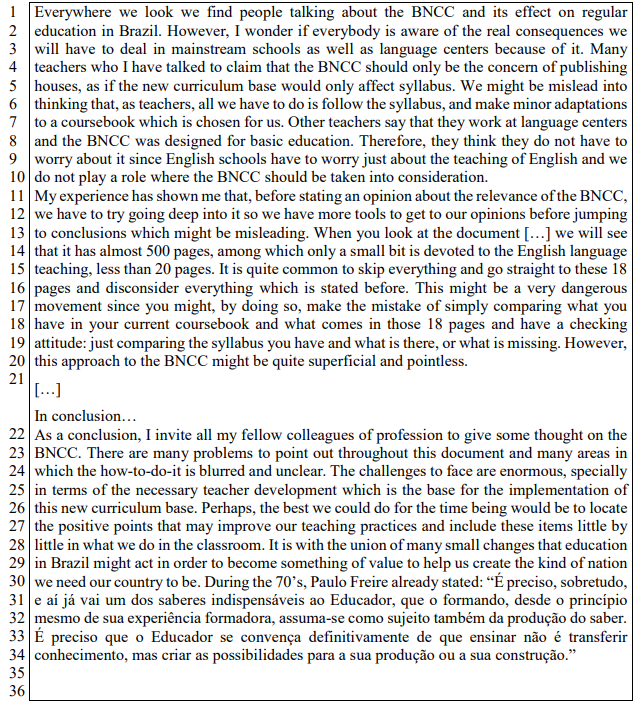
(Adapted from: https://www.luciarodriguesalves.com.br/is-the-bncc-really-going-to-affect-my-classes/. Accessed on July 1 , 2023)
In the sentence “[…] in terms of the necessary teacher development which is the base for the implementation of this new curriculum base” (lines 2 and 2 ), the word in bold:
Ano: 2023
Banca:
AMEOSC
Órgão:
Prefeitura de Bandeirante - SC
Prova:
AMEOSC - 2023 - Prefeitura de Bandeirante - SC - Professor de Inglês |
Q2272381
Inglês
Dentro do contexto da metodologia do ensino de língua
estrangeira, a abordagem comunicativa é amplamente
reconhecida por seu enfoque na comunicação eficaz e
interação linguística autêntica. No entanto, entre as
abordagens de ensino abaixo, qual se diferencia da
abordagem comunicativa ao priorizar a análise estrutural
da língua e a precisão linguística?
Ano: 2023
Banca:
AMEOSC
Órgão:
Prefeitura de Bandeirante - SC
Prova:
AMEOSC - 2023 - Prefeitura de Bandeirante - SC - Professor de Inglês |
Q2272380
Inglês
Considerando os Parâmetros Curriculares Nacionais -
Língua Inglesa, os objetivos de aprendizado estão
direcionados para a conscientização do aluno em
relação à Língua Estrangeira, abrangendo diversos
focos. Qual dos seguintes não é um desses focos?
Ano: 2023
Banca:
AMEOSC
Órgão:
Prefeitura de Bandeirante - SC
Prova:
AMEOSC - 2023 - Prefeitura de Bandeirante - SC - Professor de Inglês |
Q2272378
Inglês
A linguagem oral do inglês apresenta uma série de
desafios, incluindo a pronúncia de sons que podem
variar significativamente entre os dialetos. Entre os
seguintes sons do inglês, qual é conhecido por ser
particularmente complexo, com sua articulação
envolvendo uma mistura de vogal e consoante, e muitas
vezes representando um desafio para não nativos?
Ano: 2023
Banca:
AMEOSC
Órgão:
Prefeitura de Bandeirante - SC
Prova:
AMEOSC - 2023 - Prefeitura de Bandeirante - SC - Professor de Inglês |
Q2272376
Inglês
Texto associado
Netherlands: Phone ban announced to stop school
disruptions
(1º§) Devices including mobile phones are set to be
banned from classrooms to stop them from disrupting
learning, the Dutch government has announced. The
initiative is being introduced in collaboration with schools
and is to take effect at the start of next year.
(2º§) There will be some exceptions, including for
students with medical needs or a disability, and for
classes focused on digital skills. The ban is not legally
enforceable but may become so in the future. "Even
though mobile phones are almost intertwined with our
lives, they do not belong in the classroom," said
Education Minister Robbert Dijkgraaf. "Students must be
able to concentrate there and be given every opportunity
to learn well. We know from scientific research that
mobile phones disrupt this."
(3º§) Various studies have found limiting children's
screen time is linked to improved cognition and
concentration. Other tech including tablets and
smartwatches are also included in the Dutch ban. The
government said it would be up to individual schools to
agree the exact rules with teachers, parents and pupils -
including whether they wanted to completely ban devices
__ schools.
(4º§) The scheme is the result of an agreement between
the ministry, schools and related organisations. It will be
reviewed at the end of the 2024/2025 school year to see
how well it had worked and whether a legal ban is
needed. The announcement follows a similar decision by
Finland last week.
(5º§) Its government announced it would change the law
to make it easier __ restrict the use of phones in schools.
Other countries, including England and France, have also
proposed banning mobile phones to improve learning.
https://www.bbc.com/news/world-europe-66107027
According to the article, what evidence supports the
Dutch government's decision to ban mobile phones in
classrooms?
Ano: 2023
Banca:
AMEOSC
Órgão:
Prefeitura de Bandeirante - SC
Prova:
AMEOSC - 2023 - Prefeitura de Bandeirante - SC - Professor de Inglês |
Q2272375
Inglês
Texto associado
Netherlands: Phone ban announced to stop school
disruptions
(1º§) Devices including mobile phones are set to be
banned from classrooms to stop them from disrupting
learning, the Dutch government has announced. The
initiative is being introduced in collaboration with schools
and is to take effect at the start of next year.
(2º§) There will be some exceptions, including for
students with medical needs or a disability, and for
classes focused on digital skills. The ban is not legally
enforceable but may become so in the future. "Even
though mobile phones are almost intertwined with our
lives, they do not belong in the classroom," said
Education Minister Robbert Dijkgraaf. "Students must be
able to concentrate there and be given every opportunity
to learn well. We know from scientific research that
mobile phones disrupt this."
(3º§) Various studies have found limiting children's
screen time is linked to improved cognition and
concentration. Other tech including tablets and
smartwatches are also included in the Dutch ban. The
government said it would be up to individual schools to
agree the exact rules with teachers, parents and pupils -
including whether they wanted to completely ban devices
__ schools.
(4º§) The scheme is the result of an agreement between
the ministry, schools and related organisations. It will be
reviewed at the end of the 2024/2025 school year to see
how well it had worked and whether a legal ban is
needed. The announcement follows a similar decision by
Finland last week.
(5º§) Its government announced it would change the law
to make it easier __ restrict the use of phones in schools.
Other countries, including England and France, have also
proposed banning mobile phones to improve learning.
https://www.bbc.com/news/world-europe-66107027
Consider the sentence:
"The government said it would be up to individual schools to agree the exact rules with teachers." (3º§)
Which verb tense the sentence above is?
"The government said it would be up to individual schools to agree the exact rules with teachers." (3º§)
Which verb tense the sentence above is?
Ano: 2023
Banca:
AMEOSC
Órgão:
Prefeitura de Bandeirante - SC
Prova:
AMEOSC - 2023 - Prefeitura de Bandeirante - SC - Professor de Inglês |
Q2272374
Inglês
Texto associado
Netherlands: Phone ban announced to stop school
disruptions
(1º§) Devices including mobile phones are set to be
banned from classrooms to stop them from disrupting
learning, the Dutch government has announced. The
initiative is being introduced in collaboration with schools
and is to take effect at the start of next year.
(2º§) There will be some exceptions, including for
students with medical needs or a disability, and for
classes focused on digital skills. The ban is not legally
enforceable but may become so in the future. "Even
though mobile phones are almost intertwined with our
lives, they do not belong in the classroom," said
Education Minister Robbert Dijkgraaf. "Students must be
able to concentrate there and be given every opportunity
to learn well. We know from scientific research that
mobile phones disrupt this."
(3º§) Various studies have found limiting children's
screen time is linked to improved cognition and
concentration. Other tech including tablets and
smartwatches are also included in the Dutch ban. The
government said it would be up to individual schools to
agree the exact rules with teachers, parents and pupils -
including whether they wanted to completely ban devices
__ schools.
(4º§) The scheme is the result of an agreement between
the ministry, schools and related organisations. It will be
reviewed at the end of the 2024/2025 school year to see
how well it had worked and whether a legal ban is
needed. The announcement follows a similar decision by
Finland last week.
(5º§) Its government announced it would change the law
to make it easier __ restrict the use of phones in schools.
Other countries, including England and France, have also
proposed banning mobile phones to improve learning.
https://www.bbc.com/news/world-europe-66107027
In the text, which conjunction is used to introduce a
contrast between the idea of mobile phones being
intertwined with our lives and the belief that they do not
belong in the classroom?
Ano: 2023
Banca:
AMEOSC
Órgão:
Prefeitura de Bandeirante - SC
Prova:
AMEOSC - 2023 - Prefeitura de Bandeirante - SC - Professor de Inglês |
Q2272373
Inglês
Texto associado
Netherlands: Phone ban announced to stop school
disruptions
(1º§) Devices including mobile phones are set to be
banned from classrooms to stop them from disrupting
learning, the Dutch government has announced. The
initiative is being introduced in collaboration with schools
and is to take effect at the start of next year.
(2º§) There will be some exceptions, including for
students with medical needs or a disability, and for
classes focused on digital skills. The ban is not legally
enforceable but may become so in the future. "Even
though mobile phones are almost intertwined with our
lives, they do not belong in the classroom," said
Education Minister Robbert Dijkgraaf. "Students must be
able to concentrate there and be given every opportunity
to learn well. We know from scientific research that
mobile phones disrupt this."
(3º§) Various studies have found limiting children's
screen time is linked to improved cognition and
concentration. Other tech including tablets and
smartwatches are also included in the Dutch ban. The
government said it would be up to individual schools to
agree the exact rules with teachers, parents and pupils -
including whether they wanted to completely ban devices
__ schools.
(4º§) The scheme is the result of an agreement between
the ministry, schools and related organisations. It will be
reviewed at the end of the 2024/2025 school year to see
how well it had worked and whether a legal ban is
needed. The announcement follows a similar decision by
Finland last week.
(5º§) Its government announced it would change the law
to make it easier __ restrict the use of phones in schools.
Other countries, including England and France, have also
proposed banning mobile phones to improve learning.
https://www.bbc.com/news/world-europe-66107027
In the sentence: (2º§) "'Even though mobile phones are
almost intertwined with our lives, they do not belong in
the classroom,' said Education Minister Robbert
Dijkgraaf.", which type of reported speech is used?
Ano: 2023
Banca:
AMEOSC
Órgão:
Prefeitura de Bandeirante - SC
Prova:
AMEOSC - 2023 - Prefeitura de Bandeirante - SC - Professor de Inglês |
Q2272372
Inglês
Texto associado
Netherlands: Phone ban announced to stop school
disruptions
(1º§) Devices including mobile phones are set to be
banned from classrooms to stop them from disrupting
learning, the Dutch government has announced. The
initiative is being introduced in collaboration with schools
and is to take effect at the start of next year.
(2º§) There will be some exceptions, including for
students with medical needs or a disability, and for
classes focused on digital skills. The ban is not legally
enforceable but may become so in the future. "Even
though mobile phones are almost intertwined with our
lives, they do not belong in the classroom," said
Education Minister Robbert Dijkgraaf. "Students must be
able to concentrate there and be given every opportunity
to learn well. We know from scientific research that
mobile phones disrupt this."
(3º§) Various studies have found limiting children's
screen time is linked to improved cognition and
concentration. Other tech including tablets and
smartwatches are also included in the Dutch ban. The
government said it would be up to individual schools to
agree the exact rules with teachers, parents and pupils -
including whether they wanted to completely ban devices
__ schools.
(4º§) The scheme is the result of an agreement between
the ministry, schools and related organisations. It will be
reviewed at the end of the 2024/2025 school year to see
how well it had worked and whether a legal ban is
needed. The announcement follows a similar decision by
Finland last week.
(5º§) Its government announced it would change the law
to make it easier __ restrict the use of phones in schools.
Other countries, including England and France, have also
proposed banning mobile phones to improve learning.
https://www.bbc.com/news/world-europe-66107027
Choose the alternative that correctly fills in the blanks of
paragraphs 3º and 5º.
Ano: 2023
Banca:
AMEOSC
Órgão:
Prefeitura de Bandeirante - SC
Prova:
AMEOSC - 2023 - Prefeitura de Bandeirante - SC - Professor de Inglês |
Q2272371
Inglês
Texto associado
Netherlands: Phone ban announced to stop school
disruptions
(1º§) Devices including mobile phones are set to be
banned from classrooms to stop them from disrupting
learning, the Dutch government has announced. The
initiative is being introduced in collaboration with schools
and is to take effect at the start of next year.
(2º§) There will be some exceptions, including for
students with medical needs or a disability, and for
classes focused on digital skills. The ban is not legally
enforceable but may become so in the future. "Even
though mobile phones are almost intertwined with our
lives, they do not belong in the classroom," said
Education Minister Robbert Dijkgraaf. "Students must be
able to concentrate there and be given every opportunity
to learn well. We know from scientific research that
mobile phones disrupt this."
(3º§) Various studies have found limiting children's
screen time is linked to improved cognition and
concentration. Other tech including tablets and
smartwatches are also included in the Dutch ban. The
government said it would be up to individual schools to
agree the exact rules with teachers, parents and pupils -
including whether they wanted to completely ban devices
__ schools.
(4º§) The scheme is the result of an agreement between
the ministry, schools and related organisations. It will be
reviewed at the end of the 2024/2025 school year to see
how well it had worked and whether a legal ban is
needed. The announcement follows a similar decision by
Finland last week.
(5º§) Its government announced it would change the law
to make it easier __ restrict the use of phones in schools.
Other countries, including England and France, have also
proposed banning mobile phones to improve learning.
https://www.bbc.com/news/world-europe-66107027
In the sentence (3º§) "Other tech including tablets and
smartwatches are also included in the Dutch ban.," which
word contains a voiced fricative sound?
Ano: 2023
Banca:
AMEOSC
Órgão:
Prefeitura de Bandeirante - SC
Prova:
AMEOSC - 2023 - Prefeitura de Bandeirante - SC - Professor de Inglês |
Q2272370
Inglês
Texto associado
Netherlands: Phone ban announced to stop school
disruptions
(1º§) Devices including mobile phones are set to be
banned from classrooms to stop them from disrupting
learning, the Dutch government has announced. The
initiative is being introduced in collaboration with schools
and is to take effect at the start of next year.
(2º§) There will be some exceptions, including for
students with medical needs or a disability, and for
classes focused on digital skills. The ban is not legally
enforceable but may become so in the future. "Even
though mobile phones are almost intertwined with our
lives, they do not belong in the classroom," said
Education Minister Robbert Dijkgraaf. "Students must be
able to concentrate there and be given every opportunity
to learn well. We know from scientific research that
mobile phones disrupt this."
(3º§) Various studies have found limiting children's
screen time is linked to improved cognition and
concentration. Other tech including tablets and
smartwatches are also included in the Dutch ban. The
government said it would be up to individual schools to
agree the exact rules with teachers, parents and pupils -
including whether they wanted to completely ban devices
__ schools.
(4º§) The scheme is the result of an agreement between
the ministry, schools and related organisations. It will be
reviewed at the end of the 2024/2025 school year to see
how well it had worked and whether a legal ban is
needed. The announcement follows a similar decision by
Finland last week.
(5º§) Its government announced it would change the law
to make it easier __ restrict the use of phones in schools.
Other countries, including England and France, have also
proposed banning mobile phones to improve learning.
https://www.bbc.com/news/world-europe-66107027
Considering the context of the sentence, choose the
alternative that presents a false cognate.
Ano: 2023
Banca:
AMEOSC
Órgão:
Prefeitura de Bandeirante - SC
Prova:
AMEOSC - 2023 - Prefeitura de Bandeirante - SC - Professor de Inglês |
Q2272369
Inglês
Texto associado
Netherlands: Phone ban announced to stop school
disruptions
(1º§) Devices including mobile phones are set to be
banned from classrooms to stop them from disrupting
learning, the Dutch government has announced. The
initiative is being introduced in collaboration with schools
and is to take effect at the start of next year.
(2º§) There will be some exceptions, including for
students with medical needs or a disability, and for
classes focused on digital skills. The ban is not legally
enforceable but may become so in the future. "Even
though mobile phones are almost intertwined with our
lives, they do not belong in the classroom," said
Education Minister Robbert Dijkgraaf. "Students must be
able to concentrate there and be given every opportunity
to learn well. We know from scientific research that
mobile phones disrupt this."
(3º§) Various studies have found limiting children's
screen time is linked to improved cognition and
concentration. Other tech including tablets and
smartwatches are also included in the Dutch ban. The
government said it would be up to individual schools to
agree the exact rules with teachers, parents and pupils -
including whether they wanted to completely ban devices
__ schools.
(4º§) The scheme is the result of an agreement between
the ministry, schools and related organisations. It will be
reviewed at the end of the 2024/2025 school year to see
how well it had worked and whether a legal ban is
needed. The announcement follows a similar decision by
Finland last week.
(5º§) Its government announced it would change the law
to make it easier __ restrict the use of phones in schools.
Other countries, including England and France, have also
proposed banning mobile phones to improve learning.
https://www.bbc.com/news/world-europe-66107027
How does the Dutch government plan to determine the
success of the ban on mobile phones in classrooms?
Ano: 2023
Banca:
CETREDE
Órgão:
Prefeitura de Guaiúba - CE
Prova:
CETREDE - 2023 - Prefeitura de Guaiúba - CE - Professor Peb II - Língua Inglesa |
Q2267407
Inglês
Read the sentence below. The underlined part in the
sentence is a specific grammar structure in the English
language. Which one?
“We went to Jake’s father’s funeral.”
Choose the CORRECT answer.
“We went to Jake’s father’s funeral.”
Choose the CORRECT answer.
Ano: 2023
Banca:
CETREDE
Órgão:
Prefeitura de Guaiúba - CE
Prova:
CETREDE - 2023 - Prefeitura de Guaiúba - CE - Professor Peb II - Língua Inglesa |
Q2267406
Inglês
Choose the CORRECT answer.
My wife: “Look at all the smoke up ahead. Me: Crazy, right? And look at the number of firefighters and ambulances. The accident _________ have been serious.”
My wife: “Look at all the smoke up ahead. Me: Crazy, right? And look at the number of firefighters and ambulances. The accident _________ have been serious.”
Ano: 2023
Banca:
CETREDE
Órgão:
Prefeitura de Guaiúba - CE
Prova:
CETREDE - 2023 - Prefeitura de Guaiúba - CE - Professor Peb II - Língua Inglesa |
Q2267405
Inglês
Choose the CORRECT answer.
Talking to my child: “I know that this situation is difficult. _________ me just a little longer. Soon it will be over!”
Talking to my child: “I know that this situation is difficult. _________ me just a little longer. Soon it will be over!”
Ano: 2023
Banca:
CETREDE
Órgão:
Prefeitura de Guaiúba - CE
Prova:
CETREDE - 2023 - Prefeitura de Guaiúba - CE - Professor Peb II - Língua Inglesa |
Q2267404
Inglês
Which sentence is in the Passive Voice? Choose the
CORRECT answer.
Ano: 2023
Banca:
CETREDE
Órgão:
Prefeitura de Guaiúba - CE
Prova:
CETREDE - 2023 - Prefeitura de Guaiúba - CE - Professor Peb II - Língua Inglesa |
Q2267403
Inglês
Choose the CORRECT answer.
“What is the correct spelling of the number 5th, 15th, 50th respectively?”
“What is the correct spelling of the number 5th, 15th, 50th respectively?”
Ano: 2023
Banca:
CETREDE
Órgão:
Prefeitura de Guaiúba - CE
Prova:
CETREDE - 2023 - Prefeitura de Guaiúba - CE - Professor Peb II - Língua Inglesa |
Q2267402
Inglês
Choose the CORRECT answer.
“John works with another mate _________ name I can't remember.”
“John works with another mate _________ name I can't remember.”
Ano: 2023
Banca:
CETREDE
Órgão:
Prefeitura de Guaiúba - CE
Prova:
CETREDE - 2023 - Prefeitura de Guaiúba - CE - Professor Peb II - Língua Inglesa |
Q2267401
Inglês
What type of Conditional is the sentence below?
“I wouldn't worry if I were you.”
Choose the CORRECT answer.
“I wouldn't worry if I were you.”
Choose the CORRECT answer.
Ano: 2023
Banca:
CETREDE
Órgão:
Prefeitura de Guaiúba - CE
Prova:
CETREDE - 2023 - Prefeitura de Guaiúba - CE - Professor Peb II - Língua Inglesa |
Q2267399
Inglês
Which sentence uses the Causative appropriately?
Choose the CORRECT answer.

 Conheça nossos planos