Questões de Concurso Comentadas sobre inglês

Foram encontradas 19.378 questões

Q2392971 Inglês
It can be stated that the order of the adjectives in the noun group “rowdy audience members” found in paragraph 3 of text 1 is determined: 
Alternativas
Q2392970 Inglês
Text 1


From Shakespeare to Harry Styles: Have audiences always been rowdy?


By Clare Thorp12th July 2023


From Pink being given a giant wheel of Brie to Harry Syles getting pelled in the face by a mystery object, disruptive music and theatre shows seems to be on the rise. But is it anything new, asks Clare Thorp.


When Harry Styles was pelted with chicken nuggets while on stage at New York's Madison Square Gardens last summer, he took it in his stride. "Interesting approach," smiled Styles, who has also weathered kiwi fruits, Skittles and bunches of flowers while performing. But when a mystery object hit him in the eye at a concert in Vienna last weekend, he wasn't laughing but, rather, wincing in pain.


It was the latest in a string of incidents where audience members have hurled potentially dangerous objects at performers. Earlier this month Drake was hit on the arm by a flying phone. That came days after country singer Kelsea Ballerini was struck in the face with a bracelet. In May, Bebe Rexha was taken to hospital and needed multiple stitches after a phone hit her in the eye. A man, since charged with assault, told police he thought it "would be funny" to try and hit the singer.


It's not just live music seeing disruptive behaviour. In April, police were called to a performance of The Bodyguard musical in Manchester when rowdy audience members reacted with "unprecedented levels of violence" to staff. At other venues there has been everything from "heated arguments" to full-on brawls. And in the US, one fan's disruption of a Broadway play in December 2022 followed several other incidents of audience outbursts.


Across the cultural sphere, it feels like audiences are misbehaving. At a recent Las Vegas show, Adele weighed in, saying: "Have you noticed how people are like, forgetting … show etiquette at the moment? People just throwing shit on stage" – before warning fans not to try it with her.


Billie Eilish meanwhile, says this kind of thing, while "infuriating", is nothing new. "I've been getting hit on stage with things for like, literally, six years," she told the Hollywood Reporter. Dr Kirsty Sedgman, a senior lecturer in theatre at the University of Bristol who specialises in audience research, also cautions against calling it a new trend. "People have always thrown things on stage," says Sedgman, whose latest book, On Being Unreasonable, explores widening divisions in society over how we use public space. "Whether that's fruit as a way to signify displeasure, or softer items like underwear and flowers as a signal of adoration." Back In 1775, a performer in Sheridan's The Rivals stopped the show when he was pelted with an apple.


Adapted from: https://www.bbc.com/culture/article/20230712
The objective of question 3 is to explore the following aspect of the passive voice theory:
Alternativas
Q2392969 Inglês
Text 1


From Shakespeare to Harry Styles: Have audiences always been rowdy?


By Clare Thorp12th July 2023


From Pink being given a giant wheel of Brie to Harry Syles getting pelled in the face by a mystery object, disruptive music and theatre shows seems to be on the rise. But is it anything new, asks Clare Thorp.


When Harry Styles was pelted with chicken nuggets while on stage at New York's Madison Square Gardens last summer, he took it in his stride. "Interesting approach," smiled Styles, who has also weathered kiwi fruits, Skittles and bunches of flowers while performing. But when a mystery object hit him in the eye at a concert in Vienna last weekend, he wasn't laughing but, rather, wincing in pain.


It was the latest in a string of incidents where audience members have hurled potentially dangerous objects at performers. Earlier this month Drake was hit on the arm by a flying phone. That came days after country singer Kelsea Ballerini was struck in the face with a bracelet. In May, Bebe Rexha was taken to hospital and needed multiple stitches after a phone hit her in the eye. A man, since charged with assault, told police he thought it "would be funny" to try and hit the singer.


It's not just live music seeing disruptive behaviour. In April, police were called to a performance of The Bodyguard musical in Manchester when rowdy audience members reacted with "unprecedented levels of violence" to staff. At other venues there has been everything from "heated arguments" to full-on brawls. And in the US, one fan's disruption of a Broadway play in December 2022 followed several other incidents of audience outbursts.


Across the cultural sphere, it feels like audiences are misbehaving. At a recent Las Vegas show, Adele weighed in, saying: "Have you noticed how people are like, forgetting … show etiquette at the moment? People just throwing shit on stage" – before warning fans not to try it with her.


Billie Eilish meanwhile, says this kind of thing, while "infuriating", is nothing new. "I've been getting hit on stage with things for like, literally, six years," she told the Hollywood Reporter. Dr Kirsty Sedgman, a senior lecturer in theatre at the University of Bristol who specialises in audience research, also cautions against calling it a new trend. "People have always thrown things on stage," says Sedgman, whose latest book, On Being Unreasonable, explores widening divisions in society over how we use public space. "Whether that's fruit as a way to signify displeasure, or softer items like underwear and flowers as a signal of adoration." Back In 1775, a performer in Sheridan's The Rivals stopped the show when he was pelted with an apple.


Adapted from: https://www.bbc.com/culture/article/20230712
Passive voice is commonly used in journalistic texts. The extract below was retrieved from text 1. It justifies the use of passive voice because:

       From Pink being given a giant wheel of Brie to Harry Syles getting pelled in the face by a mystery object, disruptive music and theatre shows seems to be on the rise. 
Alternativas
Q2392968 Inglês
Text 1


From Shakespeare to Harry Styles: Have audiences always been rowdy?


By Clare Thorp12th July 2023


From Pink being given a giant wheel of Brie to Harry Syles getting pelled in the face by a mystery object, disruptive music and theatre shows seems to be on the rise. But is it anything new, asks Clare Thorp.


When Harry Styles was pelted with chicken nuggets while on stage at New York's Madison Square Gardens last summer, he took it in his stride. "Interesting approach," smiled Styles, who has also weathered kiwi fruits, Skittles and bunches of flowers while performing. But when a mystery object hit him in the eye at a concert in Vienna last weekend, he wasn't laughing but, rather, wincing in pain.


It was the latest in a string of incidents where audience members have hurled potentially dangerous objects at performers. Earlier this month Drake was hit on the arm by a flying phone. That came days after country singer Kelsea Ballerini was struck in the face with a bracelet. In May, Bebe Rexha was taken to hospital and needed multiple stitches after a phone hit her in the eye. A man, since charged with assault, told police he thought it "would be funny" to try and hit the singer.


It's not just live music seeing disruptive behaviour. In April, police were called to a performance of The Bodyguard musical in Manchester when rowdy audience members reacted with "unprecedented levels of violence" to staff. At other venues there has been everything from "heated arguments" to full-on brawls. And in the US, one fan's disruption of a Broadway play in December 2022 followed several other incidents of audience outbursts.


Across the cultural sphere, it feels like audiences are misbehaving. At a recent Las Vegas show, Adele weighed in, saying: "Have you noticed how people are like, forgetting … show etiquette at the moment? People just throwing shit on stage" – before warning fans not to try it with her.


Billie Eilish meanwhile, says this kind of thing, while "infuriating", is nothing new. "I've been getting hit on stage with things for like, literally, six years," she told the Hollywood Reporter. Dr Kirsty Sedgman, a senior lecturer in theatre at the University of Bristol who specialises in audience research, also cautions against calling it a new trend. "People have always thrown things on stage," says Sedgman, whose latest book, On Being Unreasonable, explores widening divisions in society over how we use public space. "Whether that's fruit as a way to signify displeasure, or softer items like underwear and flowers as a signal of adoration." Back In 1775, a performer in Sheridan's The Rivals stopped the show when he was pelted with an apple.


Adapted from: https://www.bbc.com/culture/article/20230712
It is accurate to state that question 1 objectives to assess readers’ ability of: 
Alternativas
Q2392967 Inglês
Text 1


From Shakespeare to Harry Styles: Have audiences always been rowdy?


By Clare Thorp12th July 2023


From Pink being given a giant wheel of Brie to Harry Syles getting pelled in the face by a mystery object, disruptive music and theatre shows seems to be on the rise. But is it anything new, asks Clare Thorp.


When Harry Styles was pelted with chicken nuggets while on stage at New York's Madison Square Gardens last summer, he took it in his stride. "Interesting approach," smiled Styles, who has also weathered kiwi fruits, Skittles and bunches of flowers while performing. But when a mystery object hit him in the eye at a concert in Vienna last weekend, he wasn't laughing but, rather, wincing in pain.


It was the latest in a string of incidents where audience members have hurled potentially dangerous objects at performers. Earlier this month Drake was hit on the arm by a flying phone. That came days after country singer Kelsea Ballerini was struck in the face with a bracelet. In May, Bebe Rexha was taken to hospital and needed multiple stitches after a phone hit her in the eye. A man, since charged with assault, told police he thought it "would be funny" to try and hit the singer.


It's not just live music seeing disruptive behaviour. In April, police were called to a performance of The Bodyguard musical in Manchester when rowdy audience members reacted with "unprecedented levels of violence" to staff. At other venues there has been everything from "heated arguments" to full-on brawls. And in the US, one fan's disruption of a Broadway play in December 2022 followed several other incidents of audience outbursts.


Across the cultural sphere, it feels like audiences are misbehaving. At a recent Las Vegas show, Adele weighed in, saying: "Have you noticed how people are like, forgetting … show etiquette at the moment? People just throwing shit on stage" – before warning fans not to try it with her.


Billie Eilish meanwhile, says this kind of thing, while "infuriating", is nothing new. "I've been getting hit on stage with things for like, literally, six years," she told the Hollywood Reporter. Dr Kirsty Sedgman, a senior lecturer in theatre at the University of Bristol who specialises in audience research, also cautions against calling it a new trend. "People have always thrown things on stage," says Sedgman, whose latest book, On Being Unreasonable, explores widening divisions in society over how we use public space. "Whether that's fruit as a way to signify displeasure, or softer items like underwear and flowers as a signal of adoration." Back In 1775, a performer in Sheridan's The Rivals stopped the show when he was pelted with an apple.


Adapted from: https://www.bbc.com/culture/article/20230712
About the communicative intention of the author, it can be said that:
Alternativas
Q2392611 Inglês
According to Capitalization Rules in English, the normatively correct sentence is.
Alternativas
Q2392610 Inglês
The spelling rules that explain why we write “M” before “P” and “B” are priorly: 
Alternativas
Q2392609 Inglês
The correct phonetic transcription to the quote “Gentlemen, the only way to achieve the impossible is to believe it is possible.” – from the movie Alice in Wonderland (2010) – is:
Alternativas
Q2392604 Inglês
Text 05 - Syllabus - See an explanation of the term ‘Syllabus’.


A syllabus is a document that describes what the contents of a language course will be and the order in which they will be taught. The content of a syllabus normally reflects certain beliefs about language and language learning.


Example

A syllabus might be designed around the order in which grammatical items are introduced. Starting with 'present simple' then 'past simple', then 'present perfect' etc.


In the classroom

There are many different types of syllabus (although often in language classrooms the syllabus from the course book is the only document). Syllabus types include grammatical, lexical and functional, which focus on the building blocks of language, and task-based and learner-centred, which focus on processes of communication and learning. 


Adapted from: https://www.teachingenglish.org.uk/professional-development/teachers/knowing-subject/q-s/syllabus accessed on July 18th, 2023.

According to text 05, Syllabus is, in Portuguese...
Alternativas
Q2392603 Inglês
Text 05 - Syllabus - See an explanation of the term ‘Syllabus’.


A syllabus is a document that describes what the contents of a language course will be and the order in which they will be taught. The content of a syllabus normally reflects certain beliefs about language and language learning.


Example

A syllabus might be designed around the order in which grammatical items are introduced. Starting with 'present simple' then 'past simple', then 'present perfect' etc.


In the classroom

There are many different types of syllabus (although often in language classrooms the syllabus from the course book is the only document). Syllabus types include grammatical, lexical and functional, which focus on the building blocks of language, and task-based and learner-centred, which focus on processes of communication and learning. 


Adapted from: https://www.teachingenglish.org.uk/professional-development/teachers/knowing-subject/q-s/syllabus accessed on July 18th, 2023.

In Text 05...
Alternativas
Q2392602 Inglês
Text 05 - Syllabus - See an explanation of the term ‘Syllabus’.


A syllabus is a document that describes what the contents of a language course will be and the order in which they will be taught. The content of a syllabus normally reflects certain beliefs about language and language learning.


Example

A syllabus might be designed around the order in which grammatical items are introduced. Starting with 'present simple' then 'past simple', then 'present perfect' etc.


In the classroom

There are many different types of syllabus (although often in language classrooms the syllabus from the course book is the only document). Syllabus types include grammatical, lexical and functional, which focus on the building blocks of language, and task-based and learner-centred, which focus on processes of communication and learning. 


Adapted from: https://www.teachingenglish.org.uk/professional-development/teachers/knowing-subject/q-s/syllabus accessed on July 18th, 2023.

There are three selections in Text 05 that appear underlined. All of them bring sentences...
Alternativas
Q2392594 Inglês

Text 03 – Idioms and proverbs 


Adapted from https://thefluentlife.com/content/difference-between-idioms-proverbs-meaning-examples/ , accessed on July 18th.

From what is briefly explained in text 03, the image below (Picture 01) represents:
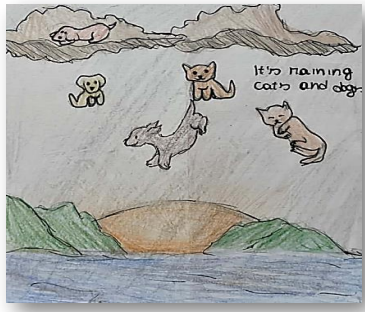


Imagem associada para resolução da questão


(Picture 01 – Illustrastion done by students in a language classroom).


Alternativas
Q2392592 Inglês
“This approach is based on the active involvement of the learner in speaking and listening to the foreign language in realistic everyday situations. No use is made of the learner’s mother tongue; learners are encouraged to think in the foreign language, and not to translate into or out of it. A great deal of emphasis is placed on good pronunciation, often introducing students to phonetic transcription before they see the standard orthography. Formal grammatical rules and terminology are avoided.”


(Adapted from “Teaching Methods”, The Cambridge Encyclopedia of Language, 3rd ed. David Crystal. P.394.)
The text excerpt above briefly describes: 
Alternativas
Q2392591 Inglês
Text 02 - (Types of social practices) Linguistics


The language spoken is one of the characteristics that most differentiate us from other animals on the planet. According to the experts, its appearance was one of the main causes of our development as a species; This is because the use of the language caused our brain to increase in capacity.


Therefore, linguistic social practices are a fundamental part of each culture. They include elements such as the language spoken, expressions and phrases made, or the importance given to certain words.


[...]


Social practices of language


Within all types of social practices that exist some of the most influencing a given society are those that have to do with their linguistic expression.


Due to the way in which language modifies the brain and the individual experience of people, the social practices of language take on great importance when it comes to understanding the customs and ways of seeing the world proper to a given society.


Even several studies have shown that bilingual people change their personality depending on the language they are speaking. So, what are the social practices of language?


These are ways of interacting that include both spoken and written language, in addition to all those activities that surround the communication process through it. Depending on the context in which we find ourselves and what we want to transmit, these practices will be different.


Also adapted from: https://www.lifepersona.com/social-practices-types-and-practices-of-language, accessed on July 17th, 2023. 
In “Within all types of social practices that exist some of the most influencing a given society are those that have to do with their linguistic expression.”, the word “a” refers to: 
Alternativas
Q2392590 Inglês
Text 02 - (Types of social practices) Linguistics


The language spoken is one of the characteristics that most differentiate us from other animals on the planet. According to the experts, its appearance was one of the main causes of our development as a species; This is because the use of the language caused our brain to increase in capacity.


Therefore, linguistic social practices are a fundamental part of each culture. They include elements such as the language spoken, expressions and phrases made, or the importance given to certain words.


[...]


Social practices of language


Within all types of social practices that exist some of the most influencing a given society are those that have to do with their linguistic expression.


Due to the way in which language modifies the brain and the individual experience of people, the social practices of language take on great importance when it comes to understanding the customs and ways of seeing the world proper to a given society.


Even several studies have shown that bilingual people change their personality depending on the language they are speaking. So, what are the social practices of language?


These are ways of interacting that include both spoken and written language, in addition to all those activities that surround the communication process through it. Depending on the context in which we find ourselves and what we want to transmit, these practices will be different.


Also adapted from: https://www.lifepersona.com/social-practices-types-and-practices-of-language, accessed on July 17th, 2023. 
From text 02, we visibly understand that:
Alternativas
Q2392589 Inglês
Text 01 - Social Practices: Types and Practices of Language.


The social practices


They are habits and ways of doing things that are established in a society and are practiced in the same way by all its inhabitants. These practices differ from one culture to another and, therefore, behaving in the same way in two different societies can lead to misunderstandings.


Because they are only implicit agreements about the way of doing things, no social practice is correct or incorrect. The adaptation of the social practices will have to do with the place and the moment in which they are carried out; for that reason it does not make sense to think that the practices of another society are wrong.


Social practices are built over the years and are modified as time passes. Therefore, what is common in today's society has nothing to do with the way in which it was correct to behave several decades ago. This means that social practices are not immutable either, but are always subject to change.


(...)


Adapted from: https://www.lifepersona.com/social-practices-types-and-practices-of-language, accessed on July 17th , 2023.


In “These practices differ from one culture to another and, therefore, behaving in the same way in two different societies can lead to misunderstandings.”, the word “misundertandings” brings an affix that: 
Alternativas
Q2392587 Inglês
Text 01 - Social Practices: Types and Practices of Language.


The social practices


They are habits and ways of doing things that are established in a society and are practiced in the same way by all its inhabitants. These practices differ from one culture to another and, therefore, behaving in the same way in two different societies can lead to misunderstandings.


Because they are only implicit agreements about the way of doing things, no social practice is correct or incorrect. The adaptation of the social practices will have to do with the place and the moment in which they are carried out; for that reason it does not make sense to think that the practices of another society are wrong.


Social practices are built over the years and are modified as time passes. Therefore, what is common in today's society has nothing to do with the way in which it was correct to behave several decades ago. This means that social practices are not immutable either, but are always subject to change.


(...)


Adapted from: https://www.lifepersona.com/social-practices-types-and-practices-of-language, accessed on July 17th , 2023.


According to what is written in text 01, it is correct to say that: 
Alternativas
Q2389806 Inglês

        Drones are an integral part of the defense and supply-chain industry. However, their prowess and versatility extend beyond these sectors. As the demand for UAVs (unmanned aerial vehicles) continues to increase, the drone market is now estimated to be valued at over 127 billion dollars.


        These uncrewed aircrafts can potentially develop numerous sectors, including transport and travel, exponentially. This is primarily due to their remarkable evolution of collision-avoidance technologies through computer vision and artificial intelligence, allowing them to operate autonomously.


        The dynamic innovation of drone transportation can positively impact emergency services by decreasing emergency response time, offering valuable data from inaccessible regions, and identifying victims via thermal imaging.


Though the concept of a UAV emerges from being “unmanned,” its autonomous power can be used to create functional, personal transportation. Well-known companies like Uber, Airbus, and Boeing are constantly working on developing self-flying drones that can take people from one place to another. 


        In conclusion, drone transportation has a lot of untapped potential beyond supply chain and security surveillance. Whether it is for emergencies, luxury, or space exploration, the future is optimistic for the travel industry.


Internet: <www.skygrid.com> (adapted).


Based on the previous text, judge the following item. 


The word “their” (second sentence of the second paragraph) refers back to “sectors” (first sentence of the second paragraph).  

Alternativas
Q2389803 Inglês

        Drones are an integral part of the defense and supply-chain industry. However, their prowess and versatility extend beyond these sectors. As the demand for UAVs (unmanned aerial vehicles) continues to increase, the drone market is now estimated to be valued at over 127 billion dollars.


        These uncrewed aircrafts can potentially develop numerous sectors, including transport and travel, exponentially. This is primarily due to their remarkable evolution of collision-avoidance technologies through computer vision and artificial intelligence, allowing them to operate autonomously.


        The dynamic innovation of drone transportation can positively impact emergency services by decreasing emergency response time, offering valuable data from inaccessible regions, and identifying victims via thermal imaging.


Though the concept of a UAV emerges from being “unmanned,” its autonomous power can be used to create functional, personal transportation. Well-known companies like Uber, Airbus, and Boeing are constantly working on developing self-flying drones that can take people from one place to another. 


        In conclusion, drone transportation has a lot of untapped potential beyond supply chain and security surveillance. Whether it is for emergencies, luxury, or space exploration, the future is optimistic for the travel industry.


Internet: <www.skygrid.com> (adapted).


Based on the previous text, judge the following item. 


The article foresees a possible use of drones to identify victims of accidents by detecting temperature emitted by their bodies. 

Alternativas
Q2389801 Inglês

        According to researchers in Mechanical Engineering at Penn State University, hummingbirds have extreme aerial agility and flight forms, which is why many drones and other aerial vehicles are designed to mimic hummingbird movement. Using a novel modeling method, Professor Bo Cheng and his team of researchers gained new insights into how hummingbirds produce wing movement, which could lead to design improvements in flying robots.


        “We essentially reverse-engineered the inner working of the wing musculoskeletal system — how the muscles and skeleton work in hummingbirds to flap the wings,” said first author and Penn State mechanical engineering graduate student Suyash Agrawal. “The traditional methods have mostly focused on measuring activity of a bird or insect when they are in natural flight or in an artificial environment where flight-like conditions are simulated. But most insects and, among birds specifically, hummingbirds are very small. The data that we can get from those measurements are limited.” 


        Penn State researchers used muscle anatomy literature, computational fluid dynamics simulation data and wing-skeletal movement information captured using micro-CT and X-ray methods to inform their model. They also used an optimization algorithm based on evolutionary strategies, known as the genetic algorithm, to calibrate the parameters of the model. According to the researchers, their approach is the first to integrate these disparate parts for biological fliers.


        With this model, the researchers uncovered previously unknown principles of hummingbird wing actuation. While Cheng emphasized that the results from the optimized model are predictions that will need validation, he said that it has implications for technological development of aerial vehicles.


Internet: <www.labmanager.com> (adapted).


Judge the following item according to the previous text.


Traditional measuring techniques offered restricted input about the flight of insects. 

Alternativas
Respostas
7561: B
7562: C
7563: A
7564: B
7565: D
7566: C
7567: D
7568: A
7569: A
7570: C
7571: B
7572: C
7573: A
7574: C
7575: D
7576: C
7577: B
7578: E
7579: C
7580: C