Questões de Concurso Sobre inglês
Foram encontradas 26.077 questões


Ano: 2026
Banca:
Instituto Legalle
Órgão:
Prefeitura de Fagundes Varela - RS
Prova:
Instituto Legalle - 2026 - Prefeitura de Fagundes Varela - RS - Professor de Língua Estrangeira |
Q4241026
Inglês
Texto associado
Sex Pollution
Sex pollution is a concept found in cultural
anthropology
-
specifically in the work of lrzlary Douglas.
In her book Purity and Danger, she examined
some of the different ways modern and more primitive
peoples determine what is clean and unclean.
Douglas explain ed that "dirt is essentially
disorder." When we clean something, we are "positively reordering our environment, making it conform to an idea."
When something or someone is determined to be
dirty, it has been contaminated by a thing from a different
category. Until it is cleaned or purified, it is partially out of
order.
In Douglas's words, "rituals of purity and impurity
create unity in experience." What is out of order becomes alien, dissonant, and suspect, making everyone else
uncomfortable.
Sexual pollution occurs when the sexes interact in
a way that blurs or ofÍends boundaries between males and
females, arrd disorder is created between the sexes.
In the case of men, it is usually believed that sexual
pollution weakens virility and diminishes their masculine
power.
Some readers may be familiar with the primitive
practice of constructing "menstrual huts" that separate
menstruating women from men. Tribes that engaged in
this practice viewed menstruating women as impure or
tainted in some way, and believed that their feminine
impurity could infect or pollute the masculine energy of
the tribe's men
-
ultimately weakening them and making
the tribe as a whole more vulnerable.
Menstrual huts are a simple example of a practice
dealing with the concept of sex pollution. There are a wide
variety of other ways that cultures have sought to contain
female energy to maintain an ordered separation of male
and female sexual identity.
Symbolically speaking, masculine identity always
represents the creation of distance and separation from
the feminine, the safety oÍ the nurturing mother, and a
protected womb-like existence. Virility is established and
maintained by venturing away from the world of women
and out into the wild, dangerous world of the men who
contend with danger and uncertainty at the edge of the
cultural perimeter and beyond. Establishing a masculine
identity always means establishing that men are not
women through the creation or revelation of contrast
between the sexes.
Fonte: https://www jack-donovan.com/sowilo /2024 /07 /06/beyond -theman-cave-sex-pollution and-the-retreat of-men-from-the-arts/
Analyze the following statements
I. If something is determined to be dirty because it has been contaminated by something from a different category, it is partially out of order until it is cleaned.
II. If something is determined to be dirty because it has been contaminated by something from different category, it is partially out of order until is cleaned.
III. lf something is determined to be dirty because it has been contaminated by something from a diÍÍerent category, it partially of order until it is cleaned.
IV. lf something is determined to be dirty because it has been contaminated by something from a different category, it partially out of order until it cleaned.
Which of the text's paraphrases about contamination creating disorder is CORRECT?
Ano: 2026
Banca:
FUNDATEC
Órgão:
Prefeitura de Água Doce - SC
Prova:
FUNDATEC - 2026 - Prefeitura de Água Doce - SC - Professor, com atuação de 6ª a 9ª séries do Ensino Fundamental Português/Inglês - Edital nº 3 PSS |
Q4237502
Inglês
Texto associado
Deaths in France surged 30% during hottest week of record June heatwave
By Jon Henley
(Available at: https://www.theguardian.com/world/2026/jul/03/deaths-france-surged-hottest-week-recordheatwave-june – text specially adapted for this test).
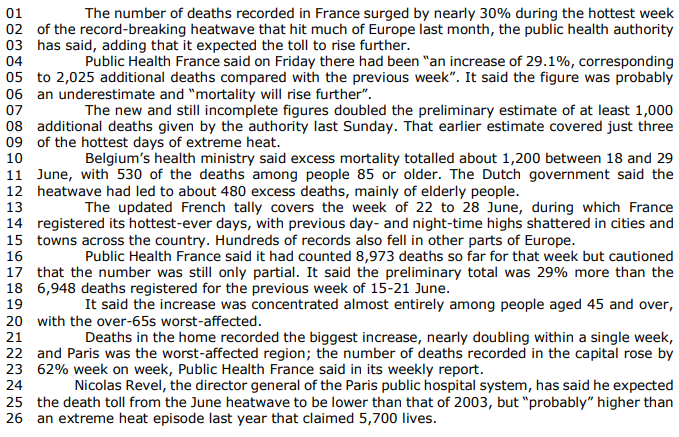
In the sentence “It said the figure was probably an underestimate [...]” (l. 05-06),
the pronoun “It” refers to:
Ano: 2026
Banca:
FUNDATEC
Órgão:
Prefeitura de Água Doce - SC
Prova:
FUNDATEC - 2026 - Prefeitura de Água Doce - SC - Professor, com atuação de 6ª a 9ª séries do Ensino Fundamental Português/Inglês - Edital nº 3 PSS |
Q4237501
Inglês
Texto associado
Deaths in France surged 30% during hottest week of record June heatwave
By Jon Henley
(Available at: https://www.theguardian.com/world/2026/jul/03/deaths-france-surged-hottest-week-recordheatwave-june – text specially adapted for this test).
Mark the alternative in which the verb “hit” is used with the same meaning as in the
sentence “the record-breaking heatwave that hit much of Europe last month […]” (l. 02).
Ano: 2026
Banca:
FUNDATEC
Órgão:
Prefeitura de Água Doce - SC
Prova:
FUNDATEC - 2026 - Prefeitura de Água Doce - SC - Professor, com atuação de 6ª a 9ª séries do Ensino Fundamental Português/Inglês - Edital nº 3 PSS |
Q4237500
Inglês
Texto associado
Deaths in France surged 30% during hottest week of record June heatwave
By Jon Henley
(Available at: https://www.theguardian.com/world/2026/jul/03/deaths-france-surged-hottest-week-recordheatwave-june – text specially adapted for this test).
What is the main purpose of the text?
Ano: 2026
Banca:
AMEOSC
Órgão:
Prefeitura de São Miguel do Oeste - SC
Prova:
AMEOSC - 2026 - Prefeitura de São Miguel do Oeste - SC - Professor (Língua Inglesa) |
Q4229162
Inglês
Texto associado
O texto seguinte servirá de base para responder à questão.
Peru's Nazca lines were paths for prehistoric culture:
Japanese researchers
Tokyo, 16 Jan (EFE).- The mysteries shrouding Peru's
Nazca Lines have intrigued scientists for decades. Now,
a group of Japanese researchers has developed a new
theory that the geoglyphs etched into the ground served
as paths and routes. The lines forged into myriad figures
of animals and plants straddle an area of 1,000 square
kilometers of the immense Ica desert in southern Peru.
They were created during the Nazca culture, a
pre-Columbian archaeological culture that flourished
between the 1st and 7th centuries BC. A research team
led by Masato Sakai, of the University of Yamagata in
western Japan, has discovered, with the help of local
archaeologists, aerial images and drones, over 350 new
etchings since 2004. Sakai says there are two types of
geoglyphs, linear motifs that were created by removing
the upper black stones to reveal the white earth
underneath and raised lines that give the pictorial
representations depth and that archeologists call relief
lines. «The linear ones exist at the beginning and end of
straight paths and can be used to travel from one valley
to another (...) while the relief ones are on the sides of
paths that are not straight and are usually etched on a
slope,» the expert says. The meaning of the lines has
long been up for debate. Some say they represented an
astronomical calendar, others considered they were
religious figures and some have even suggested that
they serve as landing pads for UFOs. «I'm interested in
letters,» Sakai says. «Everyone uses alphabets, but in
Andean civilization, they didn't have that way of
communicating, so I wanted to discover how they did
(communicate).»
The researcher is convinced that the Nazca lines were
used as a means of prehistoric communication
Despite their antiquity, the geoglyphs were not
discovered until 1930 because these could only be
appreciated with an aerial view or from some of the site's
surrounding hills. The team of Japanese researchers
started the project using satellite and aerial photos, and
more recently using drones, and have now identified
hundreds of figures, including a spider, a monkey, a
hummingbird, a condor, a pelican, a gull, a snail, a whale,
a snake and a llama. The team struck a deal with tech
giant IBM in 2019 and have tapped into state-of-the-art
artificial intelligence (AI) that could help reveal the
location of more figures and help with deciphering their
meaning. «It is always a hypothesis, but we hope that
with AI we can check whether theories are correct or
suggest better ones that coincide with the new data,» the
expert adds. Finding all the figures, which according to
the expert could be in the thousands, is key to their
conservation from both the weather and mining and
agriculture which is prevalent in the region. «For the
people of Nazca, the geoglyphs are a source of pride because the city is not very big, but many people come to
see the figures. When we find new ones, we share the
information with the local people because we know that
they will respect and defend them, because it is the work
of their ancestors» Sakai says. EFE
https://efe.com/other-news/2023-01-16/nazca-lines/
Read the excerpt below:
"Everyone uses alphabets, but in Andean civilization, they didn't have that way of communicating, so I wanted to discover how they did (communicate)."
In the context of the text, Sakai's statement indicates that his research is concerned with:
"Everyone uses alphabets, but in Andean civilization, they didn't have that way of communicating, so I wanted to discover how they did (communicate)."
In the context of the text, Sakai's statement indicates that his research is concerned with:
Ano: 2026
Banca:
AMEOSC
Órgão:
Prefeitura de São Miguel do Oeste - SC
Prova:
AMEOSC - 2026 - Prefeitura de São Miguel do Oeste - SC - Professor (Língua Inglesa) |
Q4229161
Inglês
Texto associado
O texto seguinte servirá de base para responder à questão.
Peru's Nazca lines were paths for prehistoric culture:
Japanese researchers
Tokyo, 16 Jan (EFE).- The mysteries shrouding Peru's
Nazca Lines have intrigued scientists for decades. Now,
a group of Japanese researchers has developed a new
theory that the geoglyphs etched into the ground served
as paths and routes. The lines forged into myriad figures
of animals and plants straddle an area of 1,000 square
kilometers of the immense Ica desert in southern Peru.
They were created during the Nazca culture, a
pre-Columbian archaeological culture that flourished
between the 1st and 7th centuries BC. A research team
led by Masato Sakai, of the University of Yamagata in
western Japan, has discovered, with the help of local
archaeologists, aerial images and drones, over 350 new
etchings since 2004. Sakai says there are two types of
geoglyphs, linear motifs that were created by removing
the upper black stones to reveal the white earth
underneath and raised lines that give the pictorial
representations depth and that archeologists call relief
lines. «The linear ones exist at the beginning and end of
straight paths and can be used to travel from one valley
to another (...) while the relief ones are on the sides of
paths that are not straight and are usually etched on a
slope,» the expert says. The meaning of the lines has
long been up for debate. Some say they represented an
astronomical calendar, others considered they were
religious figures and some have even suggested that
they serve as landing pads for UFOs. «I'm interested in
letters,» Sakai says. «Everyone uses alphabets, but in
Andean civilization, they didn't have that way of
communicating, so I wanted to discover how they did
(communicate).»
The researcher is convinced that the Nazca lines were
used as a means of prehistoric communication
Despite their antiquity, the geoglyphs were not
discovered until 1930 because these could only be
appreciated with an aerial view or from some of the site's
surrounding hills. The team of Japanese researchers
started the project using satellite and aerial photos, and
more recently using drones, and have now identified
hundreds of figures, including a spider, a monkey, a
hummingbird, a condor, a pelican, a gull, a snail, a whale,
a snake and a llama. The team struck a deal with tech
giant IBM in 2019 and have tapped into state-of-the-art
artificial intelligence (AI) that could help reveal the
location of more figures and help with deciphering their
meaning. «It is always a hypothesis, but we hope that
with AI we can check whether theories are correct or
suggest better ones that coincide with the new data,» the
expert adds. Finding all the figures, which according to
the expert could be in the thousands, is key to their
conservation from both the weather and mining and
agriculture which is prevalent in the region. «For the
people of Nazca, the geoglyphs are a source of pride because the city is not very big, but many people come to
see the figures. When we find new ones, we share the
information with the local people because we know that
they will respect and defend them, because it is the work
of their ancestors» Sakai says. EFE
https://efe.com/other-news/2023-01-16/nazca-lines/
The words "hypothesis," "archaeological," "created,"
"lines," "culture" and "Japanese" appear in the text.
Considering pronunciation, stress and spelling-sound
relations in English, the correct statement is:
Ano: 2026
Banca:
AMEOSC
Órgão:
Prefeitura de São Miguel do Oeste - SC
Prova:
AMEOSC - 2026 - Prefeitura de São Miguel do Oeste - SC - Professor (Língua Inglesa) |
Q4229160
Inglês
Texto associado
O texto seguinte servirá de base para responder à questão.
Peru's Nazca lines were paths for prehistoric culture:
Japanese researchers
Tokyo, 16 Jan (EFE).- The mysteries shrouding Peru's
Nazca Lines have intrigued scientists for decades. Now,
a group of Japanese researchers has developed a new
theory that the geoglyphs etched into the ground served
as paths and routes. The lines forged into myriad figures
of animals and plants straddle an area of 1,000 square
kilometers of the immense Ica desert in southern Peru.
They were created during the Nazca culture, a
pre-Columbian archaeological culture that flourished
between the 1st and 7th centuries BC. A research team
led by Masato Sakai, of the University of Yamagata in
western Japan, has discovered, with the help of local
archaeologists, aerial images and drones, over 350 new
etchings since 2004. Sakai says there are two types of
geoglyphs, linear motifs that were created by removing
the upper black stones to reveal the white earth
underneath and raised lines that give the pictorial
representations depth and that archeologists call relief
lines. «The linear ones exist at the beginning and end of
straight paths and can be used to travel from one valley
to another (...) while the relief ones are on the sides of
paths that are not straight and are usually etched on a
slope,» the expert says. The meaning of the lines has
long been up for debate. Some say they represented an
astronomical calendar, others considered they were
religious figures and some have even suggested that
they serve as landing pads for UFOs. «I'm interested in
letters,» Sakai says. «Everyone uses alphabets, but in
Andean civilization, they didn't have that way of
communicating, so I wanted to discover how they did
(communicate).»
The researcher is convinced that the Nazca lines were
used as a means of prehistoric communication
Despite their antiquity, the geoglyphs were not
discovered until 1930 because these could only be
appreciated with an aerial view or from some of the site's
surrounding hills. The team of Japanese researchers
started the project using satellite and aerial photos, and
more recently using drones, and have now identified
hundreds of figures, including a spider, a monkey, a
hummingbird, a condor, a pelican, a gull, a snail, a whale,
a snake and a llama. The team struck a deal with tech
giant IBM in 2019 and have tapped into state-of-the-art
artificial intelligence (AI) that could help reveal the
location of more figures and help with deciphering their
meaning. «It is always a hypothesis, but we hope that
with AI we can check whether theories are correct or
suggest better ones that coincide with the new data,» the
expert adds. Finding all the figures, which according to
the expert could be in the thousands, is key to their
conservation from both the weather and mining and
agriculture which is prevalent in the region. «For the
people of Nazca, the geoglyphs are a source of pride because the city is not very big, but many people come to
see the figures. When we find new ones, we share the
information with the local people because we know that
they will respect and defend them, because it is the work
of their ancestors» Sakai says. EFE
https://efe.com/other-news/2023-01-16/nazca-lines/
Considering its structure, language and communicative
purpose, the text is classified as:
Ano: 2026
Banca:
AMEOSC
Órgão:
Prefeitura de São Miguel do Oeste - SC
Prova:
AMEOSC - 2026 - Prefeitura de São Miguel do Oeste - SC - Professor (Língua Inglesa) |
Q4229159
Inglês
Texto associado
O texto seguinte servirá de base para responder à questão.
Peru's Nazca lines were paths for prehistoric culture:
Japanese researchers
Tokyo, 16 Jan (EFE).- The mysteries shrouding Peru's
Nazca Lines have intrigued scientists for decades. Now,
a group of Japanese researchers has developed a new
theory that the geoglyphs etched into the ground served
as paths and routes. The lines forged into myriad figures
of animals and plants straddle an area of 1,000 square
kilometers of the immense Ica desert in southern Peru.
They were created during the Nazca culture, a
pre-Columbian archaeological culture that flourished
between the 1st and 7th centuries BC. A research team
led by Masato Sakai, of the University of Yamagata in
western Japan, has discovered, with the help of local
archaeologists, aerial images and drones, over 350 new
etchings since 2004. Sakai says there are two types of
geoglyphs, linear motifs that were created by removing
the upper black stones to reveal the white earth
underneath and raised lines that give the pictorial
representations depth and that archeologists call relief
lines. «The linear ones exist at the beginning and end of
straight paths and can be used to travel from one valley
to another (...) while the relief ones are on the sides of
paths that are not straight and are usually etched on a
slope,» the expert says. The meaning of the lines has
long been up for debate. Some say they represented an
astronomical calendar, others considered they were
religious figures and some have even suggested that
they serve as landing pads for UFOs. «I'm interested in
letters,» Sakai says. «Everyone uses alphabets, but in
Andean civilization, they didn't have that way of
communicating, so I wanted to discover how they did
(communicate).»
The researcher is convinced that the Nazca lines were
used as a means of prehistoric communication
Despite their antiquity, the geoglyphs were not
discovered until 1930 because these could only be
appreciated with an aerial view or from some of the site's
surrounding hills. The team of Japanese researchers
started the project using satellite and aerial photos, and
more recently using drones, and have now identified
hundreds of figures, including a spider, a monkey, a
hummingbird, a condor, a pelican, a gull, a snail, a whale,
a snake and a llama. The team struck a deal with tech
giant IBM in 2019 and have tapped into state-of-the-art
artificial intelligence (AI) that could help reveal the
location of more figures and help with deciphering their
meaning. «It is always a hypothesis, but we hope that
with AI we can check whether theories are correct or
suggest better ones that coincide with the new data,» the
expert adds. Finding all the figures, which according to
the expert could be in the thousands, is key to their
conservation from both the weather and mining and
agriculture which is prevalent in the region. «For the
people of Nazca, the geoglyphs are a source of pride because the city is not very big, but many people come to
see the figures. When we find new ones, we share the
information with the local people because we know that
they will respect and defend them, because it is the work
of their ancestors» Sakai says. EFE
https://efe.com/other-news/2023-01-16/nazca-lines/
Read the excerpt below:
"The lines forged into myriad figures of animals and plants straddle an area of 1,000 square kilometers of the immense Ica desert in southern Peru."
In this context, the verb "straddle" indicates that the figures:
"The lines forged into myriad figures of animals and plants straddle an area of 1,000 square kilometers of the immense Ica desert in southern Peru."
In this context, the verb "straddle" indicates that the figures:
Ano: 2026
Banca:
AMEOSC
Órgão:
Prefeitura de São Miguel do Oeste - SC
Prova:
AMEOSC - 2026 - Prefeitura de São Miguel do Oeste - SC - Professor (Língua Inglesa) |
Q4229158
Inglês
Texto associado
O texto seguinte servirá de base para responder à questão.
Peru's Nazca lines were paths for prehistoric culture:
Japanese researchers
Tokyo, 16 Jan (EFE).- The mysteries shrouding Peru's
Nazca Lines have intrigued scientists for decades. Now,
a group of Japanese researchers has developed a new
theory that the geoglyphs etched into the ground served
as paths and routes. The lines forged into myriad figures
of animals and plants straddle an area of 1,000 square
kilometers of the immense Ica desert in southern Peru.
They were created during the Nazca culture, a
pre-Columbian archaeological culture that flourished
between the 1st and 7th centuries BC. A research team
led by Masato Sakai, of the University of Yamagata in
western Japan, has discovered, with the help of local
archaeologists, aerial images and drones, over 350 new
etchings since 2004. Sakai says there are two types of
geoglyphs, linear motifs that were created by removing
the upper black stones to reveal the white earth
underneath and raised lines that give the pictorial
representations depth and that archeologists call relief
lines. «The linear ones exist at the beginning and end of
straight paths and can be used to travel from one valley
to another (...) while the relief ones are on the sides of
paths that are not straight and are usually etched on a
slope,» the expert says. The meaning of the lines has
long been up for debate. Some say they represented an
astronomical calendar, others considered they were
religious figures and some have even suggested that
they serve as landing pads for UFOs. «I'm interested in
letters,» Sakai says. «Everyone uses alphabets, but in
Andean civilization, they didn't have that way of
communicating, so I wanted to discover how they did
(communicate).»
The researcher is convinced that the Nazca lines were
used as a means of prehistoric communication
Despite their antiquity, the geoglyphs were not
discovered until 1930 because these could only be
appreciated with an aerial view or from some of the site's
surrounding hills. The team of Japanese researchers
started the project using satellite and aerial photos, and
more recently using drones, and have now identified
hundreds of figures, including a spider, a monkey, a
hummingbird, a condor, a pelican, a gull, a snail, a whale,
a snake and a llama. The team struck a deal with tech
giant IBM in 2019 and have tapped into state-of-the-art
artificial intelligence (AI) that could help reveal the
location of more figures and help with deciphering their
meaning. «It is always a hypothesis, but we hope that
with AI we can check whether theories are correct or
suggest better ones that coincide with the new data,» the
expert adds. Finding all the figures, which according to
the expert could be in the thousands, is key to their
conservation from both the weather and mining and
agriculture which is prevalent in the region. «For the
people of Nazca, the geoglyphs are a source of pride because the city is not very big, but many people come to
see the figures. When we find new ones, we share the
information with the local people because we know that
they will respect and defend them, because it is the work
of their ancestors» Sakai says. EFE
https://efe.com/other-news/2023-01-16/nazca-lines/
Based on the way the information is organized in the text, it can be inferred that:
Ano: 2026
Banca:
AMEOSC
Órgão:
Prefeitura de São Miguel do Oeste - SC
Prova:
AMEOSC - 2026 - Prefeitura de São Miguel do Oeste - SC - Professor (Língua Inglesa) |
Q4229157
Inglês
Texto associado
O texto seguinte servirá de base para responder à questão.
Peru's Nazca lines were paths for prehistoric culture:
Japanese researchers
Tokyo, 16 Jan (EFE).- The mysteries shrouding Peru's
Nazca Lines have intrigued scientists for decades. Now,
a group of Japanese researchers has developed a new
theory that the geoglyphs etched into the ground served
as paths and routes. The lines forged into myriad figures
of animals and plants straddle an area of 1,000 square
kilometers of the immense Ica desert in southern Peru.
They were created during the Nazca culture, a
pre-Columbian archaeological culture that flourished
between the 1st and 7th centuries BC. A research team
led by Masato Sakai, of the University of Yamagata in
western Japan, has discovered, with the help of local
archaeologists, aerial images and drones, over 350 new
etchings since 2004. Sakai says there are two types of
geoglyphs, linear motifs that were created by removing
the upper black stones to reveal the white earth
underneath and raised lines that give the pictorial
representations depth and that archeologists call relief
lines. «The linear ones exist at the beginning and end of
straight paths and can be used to travel from one valley
to another (...) while the relief ones are on the sides of
paths that are not straight and are usually etched on a
slope,» the expert says. The meaning of the lines has
long been up for debate. Some say they represented an
astronomical calendar, others considered they were
religious figures and some have even suggested that
they serve as landing pads for UFOs. «I'm interested in
letters,» Sakai says. «Everyone uses alphabets, but in
Andean civilization, they didn't have that way of
communicating, so I wanted to discover how they did
(communicate).»
The researcher is convinced that the Nazca lines were
used as a means of prehistoric communication
Despite their antiquity, the geoglyphs were not
discovered until 1930 because these could only be
appreciated with an aerial view or from some of the site's
surrounding hills. The team of Japanese researchers
started the project using satellite and aerial photos, and
more recently using drones, and have now identified
hundreds of figures, including a spider, a monkey, a
hummingbird, a condor, a pelican, a gull, a snail, a whale,
a snake and a llama. The team struck a deal with tech
giant IBM in 2019 and have tapped into state-of-the-art
artificial intelligence (AI) that could help reveal the
location of more figures and help with deciphering their
meaning. «It is always a hypothesis, but we hope that
with AI we can check whether theories are correct or
suggest better ones that coincide with the new data,» the
expert adds. Finding all the figures, which according to
the expert could be in the thousands, is key to their
conservation from both the weather and mining and
agriculture which is prevalent in the region. «For the
people of Nazca, the geoglyphs are a source of pride because the city is not very big, but many people come to
see the figures. When we find new ones, we share the
information with the local people because we know that
they will respect and defend them, because it is the work
of their ancestors» Sakai says. EFE
https://efe.com/other-news/2023-01-16/nazca-lines/
Consider the sentences from the text:
"The mysteries shrouding Peru's Nazca Lines have intrigued scientists for decades."
"They were created during the Nazca culture."
"A research team led by Masato Sakai [...] has discovered [...] over 350 new etchings since 2004."
The verb forms used in the sentences are correctly explained in:
"The mysteries shrouding Peru's Nazca Lines have intrigued scientists for decades."
"They were created during the Nazca culture."
"A research team led by Masato Sakai [...] has discovered [...] over 350 new etchings since 2004."
The verb forms used in the sentences are correctly explained in:
Ano: 2026
Banca:
AMEOSC
Órgão:
Prefeitura de São Miguel do Oeste - SC
Prova:
AMEOSC - 2026 - Prefeitura de São Miguel do Oeste - SC - Professor (Língua Inglesa) |
Q4229156
Inglês
Texto associado
O texto seguinte servirá de base para responder à questão.
Peru's Nazca lines were paths for prehistoric culture:
Japanese researchers
Tokyo, 16 Jan (EFE).- The mysteries shrouding Peru's
Nazca Lines have intrigued scientists for decades. Now,
a group of Japanese researchers has developed a new
theory that the geoglyphs etched into the ground served
as paths and routes. The lines forged into myriad figures
of animals and plants straddle an area of 1,000 square
kilometers of the immense Ica desert in southern Peru.
They were created during the Nazca culture, a
pre-Columbian archaeological culture that flourished
between the 1st and 7th centuries BC. A research team
led by Masato Sakai, of the University of Yamagata in
western Japan, has discovered, with the help of local
archaeologists, aerial images and drones, over 350 new
etchings since 2004. Sakai says there are two types of
geoglyphs, linear motifs that were created by removing
the upper black stones to reveal the white earth
underneath and raised lines that give the pictorial
representations depth and that archeologists call relief
lines. «The linear ones exist at the beginning and end of
straight paths and can be used to travel from one valley
to another (...) while the relief ones are on the sides of
paths that are not straight and are usually etched on a
slope,» the expert says. The meaning of the lines has
long been up for debate. Some say they represented an
astronomical calendar, others considered they were
religious figures and some have even suggested that
they serve as landing pads for UFOs. «I'm interested in
letters,» Sakai says. «Everyone uses alphabets, but in
Andean civilization, they didn't have that way of
communicating, so I wanted to discover how they did
(communicate).»
The researcher is convinced that the Nazca lines were
used as a means of prehistoric communication
Despite their antiquity, the geoglyphs were not
discovered until 1930 because these could only be
appreciated with an aerial view or from some of the site's
surrounding hills. The team of Japanese researchers
started the project using satellite and aerial photos, and
more recently using drones, and have now identified
hundreds of figures, including a spider, a monkey, a
hummingbird, a condor, a pelican, a gull, a snail, a whale,
a snake and a llama. The team struck a deal with tech
giant IBM in 2019 and have tapped into state-of-the-art
artificial intelligence (AI) that could help reveal the
location of more figures and help with deciphering their
meaning. «It is always a hypothesis, but we hope that
with AI we can check whether theories are correct or
suggest better ones that coincide with the new data,» the
expert adds. Finding all the figures, which according to
the expert could be in the thousands, is key to their
conservation from both the weather and mining and
agriculture which is prevalent in the region. «For the
people of Nazca, the geoglyphs are a source of pride because the city is not very big, but many people come to
see the figures. When we find new ones, we share the
information with the local people because we know that
they will respect and defend them, because it is the work
of their ancestors» Sakai says. EFE
https://efe.com/other-news/2023-01-16/nazca-lines/
Read the sentence below:
"It is always a hypothesis, but we hope that with AI we can check whether theories are correct or suggest better ones that coincide with the new data," the expert adds.
The modal verb "can" is used in the sentence to express:
"It is always a hypothesis, but we hope that with AI we can check whether theories are correct or suggest better ones that coincide with the new data," the expert adds.
The modal verb "can" is used in the sentence to express:
Ano: 2026
Banca:
AMEOSC
Órgão:
Prefeitura de São Miguel do Oeste - SC
Prova:
AMEOSC - 2026 - Prefeitura de São Miguel do Oeste - SC - Professor (Língua Inglesa) |
Q4229155
Inglês
Texto associado
O texto seguinte servirá de base para responder à questão.
Peru's Nazca lines were paths for prehistoric culture:
Japanese researchers
Tokyo, 16 Jan (EFE).- The mysteries shrouding Peru's
Nazca Lines have intrigued scientists for decades. Now,
a group of Japanese researchers has developed a new
theory that the geoglyphs etched into the ground served
as paths and routes. The lines forged into myriad figures
of animals and plants straddle an area of 1,000 square
kilometers of the immense Ica desert in southern Peru.
They were created during the Nazca culture, a
pre-Columbian archaeological culture that flourished
between the 1st and 7th centuries BC. A research team
led by Masato Sakai, of the University of Yamagata in
western Japan, has discovered, with the help of local
archaeologists, aerial images and drones, over 350 new
etchings since 2004. Sakai says there are two types of
geoglyphs, linear motifs that were created by removing
the upper black stones to reveal the white earth
underneath and raised lines that give the pictorial
representations depth and that archeologists call relief
lines. «The linear ones exist at the beginning and end of
straight paths and can be used to travel from one valley
to another (...) while the relief ones are on the sides of
paths that are not straight and are usually etched on a
slope,» the expert says. The meaning of the lines has
long been up for debate. Some say they represented an
astronomical calendar, others considered they were
religious figures and some have even suggested that
they serve as landing pads for UFOs. «I'm interested in
letters,» Sakai says. «Everyone uses alphabets, but in
Andean civilization, they didn't have that way of
communicating, so I wanted to discover how they did
(communicate).»
The researcher is convinced that the Nazca lines were
used as a means of prehistoric communication
Despite their antiquity, the geoglyphs were not
discovered until 1930 because these could only be
appreciated with an aerial view or from some of the site's
surrounding hills. The team of Japanese researchers
started the project using satellite and aerial photos, and
more recently using drones, and have now identified
hundreds of figures, including a spider, a monkey, a
hummingbird, a condor, a pelican, a gull, a snail, a whale,
a snake and a llama. The team struck a deal with tech
giant IBM in 2019 and have tapped into state-of-the-art
artificial intelligence (AI) that could help reveal the
location of more figures and help with deciphering their
meaning. «It is always a hypothesis, but we hope that
with AI we can check whether theories are correct or
suggest better ones that coincide with the new data,» the
expert adds. Finding all the figures, which according to
the expert could be in the thousands, is key to their
conservation from both the weather and mining and
agriculture which is prevalent in the region. «For the
people of Nazca, the geoglyphs are a source of pride because the city is not very big, but many people come to
see the figures. When we find new ones, we share the
information with the local people because we know that
they will respect and defend them, because it is the work
of their ancestors» Sakai says. EFE
https://efe.com/other-news/2023-01-16/nazca-lines/
Read the excerpt below:
"Finding all the figures, which according to the expert could be in the thousands, is key to their conservation from both the weather and mining and agriculture which is prevalent in the region."
According to the excerpt, the identification of new geoglyphs is relevant because it:
"Finding all the figures, which according to the expert could be in the thousands, is key to their conservation from both the weather and mining and agriculture which is prevalent in the region."
According to the excerpt, the identification of new geoglyphs is relevant because it:
Ano: 2026
Banca:
AMEOSC
Órgão:
Prefeitura de São Miguel do Oeste - SC
Prova:
AMEOSC - 2026 - Prefeitura de São Miguel do Oeste - SC - Professor (Língua Inglesa) |
Q4229154
Inglês
Texto associado
O texto seguinte servirá de base para responder à questão.
Peru's Nazca lines were paths for prehistoric culture:
Japanese researchers
Tokyo, 16 Jan (EFE).- The mysteries shrouding Peru's
Nazca Lines have intrigued scientists for decades. Now,
a group of Japanese researchers has developed a new
theory that the geoglyphs etched into the ground served
as paths and routes. The lines forged into myriad figures
of animals and plants straddle an area of 1,000 square
kilometers of the immense Ica desert in southern Peru.
They were created during the Nazca culture, a
pre-Columbian archaeological culture that flourished
between the 1st and 7th centuries BC. A research team
led by Masato Sakai, of the University of Yamagata in
western Japan, has discovered, with the help of local
archaeologists, aerial images and drones, over 350 new
etchings since 2004. Sakai says there are two types of
geoglyphs, linear motifs that were created by removing
the upper black stones to reveal the white earth
underneath and raised lines that give the pictorial
representations depth and that archeologists call relief
lines. «The linear ones exist at the beginning and end of
straight paths and can be used to travel from one valley
to another (...) while the relief ones are on the sides of
paths that are not straight and are usually etched on a
slope,» the expert says. The meaning of the lines has
long been up for debate. Some say they represented an
astronomical calendar, others considered they were
religious figures and some have even suggested that
they serve as landing pads for UFOs. «I'm interested in
letters,» Sakai says. «Everyone uses alphabets, but in
Andean civilization, they didn't have that way of
communicating, so I wanted to discover how they did
(communicate).»
The researcher is convinced that the Nazca lines were
used as a means of prehistoric communication
Despite their antiquity, the geoglyphs were not
discovered until 1930 because these could only be
appreciated with an aerial view or from some of the site's
surrounding hills. The team of Japanese researchers
started the project using satellite and aerial photos, and
more recently using drones, and have now identified
hundreds of figures, including a spider, a monkey, a
hummingbird, a condor, a pelican, a gull, a snail, a whale,
a snake and a llama. The team struck a deal with tech
giant IBM in 2019 and have tapped into state-of-the-art
artificial intelligence (AI) that could help reveal the
location of more figures and help with deciphering their
meaning. «It is always a hypothesis, but we hope that
with AI we can check whether theories are correct or
suggest better ones that coincide with the new data,» the
expert adds. Finding all the figures, which according to
the expert could be in the thousands, is key to their
conservation from both the weather and mining and
agriculture which is prevalent in the region. «For the
people of Nazca, the geoglyphs are a source of pride because the city is not very big, but many people come to
see the figures. When we find new ones, we share the
information with the local people because we know that
they will respect and defend them, because it is the work
of their ancestors» Sakai says. EFE
https://efe.com/other-news/2023-01-16/nazca-lines/
A teacher uses the text about the Nazca Lines in an
English class. Students read the article, examine images
of the geoglyphs, compare different hypotheses, discuss
the use of drones and artificial intelligence, and produce
a short multimodal news report in English. The procedure
that corresponds to multiliteracies and digital literacy is:
Ano: 2026
Banca:
AMEOSC
Órgão:
Prefeitura de São Miguel do Oeste - SC
Prova:
AMEOSC - 2026 - Prefeitura de São Miguel do Oeste - SC - Professor (Língua Inglesa) |
Q4229153
Inglês
Texto associado
O texto seguinte servirá de base para responder à questão.
Peru's Nazca lines were paths for prehistoric culture:
Japanese researchers
Tokyo, 16 Jan (EFE).- The mysteries shrouding Peru's
Nazca Lines have intrigued scientists for decades. Now,
a group of Japanese researchers has developed a new
theory that the geoglyphs etched into the ground served
as paths and routes. The lines forged into myriad figures
of animals and plants straddle an area of 1,000 square
kilometers of the immense Ica desert in southern Peru.
They were created during the Nazca culture, a
pre-Columbian archaeological culture that flourished
between the 1st and 7th centuries BC. A research team
led by Masato Sakai, of the University of Yamagata in
western Japan, has discovered, with the help of local
archaeologists, aerial images and drones, over 350 new
etchings since 2004. Sakai says there are two types of
geoglyphs, linear motifs that were created by removing
the upper black stones to reveal the white earth
underneath and raised lines that give the pictorial
representations depth and that archeologists call relief
lines. «The linear ones exist at the beginning and end of
straight paths and can be used to travel from one valley
to another (...) while the relief ones are on the sides of
paths that are not straight and are usually etched on a
slope,» the expert says. The meaning of the lines has
long been up for debate. Some say they represented an
astronomical calendar, others considered they were
religious figures and some have even suggested that
they serve as landing pads for UFOs. «I'm interested in
letters,» Sakai says. «Everyone uses alphabets, but in
Andean civilization, they didn't have that way of
communicating, so I wanted to discover how they did
(communicate).»
The researcher is convinced that the Nazca lines were
used as a means of prehistoric communication
Despite their antiquity, the geoglyphs were not
discovered until 1930 because these could only be
appreciated with an aerial view or from some of the site's
surrounding hills. The team of Japanese researchers
started the project using satellite and aerial photos, and
more recently using drones, and have now identified
hundreds of figures, including a spider, a monkey, a
hummingbird, a condor, a pelican, a gull, a snail, a whale,
a snake and a llama. The team struck a deal with tech
giant IBM in 2019 and have tapped into state-of-the-art
artificial intelligence (AI) that could help reveal the
location of more figures and help with deciphering their
meaning. «It is always a hypothesis, but we hope that
with AI we can check whether theories are correct or
suggest better ones that coincide with the new data,» the
expert adds. Finding all the figures, which according to
the expert could be in the thousands, is key to their
conservation from both the weather and mining and
agriculture which is prevalent in the region. «For the
people of Nazca, the geoglyphs are a source of pride because the city is not very big, but many people come to
see the figures. When we find new ones, we share the
information with the local people because we know that
they will respect and defend them, because it is the work
of their ancestors» Sakai says. EFE
https://efe.com/other-news/2023-01-16/nazca-lines/
Based on the text about the Nazca Lines, choose the
option that synthesizes the central claim presented by the
Japanese research team.
Ano: 2026
Banca:
AMEOSC
Órgão:
Prefeitura de São Miguel do Oeste - SC
Prova:
AMEOSC - 2026 - Prefeitura de São Miguel do Oeste - SC - Professor (Língua Inglesa) |
Q4229152
Inglês
Texto associado
O texto seguinte servirá de base para responder à questão.
Peru's Nazca lines were paths for prehistoric culture:
Japanese researchers
Tokyo, 16 Jan (EFE).- The mysteries shrouding Peru's
Nazca Lines have intrigued scientists for decades. Now,
a group of Japanese researchers has developed a new
theory that the geoglyphs etched into the ground served
as paths and routes. The lines forged into myriad figures
of animals and plants straddle an area of 1,000 square
kilometers of the immense Ica desert in southern Peru.
They were created during the Nazca culture, a
pre-Columbian archaeological culture that flourished
between the 1st and 7th centuries BC. A research team
led by Masato Sakai, of the University of Yamagata in
western Japan, has discovered, with the help of local
archaeologists, aerial images and drones, over 350 new
etchings since 2004. Sakai says there are two types of
geoglyphs, linear motifs that were created by removing
the upper black stones to reveal the white earth
underneath and raised lines that give the pictorial
representations depth and that archeologists call relief
lines. «The linear ones exist at the beginning and end of
straight paths and can be used to travel from one valley
to another (...) while the relief ones are on the sides of
paths that are not straight and are usually etched on a
slope,» the expert says. The meaning of the lines has
long been up for debate. Some say they represented an
astronomical calendar, others considered they were
religious figures and some have even suggested that
they serve as landing pads for UFOs. «I'm interested in
letters,» Sakai says. «Everyone uses alphabets, but in
Andean civilization, they didn't have that way of
communicating, so I wanted to discover how they did
(communicate).»
The researcher is convinced that the Nazca lines were
used as a means of prehistoric communication
Despite their antiquity, the geoglyphs were not
discovered until 1930 because these could only be
appreciated with an aerial view or from some of the site's
surrounding hills. The team of Japanese researchers
started the project using satellite and aerial photos, and
more recently using drones, and have now identified
hundreds of figures, including a spider, a monkey, a
hummingbird, a condor, a pelican, a gull, a snail, a whale,
a snake and a llama. The team struck a deal with tech
giant IBM in 2019 and have tapped into state-of-the-art
artificial intelligence (AI) that could help reveal the
location of more figures and help with deciphering their
meaning. «It is always a hypothesis, but we hope that
with AI we can check whether theories are correct or
suggest better ones that coincide with the new data,» the
expert adds. Finding all the figures, which according to
the expert could be in the thousands, is key to their
conservation from both the weather and mining and
agriculture which is prevalent in the region. «For the
people of Nazca, the geoglyphs are a source of pride because the city is not very big, but many people come to
see the figures. When we find new ones, we share the
information with the local people because we know that
they will respect and defend them, because it is the work
of their ancestors» Sakai says. EFE
https://efe.com/other-news/2023-01-16/nazca-lines/
Read the sentence below:
"The team struck a deal with tech giant IBM in 2019 and have tapped into state-of-the-art artificial intelligence that could help reveal the location of more figures."
In the sentence, the expressions "struck a deal" and "tapped into" indicate, respectively:
"The team struck a deal with tech giant IBM in 2019 and have tapped into state-of-the-art artificial intelligence that could help reveal the location of more figures."
In the sentence, the expressions "struck a deal" and "tapped into" indicate, respectively:
Ano: 2026
Banca:
AMEOSC
Órgão:
Prefeitura de São Miguel do Oeste - SC
Prova:
AMEOSC - 2026 - Prefeitura de São Miguel do Oeste - SC - Professor (Língua Inglesa) |
Q4229151
Inglês
Texto associado
O texto seguinte servirá de base para responder à questão.
Peru's Nazca lines were paths for prehistoric culture:
Japanese researchers
Tokyo, 16 Jan (EFE).- The mysteries shrouding Peru's
Nazca Lines have intrigued scientists for decades. Now,
a group of Japanese researchers has developed a new
theory that the geoglyphs etched into the ground served
as paths and routes. The lines forged into myriad figures
of animals and plants straddle an area of 1,000 square
kilometers of the immense Ica desert in southern Peru.
They were created during the Nazca culture, a
pre-Columbian archaeological culture that flourished
between the 1st and 7th centuries BC. A research team
led by Masato Sakai, of the University of Yamagata in
western Japan, has discovered, with the help of local
archaeologists, aerial images and drones, over 350 new
etchings since 2004. Sakai says there are two types of
geoglyphs, linear motifs that were created by removing
the upper black stones to reveal the white earth
underneath and raised lines that give the pictorial
representations depth and that archeologists call relief
lines. «The linear ones exist at the beginning and end of
straight paths and can be used to travel from one valley
to another (...) while the relief ones are on the sides of
paths that are not straight and are usually etched on a
slope,» the expert says. The meaning of the lines has
long been up for debate. Some say they represented an
astronomical calendar, others considered they were
religious figures and some have even suggested that
they serve as landing pads for UFOs. «I'm interested in
letters,» Sakai says. «Everyone uses alphabets, but in
Andean civilization, they didn't have that way of
communicating, so I wanted to discover how they did
(communicate).»
The researcher is convinced that the Nazca lines were
used as a means of prehistoric communication
Despite their antiquity, the geoglyphs were not
discovered until 1930 because these could only be
appreciated with an aerial view or from some of the site's
surrounding hills. The team of Japanese researchers
started the project using satellite and aerial photos, and
more recently using drones, and have now identified
hundreds of figures, including a spider, a monkey, a
hummingbird, a condor, a pelican, a gull, a snail, a whale,
a snake and a llama. The team struck a deal with tech
giant IBM in 2019 and have tapped into state-of-the-art
artificial intelligence (AI) that could help reveal the
location of more figures and help with deciphering their
meaning. «It is always a hypothesis, but we hope that
with AI we can check whether theories are correct or
suggest better ones that coincide with the new data,» the
expert adds. Finding all the figures, which according to
the expert could be in the thousands, is key to their
conservation from both the weather and mining and
agriculture which is prevalent in the region. «For the
people of Nazca, the geoglyphs are a source of pride because the city is not very big, but many people come to
see the figures. When we find new ones, we share the
information with the local people because we know that
they will respect and defend them, because it is the work
of their ancestors» Sakai says. EFE
https://efe.com/other-news/2023-01-16/nazca-lines/
Read the sentence below:
"Despite their antiquity, the geoglyphs were not discovered until 1930 because they could only be appreciated with an aerial view or from some of the site's surrounding hills."
The word "Despite" establishes a relation of:
"Despite their antiquity, the geoglyphs were not discovered until 1930 because they could only be appreciated with an aerial view or from some of the site's surrounding hills."
The word "Despite" establishes a relation of:
Ano: 2026
Banca:
AMEOSC
Órgão:
Prefeitura de São Miguel do Oeste - SC
Prova:
AMEOSC - 2026 - Prefeitura de São Miguel do Oeste - SC - Professor (Língua Inglesa) |
Q4229150
Inglês
Texto associado
O texto seguinte servirá de base para responder à questão.
Peru's Nazca lines were paths for prehistoric culture:
Japanese researchers
Tokyo, 16 Jan (EFE).- The mysteries shrouding Peru's
Nazca Lines have intrigued scientists for decades. Now,
a group of Japanese researchers has developed a new
theory that the geoglyphs etched into the ground served
as paths and routes. The lines forged into myriad figures
of animals and plants straddle an area of 1,000 square
kilometers of the immense Ica desert in southern Peru.
They were created during the Nazca culture, a
pre-Columbian archaeological culture that flourished
between the 1st and 7th centuries BC. A research team
led by Masato Sakai, of the University of Yamagata in
western Japan, has discovered, with the help of local
archaeologists, aerial images and drones, over 350 new
etchings since 2004. Sakai says there are two types of
geoglyphs, linear motifs that were created by removing
the upper black stones to reveal the white earth
underneath and raised lines that give the pictorial
representations depth and that archeologists call relief
lines. «The linear ones exist at the beginning and end of
straight paths and can be used to travel from one valley
to another (...) while the relief ones are on the sides of
paths that are not straight and are usually etched on a
slope,» the expert says. The meaning of the lines has
long been up for debate. Some say they represented an
astronomical calendar, others considered they were
religious figures and some have even suggested that
they serve as landing pads for UFOs. «I'm interested in
letters,» Sakai says. «Everyone uses alphabets, but in
Andean civilization, they didn't have that way of
communicating, so I wanted to discover how they did
(communicate).»
The researcher is convinced that the Nazca lines were
used as a means of prehistoric communication
Despite their antiquity, the geoglyphs were not
discovered until 1930 because these could only be
appreciated with an aerial view or from some of the site's
surrounding hills. The team of Japanese researchers
started the project using satellite and aerial photos, and
more recently using drones, and have now identified
hundreds of figures, including a spider, a monkey, a
hummingbird, a condor, a pelican, a gull, a snail, a whale,
a snake and a llama. The team struck a deal with tech
giant IBM in 2019 and have tapped into state-of-the-art
artificial intelligence (AI) that could help reveal the
location of more figures and help with deciphering their
meaning. «It is always a hypothesis, but we hope that
with AI we can check whether theories are correct or
suggest better ones that coincide with the new data,» the
expert adds. Finding all the figures, which according to
the expert could be in the thousands, is key to their
conservation from both the weather and mining and
agriculture which is prevalent in the region. «For the
people of Nazca, the geoglyphs are a source of pride because the city is not very big, but many people come to
see the figures. When we find new ones, we share the
information with the local people because we know that
they will respect and defend them, because it is the work
of their ancestors» Sakai says. EFE
https://efe.com/other-news/2023-01-16/nazca-lines/
Read the excerpt below:
"When we find new ones, we share the information with the local people because we know that they will respect and defend them, because it is the work of their ancestors," Sakai says.
In an English language class, the excerpt allows the teacher to address intercultural competence by emphasizing:
"When we find new ones, we share the information with the local people because we know that they will respect and defend them, because it is the work of their ancestors," Sakai says.
In an English language class, the excerpt allows the teacher to address intercultural competence by emphasizing:
Ano: 2026
Banca:
FUNDATEC
Órgão:
Prefeitura de Água Doce - SC
Prova:
FUNDATEC - 2026 - Prefeitura de Água Doce - SC - Professor de Português / Inglês |
Q4226412
Inglês
Texto associado

US heatwave threatens 250th anniversary events and World Cup
By Dharna Noor
(Available at: https://www.theguardian.com/us-news/2026/jul/03/heatwave-world-cup-250th-anniversary –
text specially adapted for this test).
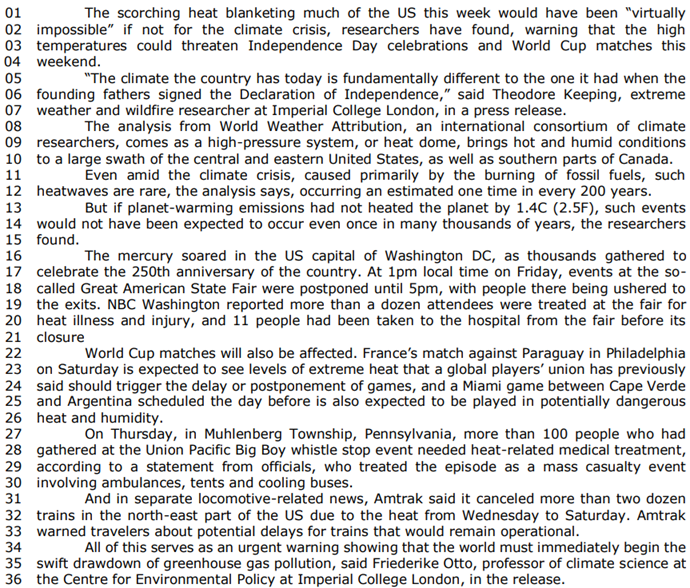
In the excerpt “But if planet-warming emissions had not heated the planet by 1.4 °C
(2.5 °F), such events would not have been expected to occur [...]” (l. 13–14), the conditional sentence
indicates that the researchers suggest that
Ano: 2026
Banca:
FUNDATEC
Órgão:
Prefeitura de Água Doce - SC
Prova:
FUNDATEC - 2026 - Prefeitura de Água Doce - SC - Professor de Português / Inglês |
Q4226411
Inglês
Texto associado
US heatwave threatens 250th anniversary events and World Cup
By Dharna Noor
(Available at: https://www.theguardian.com/us-news/2026/jul/03/heatwave-world-cup-250th-anniversary –
text specially adapted for this test).
In the sentence "[...] it will continue to get worse the longer we drag out the
inevitable transition to net zero emissions." (l. 41–42), the expression in bold means:
Ano: 2026
Banca:
FUNDATEC
Órgão:
Prefeitura de Água Doce - SC
Prova:
FUNDATEC - 2026 - Prefeitura de Água Doce - SC - Professor de Português / Inglês |
Q4226410
Inglês
Texto associado
US heatwave threatens 250th anniversary events and World Cup
By Dharna Noor
(Available at: https://www.theguardian.com/us-news/2026/jul/03/heatwave-world-cup-250th-anniversary –
text specially adapted for this test).
What is the main purpose of the text?

 Conheça nossos planos