Questões de Concurso Sobre inglês
Foram encontradas 26.340 questões


Ano: 2014
Banca:
CESPE / CEBRASPE
Órgão:
Câmara dos Deputados
Prova:
CESPE - 2014 - Câmara dos Deputados - Analista Legislativo - Consultor de Orçamento e Fiscalização Financeira |
Q420833
Inglês
Texto associado


Judge the following items, according to the text above.
Judge the following items, according to the text above.
The fragment “longer tenures yield better results” (L.8) indicates that it is necessary a considerable amount of time for an auditing company which has been hired to sharpen its auditing skills and deliver superior results.
Ano: 2014
Banca:
CESPE / CEBRASPE
Órgão:
Câmara dos Deputados
Prova:
CESPE - 2014 - Câmara dos Deputados - Analista Legislativo - Consultor de Orçamento e Fiscalização Financeira |
Q420832
Inglês
Texto associado
Judge the following items, according to the text above.
Judge the following items, according to the text above.
The author accuses some firms of bribing unscrupulous academics to put forward compelling arguments hereby they could block proposals to create mandatory audit rotation.
Ano: 2014
Banca:
CESPE / CEBRASPE
Órgão:
Câmara dos Deputados
Prova:
CESPE - 2014 - Câmara dos Deputados - Analista Legislativo - Consultor de Orçamento e Fiscalização Financeira |
Q420831
Inglês
Texto associado


Judge the items below, based on the text above.
Judge the items below, based on the text above.
In line 8, “bean-counters” is a derogatory expression used to describe second-class accountants who deal specifically with agribusiness.
Ano: 2014
Banca:
CESPE / CEBRASPE
Órgão:
Câmara dos Deputados
Prova:
CESPE - 2014 - Câmara dos Deputados - Analista Legislativo - Consultor de Orçamento e Fiscalização Financeira |
Q420830
Inglês
Texto associado
Judge the items below, based on the text above.
Judge the items below, based on the text above.
If the expression “for all the” (L.6) were replaced by despite the, the text would still be correct and the meaning of the sentence would be maintained, something that would not occur if it were replaced by if there is.
Ano: 2014
Banca:
CESPE / CEBRASPE
Órgão:
Câmara dos Deputados
Prova:
CESPE - 2014 - Câmara dos Deputados - Analista Legislativo - Consultor de Orçamento e Fiscalização Financeira |
Q420829
Inglês
Texto associado
Judge the items below, based on the text above.
Judge the items below, based on the text above.
One of the premises of the text is that every time there is a sudden economic crisis, we tend to quickly try to find a culprit.
Ano: 2014
Banca:
CESPE / CEBRASPE
Órgão:
Câmara dos Deputados
Prova:
CESPE - 2014 - Câmara dos Deputados - Analista Legislativo - Consultor de Orçamento e Fiscalização Financeira |
Q420828
Inglês
Texto associado
Judge the items below, based on the text above.
Judge the items below, based on the text above.
The title of the text refers to the fact that it is necessary to start regarding auditors as key players in today’s globalized world.
Ano: 2014
Banca:
CESPE / CEBRASPE
Órgão:
Câmara dos Deputados
Prova:
CESPE - 2014 - Câmara dos Deputados - Analista Legislativo - Consultor de Orçamento e Fiscalização Financeira |
Q420827
Inglês
Texto associado
Judge the items below, based on the text above.
Judge the items below, based on the text above.
Assessing the criteria businesses apply to set a price to their intangible assets is the kind of job that makes auditors highly anxious.
Ano: 2014
Banca:
CESPE / CEBRASPE
Órgão:
Câmara dos Deputados
Prova:
CESPE - 2014 - Câmara dos Deputados - Analista Legislativo - Consultor de Orçamento e Fiscalização Financeira |
Q420826
Inglês
Texto associado
Judge the items below, based on the text above.
Judge the items below, based on the text above.
According to the text, Congress’ underlying motivation to pass the Sarbanes-Oxley act was its indignation over the shameful behaviour of some corporations in early 21st century.
Ano: 2014
Banca:
CESPE / CEBRASPE
Órgão:
Câmara dos Deputados
Prova:
CESPE - 2014 - Câmara dos Deputados - Analista Legislativo - Consultor de Orçamento e Fiscalização Financeira |
Q420825
Inglês
Texto associado
Judge the items below, based on the text above.
Judge the items below, based on the text above.
The idea expressed in the second paragraph can be correctly explained by the following sentence: In 2002 a draft bill was voted by the American Congress proposing the setting of enhanced standard for all US state-owned-company boards, management and public accounting firms.
Ano: 2014
Banca:
CESPE / CEBRASPE
Órgão:
Câmara dos Deputados
Prova:
CESPE - 2014 - Câmara dos Deputados - Analista Legislativo - Consultor de Orçamento e Fiscalização Financeira |
Q420824
Inglês
Texto associado


According to the text above, judge the following item.
According to the text above, judge the following item.
Without changing the meaning of the text, the fragment “explains the basic rationale for instituting controls rather straightforwardly” (L.16-17) could be correctly replaced with explains a common-sense approach to retain control instead of simply handing it over.
Ano: 2014
Banca:
CESPE / CEBRASPE
Órgão:
Câmara dos Deputados
Prova:
CESPE - 2014 - Câmara dos Deputados - Analista Legislativo - Consultor de Orçamento e Fiscalização Financeira |
Q420823
Inglês
Texto associado
According to the text above, judge the following item.
According to the text above, judge the following item.
People have inherited from the Bible the notion that auditing is necessary because of the inherently dishonest nature of human beings.
Ano: 2014
Banca:
CESPE / CEBRASPE
Órgão:
Câmara dos Deputados
Prova:
CESPE - 2014 - Câmara dos Deputados - Analista Legislativo - Consultor de Orçamento e Fiscalização Financeira |
Q420822
Inglês
Texto associado
According to the text above, judge the following item.
According to the text above, judge the following item.
The word “allay” (L.3) is used as a verb and it means reduce or ease.
Ano: 2014
Banca:
CESPE / CEBRASPE
Órgão:
Câmara dos Deputados
Prova:
CESPE - 2014 - Câmara dos Deputados - Analista Legislativo - Consultor de Orçamento e Fiscalização Financeira |
Q420821
Inglês
Texto associado
According to the text above, judge the following item.
According to the text above, judge the following item.
The author points to a discontinuity in the history of financial bookkeeping from the end of the 15th century to the 18th century.
Q418808
Inglês
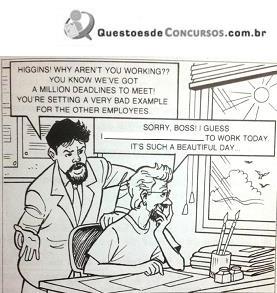
Read the dialogue in the picture. Choose the option to fill in the blank.
Q418807
Inglês
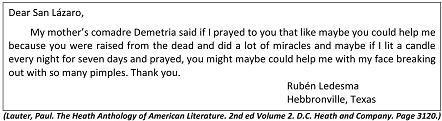
It is true about the message that
Q418806
Inglês
Texto associado
This (Illegal) American Life
By Maria E. Andreu
My parents came to New York City to make their fortune when I was a baby. Irresponsible and dreamy and in their early 20s, they didn't think things through when their visa expired; they decided to stay just a bit longer to build up a nest egg.
But our stay got progressively longer, until, when I was 6, my grandfather died in South America. My father decided my mother and I should go to the funeral and, with assurances that he would handle everything, sat me down and told me I'd have a nice visit in his boyhood home in Argentina, then be back in America in a month.
I didn't see him for two years.
We couldn't get a visa to return. My father sent us money from New Jersey, as the months of our absence stretched into years. Finally, he met someone who knew "coyotes" - people who smuggled others into the U.S. via Mexico. He paid them what they asked for, and we flew to Mexico City.
They drove us to the Mexican side of the border, and left us at a beach. Another from their operation picked us up there and drove us across as his family. We passed Disneyland on our way to the airport, where we boarded the plane to finally rejoin my father.
As a child, I had thought coming back home would be the magical end to our troubles, but in many ways it was the beginning. I chafed at the strictures of undocumented life: no social security number meant no public school (instead I attended a Catholic school my parents could scarcely afford); no driver's license, no after-school job. My parents had made their choices, and I had to live with those, seeing off my classmates as they left on a class trip to Canada, or packing to go off to college, where 1 could not go.
The year before I graduated from high school, Congress passed the amnesty law of 1987. A few months after my 18th birthday, I became legal and what had always seemed a blank future of no hope suddenly turned dazzling with possibility.
When I went for my interview at the Immigration and Naturalization Service, the caseworker looked at me quizzically when he heard me talk in unaccented English and joke about current events. Surely this American teenager did not fit in with the crowd of illegals looking to make things right.
At the time, I was flattered. His confusion meant I could pass as an American.
(Newsweek, October 2f 2008. Page 12.)
In "Finally, he met someone who knew 'coyotes' - people who smuggled others into the United States via Mexico." the relative pronouns can
Q418805
Inglês
Texto associado
This (Illegal) American Life
By Maria E. Andreu
My parents came to New York City to make their fortune when I was a baby. Irresponsible and dreamy and in their early 20s, they didn't think things through when their visa expired; they decided to stay just a bit longer to build up a nest egg.
But our stay got progressively longer, until, when I was 6, my grandfather died in South America. My father decided my mother and I should go to the funeral and, with assurances that he would handle everything, sat me down and told me I'd have a nice visit in his boyhood home in Argentina, then be back in America in a month.
I didn't see him for two years.
We couldn't get a visa to return. My father sent us money from New Jersey, as the months of our absence stretched into years. Finally, he met someone who knew "coyotes" - people who smuggled others into the U.S. via Mexico. He paid them what they asked for, and we flew to Mexico City.
They drove us to the Mexican side of the border, and left us at a beach. Another from their operation picked us up there and drove us across as his family. We passed Disneyland on our way to the airport, where we boarded the plane to finally rejoin my father.
As a child, I had thought coming back home would be the magical end to our troubles, but in many ways it was the beginning. I chafed at the strictures of undocumented life: no social security number meant no public school (instead I attended a Catholic school my parents could scarcely afford); no driver's license, no after-school job. My parents had made their choices, and I had to live with those, seeing off my classmates as they left on a class trip to Canada, or packing to go off to college, where 1 could not go.
The year before I graduated from high school, Congress passed the amnesty law of 1987. A few months after my 18th birthday, I became legal and what had always seemed a blank future of no hope suddenly turned dazzling with possibility.
When I went for my interview at the Immigration and Naturalization Service, the caseworker looked at me quizzically when he heard me talk in unaccented English and joke about current events. Surely this American teenager did not fit in with the crowd of illegals looking to make things right.
At the time, I was flattered. His confusion meant I could pass as an American.
(Newsweek, October 2f 2008. Page 12.)
In "My father decided my mother and I should go to the funeral" the modal can be replaced by
Q418804
Inglês
Texto associado
This (Illegal) American Life
By Maria E. Andreu
My parents came to New York City to make their fortune when I was a baby. Irresponsible and dreamy and in their early 20s, they didn't think things through when their visa expired; they decided to stay just a bit longer to build up a nest egg.
But our stay got progressively longer, until, when I was 6, my grandfather died in South America. My father decided my mother and I should go to the funeral and, with assurances that he would handle everything, sat me down and told me I'd have a nice visit in his boyhood home in Argentina, then be back in America in a month.
I didn't see him for two years.
We couldn't get a visa to return. My father sent us money from New Jersey, as the months of our absence stretched into years. Finally, he met someone who knew "coyotes" - people who smuggled others into the U.S. via Mexico. He paid them what they asked for, and we flew to Mexico City.
They drove us to the Mexican side of the border, and left us at a beach. Another from their operation picked us up there and drove us across as his family. We passed Disneyland on our way to the airport, where we boarded the plane to finally rejoin my father.
As a child, I had thought coming back home would be the magical end to our troubles, but in many ways it was the beginning. I chafed at the strictures of undocumented life: no social security number meant no public school (instead I attended a Catholic school my parents could scarcely afford); no driver's license, no after-school job. My parents had made their choices, and I had to live with those, seeing off my classmates as they left on a class trip to Canada, or packing to go off to college, where 1 could not go.
The year before I graduated from high school, Congress passed the amnesty law of 1987. A few months after my 18th birthday, I became legal and what had always seemed a blank future of no hope suddenly turned dazzling with possibility.
When I went for my interview at the Immigration and Naturalization Service, the caseworker looked at me quizzically when he heard me talk in unaccented English and joke about current events. Surely this American teenager did not fit in with the crowd of illegals looking to make things right.
At the time, I was flattered. His confusion meant I could pass as an American.
(Newsweek, October 2f 2008. Page 12.)
In "They decided to stay a bit longer to build up a nest egg" NESTEGG is a/an
Q418803
Inglês
Texto associado
This (Illegal) American Life
By Maria E. Andreu
My parents came to New York City to make their fortune when I was a baby. Irresponsible and dreamy and in their early 20s, they didn't think things through when their visa expired; they decided to stay just a bit longer to build up a nest egg.
But our stay got progressively longer, until, when I was 6, my grandfather died in South America. My father decided my mother and I should go to the funeral and, with assurances that he would handle everything, sat me down and told me I'd have a nice visit in his boyhood home in Argentina, then be back in America in a month.
I didn't see him for two years.
We couldn't get a visa to return. My father sent us money from New Jersey, as the months of our absence stretched into years. Finally, he met someone who knew "coyotes" - people who smuggled others into the U.S. via Mexico. He paid them what they asked for, and we flew to Mexico City.
They drove us to the Mexican side of the border, and left us at a beach. Another from their operation picked us up there and drove us across as his family. We passed Disneyland on our way to the airport, where we boarded the plane to finally rejoin my father.
As a child, I had thought coming back home would be the magical end to our troubles, but in many ways it was the beginning. I chafed at the strictures of undocumented life: no social security number meant no public school (instead I attended a Catholic school my parents could scarcely afford); no driver's license, no after-school job. My parents had made their choices, and I had to live with those, seeing off my classmates as they left on a class trip to Canada, or packing to go off to college, where 1 could not go.
The year before I graduated from high school, Congress passed the amnesty law of 1987. A few months after my 18th birthday, I became legal and what had always seemed a blank future of no hope suddenly turned dazzling with possibility.
When I went for my interview at the Immigration and Naturalization Service, the caseworker looked at me quizzically when he heard me talk in unaccented English and joke about current events. Surely this American teenager did not fit in with the crowd of illegals looking to make things right.
At the time, I was flattered. His confusion meant I could pass as an American.
(Newsweek, October 2f 2008. Page 12.)
I n "I was flattered. His confusion meant I could pass as an American." FLATTERED is
Q418802
Inglês
Texto associado
This (Illegal) American Life
By Maria E. Andreu
My parents came to New York City to make their fortune when I was a baby. Irresponsible and dreamy and in their early 20s, they didn't think things through when their visa expired; they decided to stay just a bit longer to build up a nest egg.
But our stay got progressively longer, until, when I was 6, my grandfather died in South America. My father decided my mother and I should go to the funeral and, with assurances that he would handle everything, sat me down and told me I'd have a nice visit in his boyhood home in Argentina, then be back in America in a month.
I didn't see him for two years.
We couldn't get a visa to return. My father sent us money from New Jersey, as the months of our absence stretched into years. Finally, he met someone who knew "coyotes" - people who smuggled others into the U.S. via Mexico. He paid them what they asked for, and we flew to Mexico City.
They drove us to the Mexican side of the border, and left us at a beach. Another from their operation picked us up there and drove us across as his family. We passed Disneyland on our way to the airport, where we boarded the plane to finally rejoin my father.
As a child, I had thought coming back home would be the magical end to our troubles, but in many ways it was the beginning. I chafed at the strictures of undocumented life: no social security number meant no public school (instead I attended a Catholic school my parents could scarcely afford); no driver's license, no after-school job. My parents had made their choices, and I had to live with those, seeing off my classmates as they left on a class trip to Canada, or packing to go off to college, where 1 could not go.
The year before I graduated from high school, Congress passed the amnesty law of 1987. A few months after my 18th birthday, I became legal and what had always seemed a blank future of no hope suddenly turned dazzling with possibility.
When I went for my interview at the Immigration and Naturalization Service, the caseworker looked at me quizzically when he heard me talk in unaccented English and joke about current events. Surely this American teenager did not fit in with the crowd of illegals looking to make things right.
At the time, I was flattered. His confusion meant I could pass as an American.
(Newsweek, October 2f 2008. Page 12.)
Some of the author's hassles were

 Conheça nossos planos