Questões de Concurso
Sobre pronomes | pronouns em inglês
Foram encontradas 1.068 questões


Laszlo Krasznahorkai Is Awarded Nobel Prize in Literature
Laszlo Krasznahorkai, a Hungarian novelist known for his dystopian themes and relentless prose, with winding sentences that can run on for pages, was awarded the Nobel Prize in Literature on Thursday. The Swedish Academy, which organizes the prize, said at a news conference that Krasznahorkai had received the award “for his compelling and visionary oeuvre that, in the midst of apocalyptic terror, reaffirms the power of art.”
Krasznahorkai (pronounced CRAS-now-hoar-kay), 71, has been a perennial favorite for the Nobel. Hailed as a “master of the apocalypse” by Susan Sontag, Krasznahorkai has long been revered by fellow writers for his idiosyncratic style and bleak narratives that can often be slyly humorous.
He’s also written half a dozen screenplays in collaboration with the Hungarian movie director Bela Tarr, who has adapted several of his novels for the screen. Tarr filmed “The Melancholy of Resistance,” which is among Krasznahorkai’s best-known works, as “Werckmeister Harmonies,” in 2000. The novel, filled with vast sentences, concerns events in a small Hungarian town after a circus arrives with a huge stuffed whale in tow.
Krasznahorkai told The New York Times in 2014 that he had tried to develop an absolutely original style, adding, “I wanted to be free to stray far from my literary ancestors, and not make some new version of Kafka or Dostoyevsky or Faulkner.”
Steve Sem-Sandberg, a member of the committee that awarded the prize, praised Krasznahorkai’s “powerful, musically inspired epic style” at the news conference announcing the Nobel. “It is Krasznahorkai’s artistic gaze, which is entirely free of illusion and which sees through the fragility of the social order, combined with his unwavering belief in the power of art that has motivated the academy to award the prize,” Sem-Sandberg added.
A spokeswoman for Krasznahorkai’s German publisher said in an email on Thursday that the author was not conducting any interviews, although earlier in the day he briefly spoke to Swedish radio: “I’m very happy, thank you,” he said, adding, “I don’t know what’s coming in the future.”
Krasznahorkai was born in Gyula, a small town about 120 miles from Budapest, in 1954. His family’s Jewish roots were kept a secret — his grandfather changed the family name from Korin to Krasznahorkai to assimilate — and Krasznahorkai didn’t know about his Jewish heritage until his father told him when he was 11.
He was a musical prodigy, and worked as a professional musician for several years in his youth, playing piano in a jazz band and singing in a rock group. His father was a lawyer, and his mother worked in the social welfare ministry. Inspired by Kafka, an author he revered, he planned to study law and was fascinated by criminal psychology, but ended up studying Hungarian language and literature.
After school, Krasznahorkai undertook military service but, he has said in interviews, deserted the army after being punished for insubordination. He then took on odd jobs — including working as a miner and as a night watchman for 300 cows, a post that allowed him to read work by Dostoyevsky and Malcolm Lowry’s “Under the Volcano,” a book he called his “bible.”
When he began writing, his aim was to complete one book, then pursue a career in music. At the time he published his first short story, artists and writers were subject to censorship under Hungary’s Communist regime, and he was taken in for questioning by the police, who interrogated him about his anti-Communist views and took away his passport.
Krasznahorkai was undeterred. In 1985, he published his subversive debut novel, “Satantango,” about life in a poor, crumbling hamlet, which was a literary sensation in Hungary. “Nobody, myself included, could understand how it was possible to publish ‘Satantango’ because it’s anything but an unproblematic novel for the Communist system,” he said in a 2018 Paris Review interview.
“He doesn’t deal with grand politics, he’s dealing with the experiences of people who live within societies that are decaying and falling apart,” said the poet George Szirtes, who translated “Satantango” and several other works by Krasznahorkai. Tarr filmed an adaptation, which lasts for over seven hours, in 1994. In an interview on Thursday he recalled reading the book in one night and asking if he could turn it into a movie, only to find the author annoyed to be woken up during Easter holidays. The novel was filled with “these poor people, these miserable people,” Tarr said, but Krasznahorkai gave them a rare “dignity.”
Szirtes said that Krasznahorkai never expected his books — filled with endless clauses and sub-clauses — to catch on with a wide international audience. “The books can look daunting in some ways, simply because there is no break in them,” Szirtes said. In recent decades, Krasznahorkai has received a stream of accolades outside his home country. In 2015, he won the Man Booker International Prize, which at the time was awarded for an author’s entire body of work rather than a specific novel.
In the United States, New Directions has published a dozen of his books in translation, and more are forthcoming, including “Zsömle Is Gone,” a satire about an elderly retired electrician living in the countryside who believes he’s a descendant of Hungarian royalty. Barbara Epler, the publisher of New Directions, said one of the most striking things about Krasznahorkai’s work is his ability to weave unexpected humor into bleak stories. “What’s amazing is its anti-gravitational element — all this darkness and within it, an escalating, incredibly deadpan hilarity,” she said.
The Nobel Prize is literature’s major honor, and typically the capstone to a writer’s career. Past recipients have included the authors Saul Bellow and Toni Morrison, the playwright Harold Pinter and, in 2016, Bob Dylan. Krasznahorkai had featured among bookmakers’ favorites to win the prize for many years. He is the second Hungarian to receive the literature Nobel after Imre Kertész, a novelist and Holocaust survivor, in 2002.
While Krasznahorkai’s work has often been praised for its political overtones, he has rejected the idea that he’s writing political allegories. “I never want to write some political novels,” he told The New York Times in 2014. “My resistance against the Communist regime was not political. It was against a society.”
Krasznahorkai isn’t comfortable being cast as a social or political prognosticator. He has said he’s never felt at ease discussing his work, and doesn’t see himself as “part of literary life.” “Writing, for me, is a totally private act,” he told The Paris Review. “I’m ashamed to speak about my literature — it’s the same as if you were to ask me about my most private secrets.”
Adapted from: https://www.nytimes.com/2025/10/09/
“The United Nations ______ is one part of the UN System. Cooperation between the UN and the other entities of the UN system is essential in order to achieve the purposes of the Organization laid out in the UN Charter. Since _____ Charter was written, the United Nations has been mandated to do new work which was not envisioned at the time of its creation. The Organization has set goals to build a more sustainable world, and _____ has agreed to collective action to slow down climate change.”
Source: https://www.un.org/en/our-work (28/09/2025)
Read the text to answer the question.
The archetype of the classic witch is a cornerstone of global folklore and fiction, often depicted as a formidable and sinister antagonist. These figures are deeply embedded in collective storytelling, usually characterized by their malevolent intentions towards protagonists, especially innocent children or virtuous heroes. Their narrative role is fundamentally to embody the forces of darkness, chaos, or forbidden knowledge, creating a clear moral contrast and a formidable obstacle for the main characters to overcome. From European fairy tales to modern pop culture, the classic witch serves as a powerful symbol of fear and the supernatural.
Physically, the traditional witch is frequently described as an old, haggard woman with exaggeratedly ugly features, which visually symbolizes her inner corruption and alienation from societal norms. Common traits include a long, hooked nose, warts, disheveled gray hair, and crooked fingers. She is typically clothed in dark, ragged robes and a pointed, wide-brimmed hat, an image popularized and solidified by Western media. This distinct and fearsome appearance is designed to evoke immediate unease and signal her dangerous nature to the audience.
The classic witch's power is intrinsically linked to specific magical tools and practices. The bubbling cauldron is her quintessential instrument, used for brewing potent potions, casting spells, and concocting mysterious elixirs. Her magic often involves ancient books ofspells, enchanted mirrors that show more than mere reflections, and the command over supernatural familiars like black cats, crows, or toads. These elements are not just props; they are extensions of her will and the sources of her power, which she uses to curse, transform, or deceive those who cross her path.
This archetype finds vivid expression in some of the most famous villains of literature and film. The Wicked Witch of the West from The Wizard of Oz menaces Dorothy with her command over flying monkeys and her thirst for revenge. The Evil Queen from Snow White, obsessed with being the "fairest of them all," uses a poisoned apple in her deadly scheme. Similarly, Maleficent from Sleeping Beauty is a figure of pure vengeance, cursing an infant princess to a sleep-like death. Beyond Anglo-American tales, other cultures have their own versions, such as Brazil's Cuca, a child-eating alligator-witch from Sítio do Picapau Amarelo.
However, the portrayal of the witch is not monolithic and has evolved to include more nuanced or comedic figures. In the Mexican sitcom El Chavo del Ocho, Doña Clotilde, nicknamed "La Bruja del 71," is a neighborhood eccentric whose witch persona is more a source of gossip and lighthearted fear than genuine evil. Furthermore, modern narratives like the film Hocus Pocus present the Sanderson sisters as a blend of the classic tropes—complete with spell books and a thirst for youth—but with a comedic and less terrifying demeanor, showcasing the adaptability and enduring fascination with this iconic character type.
“Her magic often involves ancient books of spells, enchanted mirrors that show more than mere reflections, and the command over supernatural familiars like black cats, crows, or toads. These elements are not just props; they are extensions of her will and the sources of her power…”
In this excerpt, the pronoun “they” refers to:
I. "This" is an example of reference, specifically referring back to the entire preceding clause ("John arrived late").
II. "He" is an example of anaphora, referring back to the antecedent "John".
III. The connection between the sentences relies on lexical repetition rather than pronominal reference.
It is correct what is stated
Are Some Sugars ‘Less Bad’ Than Others?
Q: I’m trying to limit sugar, but I love sweets. Are “natural” sweeteners like honey and agave syrup healthier alternatives to table sugar?
You probably know that the sugars in fruits, vegetables and other plants are far better for you than the added sugars often found in processed foods like sodas, candy bars and many baked goods.
But in that category of added sugars, there’s an array of sweeteners that are often seen as more “natural” or healthier than others. Honey, maple syrup and agave nectar, for instance, are commonly touted as “better for you” swaps for regular sugar, such as in many health-focused baking recipes and on social media.
Is that right? We asked three nutrition experts to help us sort it out.
Source:
https://www.nytimes.com/2025/10/28/well/eat/health-
effects-honey-maple-syrup-agave.html
Direct speech: The chair said to the board, “We can’t approve the draft that the consultant, whose portfolio I admire, emailed yesterday unless she sends us the missing data now.”
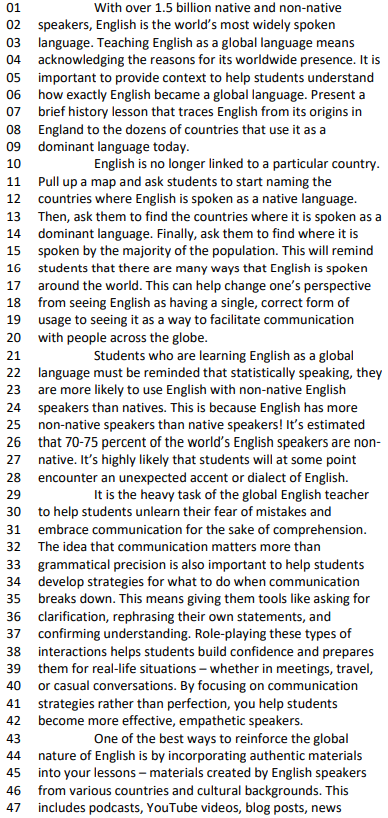
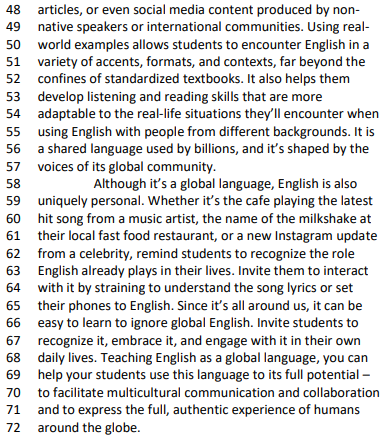

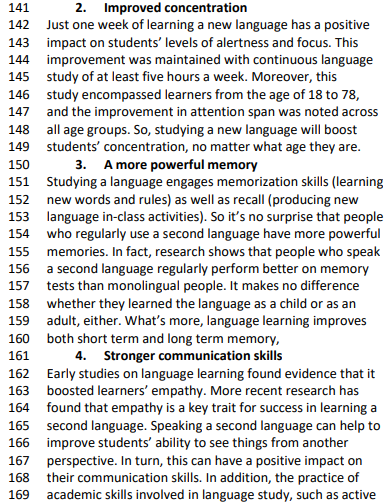
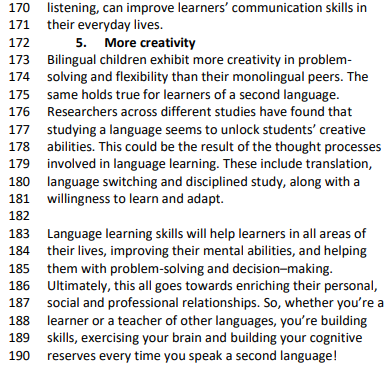
“I saw _________ 3 driving through Eternity in a timeless taxi.” Katherine Mansfield
“The fool doth think he is wise, but the wise man knows _________ 4 to be a fool.”
( ) No trecho “Everyone knows first impressions are important—and we don’t just make them based on sight,” o pronome “them” refere-se a “first impressions”, e seu uso está correto no contexto da frase.
( ) Na sentença “BetUS Casino crafted the report, which is current as of Aug. 15, 2025,” o pronome relativo “which” refere-se a BetUS Casino, funcionando como sujeito da oração subordinada.
( ) Na frase “The more of these professionals in an area, the more trustworthy the accent,” a palavra “these” refere-se especificamente a lawyers and primary-care doctors, mencionados anteriormente.
( ) Em “Once the study authors had the information in hand, they weighted the data and ranked the regions,” o pronome “they” está incorretamente empregado, pois não possui um referente claro no texto anterior.
( ) Na sentença “Want to sound just like a Bostonian? Start by dropping some of your R’s,” o pronome possessivo “your” referese genericamente ao leitor, mantendo o tom informal e direto do texto.
A sequência correta é:
O texto seguinte servirá de base para responder à questão.
Are 'the world's most beautiful islands' in danger?
Norway's stunning Lofoten Islands have gone viral for their midnight summer sun. But as the isles face overtourism for the first time, residents have an important message for visitors.
Located 300km inside the Arctic Circle, Norway's Lofoten archipelago rises dramatically from the sea in a jagged, mountainous crescendo. Its otherworldly glacier-sculpted landscapes and magical 24-hour summer daylight have led the isles to proudly dub themselves "the world's most beautiful islands". But it's a roadside stop, not a soaring summit or majestic fjord, that convinces me of this self-declared moniker.
Just a few paces away from the village of Flakstad on the island of Flakstadøya, I spy a beach where the water shifts from turquoise to glass-clear as it laps against basalt rock and sugar-white sand. It's a scene more Aegean than Arctic − until you see the ridge of craggy mountains floating above the fjord, the last snow clinging to their flanks. From late May to the end of July, Lofoten is bathed in constant daylight, and in this endless summer sun, the colours feel heightened. Standing on the sand, it's hard to imagine anywhere more idyllic.
Locals tell me that the 24-hour sun bathes these islands in a unique light and point to round-the-clock fishing and 02:00 tee times as quintessential summertime experiences. But kayaks crisscross the waters in every season, and hikers come year-round for the panoramic mountaintop views of silent fjords and romantic waterside villages that define the islands, chasing the midnight sun or the Northern Lights. At times, the only sounds around are the cries of the island's resident avians: sea eagles, puffins and razorbills.
The Lofoten archipelago is made up of seven principal islands off the North West coast of Norway. The E10 highway runs for nearly 175km through the archipelago, threading the five largest, Austvågøya, Vestvågøya, Moskenesøya, Flakstadøya and Gimsøya, by a series of impressively engineered bridges and tunnels, allowing drivers to move between islands with ease.
Visitors here are nothing new. The islands were home to northern Norway's earliest Viking settlement, drawing traders from as far away as Iceland. For centuries, tens of thousands of sailors journeyed here each winter to fish for Arctic cod, a tradition still reflected in the red rorbuer (fishermen's cabins) that now host tourists instead of seafarers.
And yet, tourism was late to come to this far-flung corner of the world. It only started to grow significantly in the past 20 years, helped initially by improved road and ferry links, then accelerated as social media began showcasing Lofoten's stunning scenery to a global audience. Now Lofoten's beauty is no longer a secret, and what was once a seasonal outpost of survival and commerce has evolved into one of Norway's most popular destinations. In 2023, the islands welcomed around one million visitors, or roughly 40 times Lofoten's permanent population of 25,000.
But as European heatwaves drive travellers further north and new seasonal flights from Paris, Frankfurt and Zurich launched last year, tourism is only set to rise further. A weaker Norwegian krone is helping to seal the deal.
Lofoten residents Astrid Haugen and Frida Berg explain that they're proud to share their home and welcome the jobs (and the new bars and restaurants) brought about by tourism, but wonder whether infrastructure can keep up. They also worry whether this influx of visitors will affect the landscape and fragile ecosystem that make Lofoten so special.
I meet up with them on Unstad beach, at the north-western corner of Vestvågøy, one of the best places on the islands to catch the midnight sun, thanks to its unobstructed views across the bay. Even at 23:00, surfers cheer each another on from the waves. Families enjoy snacks on the rocks while children shriek in the shallows as they splash in the frigid, single-digit Arctic waters. Mountains hover on either side of us, framed by a sky a few shades paler than the sea.
"When I used to travel abroad and said I was from Lofoten, people looked blank," says Haugen, as we stroll the beach. "Now they've seen pictures online and can't believe this is my everyday view."
"That's part of the problem," adds Berg. "This is our home − not just a backdrop for a Facebook selfie. When people litter or block roads, it's so frustrating".
Many residents I speak with share this frustration. They're not just bothered by the number of visitors, but by their behaviour.
I see many examples of this during my week on Lofoten. RVs creep along narrow fjordside roads to snap a photo, oblivious to the traffic building behind them. At 20:00, the car park hike up the vertiginous Reinebringen mountain resembles a suburban shopping centre on Black Friday, jarring with the peaceful surroundings. Groups of eager tourists spill out, eager to tackle the 1,978 steps that separate them from the vertiginous panorama at the summit.
Some locals have had enough. In a recent radio interview, Flakstad mayor Einar Benjaminson warned of shifting sentiment: "Ten years ago, maybe 2% of our residents didn't want tourism. Now it's more like 25%."
As in many tourist hotspots, Lofoten residents are also frustrated that an increasing number of homes are being bought by wealthy outsiders. Some are purchased as seasonal getaways or turned into short-term accommodation, hollowing out villages in winter; in other areas whole settlements have been turned into sleek resorts.
Nusfjord, on Lofoten's southern coast, illustrates this shift. The historic fishing village is postcard-perfect, with ed and ochre warehouses perched on a narrow isthmus facing the sea, appearing frozen in time on its 19th-Century foundations.
The permanent population? 22. The number of annual tourists? 90,000.
After the village's fishing industry migrated to more populated areas, Nusfjord's centre became a Unesco World Heritage site, combining tourist accommodation and "a living museum where you can touch, feel and breathe the history of coastal Norway," according to local historian Ingrid Larsen. It remains an utterly charming stop: the museum, set in a former cod liver factory, offers insights into the village's fishing legacy; the restored general store serves excellent cinnamon buns; and the boardwalk, backed by a rippled grey ridgeline, is undeniably scenic.
Erling Hansen, a tour guide, understands the locals' concern but is pragmatic: "Without tourism, there probably would be no village in Nusfjord anymore."
Later that day in Henningsvær − 80km and several peninsulas away from Nusfjord − the contrast is stark. Even at 22:00, the village hums with life as locals revel in the extended daylight. Teenagers swarm towards the floodlit football pitch, improbably perched on a rocky outcrop. Two neighbours paint their front doors − one white, one blue − gesturing mid-conversation with dripping brushes.
At the harbour, tools clank as fishermen check their nets. "The fish bite better at midnight," one says with a grin.
Tourism supports 19% of local jobs on the islands. Around-the-clock fishing trips offer visitors a taste of tradition − and locals a new income stream. The message is clear: guests are welcome, but as Hansen says, "We're not some Arctic Disneyworld".
Earlier this year, the Norwegian government gave councils in high-tourism areas the right to introduce a visitor tax. Lofoten plans to roll it out in 2026. The revenue will help fund overstretched infrastructure, from extra parking to trail signage urging hikers to stick to the path − in case the dizzying drop-offs weren't clear enough.
Mayor Benjaminson welcomes the budgetary relief. "We no longer need to choose between renovating a school or cleaning up after tourists," he says dryly.
It's part of a broader, gently persuasive strategy. Local tourism campaigns feature locals − including schoolchildren − asking visitors to drive responsibly, take their rubbish home and avoid disturbing local wildlife when hiking. Officials also hope to promote Lofoten year-round, easing the summer surge and preventing areas becoming ghost towns when the light fades.
Back at Unstad, the light softens to amber as I walk along the shore with Haugen and Berg. A lone surfer rides a gilded wave while multiple families are trying − and failing − to convince their children that constant daylight doesn't cancel bedtime.
"It's hard," says Berg. "We want people to love Lofoten − just not so much that it stops being Lofoten."
She has captured the dilemma. Tourism funds heritage projects that might otherwise vanish, but the endless days − and the crowds they bring − stretch local patience and infrastructure.
And still, Lofoten captivates. Peaks catch fire as the sun stretches over the sea, quietly inviting us to linger.
Amid this serene beauty are homes, schools and businesses. Locals are learning how to share the magic without losing it. They hope visitors will do more than admire the view − that they'll tread lightly, listen closely and help protect what attracted them in the first place.
https://www.bbc.com/travel/article/20250801-are-the-worlds-most-beaut iful-islands-in-dange

 Conheça nossos planos