Questões de Concurso
Comentadas sobre pronomes | pronouns em inglês
Foram encontradas 829 questões


The Underwater Centre secures its biggest ever contract – worth $1.3million - to train Russian saturation divers
Your Oil and Gas News Magazine The world's leading commercial diver and Remotely Operated Vehicle (ROV) training facility, based in the Scottish Highlands and Australia, has secured its biggest ever contract – worth US$ 1.3 million – to train Russian saturation divers.
The award cements its reputation as a major service provider for the growing worldwide oil and gas industry. The men, already experienced air divers, were trained on saturation procedures and techniques and will receive the Australian Diver Accreditation Scheme (ADAS) and the Closed Bell certification. More advanced than the ADAS, the Closed Bell is the certification appropriate to deep water dives of 60 meters / 200 feet, using a trimix tank with 16 percent oxygen (O2). During the training, divers lived in a chamber for up to 28 days, which was pressurized to the same pressure of the sea, exactly at the depth that they will be working at. Living and working at pressure mean that they can be transported quickly and efficiently to the work site under the water without decompression stops, allowing divers to work in much greater depths and for much longer periods of time. MRTS Managing Director Alexander Kolikov said: “Oil and gas firms in Russia are currently facing a skills shortage due to the rapidly increasing amount of exploration work underway at the moment. By investing in the training of our divers in saturation diving, we are addressing this need for experts in maintenance and repair activities vital to maintaining Russia's subsea infrastructure." Steve Ham, General Manager at the Fort William Centre said: “We were delighted when MRTS chose The Underwater Centre to train its divers in saturation diving, and I think this is testament to the hard work we have been putting in to ensure our reputation as a world-class training facility. Available at: . Retrieved on: 28 June 2012. Adapted.

Some of you may be familiar with OSHA - the Occupational Safety & Health Administration. The sole purpose of this agency is to keep American workers safe. Complying with OSHA regulations isn't always easy, but if we work together, we can do it. Yet, complying with regulations is not the real reason for working safely. Our real motive is simple. We care about each and every one of you and will do what is necessary to prevent you from being injured.
However, keeping our workplace safe takes input from everyone. Management, supervisor, and all of you have to come together on this issue, or we're in trouble. For example, upper management has to approve the purchase of safe equipment. Supervisors, including myself, have to ensure that each of you knows how to use that equipment safely. Then it's up to you to follow through the task and use the equipment as you were trained. If any one part of this chain fails, accidents are going to happen and people are going to get hurt.
Responsibility Number One - Recognize Hazards
At the core of your safety responsibilities lies the task of recognizing safety and health hazards. In order to do that, you must first understand what constitutes a hazard. Extreme hazards are often obvious. Our hopes are that you won't find too many of those around here.
There are, however, more subtle hazards that won't jump up and bite you. As a result of your safety training and meetings like these, some things may come to mind. For example, a machine may not be easy to lock out. Common practice may be to use a tag. This is a potential hazard and should be discussed. Maybe something can be changed to make it easier to use a lock. Other subtle hazards include such things as frayed electrical cords, a loose machine guard, a cluttered aisle, or maybe something that just doesn't look right.
Responsibility Number Two - Report Hazards
A big part of recognizing hazards is using your instincts. Nobody knows your job as well as you do, so we're counting on you to let us know about possible problems. Beyond recognizing hazards, you have to correct them or report them to someone who can. This too, is a judgement call. For example, if something spills in your work area you can probably clean it up yourself. However, if there is an unlabeled chemical container and you have no idea what it is, you should report it to your supervisor.
Additional Employee Responsibilities
Good housekeeping is a major part of keeping your work area safe. For example, you should take a few minutes each day to ensure that aisles, hallways, and stairways in your work area are not obstructed. If boxes, equipment, or anything else is left to pile up, you have a tripping hazard on your hands. Those obstructions could keep you from exiting the building quickly and safely should you face an emergency situation.
Also watch out for spills. These can lead to slips and falls. Flammable materials are another thing to be aware of. Make sure they are disposed of properly.
Keep Thinking. Even if you're doing your job safely and you are avoiding hazards, there are often even better ways to work safely. If you have ideas for improving the safety of your job or that of co-workers, share them.
Concluding Remarks
While nothing we do can completely eliminate the threat of an incident, we can work together to improve our odds. As I said, this must be a real team effort and I'm counting on input from all of you. Let's keep communicating and continue to improve safety.
Available at: <http://www.ncsu.edu/ehs/www99/right/training/meeting/emplores.html>.Retrieved on: April 1st, 2012. Adapted.
The x2 is an experimental helicopter being developed by Sikorsky, an American company, which hopes it will be zipping along at more than 460kph. The company, however, is interested in more than just breaking speed records. It plans to use the technology developed for the x2 in commercial helicopters.
Sikorsky reckons that future helicopters built using the x2 technology would be extremely versatile machines. They would dash to and from a medical emergency a lot faster. They would also be very agile in flight, which would increase their capabilities in combat.
(Adapted from The Economist September 11, 2010, page 98)
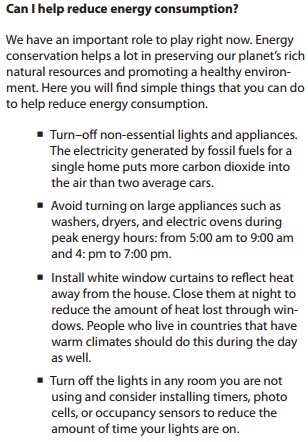
As palavras "We" e "Our" estão sendo usadas no texto como:
Can I help reduce energy consumption?
We have an important role to play right now. Energy conservation helps a lot in preserving our planet’s rich natural resources and promoting a healthy environment. Here you will find simple things that you can do to help reduce energy consumption.
· Turn–off non-essential lights and appliances. The electricity generated by fossil fuels for a single home puts more carbon dioxide into the air than two average cars.
· Avoid turning on large appliances such as washers, dryers, and electric ovens during peak energy hours: from 5:00 am to 9:00 am and 4: pm to 7:00 pm.
· Install white window curtains to reflect heat away from the house. Close them at night to reduce the amount of heat lost through windows. People who live in countries that have warm climates should do this during the day as well.
· Turn off the lights in any room you are not using and consider installing timers, photo cells, or occupancy sensors to reduce the amount of time your lights are on.


Information Systems (IS) is concerned with the information that computer systems can provide to aid a company, non-profit or governmental organization in defining and achieving its goals. It is also concerned with the processes that an enterprise can implement and improve using information technology. IS professionals must understand both technical and organizational factors , 5 and must be able to help an organization determine how information and technology-enabled business processes can provide a foundation for superior organizational performance. They serve as a bridge between the technical and management communities within an organization. What information does the enterprise need? How is that information generated? Is it delivered to the people who need it? Is it presented to them in ways that permit them to use it readily? 10 Is the organization structured to be able to use technology effectively? Are the business processes of the organization well designed? Do they use the opportunities created by information technology fully? Does the organization use the communication and collaboration capabilities of information technologies appropriately? Is the organization capable of adapting quickly enough to changing external circumstances? These are the important issues that businesses rely on IS people to 15 address. A majority of IS programs are located in business schools; however, they may have different names such as management information systems, computer information systems, or business information systems. All IS degrees combine business and computing topics, but the emphasis between technical and organizational issues varies among programs. For example, 20 programs differ substantially in the amount of programming required. Traditionally, many graduates of IS programs have functioned in roles that are similar to the roles for which IT programs explicitly prepare their students. Information systems graduates continue to fill these roles, but the new programs in information technology offer an alternative path to these positions. INFORMATION Systems. Disponível em: . Acesso em: 03 jan. 2011.
By Rachel Ehrenberg Science News, Web edition: Monday, February 21st, 2011
WASHINGTON — Getting blood or other perishable supplies to an area that’s been struck by an earthquake or hurricane isn’t as simple as asking what brown can do for you. But a new model quickly determines the best routes and means for delivering humanitarian aid, even in situations where bridges are out or airport tarmacs are clogged with planes.
The research, presented February 18 at the annual meeting of the American Association for the Advancement of Science, could help get supplies to areas which have experienced natural disasters or help prepare for efficient distribution of vaccines when the flu hits.
Efficient supply chains have long been a goal of manufacturers, but transport in fragile networks — where supply, demand and delivery routes may be in extremely rapid flux — requires a different approach, said Anna Nagurney of the University of Massachusetts Amherst, who presented the new work. Rather than considering the shortest path from one place to another to maximize profit, her system aims for the cleanest path at minimum cost, while capturing factors such as the perishability of the product and the uncertainty of supply routes. ‘You don’t know where demand is, so it’s tricky,’ said Nagurney. ‘It’s a multicriteria decision-making problem.’
By calculating the total cost associated with each link in a network, accounting for congestion and incorporating penalties for time and products that are lost, the computer model calculates the best supply chain in situations where standard routes may be disrupted.
‘Mathematical tools are essential to develop formal means to predict, and to respond to, such critical perturbations,’ said Iain Couzin of Princeton University, who uses similar computational tools to study collective animal behavior. ‘This is particularly important where response must be rapid and effective, such as during disaster scenarios … or during epidemics or breaches of national security.
’ The work can be applied to immediate, pressing situations, such as getting blood, food or medication to a disaster site, or to longer-term problems such as determining the best locations for manufacturing flu vaccines. . Retrieved April 7th, 2011.
'CityVille' now bigger on Facebook than 'FarmVille'
(Mashable) -- Facebook game developer Zynga has proved once
again that it knows exactly what it needs to do to keep millions of
Facebook users happy and occupied.
In less than a month, its latest game "CityVille"___ ______
(become) the most popular application on Facebook, surpassing
Zynga's previous hit "FarmVille" in all areas.
According to AppData, "CityVille" now has 16.8 million daily
active users, compared to "FarmVille's" 16.4 million. Looking at
monthly active users, "CityVille" is also ahead with 61.7 million
users, while "FarmVille" trails behind with 56.8 million users.
Zynga's "FrontierVille" and "Texas HoldEm Poker" also round out
the top five: put those four apps together (we'll disregard the fact
that many of those users overlap for a second) and you have a
very impressive number: 184 million active users across four
games.
The only non-Zynga app in the top five list is "Phrases," _____ at
one point threatened to take the top place, but is now
overshadowed by both "CityVille" and "FarmVille."
"CityVille's" future success wasn't hard to predict after an
amazingly good start at the beginning of December, but it's still
impressive to see Zynga amassing tens of millions of users in a
matter of days, proving that all that venture capital that went into
the company isn't there by accident.
Fonte :cnn.com
4 complexity of the problem is intrinsically linked with overarching societal issues, such as poverty reduction, economic development and population growth
7 After a decade of work on integrating Earth- and satellite-based observing networks, thereby establishing new observation methods that have made a tremendous impact on
10 the way climate change and physical oceanic variability is measured, scientists are once again exploring uncharted waters and looking to set a new course for the future at the
13 OceanObs'09 Conference in Venice, Italy on September 21-25. Ten years ago — at the first conference for a comprehensive ocean observing system — scientists envisioned measuring
16 satellite altimetry of sea-surface height with tide gauges and buoy measurements in order to forecast ocean currents. They brainstormed methods for monitoring changes in temperature
19 and salinity in the Southern Ocean and the South Atlantic which had never been systematically monitored. They also drew up a plan for implementing a global array of temperature
22 and salinity floats that would profile the water column down to a depth of 2,000 meters in real time. The initiatives launched at that conference a decade ago have since provided data that
25 fed the International Panel on Climate Change (IPCC) assessments of human influence on climate change, improved seasonal forecasts crucial for agriculture, hydropower, and
28 storm prediction and provided information invaluable to the lives and safety of mariners. Internet: (adapted).
4 level rise, increased temperatures), both current and predicted, will intersect with society and economies and the potentially significant environmental and human impacts that will result.
7 Of emerging interest are the potential impacts of climate change on the enjoyment of human rights and wellbeing. Weather and environmental degradation have, as one of
10 multiple stressors, threatened lives and livelihoods throughout history, but what makes this interaction more relevant today is the growing evidence that greenhouse gases (GHG) emissions
13 have contributed and will continue to contribute to long-term or permanent changes to our ecosystems and landscapes and will increase the frequency and severity of extreme events. This
16 amplifies existing social risks and vulnerabilities and will therefore increase the pressures faced by many disadvantaged individuals and populations in Canada and abroad.
19 On January 15 2009, the United Nations High Commissioner for Human Rights (UNHCHR) released a study on climate change and human rights in response to UN
22 Resolution 7/23 in which signatories expressed concern “that climate change poses an immediate and far-reaching threat to people and communities around the world and has implications
25 for the full enjoyment of human rights.” Internet: (adapted)
Answer question according to TEXT 1 below, adapted from http://news.bbc.co.uk/2/hi/americas/8606466.stm (accessed on April 7th, 2010) .
TEXT 1
At least 200 people have died in the Brazilian state of Rio de Janeiro after another storm. This is arguably the worst torrential rain for decades, causing flooding and landslides. Our website readers in Rio de Janeiro have been sharing their experiences.
Comment 1 - I’ve never seen such chaos. We weren’t prepared for this, even though we were warned that a big storm was about to come. Newspapers are saying that the reason for the catastrophe is the garbage. Well it may have been. We need to teach recycling at schools and community groups, otherwise we will have more disasters like this. (Lia, Niterói)
Comment 2 - Today I witnessed Rio de Janeiro on the brink of collapse. I ventured out around midday, just as the electric power blacked out in my neighbourhood. Three hours later, looking out of my office window, the city still reminded me of a war zone. “What´ve we done to deserve this?”, I thought. It’s night time now and I haven’t been able to return home. I might do so tomorrow. (José, Rio)
Comment 3 - Worldwide, we are seeing more and more
climate instability. The deserts of central Asia are growing,
while areas of the US (and now Rio) are drenched. The lakes
in Minnesota have never thawed this early, at any time in the
recorded record. The icecaps will be history, and islands
around the world are disappearing under the surf. The oceans
are warming, the coral reefs are dying. How much more
evidence do we need of global warming? (João, Brasília)

Internet: <coursel .winona.edu> (adapted).
Judge the following item, according to the text.
The word“which” (L.5) refers to the best method.
We have to do something about pollution. _____ hurts all of _____.
To understand your parents` love you must raise children _____.
_____ knows a lot of stories and the boy loves to listen to _____.
lacunas.


All of the following language features are found in the fragment and could be highlighted by the teacher to help students grasp the form and meaning of this passage, but for

 Conheça nossos planos