Questões de Concurso
Sobre presente simples | simple present em inglês
Foram encontradas 342 questões


Regarding verb tenses and verb forms, choose the option that completes the sentence correctly.
"Back when I______ in high school, I ________many friends and _____ involved in several activities. Now that we_____ older and have different lives, we still _____in touch regularly to catch up."

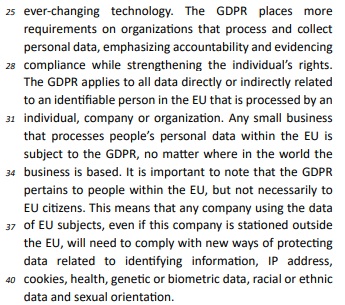
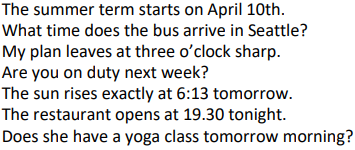
As questão diz respeito ao texto. Leia-o atentamente antes de respondê-la.
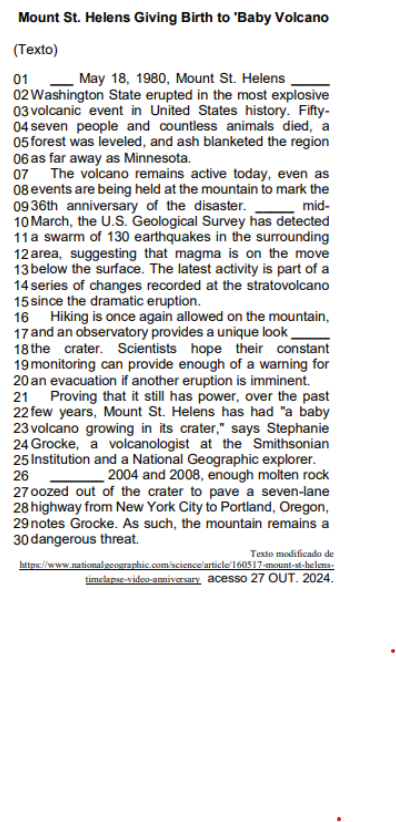
I- ‘Can’ (line 19) is a modal verb with the meaning of possibility;
II- ‘Has detected’ (line 10) is a Simple present verbal tense example;
III-‘has had’ (line 22) is part of Past Perfect verbal tense;
IV- ‘Oozed out of’ (line 27) is a phrasal verb;
Text
Reading skill will help you to improve your understanding of the language and build your vocabulary.
Read the text below carefully.
Social media, magazines and shop windows bombard people daily with things to buy, and British consumers are buying more clothes and shoes than ever before. Online shopping means it is easy for customers to buy without thinking, while major brands offer such cheap clothes that they can be treated like disposable items – worn two or three times and then thrown away
In Britain, the average person spends more than £1,000 on new clothes a year, which is around four per cent of their income. That might not sound like much, but that figure hides two far more worrying trends for society and for the environment. First, a lot of that consumer spending is via credit cards. British people currently owe approximately £670 per adult to credit card companies. That’s 66 per cent of the average wardrobe budget. Also, not only are people spending money they don’t have, they’re using it to buy things they don’t need. Britain throws away 300,000 tons of clothing a year, most of which goes into landfill sites.
People might not realize they are part of the disposable clothing problem because they donate their unwanted clothes to charities. But charity shops can’t sell all those unwanted clothes. Fast fashion goes out of fashion as quickly as it came in and is often too poor quality to recycle; people don’t want to buy it second-hand. Huge quantities end up being thrown away, and a lot of clothes that charities can’t sell are sent abroad, causing even more economic and environmental problems.
However, a different trend is springing up in opposition to consumerism – the ‘buy nothing’ trend. The idea originated in Canada in the early 1990s and then moved to the US, where it became a rejection of the overspending and overconsumption of Black Friday and Cyber Monday during Thanksgiving weekend. On Buy Nothing Day people organize various types of protests and cut up their credit cards. Throughout the year, Buy Nothing groups organize the exchange and repair of items they already own.
The trend has now reached influencers on social media who usually share posts of clothing and make- -up that they recommend for people to buy. Some YouTube stars now encourage their viewers not to buy anything at all for periods as long as a year. Two friends in Canada spent a year working towards buying only food. For the first three months they learned how to live without buying electrical goods, clothes or things for the house. For the next stage, they gave up services, for example haircuts, eating out at restaurants or buying petrol for their cars. In one year, they’d saved $55,000.
The changes they made meant two fewer cars on the roads, a reduction in plastic and paper packaging and a positive impact on the environment from all the energy saved. If everyone followed a similar plan, the results would be impressive. But even if you can’t manage a full year without going shopping, you can participate in the anti-consumerist movement by refusing to buy things you don’t need. Buy Nothing groups send a clear message to companies that people are no longer willing to accept the environmental and human cost of overconsumption.
source: learnenglish.britishcouncil.org
Read the sentences below and determine whether they are true ( T ) or false ( F ), according to structure and grammar use.
( ) The verbs worn and thrown (1st paragraph of the text) has its infinitive form as wear and throw.
( ) The underlined words in the text: nothing, anything and, everyone are examples of relative pronouns.
( ) The singular form of the following words from the text clothes and goods are, respectively cloth and good.
( ) The following sentence from the text: “Fast fashion goes out of fashion as quickly as it came in …” (3rd paragraph of the text). The words in bold are being used to compare things that are equal in some way.
( ) The negative form of the sentence “In one year, they’d saved $55,000.” (5th paragraph of the text), is “In one year, they hadn’t saved $55,000.”
Select the option that presents the correct sequence from top to bottom.
Read Text I and answer question

POLITICAL POLLS
Despite their popularity, political polls, often seen on TV during elections, sometimes give _______1 results, and some Americans question their _______ 2 .
_______ 3 both 2016 and 2020, most national polls overestimated support for Democrats. Polls aim to show what people think at a certain time but can be tricky to predict future outcomes accurately.
Mallory Newall explains that reliable polls focus on understanding public opinions rather than just predicting election winners. She warns _______4 reading too much into small differences in polls, especially far _______5 election day. Red flags for bad polls include _______6 the right people and not being clear about how the data was collected.
Polling methods _______ 7 since 2016, with more surveys done on line. Online surveys may influence results; however, concerns remain about reaching everyone, especially in rural areas without good internet. Although _______8 challenges, polls remain important _______9 public opinion.
Source:
https://www.newsinlevels.com/products/political-polls-level-3/
A Well Respected Man
The Kinks
'Cause he gets up in the morning
And he goes to work at nine
And he comes back home at five-thirty
Gets the same train every time
'Cause his world is built 'round punctuality
It never fails
And he's oh, so good
And he's oh, so fine
And he's oh, so healthy
In his body and his mind
(…)
And his mother goes to meetings
While his father pulls the maid
And she stirs the tea with councilors
While discussing foreign trade
And she passes looks, as well as bills
At every suave young man (…)
DAVIES, Ray. A well respected man. Disponível em: https://lyrics.lyricfind.com/lyrics/the-kinks-a-well-respected-man. Acesso em: 12 jul. 2024. Adaptado.
Letras de música podem ser ótimos recursos para desenvolver uma habilidade exigida pelo currículo escolar. A letra de “A well respected man” poderia ser mais bem usada para trabalhar qual habilidade dos estudantes?
Fill in the blank with the appropriate verb form.
(Available: https://stock.adobe.com.)
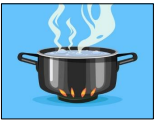
“If you boil water, it ______________ into steam, that’s a scientific fact and there’s no doubt about it!”
In the English tense system, the simple present can be used to describe actions that occurred in the past.
Village’s Amateur Archaeologists Find Lost Tudor Palace
- When a group of amateur archaeologists set out to find the buried remains of a Tudor palace
- in their Northamptonshire village five years ago, they knew the odds were against them. “Many
- of us were brought up in the village, and you hear about this lost palace, and wonder whether
- it’s a myth or real. So we just wanted to find it”, said Chris Close, the chair of the Collyweston
- Historical and Preservation Society (Chaps) which made the discovery of the Palace of
- Collyweston in a back garden this year. “But we’re a bunch of amateurs. We had no money, no
- expertise, no plans, no artist impressions to go off, and nothing remaining of the palace. It was
- naivety and just hard work that has led us to it”.
- The site was found using geophysical surveys and ground-penetrating radar. Various
- attempts had been made in the 1980s and 90s to find Collyweston Palace, the home of Henry
- VII’s mother, Lady Margaret Beaufort. However, without the advantage of modern technology,
- none had succeeded. The palace was famous during the 15th century and several historic events
- took place there. The pre-wedding celebrations of Margaret Tudor to James IV of Scotland in
- 1503 took place in the palace, and Henry VIII is recorded as holding court there on 16 and 17
- October 1541. By the mid-17th century, it had fallen into disrepair, and until the Chaps dig
- uncovered the palace walls in March, there was very little remaining evidence of its existence.
- “A number of things have only really come to light as we’ve done this project”, said Close.
- “As you do more and more research, and various different records start to become unearthed,
- we realized Collyweston had privy councils being run from here, which is of massive national
- importance”. Historians from the University of York helped verify the group’s findings and identify
- the palace through some uncovered stone moldings, and will work with Chaps on more
- excavations to further reveal the structure and conserve it for the future.
- The Chaps team, which comprises more than 80 members ranging from teenagers to people
- in their 70s and 80s, first set out their plan to find the palace in March 2018, using “local folktales
- and hearsay” to help refine their search area. They carried out geophysical surveys and used
- ground-penetrating radar (GPR) to help reveal the location of the palace walls, before securing
- permission from homeowners to excavate in gardens. “We’ve done it all on an absolute
- shoestring”, said Close. “We’ve basically done an £80,000-£90,000 project for roughly £13,000.
- For us, being a little society, to have achieved this with no money, or expertise, or plans, I think
- it’s something that the whole society should be proud of”.
(Available at: https://www.theguardian.com/science/2023/dec/06/tudor-collyweston-palace-northamptonshire-found-in-garden-by-amateur-archeologists - text especially adapted for this test).
The sentence “Many of us were brought up in the village” (l. 02-03) is in the simple past and passive voice. Which sentence below is also an example of a simple past passive structure?
Read Text | and answer questions 05 to 13.
Netflix is trying to prove to the world that it's all grown up
Netflix is trying to persuade Wall Street that it is now all grown up. After squeezing out millions of additional subscribers via its password sharing crackdown and through the introduction of cheaper advertiser-supported plans, the streamer knows that its growth spurts are coming to an end — and now it wants investors to stop obsessing over those pesky membership numbers and instead focus on other metrics.
"In our early days, when we had little revenue or profit, membership growth was a strong indicator of our future potential. But now we're generating very substantial profit and free cash flow. We are also developing new revenue streams like advertising and our extra member feature, so memberships are just one component of our growth", Netflix told shareholders as it reported quarterly earnings.
To that end, Netflix said that it will no longer report quarterly subscriber numbers, starting in 2025. Alas, the metric that Wall Street has forever judged Netflix on — the metric that prompted legacy media companies to burn endless piles of cash in their bids to compete with the streamer — will be retired. The decision to shut off transparency on the metric represents a significant turning point in the streaming revolution. For years, Netflix has prided itself on being extraordinarily transparent. Now it is aiming to hold its cards closer to its chest. And given that streaming giant is the trendsetter in the space, one could expect that other media companies will be inspired by the company's move and also opt to cease reporting such data.
To be fair, what Netflix is saying isn't necessarily off base either. As the company shifts its business model away from subscriptions and toward advertising and other revenue streams, it makes sense to consider how much time users are spending on the service. The more content a user consumes on Netflix, the more likely they are to continue paying for the service, and the more money Netflix then makes from that single subscriber. "We're focused on revenue and operating margin as our primary financial metrics — and engagement (i.e. time spent) as our best proxy for customer satisfaction,” Netflix underscored in its letter to shareholders.
Regardless, less transparency in an already opaque industry is not ideal. The walled garden of streaming already lacks the same detailed viewership data that Nielsen collects on linear television broadcasters. Now, visibility into the streaming world will get even dimmer.
The announcement from Netflix managed to overshadow its otherwise stellar quarter. The company handily beat expectations and added a staggering 9.3 million subscribers, meaning it now boasts nearly 270 million in total. Netflix also beat analyst expectations on both earnings and revenue. However, it wasn't all good news. Netflix forecasted its subscriber growth to be lower in quarter two, chalking it up to “typical seasonality.” That led the stock to slide nearly 5% in after-hours trading.
Whether "typical seasonality” is solely to blame, or whether the streamer is simply starting to hit a ceiling, is hard to tell. Perhaps it is a mix of both. Whatever the cause, the stock sliding on the less-than-ideal outlook is a prime example of why Netflix wants Wall Street to stop focusing on its subscriber numbers. And, in one year's time, investors won't have a choice.
Adapted from: https://edition.cnn.com/2024/04/19/media/netflix-subscription-numbers/index.html
Choose the sentence in which the word in italics is a regular verb.
Identify the correct past tense form of the verb "to eat" in the following sentence:
The children _______ all their sandwiches before going to play.
Match the verb forms to their correct uses:
1 - "Have been working"
2 - "Were working"
3 - "Had worked"
4 - "Has worked"
( ) Past perfect
( ) Present perfect continuous
( ) Past continuous
( ) Present perfect Identify the correct matching, respectively:
Text 1
Structure of education in Singapore
The complete control and management of Singapore’s education is in the hands of the Ministry of Education (MOE). With continuous endeavour from MOE, today Singapore can be considered to have a strong and well-reputed education system. As per recent study Singapore is ranked fourth in terms of World’s Best Education System.
The preschools are run by the private sector, including religious bodies, community foundations, business groups, etc. However, every preschool need to register itself with the Singapore Ministry of Education before being functional.
After completion of 6 years of primary education, students have to appear for a Primary School Leaving Exam (PSLE). All those students who passed the exam are admitted in a secondary level course, which is usually completed in 4-5 years. It is similar to attending seventh grade through tenth grade in the American education system.
After completion of the secondary education, the students need to appear in Singaporean GCE ‘O’ Level exam. Based on the merit in that exam, students proceed to pre-university education, which is similar to attending eleventh grade and twelfth grade as per the American education system. At this level students can opt for a wide range of subjects from varied academic areas covering Humanities, Arts and Languages, Sciences and Mathematics streams.
www.singaporeeducation.info/Education-System/ Structure-of-Education
Read the following sentence from text 1:
However, every preschool need to register itself with the Singapore Ministry of Education before being functional.
Analyze the underlined words.
1. However is an adverb that can be used at the beginning of a sentence, to introduce a contrasting statement.
2. itself is a relative pronoun that can be used to refer back to register.
3. being is a verb in the progressive tense that means life.
Choose the alternative which contains the correct affirmatives.
In the sentence "It is essential that he __________ on time," which verb form should be used to complete the sentence?

 Conheça nossos planos