Questões de Concurso
Sobre presente perfeito | present perfect em inglês
Foram encontradas 222 questões


(Available in: www.cbsnews.com/news/most-googled-searches-of-2023/ – text especially adapted for this test).
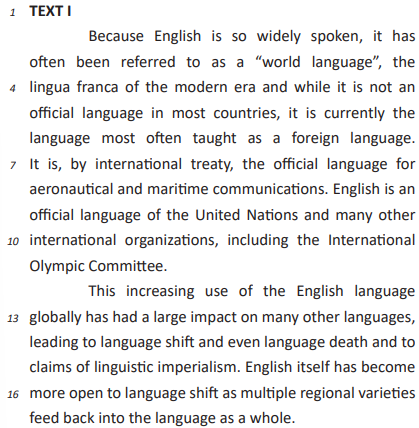
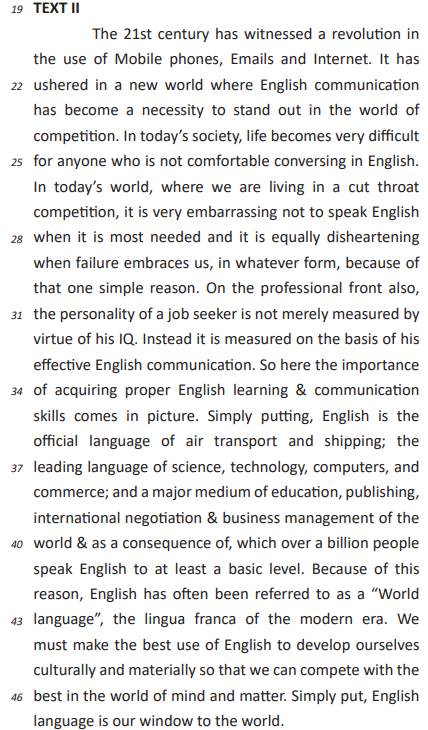
In text II, the verbs “has witnessed” (line 20), “has become” (line 23) and “has ushered” (lines 21 and 22) are in the present perfect tense, as well as the sentence “Because of this reason, English has often been referred to as a ‘World language’, the lingua franca of the modern era.” (lines from 41 to 43).
Julgue o item subsequente.
The sentence: "We have been to the beach last summer"
the sentence as a whole is in the present perfect tense.
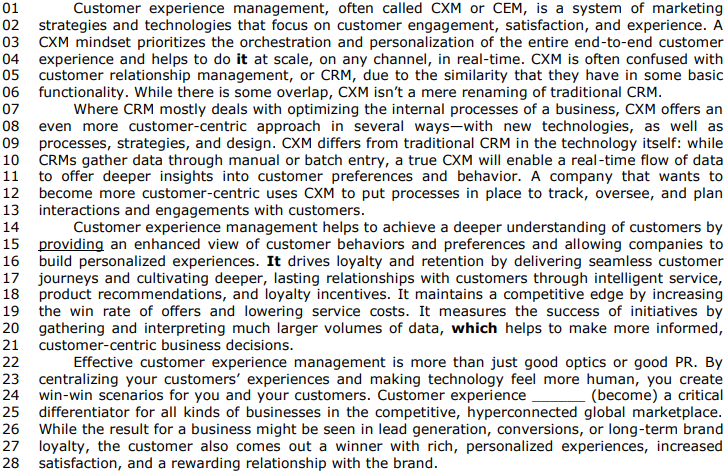
What is customer experience management?
(Available at: www.dynamics.microsoft.com/en-us/marketing/what-is-customer-experience-management-cxm/
– text specially adapted for this test).
Internet: <sciencedaily.com> (adapted).
Considering the information stated in the text above and the vocabulary used in it, judge the following item.
The verb “realized” (first sentence of the text) could be replaced with reached a milestone without changing the meaning of the sentence.
"I’ve had those two days to recharge my batteries".
“My mom: Where is your father? I need to talk to him.
My friend: He __________________ to the supermarket. If it is important, you should call him.”
For question, choose the best option to fill in blanks CORRECTLY and RESPECTIVELY.
I- Viola’s a great actress, _____ she?
II- She’s already been nominated to Oscar, ___ she?
III- She’d played a similar character before, _____ she?
For question, choose the best option to fill in blanks CORRECTLY and RESPECTIVELY.
I - I _________ in Teutônia.
II - I _________ in Gramado for 2 years, from 2020 to 2022.
III - I _________ in Teutônia for two years now.
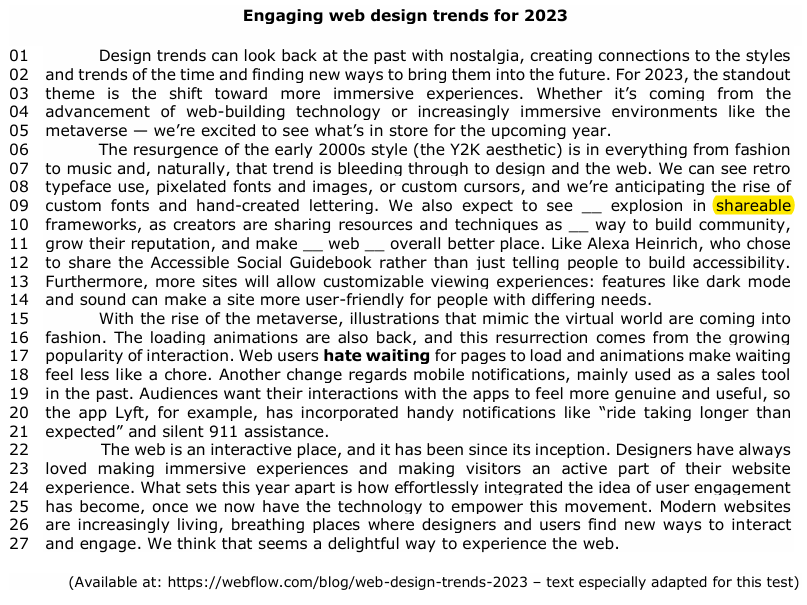
Consider the sentence in line 22 as follows:
1. “The web is an interactive place,”
2. “and it has been since its inception.”
Choose the correct explanation for the verb tenses used, considering the context presented in the text.
Text 1
Green shoppers around the world
If you want to be a responsible consumer, think about not just how much you buy, but also about what’s good for the planet. Green Shoppers United is an international non-profit organization for the promotion of responsible consumerism.
Labels
Read the labels. Some...................the ingredients that manufacturers use in products, such as cosmetics or toiletries, can damage the environment. Some ingredients are only used...................make things prettier, or more colorful, but they might also be harmful. Don’t buy things that contain substances that harm you or the world you live................... For example, research shows a potential link...................the preservatives called parabens, often found in beauty products, and some types of cancer.
Transport
In today’s global economy, it is easier for companies to buy products and materials where they’re cheap, and transport them over enormous distances to get them to customers. If you can, buy things locally. The local food movement has grown steadily in recent years, and it’s often possible to track down locally grown, or produced, products, rather than those that have been transported long distances. If we stop buying goods that have had to fly over continents to get to us, companies may stop transporting them around unnecessarily. A bargain may cost you less personally, but the real price we pay for it in the long run may turn out to be too high, as jet fuel continues to pollute our environment.
Environment
Responsible consumers recycle to reduce waste, and its negative impact on our environment. A lot of the plastic packaging we use for food and drink is recyclable, but not all of it. The most common packaging materials are still non-recyclable polyethylene and PVC. Seventy million tons are used every year. Look at the recycling labels carefully. Manufacturers should use recyclable plastics, like PET, wherever possible. Some have also begun using lighter materials, for example, 30% lighter PET plastic for drinks bottles, to reduce the amount of plastic waste. Transporting lighter materials is cheaper, and uses less fuel, too – so the solution may actually benefit everyone.
Packaging
We’ve all purchased products wrapped in foil, then sealed in a bag, and then put in a box. Why? Write to companies that you think produce wasteful packaging. Ask them to think about what’s really necessary. Make them realize they can save money by using less packaging and, at the same time, help save our planet.
Consumers
A lot of us expect products these days to be more environmentally friendly. However, research has shown that we don’t want to pay more, and we don’t want to compromise on the quality of products, either. For example, one manufacturer recently had to switch back to less environmental packaging of potato chips, just because customers didn’t like the noise their “green” bags made when they were opened! Think about the effects of your shopping choices. Buy less to save the world, and join our effort to make shopping greener!
“The local food movement has grown steadily in recent years, and it’s often possible to track down locally grown, or produced, products, rather than those that have been transported long distances.”
We can infer that the underlined words are being used in which verb tenses?
Read the Text I and answer the five questions that follow it.
Text I
Correspondence
Human genome editing: potential seeds of conflict
Recently, The Lancet published an important declaration regarding the necessity of regulating and legislating for human genome editing. We agree with their opinions that the human genome editing technology and resulting research can have both positive and negative effects on human society. The use of genome editing for research and commercial purposes has sparked debates in both biological and political realms. However, most of them have mainly focused on the effects of human genome editing on the patients themselves, and little attention has been paid to their offspring.
Several films, such as Gattaca and Gundam SEED, have addressed the conflicts that arise from human genome editing. Such conflicts not only exist within the generation who have experienced editing but are also transmitted to their offspring. For example, in these films, the offspring of people without genome editing felt a sense of unfairness regarding the inferiority of their physical (or other non-edited domains) status, whereas the offspring of people with genome editing grew up in a biased, discriminated against, and ostracized environment. They could have lived in peace with a strong and well regulated government; however, when the tenuous grip of government weakens, jealousy and resentment can lead to ruins. Although these scenes still exist in films, they might become increasingly plausible in decades to come. Using the concept of preparedness, access, countermeasures, tools, and trust, we should prepare legitimate human genome editing, establish access to deal with imminent or potential discrimination, develop countermeasures and tools for prevention and resolution of conflict, and entrust future generations with the responsibility to use them wisely.
Bing-Yan Zeng, Ping-Tao Tseng, *Chih-Sung Liang
Adapted from: www.thelancet.com, vol. 401, June 24, 2023 athttps://www.thelancet.com/action/showPdf?pii=S0140-6736%2823%2901084-X
The main verb in “has sparked debates” is similar in meaning to
The last period of the text is in the present perfect tense in which “been” is the past participle of the verb to be.
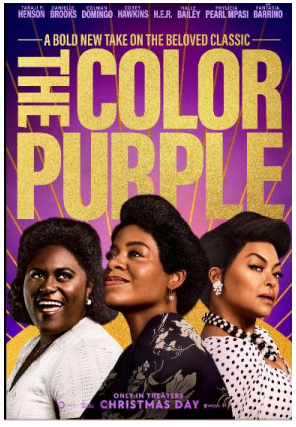
I. “Oprah has joined forces with Steven Spielberg, Quincy Jones, and Scott Sanders to bring The Color Purple musical”
II. "In 1985, Oprah made her acting debut as Sofia in Spielberg’s adaptation of Alice Walker’s novel—and earned an Academy Award nomination. "
III. “Celie, the protagonist of The Color Purple, endures the unimaginable while growing up in rural Georgia—and triumphs, thanks in part to the support of the book’s other women protagonists, Sofia and Shug Avery.”
Concerning the Present Perfect, analyze the following items.
I. We use the present perfect to talk about situations continuing up to now.
II. We often use the present perfect for actions repeated up to now.
III. We do not use the present perfect when we say how long they have lasted.
The CORRECT item(s) is(are):

 Conheça nossos planos