Questões de Concurso
Comentadas sobre preposições | prepositions em inglês
Foram encontradas 503 questões


Instruction: answer questions 31 to 40 based on the following text. The highlights throughout the text are cited in the questions.
Carnival
- ______ Carnival is ____ festival celebrated in _____countries of Catholic tradition, often
- with public parades of playful, imaginative wagons typically called "floats, masking, jokes and
- feasts”.
- Etymology
- The word carnival comes from the Latin "carnem levare" (=eliminate meat) and
- originally indicated the banquet that was held on the last day of Carnival (Mardi Gras),
- immediately before Lent, the period of fasting and abstinence when Christians would abstain
- _____ meat. The first evidence of the use of the word "carnevale" (or "carnevalo") are the texts
- of minstrel Matazone da Caligano of the late 13th century and writer Giovanni Sercambi around
- 1400.
- Carnival period
- In Catholic countries, traditionally Carnival begins on the Septuagesima Sunday (70
- days to Easter, it was the first of the nine Sundays before the Holy Week in the Gregorian
- calendar), and in the Roman rite ends on the Tuesday before Ash Wednesday, which marks the
- beginning of Lent. The climax is usually from Thursday until Tuesday, the last day of Carnival.
- Being connected with Easter which is a moveable feast, the final dates of Carnival vary each
- year, though in some places it may begin already on 17th January. Since Catholic Easter is on
- the Sunday after the 17first full moon of spring, therefore from 22 March to 25 April, and since
- there are 46 days between Ash Wednesday and Easter, then in non-leap years the last day of
- Carnival, Mardi Gras, can fall any time within February 3 to March 9.
- In the Ambrosian rite, which is followed in the Archdiocese of Milan and in some
- neighboring dioceses, Lent begins with the first Sunday of Lent, therefore the last day of
- Carnival is on Saturday, four days later than the Mardi Gras in other areas of Italy.
- Carnival in antiquity
- Although present in the Catholic tradition, Carnival has its origins in much older
- celebrations, such as the Greek Dionysian festivals ("Anthesteria") or the Roman "Saturnalia".
- During these ancient rites a temporary dissolution of the social obligations and hierarchies took
- place in favor of chaos, jokes and even debauchery. From a historical and religious point of
- view Carnival represented, therefore, a period of renewal, when chaos replaced the established
- order, but once festive period was over, a new or the old order re-emerged for another cycle
- until the next carnival.
- In Babylon, shortly after the vernal equinox the process of the foundation of the cosmos
- was re-enacted, described with the myth of the struggle of Marduk, the savior-god with Tiamat
- the dragon, which ended with the victory of the former. During these ceremonies a procession
- was held in which the forces of chaos were allegorically represented fighting the recreation of
- the universe, that is the myth of the death and resurrection of Marduk, the savior. In the parade
- there was a ship on wheels where the deities Moon and Sun were carried along a large avenue
- - a symbol of the Zodiac - to the sanctuary of Babylon, symbol of the earth. This period was
- accompanied by an unbridled freedom and a reversal of social order and morality.
- In the Roman world the feast in honor of the Egyptian goddess Isis involved the presence
- of masked groups, as told by Lucius Apuleius in the Metamorphoses (Book XI). Among the
- Romans the end of the old year was represented by a man covered with goat skins, carried in
- procession, hit with sticks and called Mamurius Veturius.
- Carnival is therefore a moment in a mythic cycle, it is the movement of spirits between
- heaven, earth and the underworld. In the spring, when the earth begins to show its power,
- Carnival opens a passage between the earth and the underworld, whose souls must be honored
- and for a short period the living lend them their bodies wearing masks. Masks therefore have
- often an apotropaic meaning, as the wearer takes on the features of the spirit represented.
- In the 15th and 16th centuries, the Medici in Florence organized large masked carts
- called "Trionfi" accompanied by carnival songs and dances one, the "Trionfo di Bacco e Arianna"
- also written by Lorenzo the Magnificent. In Rome under the Popes horse races took place and
- a called the "race of moccoletti" where runners bearing lit candles tried to blow out each other's
- candles.
(Available at: http://www.italyheritage.com/traditions/carnival/2023/04/14/ – text especially adapted for this test).
The alternative that best fills in the blank that follows the verb ‘abstain’ in line 07 is:
Identify the sentence that uses the prepositions "in", "on", and "at" correctly.
Text 1
Structure of education in Singapore
The complete control and management of Singapore’s education is in the hands of the Ministry of Education (MOE). With continuous endeavour from MOE, today Singapore can be considered to have a strong and well-reputed education system. As per recent study Singapore is ranked fourth in terms of World’s Best Education System.
The preschools are run by the private sector, including religious bodies, community foundations, business groups, etc. However, every preschool need to register itself with the Singapore Ministry of Education before being functional.
After completion of 6 years of primary education, students have to appear for a Primary School Leaving Exam (PSLE). All those students who passed the exam are admitted in a secondary level course, which is usually completed in 4-5 years. It is similar to attending seventh grade through tenth grade in the American education system.
After completion of the secondary education, the students need to appear in Singaporean GCE ‘O’ Level exam. Based on the merit in that exam, students proceed to pre-university education, which is similar to attending eleventh grade and twelfth grade as per the American education system. At this level students can opt for a wide range of subjects from varied academic areas covering Humanities, Arts and Languages, Sciences and Mathematics streams.
www.singaporeeducation.info/Education-System/ Structure-of-Education
Some prepositions are missing in the text below.
Choose the alternative that presents the correct missing prepositions.
Cities are diverse ............... general, including in food, people, things to do - you name it! Your neighbors likely all have interesting and unique backgrounds, and you can learn a ton ................ having conversations in the laundry room. My upstairs neighbor is a sheriff and he always has crazy stories to tell me.
I love living in a building where everyone is different, especially if they’re willing to strike up a conversation. No two people in any city are the same.
Cities buzz energy .............. There are always people doing something, and that can be exciting. However, some people may not like that kind .............. atmosphere. But for those of us who do, it makes leaving your apartment every day a joy.
www.forbes.com/sites/rent
Regarding the use of prepositions related to time in English, analyze the following sentences:
I - I have an important meeting ______ Monday morning, so I can't stay out too late on Sunday.
II - The concert is scheduled to start ______ 7:30 PM, so make sure to arrive early.
III - We usually go for a walk in the park _____ the evening, just before sunset.
IV - The museum is closed _____ Mondays, so we'll have to visit on another day.
V - My birthday is _____ March 15, and I'm planning a small celebration with friends.
Select the option that correctly fills in the blanks.
We use the prepositions: to, through and towards exclusively with dynamic verbs, which express movement and not fixed location.
The Preposition in is used to indicate time, be it the year, the month, the seasons or a part of the day. Therefore, the sentence: He sleeps late in night, is correct.
As preposições são dividas para indicar tempo (ou duração) quanto lugar (ou posição, movimento e direção), independente do contexto possuem o mesmo significado.
Em inglês, a preposição "on" pode ser usada para indicar meios eletrônicos, nos quais as informações são disponibilizadas, locais e objetos que possuem uma superfície.
Complete the sentences with the correct prepositions:
- It sounds like a great idea. You should go _______ it!
- I’ve got a lot _______ my plates these days and I rarely see my friends.
Text 1
The Courage to Be Imperfect
Perfectionism, self-examination and the kissing of frogs
Michael J. Formica
Posted July 9, 2009
Someone once said that there are two kinds of people in the world - those who are right... And nowhere are we more inclined to want to be right than with regard to ourselves. In fact, more often than not, we want to be perfect. What this striving for perfection often leads to is a kind of social paralysis.
If we are constantly focused on making the right decision, we will sometimes find ourselves in a place ranging from morbid indecision to outright fear. Getting it right, making the good choice and avoiding the faux pas endorse in us a rigidity of character and action that is limiting and, in derailing our momentum, deflects our potential evolution.
The willingness to be wrong or, as more properly suggested here, the courage to be imperfect, allows us the opportunity to discover many things about ourselves. Without exercising this courage, we put ourselves into a straightjacket of sorts, setting our thoughts and actions in a dismally fettered pattern.
This line of thinking was prompted by a conversation that I had with a client yesterday where in she had come to the conclusion that she was a bit of a perfectionist. What she had puzzled out for herself was that her perfectionism, rather than serving her, was actually hindering her ability to be flexible, open to new possibilities and clear about what she wanted for herself and her life.
At some point, I suggested that the fairy tale about the princess kissing frogs to find the prince was a good metaphor for stepping outside of one's comfort zone and "trying something on for size' without an overly self-conscious regard for the potential consequences of the choice. She mentioned that a few days earlier she had seen the trailer for a movie in which the princess kissed a frog and turned into a frog herself. Brilliant.
If we are unwilling to kiss a few frogs - to explore the possibilities that are presented to us in anticipation of finding something unexpected - then we, ourselves, may turn into frogs. That is, become stuck in our place and condemned to something that is not us. We can, without the willingness to be open to making mistakes, limit ourselves right into a state of personal inauthenticity.
Available
in:<https://www.psychologytoday.com/intl/blog/enlightened-living/200907/the-courage-be-imperfect>
I. In the structure “The willingness to be wrong or” the word “willingness” is an adjective formed by suffix.
II. In the structure “many things about ourselves” has a reflexive pronoun and preposition.
III. The word “straightjacket” means a situation in which you feel comfortable and in which your ability and determination are not being tested.
IV. In the expression “dismally fettered pattern” the word “fettered” can be replace by “enchain”.
Which ones are correct?
"The conference is scheduled to start _____ 9:00 AM."
"Juggling ________ meetings, deadlines, and coffee breaks, she finds solace in the camaraderie of her colleagues."
Choose the correct sentence.
The politician was not glad at ___________ the news
Let’s go ________ bed we can continue _________ talk tomorrow. I am __________ of form.
“Wonderful experience”: Researcher’s close encounter with Svalbard polar bears
By Miranda Bryant
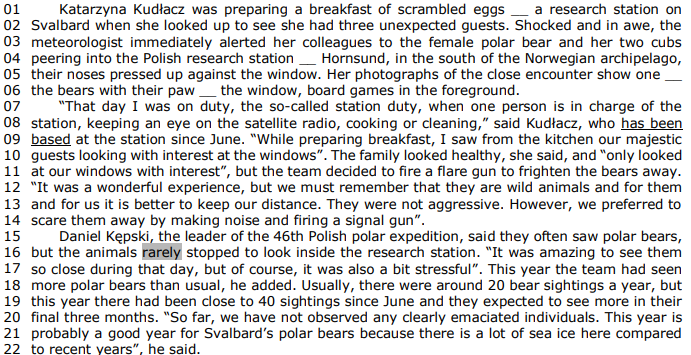
(Available at: www.theguardian.com/environment/2024/apr/02/wonderful-experience-svalbardresearchers-close-encounter-with-svalbard-polar-bears – text especially adapted for this test).
Analyze the assertions below.
I - "In" correctly fills the gap in the text. II - There is a phrasal verb in the sentence “(…) which included laying off more than (…)”. III - The words in italics are respectively: an uncountable noun; a personal pronoun; the comparative form of the adjective “quart”.
It is correct to affirm that:
Read Text I and answer question.
Text I
How to have a healthier relationship with your phone
A few years ago, a Google employee sent an email to thousands of her co-workers: What if for six weeks straight, you spent one night per week without technology? The email was from Laura Mae Martin, Google’s executive productivity adviser, a role that, among other things, was created to help staff members foster healthier relationships with their gadgets and apps. After she sent the note, Ms. Martin was flooded with responses from coworkers eager for a respite from some of the very products they helped build. Thousands of employees have since participated in the annual “No-Tech Tuesday Night Challenge,” said Ms. Martin.
The problem she was trying to solve isn’t unique to Google workers. One survey found that Americans say they spend too much time on their phones. But dramatic solutions – a digital detox, a phone downgrade or a complete exit from social media – may feel impractical.
Is it possible to have a healthy relationship with technology while still using it daily? Fortunately, according to experts, the answer is a resounding ‘yes’ and here are a few things you can try:
First, start with one simple question.
You know that urge you get to reach for your phone without realizing it? And then, before you know it, you’re an hour into a social media binge? If you want to peacefully coexist with technology, you need to get a handle on those impulses, said Richard J. Davidson, the founder and director of the Center for Healthy Minds at the University of Wisconsin-Madison. According to him, people should start by noticing when they have an urge to lift their phone or open social media on their browser window. By becoming conscious of what you’re about to do, you’re interrupting an automatic behavior and awakening the part of your brain that governs self-control, he added. As one research article suggests, awareness of your actions can help you rein in bad habits.
Secondly, take the “mobile” out of your mobile devices.
Dr. Anna Lembke, a professor of psychiatry and addiction medicine at Stanford University School of Medicine, said one of the biggest problems with smartphones is what she calls “texting while running to catch a bus.” Using our devices while we’re on the move – walking from meeting to meeting, taking a child to school or catching a bus – prevents us from being more engaged in our lives, Dr. Lembke said.
One way to create harmony with technology is to limit your phone use when you’re on the move. Headed out for a walk? Turn off your notifications. Going to grab a coffee? Leave your phone on your desk. If you’re feeling brave, try powering down your phone while in transit. It won’t buzz with notifications, text messages or phone calls, which Dr. Lembke said could help you focus on the world around you.
Last of all, make technology work for you.
One thing experts agree on: To forge a healthy relationship with technology, you need to be in control of it and not the other way around. Think about your gadgets as tools that you decide how to use.
“Make it work for you, not against you; whether it’s an email program or your dishwasher, it’s the intention behind how you’re using it that really makes the big difference”, said Ms. Martin, the productivity expert at Google.
(Adapted from:
https://www.nytimes.com/2024/03/21/well/social-media-phone-addiction.html)
A - “Is it possible to have a healthy relationship with technology while still using it daily?” B - “According to him, people should start by noticing when they have an urge to lift their phone or open social media on their browser window.” C - “If you want to peacefully coexist with technology, you need to get a handle on those impulses, said Richard J. Davidson, the founder and director of the Center for Healthy Minds at the University of Wisconsin-Madison.
Considering the order B-C-A, it is correct to affirm that the words in italics are correctly and respectively:

 Conheça nossos planos