Questões de Concurso
Comentadas sobre palavras conectivas | connective words em inglês
Foram encontradas 501 questões


TEXT II - Text for question.
The challenges of learning English skills and the integration of social media and video conferencing tools to help ESL learners coping with the challenges during COVID-19 pandemic: a literature review
Yong Hua Ying, Winson Eng Wei Siang, Maslawati Mohamad
Abstract
During the COVID-19 pandemic, the abrupt closures of all learning institutions have caused English as a Second Language (ESL) learners to have significant difficulties learning the English language especially for speaking skills. Speaking is one of the most important skills to learn because it is the primary mode of communication around the world. However, the majority of ESLlearners are still trying to improve their English speaking abilities. Since the implementation of the COVID-19 lockdowns, e-learning has been a well-known solution all over the world. Learners and educators need more time to adjust to online teaching and learning because most of them are exploring new technical innovations and strategies to be used in the classroom. As a result, this study includes a literature review on the challenges ESL learners encounter in learning speaking skills, as well as the use of social media and video conferencing tools to teach speaking skills. Lack of motivation and self-confidence, fear, hesitation, and limited vocabulary are some of the challenges faced by ESL learners. Hence, it is vital to determine the technology intervention used in teaching and developing speaking skills among these learners based on previous study. During the COVID-19 pandemic, some of the interventions in teaching speaking skills included utilizing social media and video conferencing applications like Facebook, WhatsApp, and others for online teaching and learning. Educators of ESLmight then pick the ones that would work best in their particular classroom.
Keywords: E-Learning, Learning of Language Skills, Social Media, Video Conferencing Tools, COVID-19 Pandemic Adapted from: https://www.scirp.org/journal/paperinformation.aspx?paperid=110450. Accessed on January 20 , 2022. th
The words however, since and hence belong, respectively, to the following word classes:
I.Therefore; Thus; As a result.
II.Later; Subsequently; Afterwards.
III.Besides; Furthermore; Moreover.
Check the correct alternative concerning the function of discourse markers.
I.Did the teacher look angry? No, ___________ she was peaceful.
II.___________ the candidates who studied more are going to succeed.
Mark the correct alternative.
“When preparing for a speech it is important to rehearse. _________, you want to deliver a meaningful message to your audience.”
Which is the function of the linking word “Moreover” in the sentence below:
“Moreover he is considered to be a founder of the environmental non-profit organization.”
Some terms are used to link clauses or sentences, in order to demonstrate a condition, for example, or to make a comparison or contrast. So, choose the alternative that contains the right linking word to complete the following sentence:
We're in trouble! People don't care about nature, animals, plants, the air and the forest, ______________________, causing tragedies all around the world.
Considere a tirinha abaixo.
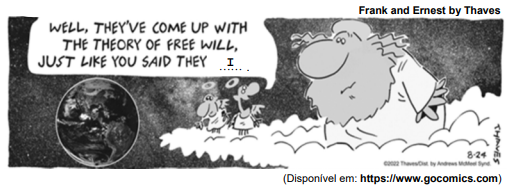
A palavra ou expressão que conclui adequadamente, na lacuna I, a fala do anjo para Deus é
They propose the mixing of __________________and _______________comprehension with __________________and ________________ expression.
Choose the alternative that contains the correct words to complete the sentence.
On the basis of this definition, it is correct to say that the words “almost” (last sentence of the second paragraph), “favor” (third sentence of the fourth paragraph), “which” (first sentence of the last paragraph) and “between” (third sentence of the last paragraph), which were taken from text 4A1-II, are, respectively,
Read text I and answer the question that follow it.
Text I
The New Rules of Data Privacy
The data harvested from our personal devices, along with our trail of electronic transactions and data from other sources, now provides the foundation for some of the world’s largest companies. […] For the past two decades, the commercial use of personal data has grown in wild-west fashion. But now, because of consumer mistrust, government actions, and competition for customers, those days are quickly coming to an end.
For most of its existence, the data economy was structured around a “digital curtain” designed to obscure the industry’s practices from lawmakers and the public. Data was considered company property and a proprietary secret, even though the data originated from customers’ private behavior. That curtain has since been lifted and a convergence of consumer, government, and market forces are now giving users more control over the data they generate. Instead of serving as a resource that can be freely harvested, countries in every region of the world have begun to treat personal data as an asset owned by individuals and held in trust by firms.
This will be a far better organizing principle for the data economy. Giving individuals more control has the potential to curtail the sector’s worst excesses while generating a new wave of customer-driven innovation, as customers begin to express what sort of personalization and opportunity they want their data to enable. And while Adtech firms in particular will be hardest hit, any firm with substantial troves of customer data will have to make sweeping changes to its practices, particularly large firms such as financial institutions, healthcare firms, utilities, and major manufacturers and retailers.
Leading firms are already adapting to the new reality as it unfolds. The key to this transition — based upon our research on data and trust, and our experience working on this issue with a wide variety of firms— is for companies to reorganize their data operations around the new fundamental rules of consent, insight, and flow.
[…]
Federal lawmakers are moving to curtail the power of big tech. Meanwhile, in 2021 state legislatures proposed or passed at least 27 online privacy bills regulating data markets and protecting personal digital rights. Lawmakers from California to China are implementing legislation that mirrors Europe’s GDPR, while the EU itself has turned its attention to regulating the use of AI. Where once companies were always ahead of regulators, now they struggle to keep up with compliance requirements across multiple jurisdictions.
Adapted from: https://hbr.org/2022/02/the-new-rules-of-data-privacy
February 25, 2022 – Retrieved September 6, 2022

The term “However” (line 10) can be correctly replaced by the conjunction Hence, without changing its meaning.
I. It’s kind of hard to decide _________ or not to call him.
II. ________ you like, I’ll come to Singapore with Sarah.
III. ________ he doesn’t come back in half an hour, I’m going home.
The sentence below can be classified as:
“If I get late, start the meeting without me.”
São conectivos que têm efeito de adição, EXCETO:
However, we need to think about animals, too ‘…but is now under threat from nature itself.’ ‘Due to exhaustion or stormy weather…’ ‘As a result of all these factors…’
We can infer that the words in bold:
1. They are called discourse markers or linking words, as they help the speaker to manage the conversation and mark when it changes.
2. Discourse markers are words and phrases used in reading to ‘signpost’ discourse.
3. Linking words show us turns, join ideas together, and generally control communication.
4. Discourse markers are referred to more commonly as ‘linking words’ and ‘linking phrases’, or ‘sentence connectors’.
5. They are used more frequently in speech, unless the speech is very formal.
Choose the alternative which contains all the correct affirmatives.

 Conheça nossos planos