Questões de Concurso
Sobre os advérbios (grau, a finalidade, contraste ...) | adverbs (degree, purpose, contrast...) em inglês
Foram encontradas 82 questões


I. She past the test, because she study a lot.
II. After you arrive here, we'll go out with our friends.
III. Although he is handsome, he isn't a good person.
Sobre Adverb Clauses, assinale a alternativa correta:
Instruction: answer question based on the following text.
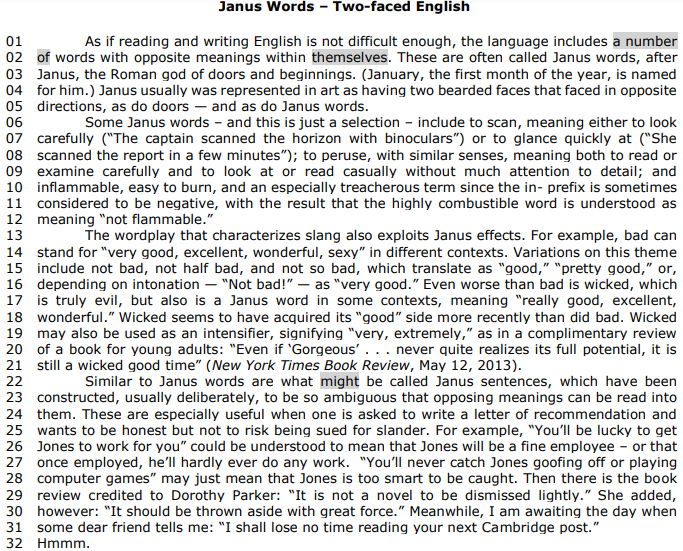
(Avalaible in: https://dictionaryblog.cambridge.org/2013/07/01/janus-words-two-faced-english/#more-2382 –
text especially adapted for this test).
I. “More recently than” is a superlative structure with an adverb.
II. If “more recently than” were substituted by “not as recently as,” without altering the order of any other word in the sentence, there would be no changes in meaning.
III. If “than did bad” were removed from the sentence, it would still be grammatically correct.
Which statements are correct?
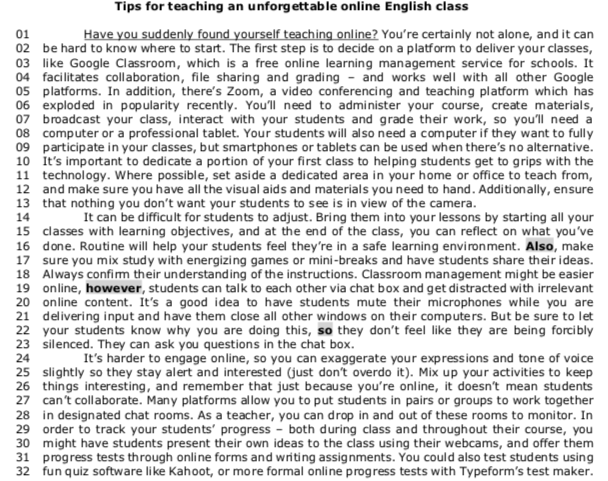
(Avaliable in: https://www.cambridgeenglish.org/blog/12-tips-for-teaching-an-online-english-class/ – text adapted specially for this test).
Answers the question according to the text below.
Organ Donation and Transplant
1._____boys formed the group to the game. 2._____people in the ship had chances to survive. 3.She has _____ time to catch the train.
The correct order is:
Leia os quadrinhos para responder à questão.

(www.magoosh.com)
Read the following text and answer question.
Introduction to global food loss and food waste
Food losses and food waste are quickly becoming a top global issue, because while there are millions of families with children starving, others are living in abundance, with many others carelessly throwing food away. Many of us have wasted food in one way or the other, but the real food losses and waste matter is ______ than just consumer food waste.
From farming fields and storage places, through transportation, processing, market places, down to
consumption places such as homes, schools, restaurants and workplaces, more than half of all food
produced globally go to waste. This is a tragedy!
In developing countries, it takes a lot of man-power to produce food. In more advanced countries, machines and technology are used, but the drain on energy, destruction of vegetative lands, the use of chemicals and ______ impact on the environment are phenomenal. Putting all that together, it is clear that a major problem has emerged and we are all in a position to help in one way or the other.
(Adapted from: https://goo.gl/ySEn3F. Access: 01/23/2018)
The words such as in “ such as homes, schools, restaurants and workplaces…” indicates
Nice to meet you
One of the things you learn when studying English is how to present yourself and most people learn phrases such as “How do you do?” or “Hi, my name is…”. However, one thing that language teachers don’t explain is that British people very rarely use these expressions. British people are not very good at introductions in informal situations. They are not sure what to say or what do with their hands. Whereas Brazilians or Americans will confidently extend their hands to people they meet at parties or social situations, English people prefer just to smile.
Expressions like “Hello, I’m John Smith”, “Hi, my name is…” are only used when we have to identify ourselves; for example when we go to an appointment at the dentist’s or the hairdresser’s, or if we’re telephoning someone to ask for information about ourselves.
Dialogues in school books where English teenagers present themselves to each other on the first day of school are pure fantasy. In informal social situations, British people prefer to stay chatting about something neutral like the weather, or else they use humour to break the ice. When the conversation has progressed, or even just before leaving, you can say, “I’m Ann, by the way.”, or “I didn’t catch your name”. If you meet the person again you can say, “Hello again” or, more colloquially, “Hi ya”, which stands for “Hello, nice to see you again”.
In the case of formal meetings or business situations, many language courses teach the expression “How do you do?” – to which you should answer “How do you do?”. This phrase is also recommended by the website ediplomat.com and Drett’, the famous specialist publisher that has a range of guides on British etiquette. I have said “How do you do” in my entire life and no one has never said that to me! In today’s Britain this expression is best reserved for extremely formal situations. It is, however, something that people over 60 might say, so if your elderly boss or professor uses this expression with you, then it’s polite to answer in the same way
 The fair trade movement, which aims
ensure that fair prices are paid to producers in
developing countries, is one of the true global success
stories recent decades. The International
Fairtrade Certification Mark, a guarantee that producers are getting a fair price, has become one of the
most recognizable logos the world, which
91 percent of customers associate positive
values. When the logo first appeared in the UK, the
country where the largest number of fair-trade products are sold, nobody expected that the number of
certified products would grow from only 3 to over
4,500 in just 18 years. In 2011, people around the
world spent more than 6.5 billion US dollars on fair-
-trade certified goods, signifying a 12 percent increase
in sales from the previous year. This was at a time
when most market segments in the developed world
were still shrinking or stagnating from the after effects
of the 2008 banking crisis. Over 1.2 million farmers
and workers living in 66 countries benefit from fair-
-trade certification by being able to sell their products
at competitive prices, to ensure sustainability.
The fair trade movement, which aims
ensure that fair prices are paid to producers in
developing countries, is one of the true global success
stories recent decades. The International
Fairtrade Certification Mark, a guarantee that producers are getting a fair price, has become one of the
most recognizable logos the world, which
91 percent of customers associate positive
values. When the logo first appeared in the UK, the
country where the largest number of fair-trade products are sold, nobody expected that the number of
certified products would grow from only 3 to over
4,500 in just 18 years. In 2011, people around the
world spent more than 6.5 billion US dollars on fair-
-trade certified goods, signifying a 12 percent increase
in sales from the previous year. This was at a time
when most market segments in the developed world
were still shrinking or stagnating from the after effects
of the 2008 banking crisis. Over 1.2 million farmers
and workers living in 66 countries benefit from fair-
-trade certification by being able to sell their products
at competitive prices, to ensure sustainability.
 Fair-trade initiatives have been growing steadily since the late 1960s, when the fair trade
movement started with only a handful of committed
individuals in the West who believed there was an
alternative to the exploitation of farmers and workers
in the developing world. Fair trade ensures fair prices
for suppliers, as well as payment of a premium that
can be reinvested in the local communities (for example, in schools or sanitation) or in improving productivity. In India, for instance, a group of rice farmers used
the premium to buy farm machinery, which meant a
30 percent improvement in production.
Fair-trade initiatives have been growing steadily since the late 1960s, when the fair trade
movement started with only a handful of committed
individuals in the West who believed there was an
alternative to the exploitation of farmers and workers
in the developing world. Fair trade ensures fair prices
for suppliers, as well as payment of a premium that
can be reinvested in the local communities (for example, in schools or sanitation) or in improving productivity. In India, for instance, a group of rice farmers used
the premium to buy farm machinery, which meant a
30 percent improvement in production.
 As consumers look for, and recognize, the logo
and purchase fair-trade products, they put
pressure on companies and governments to do more
for global welfare. They also put pressure on supermarkets to sell fair-trade goods at the same price as
conventional products, shifting the extra costs involved from consumers to the corporations that collect
the profits.
As consumers look for, and recognize, the logo
and purchase fair-trade products, they put
pressure on companies and governments to do more
for global welfare. They also put pressure on supermarkets to sell fair-trade goods at the same price as
conventional products, shifting the extra costs involved from consumers to the corporations that collect
the profits.
 Critics of the fair trade movement say it is still
not doing enough. They stress that the key to
long-term development is not in small local improvements, but in moving the developing world from
the production of raw materials into processing them,
which can bring in greater profit. There are already some signs of this happening. A group of tea growers
in Kenya recently set up a processing factory to deliver the final products directly to their customers in
the West. By switching from the export of raw tea to
boxed fair-trade products, they achieved 500 percent
higher profits.
Critics of the fair trade movement say it is still
not doing enough. They stress that the key to
long-term development is not in small local improvements, but in moving the developing world from
the production of raw materials into processing them,
which can bring in greater profit. There are already some signs of this happening. A group of tea growers
in Kenya recently set up a processing factory to deliver the final products directly to their customers in
the West. By switching from the export of raw tea to
boxed fair-trade products, they achieved 500 percent
higher profits.
 It is important to realize that, despite all of its
benefits, the fair trade movement has its limitations. Some of the poorest farmers can’t afford to pay
the certification fees required for each fair-trade initiative, while others work for big, multinational employers that are excluded from participating. Fair trade is
certainly a step in the right direction, but there is a lot
more we must continue to do in order to help people
in the world’s poorest regions.
It is important to realize that, despite all of its
benefits, the fair trade movement has its limitations. Some of the poorest farmers can’t afford to pay
the certification fees required for each fair-trade initiative, while others work for big, multinational employers that are excluded from participating. Fair trade is
certainly a step in the right direction, but there is a lot
more we must continue to do in order to help people
in the world’s poorest regions.“A group of tea growers in Kenya recently set up a processing factory to deliver the final products directly to their customers in the West. By switching from the export of raw tea to boxed fair-trade products, they achieved 500 percent higher profits.”
The underlined words are examples of:
Choose the best option to complete the following dialog:
A: My car is __________ yours. Even though, it is __________ comfortable.
B: I don’t; agree. Your car is __________ mine.
TEXTO I
English for Specific Purposes
English for specific purposes (ESP) refers to language research and instruction that focuses on the specific communicative needs and practices of particular social groups. Emerging out of Halliday, Macintosh, and Strevens’ (1964) groundbreaking work nearly 40 years ago, ESP started life as a branch of English language teaching, promising a stronger descriptive foundation for pedagogic materials. In the years since, ESP has consistently been at the cutting-edge of both theory development and innovative practice in applied linguistics, making a significant contribution to our understanding of the varied ways language is used in particular communities. Drawing on a range of interdisciplinary influences for its research methods, theory, and practices, ESP has consistently provided grounded insights into the structures and meanings of texts, the demands placed by academic or workplace contexts on communicative behaviors, and the pedagogic practices by which these behaviors can be developed.
HYLAND, K. “English for specific purposes: some influences and impacts”. In: Cummins, J. and Davison, C., (eds.) The International Handbook of English language education. Springer: Norwell, Mass, 2006.

Based on the text, judge the following item.
At the present time expresses the same idea as “Actually” (line 11).
Based on the text, judge the following item.
Text III
Here are some of the conclusions of a study conducted by The British Council to examine the policy, perceptions and influencing factors of English in Brazil:
[…] Brazil does not have a policy that focuses solely on teaching and learning English. The National Education Guidelines identify English as one of many foreign languages offered to students in primary and secondary education. Various English language learning initiatives have emerged at the federal, state and municipal levels however many English initiatives have limited success due to unbalanced curriculums, limited class time, teachers lacking the linguistic and pedagogical knowledge to effectively guide students, and minimal resources.[…]
Those working in internationalised industries, especially in management roles, do need English for employment though they may use it sparingly. As FDI ("Foreign Direct Investment") and interaction with other countries grow, especially in localised sectors, the demand for English as a medium of communication will increase. Currently, Brazil‘s average level of education and lack of English are perceived by some as detrimental to its economic growth and investment.[…]
Perceptions of English language use are changing. Younger generations are more open to English and link it less to a political agenda and more with personal growth and opportunity. Although there seem to be deeply-rooted ideological barriers at a national level to prioritise English over other languages, at an individual level, the language is gaining increased value and influence.
(Source: British Council Education Intelligence. (2015). English in Brazil: An examination of policy, perceptions and
influencing factors. Retrieved and adapted from https://ei.britishcouncil.org/sites/default/files/latin-americaresearch/English%20in%20Brazil.pdf.)
TEXT 5:


 Conheça nossos planos