Questões de Concurso
Sobre os advérbios (grau, a finalidade, contraste ...) | adverbs (degree, purpose, contrast...) em inglês
Foram encontradas 86 questões


In the passage, which word is an adverb that modifies the verb 'told'?


Read Text IV and answer the three questions that follow it:
Text IV

Adapted from: https://www.facebook.com/photo/?fbid=1294646317355834&set
=a.915379355282534
The function of “really” in “Do you really split bills [..]” is to
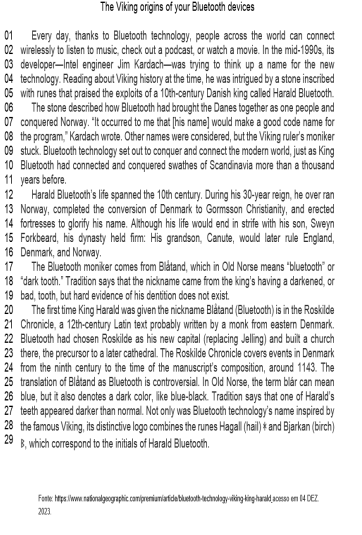
O texto IV refere-se à questão.
TEXTO IV
From Rockets to Ball Bearings, Pentagon Struggles to Feed War Machine: The flow of arms to Ukraine has exposed a worrisome lack of production capacity in the United States that has its roots in the end of the Cold War. By Eric Lipton
March 24, 2023,
Disponível em: www.nytimes.com
WASHINGTON — The Navy admiral had a blunt message for the military contractors building precision-guided missiles for his warships, submarines and planes at a moment when the United States is dispatching arms to Ukraine and preparing for the possibility of conflict with China.
“Look at me. I am not forgiving the fact you’re not delivering the ordnance we need. OK?” Adm. Daryl Caudle, who is in charge of delivering weapons to most of the Navy’s East Coast-based fleet, warned contractors during an industry gathering in January. “We’re talking about warfighting, national security, and going against a competitor here and a potential adversary that is like nothing we’ve ever seen. And we can’t dillydally around with these deliveries.”
His open frustration reflects a problem that has become worryingly apparent as the Pentagon dispatches its own stocks of weapons to help Ukraine hold off Russia and Washington warily watches for signs that China might provoke a new conflict by invading Taiwan: The United States lacks the capacity to produce the arms that the nation and its allies need at a time of heightened superpower tensions.
Industry consolidation, depleted manufacturing lines and supply chain issues have combined to constrain the production of basic ammunition like artillery shells while also prompting concern about building adequate reserves of more sophisticated weapons including missiles, air defense systems and counter-artillery radar.
The Pentagon, the White House, Congress and military contractors are all taking steps to address the issues.
Procurement budgets are growing. The military is offering suppliers multiyear contracts to encourage companies to invest more in their manufacturing capacity and is dispatching teams to help solve supply bottlenecks. More generally, the Pentagon is abandoning some of the costcutting changes embraced after the end of the Cold War, including corporate-style just-in-time delivery systems and a drive to shrink the industry.
Dutch government bans phones in schools The Dutch government has announced a ban ______01 mobile phones, tablets, and smartwatches in classrooms starting ______02 January 1, 2024.
The aim is to reduce distractions ______03 lessons and promote better concentration and studying opportunities for students. ______04, devices
_______________05 if they are specifically required for digital skills lessons, for medical reasons, or students with disabilities.
Education Minister Robbert Dijkgraaf ______06 that ______07 mobile phones are a significant part of ______08 lives, they are not suitable for the classroom, and scientific research ______09 this view.
The ban is the result of an agreement between the ministry, schools, and related organizations. Schools have the flexibility to implement the ban in their way, but if the desired outcomes ______10 achieved by the summer of 2024, legal rules ______11 enforced.
Source: https://www.newsinlevels.com/products/dutch government-bans-phones-in-schools-level-3/.
Julgue o item subsequente.
Adverbs of frequency, like “always” or “rarely,” indicate
how often an action takes place. Proper use of these
adverbs contributes to accurate communication, allowing
speakers to express routines, habits, or the frequency of
specific events in American English.
Text CB1A2-I
Although an oft-cited poll showed that 85% of Americans approve of organ donation, less than half had made a decision about donating, and fewer still (28%) had granted permission by signing a donor card, a pattern also observed in Germany, Spain, and Sweden. Given the shortage of donors, the gap between approval and action is a matter of life and death.
What drives the decision to become a potential donor? Within the European Union, donation rates vary by nearly an order of magnitude across countries and these differences are stable from year to year. Even when controlling for variables such as transplant infrastructure, economic and educational status, and religion, large differences in donation rates persist. Why?
Most public policy choices have a no-action default, that is, a condition is imposed when an individual fails to make a decision. In the case of organ donation, European countries have one of two default policies. In presumed-consent states, people are organ donors unless they register not to be, and in explicitconsent countries, nobody is an organ donor without registering to be one.
We examined the rate of agreement to become a donor across European countries with explicit and presumed consent laws. If preferences concerning organ donation are strong, we would expect defaults to have little or no effect. However, defaults appear to make a large difference: the four opt-in countries (Denmark, Netherlands, United Kingdom, Germany) had lower rates than the six opt-out countries (Austria, Belgium, France, Hungary, Poland, Portugal, Sweden). The two distributions have no overlap, and nearly 60 percentage points separate the two groups
Our data suggest changes in defaults could increase donations in the United States of additional thousands of donors a year. Because each donor can donate for about three transplants, the consequences are substantial in lives saved. Our results stand in contrast with the suggestion that defaults do not matter. Policy-makers performing analysis in this and other domains should consider that defaults make a difference.
Eric J. Johnson; Daniel Goldstein. Do Defaults Save Lives?
Internet: <www.dangoldstein.com> (adapted).
1. Our high turnover rate has been a growing _______ for us. 2. A rose in full bloom had been allowed to grow _______ one of the walls. 3. The company is growing _______ all the time. 4. Opposition to the latest proposals is growing _______ . 5. The Catholic community in Edinburgh began to grow _______ in the mid-19th Century.
( ) considerably ( ) steadily ( ) concern ( ) bigger ( ) unchecked up
Julgue o item subsequente.
Leia o texto para responder a questão.
English as a Lingua Franca
A number of researchers have studied conversations in English as a Lingua Franca and have noted a number of somewhat surprising characteristics, including:
• Non-use of third person present simple tense -s (She look very sad).
• Interchangeable use of the relative pronouns who and which (a book who, a boy which).
• Omission of articles where they are mandatory in native-speaker English.
• Increasing of redundancy by adding “inexistent” prepositions (We have to study about…, The article treats of…).
• Pluralisation of nouns which are considered uncountable in native-speaker English (informations, staffs).
The evidence suggests that non-native speakers are not conforming to a native English standard. Indeed they seem to get along perfectly well despite the fact that they miss things out and put things in which they ‘should not do’. Not only this, but they are actually better at ‘accommodating’ - that is, negotiating shared meaning through helping each other in a more cooperative way - than, it is suggested, native speakers are when talking to second language speakers (Jenkins 2004). In other words, non-native speakers seem to be better at ELF communication than native speakers are.
(Jeremy Harmer, The practice of English language teaching. Adaptado)
Leia o texto 1 para responder a questão que se segue.
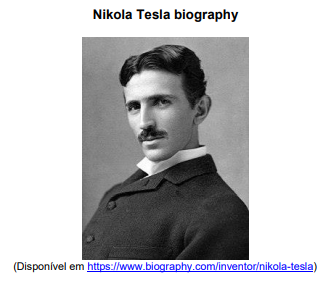
I. explicativo, pois constata onde ele nasceu. II. argumentativo, pois discute o lugar de nascimento dele. III. temporal, pois marca o tempo cronológico em que ele nasceu.

 Conheça nossos planos