Questões de Concurso
Sobre os advérbios (grau, a finalidade, contraste ...) | adverbs (degree, purpose, contrast...) em inglês
Foram encontradas 86 questões


Leia o texto a seguir:
How Teachers Feel About Adapting Instruction for Students
With Disabilities
School leadership and teaching experience strongly infl uence educators’ confi dence in their ability to adapt instruction for students with disabilities, according to a new survey. But most teachers, regardless of tenure, don’t feel prepared to diff erentiate lessons.
General education teachers were markedly less likely to feel confi dent in their ability to diff erentiate instruction than special educators. This confi dence gap exists despite most students with learning disabilities spending the majority of their school day in general education classrooms, according to a new nationally representative survey of 1,654 general and special educators by the National Center for Learning Disabilities and West Ed.
The State of Learning Disabilities survey explored educators’ confi dence in adapting instruction and the school-level factors that shape that confi dence.
Less than half of all general educators (42%) felt completely confi dent in their ability to adapt instruction for students with learning disabilities. That number drops to 17% for novice teachers with fewer than three years of experience, compared with 60% of novice special education teachers who felt completely confi dent in their abilities.
Fonte: Revista Education Week. Disponível em: https://www.edweek.org/ teaching-learning/how-teachers-feel-about-adapting-instruction-for-students-with-disabilities/2026/08. Excerto Adaptado. Acesso em: 25 de agosto de 2026.
Observe o fragmento abaixo:
“But most teachers, regardless of tenure, don’t feel prepared to diff erentiate lessons.” (1º parágrafo).
Os termos destacados são classificados, respectivamente, como:
"Although the newly appointed coordinator spoke remarkably calmly during the meeting, several parents still questioned the proposal."
The sentence contains forms whose classification depends on their syntactic function in context. Mark T, for true, and F, for false.
(__)"Although" functions as a subordinating conjunction introducing a concessive clause.
(__)"Newly" functions adverbially by modifying "appointed."
(__)"Remarkably" functions as an adverb modifying the degree expressed by "calmly."
(__)"Several" functions as a definite article because it determines the plural noun "parents."
After analysis, select the alternative that presents the CORRECT sequence of the items above, from top to bottom.
"Archaeologists now believe the Aquiry civilisation [...] may have been around three times larger than previously expected."
The words "now," "larger," and "previously" belong to different grammatical categories and perform distinct functions in the sentence.
Choose the CORRECT grammatical classification of the words in the sentence.
Leia o texto a seguir.
The world cup debutants determined to prove nothing is impossible
When the 2026 FIFA World Cup kicks off on June 11 in Mexico City, it will set in motion a flurry of historic firsts.
A newly expanded 48-team tournament, three countries: the US, Canada and Mexico as hosts and we’ll also get to see four debutants in the shape of Curaçao, Jordan, Uzbekistan and Cape Verde.
It was in October of last year that Cape Verde, the African archipelago nation — with a population of just over half a million people — qualified for its first ever World Cup after beating Eswatini 3-0 to become the third-smallest country after Curaçao and Iceland eight years ago to make it through to football’s biggest stage.
It was a feat made even more impressive by the fact the Blue Sharks ended up four points ahead of traditional continental powerhouse Cameroon, topping their Confederation of African Football qualifying group in the process.
It’s no wonder the team’s head coach Pedro Leitão Brito — better known as Bubista — was beaming with pride when he dropped by the CNN studios in Atlanta recently as part of a visit to Mercedes-Benz stadium, where Cape Verde will begin their World Cup campaign on June 15 against the 2010 winners and reigning European champions, Spain.
“We are so excited. I think the people are so excited and we’re going to do our best for our people,” Bubista — a distinguished former captain and defender on the national team — told CNN Sports.
Bubista oversaw a truly history-making qualifying campaign. A sequence of results that included a highly impressive five straight wins, the highlight of which featured a never-to-be-forgotten 1-0 triumph over the Cameroonians in September 2025.
But it’s October 13, 2025, that will be indelibly etched into the memory of all who witnessed Cape Verde’s historic win against Eswatini. A victory that would spark frenzied celebrations of joy in the country’s capital city Praia.
“Our people are so excited and so happy. Our people in the world, it’s just so great for our qualification and now our people are so grateful for everything,” Bubista added.
Cape Verde may be about to play in a first ever World Cup, but the national team is no stranger to success when it comes to competing in the Africa Cup of Nations having reached the quarterfinals in 2013 and then again, a decade later. Bubista oversaw the latter campaign but now the head coach’s focus is fully on his team’s tournament opener against Spain.
“We know it’s a very difficult match … They have very good players. We will respect them but anything is possible. We’re going to do our best to show the world what we can do in football,” Bubista reflected.
“We know it’s a hard game, but we have our heart and team spirit and this is important for us. Our unity is our strength,” he added.
The Blue Sharks will arrive in the US with a talented squad including Villarreal’s Logan Costa, Paris Saint-Germain 18-year-old Fabio Domingos and 36-year-old Ryan Mendes, who is the country’s most-capped player — with more than 90 appearances for the national team — and is Cape Verde’s all-time leading goalscorer.
And then there’s the remarkable story of the Shamrock Rovers forward Roberto “Pico” Lopes who was born in Ireland, but when it comes to international football, represents Cape Verde, currently ranked 69th in the world.
Lopes had always wanted to play for Ireland but when that didn’t materialize, he ended up playing for his father’shomeland after famously being recruited through a LinkedIn message from then-team head coach Rui Águas. Initially Lopes ignored the first message sent in Portuguese as spam but not the second one sent a few months later in English.
Fonte: https://edition.cnn.com/sport/cape-verde-world-cup-debutants-nothing-isimpossible-spc. Excerto. Acessado em: 07/06/2026.
Leia o texto a seguir.
The world cup debutants determined to prove nothing is impossible
When the 2026 FIFA World Cup kicks off on June 11 in Mexico City, it will set in motion a flurry of historic firsts.
A newly expanded 48-team tournament, three countries: the US, Canada and Mexico as hosts and we’ll also get to see four debutants in the shape of Curaçao, Jordan, Uzbekistan and Cape Verde.
It was in October of last year that Cape Verde, the African archipelago nation — with a population of just over half a million people — qualified for its first ever World Cup after beating Eswatini 3-0 to become the third-smallest country after Curaçao and Iceland eight years ago to make it through to football’s biggest stage.
It was a feat made even more impressive by the fact the Blue Sharks ended up four points ahead of traditional continental powerhouse Cameroon, topping their Confederation of African Football qualifying group in the process.
It’s no wonder the team’s head coach Pedro Leitão Brito — better known as Bubista — was beaming with pride when he dropped by the CNN studios in Atlanta recently as part of a visit to Mercedes-Benz stadium, where Cape Verde will begin their World Cup campaign on June 15 against the 2010 winners and reigning European champions, Spain.
“We are so excited. I think the people are so excited and we’re going to do our best for our people,” Bubista — a distinguished former captain and defender on the national team — told CNN Sports.
Bubista oversaw a truly history-making qualifying campaign. A sequence of results that included a highly impressive five straight wins, the highlight of which featured a never-to-be-forgotten 1-0 triumph over the Cameroonians in September 2025.
But it’s October 13, 2025, that will be indelibly etched into the memory of all who witnessed Cape Verde’s historic win against Eswatini. A victory that would spark frenzied celebrations of joy in the country’s capital city Praia.
“Our people are so excited and so happy. Our people in the world, it’s just so great for our qualification and now our people are so grateful for everything,” Bubista added.
Cape Verde may be about to play in a first ever World Cup, but the national team is no stranger to success when it comes to competing in the Africa Cup of Nations having reached the quarterfinals in 2013 and then again, a decade later. Bubista oversaw the latter campaign but now the head coach’s focus is fully on his team’s tournament opener against Spain.
“We know it’s a very difficult match … They have very good players. We will respect them but anything is possible. We’re going to do our best to show the world what we can do in football,” Bubista reflected.
“We know it’s a hard game, but we have our heart and team spirit and this is important for us. Our unity is our strength,” he added.
The Blue Sharks will arrive in the US with a talented squad including Villarreal’s Logan Costa, Paris Saint-Germain 18-year-old Fabio Domingos and 36-year-old Ryan Mendes, who is the country’s most-capped player — with more than 90 appearances for the national team — and is Cape Verde’s all-time leading goalscorer.
And then there’s the remarkable story of the Shamrock Rovers forward Roberto “Pico” Lopes who was born in Ireland, but when it comes to international football, represents Cape Verde, currently ranked 69th in the world.
Lopes had always wanted to play for Ireland but when that didn’t materialize, he ended up playing for his father’shomeland after famously being recruited through a LinkedIn message from then-team head coach Rui Águas. Initially Lopes ignored the first message sent in Portuguese as spam but not the second one sent a few months later in English.
Fonte: https://edition.cnn.com/sport/cape-verde-world-cup-debutants-nothing-isimpossible-spc. Excerto. Acessado em: 07/06/2026.
"________ it was raining heavily, they decided to go for a walk in the park."
California is Free of Drought for The First Time in 25 Years
By Clara Harter
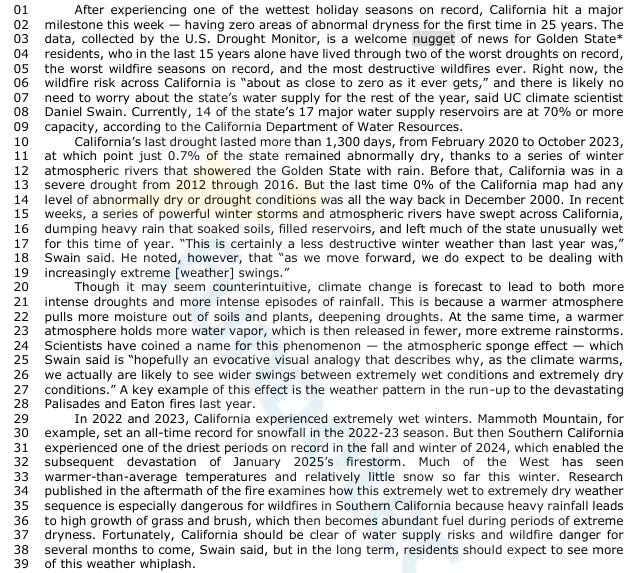
*California can be referred to as “The Golden State”.
(Available at: https://www.latimes.com/california/story/2026-01-09/california-has-no-areas-of-dryness-first- time-in-25-years – text specially adapted for this test).
Mark the item that CORRECTLY fills in the blank below.
I managed to download the song __________.
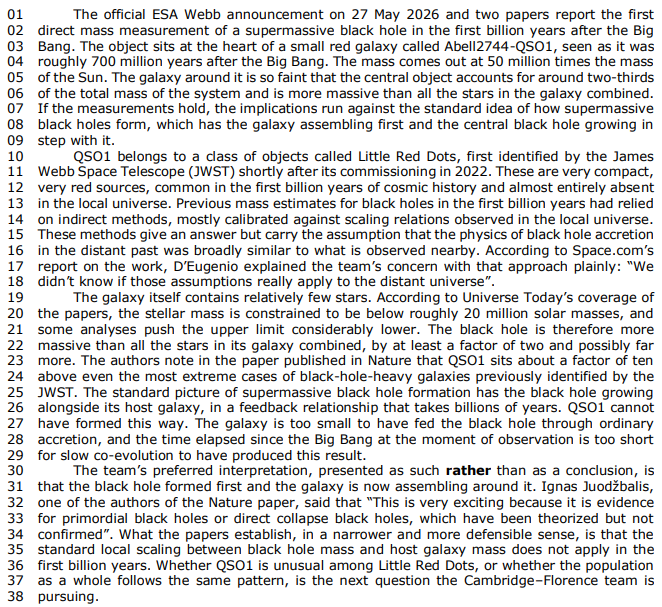
TEXT
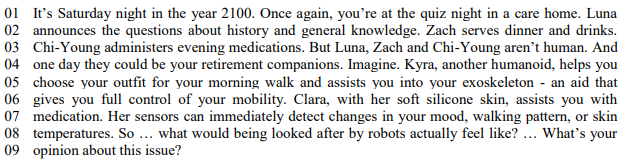
Adapted from: BBC Ideas and The Open University (2026) Would you want to be cared for by a robot when you are older? [video]. Instagram. Available at: https://www.instagram.com/reel/DX_03WVle-- /?igsh=MXhhdHJ4NzlpeGE5dA%3D%3D. (Accessed: May 31, 2026).
ANSWER QUESTION ACCORDING TO THE TEXT ABOVE.
Conjunctions in English establish different relations between clauses, such as addition, contrast, cause, and consequence. Consider the sentence: "She studied hard for the exam, ___ she got a low grade." Choose the alternative that presents the conjunction that appropriately fills the gap, establishing a relation of contrast between the two clauses.

 Conheça nossos planos