Questões de Concurso
Sobre interpretação de texto | reading comprehension em inglês
Foram encontradas 12.713 questões


Ano: 2010
Banca:
CESGRANRIO
Órgão:
BNDES
Provas:
CESGRANRIO - 2010 - BNDES - Analista de Sistemas - Suporte
|
CESGRANRIO - 2010 - BNDES - Arquiteto |
CESGRANRIO - 2010 - BNDES - Arquivista |
CESGRANRIO - 2010 - BNDES - Advogado |
Q71381
Inglês


Max Levchin, mentioned in paragraph 4 (lines 34-39), can be considered a(an)
Ano: 2010
Banca:
CESGRANRIO
Órgão:
BNDES
Provas:
CESGRANRIO - 2010 - BNDES - Analista de Sistemas - Suporte
|
CESGRANRIO - 2010 - BNDES - Arquiteto |
CESGRANRIO - 2010 - BNDES - Arquivista |
CESGRANRIO - 2010 - BNDES - Advogado |
Q71380
Inglês
Mulins and Komisar, in paragraph 3 (lines 21-33), state that the typical business startup process is usually unsuccessful because it
Ano: 2010
Banca:
CESGRANRIO
Órgão:
BNDES
Provas:
CESGRANRIO - 2010 - BNDES - Analista de Sistemas - Suporte
|
CESGRANRIO - 2010 - BNDES - Arquiteto |
CESGRANRIO - 2010 - BNDES - Arquivista |
CESGRANRIO - 2010 - BNDES - Advogado |
Q71379
Inglês
Google, Starbucks and PayPal are mentioned in paragraph 1 (lines 1-8) since they
Ano: 2010
Banca:
CESGRANRIO
Órgão:
BNDES
Provas:
CESGRANRIO - 2010 - BNDES - Analista de Sistemas - Suporte
|
CESGRANRIO - 2010 - BNDES - Arquiteto |
CESGRANRIO - 2010 - BNDES - Arquivista |
CESGRANRIO - 2010 - BNDES - Advogado |
Q71378
Inglês
According to the authors,
Ano: 2010
Banca:
CESPE / CEBRASPE
Órgão:
ANEEL
Provas:
CESPE / CEBRASPE - 2010 - ANEEL - Todos os Cargos - Nível Superior
|
CESPE / CEBRASPE - 2010 - ANEEL - Especialista em Regulação de Serviços Públicos de Energia - Área 1 |
CESPE / CEBRASPE - 2010 - ANEEL - Especialista em Regulação de Serviços Públicos de Energia - Área 2 |
CESPE / CEBRASPE - 2010 - ANEEL - Especialista em Regulação de Serviços Públicos de Energia - Área 3 |
CESPE / CEBRASPE - 2010 - ANEEL - Especialista em Regulação de Serviços Públicos de Energia - Área 4 |
CESPE / CEBRASPE - 2010 - ANEEL - Especialista em Regulação de Serviços Públicos de Energia - Área 5 |
CESPE / CEBRASPE - 2010 - ANEEL - Analista Administrativo - Área 2 |
Q70801
Inglês
Texto associado
Europe and North Africa could be powered solely by
renewable electricity by 2050 through the implementation of a
"SuperSmart Grid", according to a report issued this week by global
advisory firm PricewaterhouseCoopers (PwC).
According to Energy Source, the achievement of 100 per
cent renewable electricity would address energy security and supply
concerns, while decarbonizing electricity generation and reducing
energy poverty, according to the study.
The proposed SuperSmart Grid would allow load and
demand management for power independently of where and when
the electricity is generated.
The system would capitalize on natural resources and
established weather patterns and would incorporate: southern
Europe and North Africa's solar power potential; the hydro
capability of Scandinavia and the European Alps; onshore and
offshore wind farms in the Baltic and the North Sea; Europe's
potential for tidal and wave power; and biomass generation across
the continent.
According to Gus Schellekens, director of sustainability
and climate change at PricewaterhouseCoopers, Europe is now at
a crossroads, where the choice and ability to achieve renewable
power at scale is evident. "Opportunities to use clean and affordable
natural sources of electricity have been flirted with over the past
150 years. This study lays out a clear framework of how this time
could be different", he says.
The dominant source of European power is fossil fuels (55
per cent), while nuclear power provides 30 per cent and 15 per cent
is derived from renewable sources. According to the PwC study, a
renewables-powered Europe would change the landscape for
consumers and business. Electro-mobility could be introduced on
a mass scale, eliminating the carbon costs of day-to-day transport
for people and goods.

renewable electricity by 2050 through the implementation of a
"SuperSmart Grid", according to a report issued this week by global
advisory firm PricewaterhouseCoopers (PwC).
According to Energy Source, the achievement of 100 per
cent renewable electricity would address energy security and supply
concerns, while decarbonizing electricity generation and reducing
energy poverty, according to the study.
The proposed SuperSmart Grid would allow load and
demand management for power independently of where and when
the electricity is generated.
The system would capitalize on natural resources and
established weather patterns and would incorporate: southern
Europe and North Africa's solar power potential; the hydro
capability of Scandinavia and the European Alps; onshore and
offshore wind farms in the Baltic and the North Sea; Europe's
potential for tidal and wave power; and biomass generation across
the continent.
According to Gus Schellekens, director of sustainability
and climate change at PricewaterhouseCoopers, Europe is now at
a crossroads, where the choice and ability to achieve renewable
power at scale is evident. "Opportunities to use clean and affordable
natural sources of electricity have been flirted with over the past
150 years. This study lays out a clear framework of how this time
could be different", he says.
The dominant source of European power is fossil fuels (55
per cent), while nuclear power provides 30 per cent and 15 per cent
is derived from renewable sources. According to the PwC study, a
renewables-powered Europe would change the landscape for
consumers and business. Electro-mobility could be introduced on
a mass scale, eliminating the carbon costs of day-to-day transport
for people and goods.
It is possible to infer from the text that
electro-mobility introduced on a mass scale can make everyday transport for people and goods cheaper.
electro-mobility introduced on a mass scale can make everyday transport for people and goods cheaper.
Ano: 2010
Banca:
CESPE / CEBRASPE
Órgão:
ANEEL
Provas:
CESPE / CEBRASPE - 2010 - ANEEL - Todos os Cargos - Nível Superior
|
CESPE / CEBRASPE - 2010 - ANEEL - Especialista em Regulação de Serviços Públicos de Energia - Área 1 |
CESPE / CEBRASPE - 2010 - ANEEL - Especialista em Regulação de Serviços Públicos de Energia - Área 2 |
CESPE / CEBRASPE - 2010 - ANEEL - Especialista em Regulação de Serviços Públicos de Energia - Área 3 |
CESPE / CEBRASPE - 2010 - ANEEL - Especialista em Regulação de Serviços Públicos de Energia - Área 4 |
CESPE / CEBRASPE - 2010 - ANEEL - Especialista em Regulação de Serviços Públicos de Energia - Área 5 |
CESPE / CEBRASPE - 2010 - ANEEL - Analista Administrativo - Área 2 |
Q70800
Inglês
Texto associado
Europe and North Africa could be powered solely by
renewable electricity by 2050 through the implementation of a
"SuperSmart Grid", according to a report issued this week by global
advisory firm PricewaterhouseCoopers (PwC).
According to Energy Source, the achievement of 100 per
cent renewable electricity would address energy security and supply
concerns, while decarbonizing electricity generation and reducing
energy poverty, according to the study.
The proposed SuperSmart Grid would allow load and
demand management for power independently of where and when
the electricity is generated.
The system would capitalize on natural resources and
established weather patterns and would incorporate: southern
Europe and North Africa's solar power potential; the hydro
capability of Scandinavia and the European Alps; onshore and
offshore wind farms in the Baltic and the North Sea; Europe's
potential for tidal and wave power; and biomass generation across
the continent.
According to Gus Schellekens, director of sustainability
and climate change at PricewaterhouseCoopers, Europe is now at
a crossroads, where the choice and ability to achieve renewable
power at scale is evident. "Opportunities to use clean and affordable
natural sources of electricity have been flirted with over the past
150 years. This study lays out a clear framework of how this time
could be different", he says.
The dominant source of European power is fossil fuels (55
per cent), while nuclear power provides 30 per cent and 15 per cent
is derived from renewable sources. According to the PwC study, a
renewables-powered Europe would change the landscape for
consumers and business. Electro-mobility could be introduced on
a mass scale, eliminating the carbon costs of day-to-day transport
for people and goods.
renewable electricity by 2050 through the implementation of a
"SuperSmart Grid", according to a report issued this week by global
advisory firm PricewaterhouseCoopers (PwC).
According to Energy Source, the achievement of 100 per
cent renewable electricity would address energy security and supply
concerns, while decarbonizing electricity generation and reducing
energy poverty, according to the study.
The proposed SuperSmart Grid would allow load and
demand management for power independently of where and when
the electricity is generated.
The system would capitalize on natural resources and
established weather patterns and would incorporate: southern
Europe and North Africa's solar power potential; the hydro
capability of Scandinavia and the European Alps; onshore and
offshore wind farms in the Baltic and the North Sea; Europe's
potential for tidal and wave power; and biomass generation across
the continent.
According to Gus Schellekens, director of sustainability
and climate change at PricewaterhouseCoopers, Europe is now at
a crossroads, where the choice and ability to achieve renewable
power at scale is evident. "Opportunities to use clean and affordable
natural sources of electricity have been flirted with over the past
150 years. This study lays out a clear framework of how this time
could be different", he says.
The dominant source of European power is fossil fuels (55
per cent), while nuclear power provides 30 per cent and 15 per cent
is derived from renewable sources. According to the PwC study, a
renewables-powered Europe would change the landscape for
consumers and business. Electro-mobility could be introduced on
a mass scale, eliminating the carbon costs of day-to-day transport
for people and goods.
It is possible to infer from the text that
the use of not dirty and inexpensive natural sources of electricity has been considered during the last 150 years.
the use of not dirty and inexpensive natural sources of electricity has been considered during the last 150 years.
Ano: 2010
Banca:
CESPE / CEBRASPE
Órgão:
ANEEL
Provas:
CESPE / CEBRASPE - 2010 - ANEEL - Todos os Cargos - Nível Superior
|
CESPE / CEBRASPE - 2010 - ANEEL - Especialista em Regulação de Serviços Públicos de Energia - Área 1 |
CESPE / CEBRASPE - 2010 - ANEEL - Especialista em Regulação de Serviços Públicos de Energia - Área 2 |
CESPE / CEBRASPE - 2010 - ANEEL - Especialista em Regulação de Serviços Públicos de Energia - Área 3 |
CESPE / CEBRASPE - 2010 - ANEEL - Especialista em Regulação de Serviços Públicos de Energia - Área 4 |
CESPE / CEBRASPE - 2010 - ANEEL - Especialista em Regulação de Serviços Públicos de Energia - Área 5 |
CESPE / CEBRASPE - 2010 - ANEEL - Analista Administrativo - Área 2 |
Q70797
Inglês
Texto associado
Europe and North Africa could be powered solely by
renewable electricity by 2050 through the implementation of a
"SuperSmart Grid", according to a report issued this week by global
advisory firm PricewaterhouseCoopers (PwC).
According to Energy Source, the achievement of 100 per
cent renewable electricity would address energy security and supply
concerns, while decarbonizing electricity generation and reducing
energy poverty, according to the study.
The proposed SuperSmart Grid would allow load and
demand management for power independently of where and when
the electricity is generated.
The system would capitalize on natural resources and
established weather patterns and would incorporate: southern
Europe and North Africa's solar power potential; the hydro
capability of Scandinavia and the European Alps; onshore and
offshore wind farms in the Baltic and the North Sea; Europe's
potential for tidal and wave power; and biomass generation across
the continent.
According to Gus Schellekens, director of sustainability
and climate change at PricewaterhouseCoopers, Europe is now at
a crossroads, where the choice and ability to achieve renewable
power at scale is evident. "Opportunities to use clean and affordable
natural sources of electricity have been flirted with over the past
150 years. This study lays out a clear framework of how this time
could be different", he says.
The dominant source of European power is fossil fuels (55
per cent), while nuclear power provides 30 per cent and 15 per cent
is derived from renewable sources. According to the PwC study, a
renewables-powered Europe would change the landscape for
consumers and business. Electro-mobility could be introduced on
a mass scale, eliminating the carbon costs of day-to-day transport
for people and goods.
renewable electricity by 2050 through the implementation of a
"SuperSmart Grid", according to a report issued this week by global
advisory firm PricewaterhouseCoopers (PwC).
According to Energy Source, the achievement of 100 per
cent renewable electricity would address energy security and supply
concerns, while decarbonizing electricity generation and reducing
energy poverty, according to the study.
The proposed SuperSmart Grid would allow load and
demand management for power independently of where and when
the electricity is generated.
The system would capitalize on natural resources and
established weather patterns and would incorporate: southern
Europe and North Africa's solar power potential; the hydro
capability of Scandinavia and the European Alps; onshore and
offshore wind farms in the Baltic and the North Sea; Europe's
potential for tidal and wave power; and biomass generation across
the continent.
According to Gus Schellekens, director of sustainability
and climate change at PricewaterhouseCoopers, Europe is now at
a crossroads, where the choice and ability to achieve renewable
power at scale is evident. "Opportunities to use clean and affordable
natural sources of electricity have been flirted with over the past
150 years. This study lays out a clear framework of how this time
could be different", he says.
The dominant source of European power is fossil fuels (55
per cent), while nuclear power provides 30 per cent and 15 per cent
is derived from renewable sources. According to the PwC study, a
renewables-powered Europe would change the landscape for
consumers and business. Electro-mobility could be introduced on
a mass scale, eliminating the carbon costs of day-to-day transport
for people and goods.
Based on the text, judge the items below.
The complete substitution of the current sources would be directed to energy security and supply concerns as well as decarbonizing electricity generation and reducing energy poverty.
The complete substitution of the current sources would be directed to energy security and supply concerns as well as decarbonizing electricity generation and reducing energy poverty.
Ano: 2010
Banca:
CESPE / CEBRASPE
Órgão:
ANEEL
Provas:
CESPE / CEBRASPE - 2010 - ANEEL - Todos os Cargos - Nível Superior
|
CESPE / CEBRASPE - 2010 - ANEEL - Especialista em Regulação de Serviços Públicos de Energia - Área 1 |
CESPE / CEBRASPE - 2010 - ANEEL - Especialista em Regulação de Serviços Públicos de Energia - Área 2 |
CESPE / CEBRASPE - 2010 - ANEEL - Especialista em Regulação de Serviços Públicos de Energia - Área 3 |
CESPE / CEBRASPE - 2010 - ANEEL - Especialista em Regulação de Serviços Públicos de Energia - Área 4 |
CESPE / CEBRASPE - 2010 - ANEEL - Especialista em Regulação de Serviços Públicos de Energia - Área 5 |
CESPE / CEBRASPE - 2010 - ANEEL - Analista Administrativo - Área 2 |
Q70796
Inglês
Texto associado
Europe and North Africa could be powered solely by
renewable electricity by 2050 through the implementation of a
"SuperSmart Grid", according to a report issued this week by global
advisory firm PricewaterhouseCoopers (PwC).
According to Energy Source, the achievement of 100 per
cent renewable electricity would address energy security and supply
concerns, while decarbonizing electricity generation and reducing
energy poverty, according to the study.
The proposed SuperSmart Grid would allow load and
demand management for power independently of where and when
the electricity is generated.
The system would capitalize on natural resources and
established weather patterns and would incorporate: southern
Europe and North Africa's solar power potential; the hydro
capability of Scandinavia and the European Alps; onshore and
offshore wind farms in the Baltic and the North Sea; Europe's
potential for tidal and wave power; and biomass generation across
the continent.
According to Gus Schellekens, director of sustainability
and climate change at PricewaterhouseCoopers, Europe is now at
a crossroads, where the choice and ability to achieve renewable
power at scale is evident. "Opportunities to use clean and affordable
natural sources of electricity have been flirted with over the past
150 years. This study lays out a clear framework of how this time
could be different", he says.
The dominant source of European power is fossil fuels (55
per cent), while nuclear power provides 30 per cent and 15 per cent
is derived from renewable sources. According to the PwC study, a
renewables-powered Europe would change the landscape for
consumers and business. Electro-mobility could be introduced on
a mass scale, eliminating the carbon costs of day-to-day transport
for people and goods.
renewable electricity by 2050 through the implementation of a
"SuperSmart Grid", according to a report issued this week by global
advisory firm PricewaterhouseCoopers (PwC).
According to Energy Source, the achievement of 100 per
cent renewable electricity would address energy security and supply
concerns, while decarbonizing electricity generation and reducing
energy poverty, according to the study.
The proposed SuperSmart Grid would allow load and
demand management for power independently of where and when
the electricity is generated.
The system would capitalize on natural resources and
established weather patterns and would incorporate: southern
Europe and North Africa's solar power potential; the hydro
capability of Scandinavia and the European Alps; onshore and
offshore wind farms in the Baltic and the North Sea; Europe's
potential for tidal and wave power; and biomass generation across
the continent.
According to Gus Schellekens, director of sustainability
and climate change at PricewaterhouseCoopers, Europe is now at
a crossroads, where the choice and ability to achieve renewable
power at scale is evident. "Opportunities to use clean and affordable
natural sources of electricity have been flirted with over the past
150 years. This study lays out a clear framework of how this time
could be different", he says.
The dominant source of European power is fossil fuels (55
per cent), while nuclear power provides 30 per cent and 15 per cent
is derived from renewable sources. According to the PwC study, a
renewables-powered Europe would change the landscape for
consumers and business. Electro-mobility could be introduced on
a mass scale, eliminating the carbon costs of day-to-day transport
for people and goods.
Based on the text, judge the items below.
Europe and North Africa will be powered by renewable electricity in forty years' time.
Europe and North Africa will be powered by renewable electricity in forty years' time.
Ano: 2010
Banca:
CESPE / CEBRASPE
Órgão:
MPU
Provas:
CESPE - 2010 - MPU - Analista de Informática - Banco de Dados
|
CESPE - 2010 - MPU - Analista de Informática - Desenvolvimento de Sistemas |
Q70324
Inglês
Texto associado
Julgue se os itens a seguir, escritos em língua inglesa, estão técnica
e gramaticalmente corretos.
e gramaticalmente corretos.
Whenever a new release of a software package is announced, the organization needs to buy it immediately for its own safe.
Ano: 2010
Banca:
CESPE / CEBRASPE
Órgão:
MPU
Provas:
CESPE - 2010 - MPU - Analista de Informática - Banco de Dados
|
CESPE - 2010 - MPU - Analista de Informática - Desenvolvimento de Sistemas |
Q70323
Inglês
Texto associado
Julgue se os itens a seguir, escritos em língua inglesa, estão técnica
e gramaticalmente corretos.
e gramaticalmente corretos.
Information technology people know the importance of periodical backup to make possible to restore non important information.
Q68065
Inglês

The fragment "This means that - in a fair world - we would have to reduce our energy use much more than them." (lines 58-60) implies that
Q68064
Inglês
China is mentioned in paragraph 5 (lines 44 - 50) because it is
Q68063
Inglês
The fragment "...energy-sucking gadgets..." (line 23) means
Q68062
Inglês
According to Richard Heinberg's proposal
Q68061
Inglês
In "we will only have to make sure that these are energy efficient." (line 25-26), the pronoun 'these' refers to
Q68059
Inglês
"In this scenario," (line 16), refers to a situation in which the
Q68057
Inglês
De Decker introduces the text saying "Don't get me wrong:" (line 1) because
Ano: 2010
Banca:
CESPE / CEBRASPE
Órgão:
Banco da Amazônia
Prova:
CESPE - 2010 - Banco da Amazônia - Técnico Científico - Tecnologia da Informação - Arquitetura de Tecnologia |
Q67080
Inglês
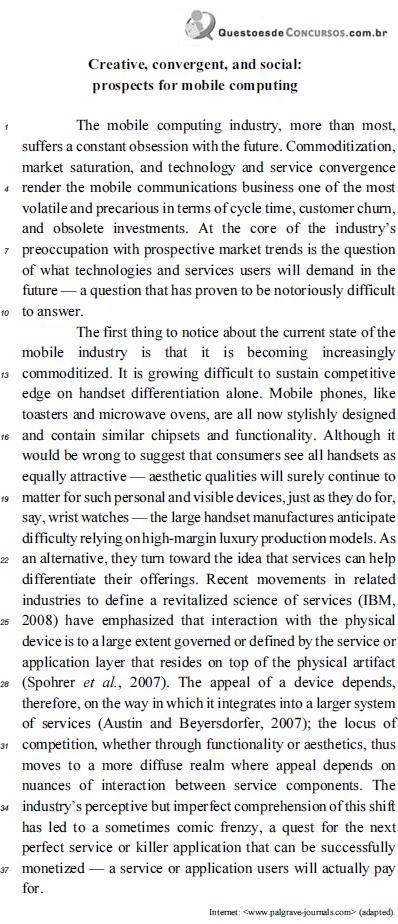
Judge the following items according to the text above.
The text highlights themes salient in the rapidly converging mobile computing industry.
The text highlights themes salient in the rapidly converging mobile computing industry.
Ano: 2010
Banca:
FCC
Órgão:
BAHIAGÁS
Provas:
FCC - 2010 - BAHIAGÁS - Analista de Processos Organizacionais - Contabilidade
|
FCC - 2010 - BAHIAGÁS - Analista de Processos Organizacionais - Direito |
FCC - 2010 - BAHIAGÁS - Analista de Processos Organizacionais - Administração |
FCC - 2010 - BAHIAGÁS - Analista de Processos Organizacionais - Engenharia |
FCC - 2010 - BAHIAGÁS - Analista de Processos Organizacionais - Economia |
FCC - 2010 - BAHIAGÁS - Analista de Processos Organizacionais - Análise de Sistemas |
Q66595
Inglês
Texto associado
Tuesday 23 February 2010
OFGEM'S DECISION AGAINST NATIONAL GRID'S
METERING CASE IS FURTHER ENDORSED BY THE
COURT OF APPEAL
Ofgem welcomes today's Court of Appeal ruling that
National Grid breached the law and acted anti-competitively in
the domestic gas metering market, endorsing Ofgem's April
2008 findings.
Today's ruling fully endorses the substance of Ofgem's
case, that the multi-million pound contracts struck by National
Grid with suppliers in 2002 when the metering market was
opened to competition harmed new entrants' ability to compete
and acted against consumers' interests.
The effect of the Court of Appeal's ruling is that suppliers
will be free to renegotiate the terms of contracts with National
Grid Gas, and it opens the door to claims for damages against
National Grid by competing meter operators, as the competition
law regime allows.
Welcoming today's ruling, Ofgem's Chairman Lord Mogg
said "We welcome the Court of Appeal's endorsement of
Ofgem's decision. This confirms that National Grid breached the
law and acted anti-competitively. It is a victory for consumers
and strikes a firm blow in favour of new and competing entrants
in Britain's energy market. Today's ruling shows that energy
companies who hold and abuse positions of market dominance
will face the full force of regulatory action and the law."
Today's ruling follows an earlier decision in April 2009 in
favour of Ofgem by the Competition Appeal Tribunal.
OFGEM'S DECISION AGAINST NATIONAL GRID'S
METERING CASE IS FURTHER ENDORSED BY THE
COURT OF APPEAL
Ofgem welcomes today's Court of Appeal ruling that
National Grid breached the law and acted anti-competitively in
the domestic gas metering market, endorsing Ofgem's April
2008 findings.
Today's ruling fully endorses the substance of Ofgem's
case, that the multi-million pound contracts struck by National
Grid with suppliers in 2002 when the metering market was
opened to competition harmed new entrants' ability to compete
and acted against consumers' interests.
The effect of the Court of Appeal's ruling is that suppliers
will be free to renegotiate the terms of contracts with National
Grid Gas, and it opens the door to claims for damages against
National Grid by competing meter operators, as the competition
law regime allows.
Welcoming today's ruling, Ofgem's Chairman Lord Mogg
said "We welcome the Court of Appeal's endorsement of
Ofgem's decision. This confirms that National Grid breached the
law and acted anti-competitively. It is a victory for consumers
and strikes a firm blow in favour of new and competing entrants
in Britain's energy market. Today's ruling shows that energy
companies who hold and abuse positions of market dominance
will face the full force of regulatory action and the law."
Today's ruling follows an earlier decision in April 2009 in
favour of Ofgem by the Competition Appeal Tribunal.
Infere-se do texto que
Ano: 2010
Banca:
FCC
Órgão:
BAHIAGÁS
Provas:
FCC - 2010 - BAHIAGÁS - Analista de Processos Organizacionais - Contabilidade
|
FCC - 2010 - BAHIAGÁS - Analista de Processos Organizacionais - Direito |
FCC - 2010 - BAHIAGÁS - Analista de Processos Organizacionais - Administração |
FCC - 2010 - BAHIAGÁS - Analista de Processos Organizacionais - Engenharia |
FCC - 2010 - BAHIAGÁS - Analista de Processos Organizacionais - Economia |
FCC - 2010 - BAHIAGÁS - Analista de Processos Organizacionais - Análise de Sistemas |
Q66594
Inglês
Texto associado
Tuesday 23 February 2010
OFGEM'S DECISION AGAINST NATIONAL GRID'S
METERING CASE IS FURTHER ENDORSED BY THE
COURT OF APPEAL
Ofgem welcomes today's Court of Appeal ruling that
National Grid breached the law and acted anti-competitively in
the domestic gas metering market, endorsing Ofgem's April
2008 findings.
Today's ruling fully endorses the substance of Ofgem's
case, that the multi-million pound contracts struck by National
Grid with suppliers in 2002 when the metering market was
opened to competition harmed new entrants' ability to compete
and acted against consumers' interests.
The effect of the Court of Appeal's ruling is that suppliers
will be free to renegotiate the terms of contracts with National
Grid Gas, and it opens the door to claims for damages against
National Grid by competing meter operators, as the competition
law regime allows.
Welcoming today's ruling, Ofgem's Chairman Lord Mogg
said "We welcome the Court of Appeal's endorsement of
Ofgem's decision. This confirms that National Grid breached the
law and acted anti-competitively. It is a victory for consumers
and strikes a firm blow in favour of new and competing entrants
in Britain's energy market. Today's ruling shows that energy
companies who hold and abuse positions of market dominance
will face the full force of regulatory action and the law."
Today's ruling follows an earlier decision in April 2009 in
favour of Ofgem by the Competition Appeal Tribunal.
OFGEM'S DECISION AGAINST NATIONAL GRID'S
METERING CASE IS FURTHER ENDORSED BY THE
COURT OF APPEAL
Ofgem welcomes today's Court of Appeal ruling that
National Grid breached the law and acted anti-competitively in
the domestic gas metering market, endorsing Ofgem's April
2008 findings.
Today's ruling fully endorses the substance of Ofgem's
case, that the multi-million pound contracts struck by National
Grid with suppliers in 2002 when the metering market was
opened to competition harmed new entrants' ability to compete
and acted against consumers' interests.
The effect of the Court of Appeal's ruling is that suppliers
will be free to renegotiate the terms of contracts with National
Grid Gas, and it opens the door to claims for damages against
National Grid by competing meter operators, as the competition
law regime allows.
Welcoming today's ruling, Ofgem's Chairman Lord Mogg
said "We welcome the Court of Appeal's endorsement of
Ofgem's decision. This confirms that National Grid breached the
law and acted anti-competitively. It is a victory for consumers
and strikes a firm blow in favour of new and competing entrants
in Britain's energy market. Today's ruling shows that energy
companies who hold and abuse positions of market dominance
will face the full force of regulatory action and the law."
Today's ruling follows an earlier decision in April 2009 in
favour of Ofgem by the Competition Appeal Tribunal.
A decisão a que se refere o texto

 Conheça nossos planos