Questões de Concurso
Sobre interpretação de texto | reading comprehension em inglês
Foram encontradas 12.709 questões


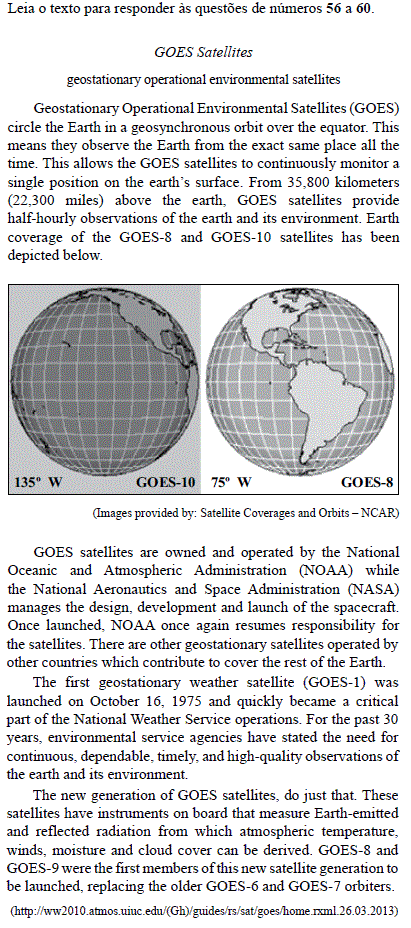
A sentença no primeiro parágrafo – This means they observe the Earth from the exact same place all the time. –
In the fourth paragraph, the term that in – The new generation of GOES satellites, do just that. – refers to the
GOES-8 and GOES-10
According to the text, GOES supply
Analise o texto a seguir:
The Internet has become such an integral part of our lives, with such powerful capabilities, that it is easy to forget that this technological marvel was created by the long, hard, dedicated efforts of human beings – folks who had a vision of what universal networking could become and worked to make it happen. The key people, projects, and organizations that helped create the Internet are described below, first in a top-level summary and then in sections in roughly chronological order.
(Extraído de: Internet History. http://www.livinginternet.com/i/ii.htm)
Baseando-se no texto apresentado, é correto afirmar que
Considere o texto a seguir:
We should point out here that the focal point of any operating system is its ‘kernel’. Without going into great detail, the kernel is what tells the big chip that controls your computer to do what you want the program that you’re using to do. To use a metaphor, if you go to your favorite Italian restaurant and order ‘Spaghetti alla Bolognese’, this dish is like your operating system. There are a lot of things that go into making that dish like pasta, tomato sauce, meatballs and cheese. Well, the kernel is like the pasta. Without pasta, that dish doesn’t exist. You might as well find some bread and make a sandwich. A plate of just pasta is fairly unappetizing.
Without a kernel, an operating system doesn’t exist. Without programs, a kernel is useless.
(Extraído de: Beginners Level Course: What is Linux? linux.org.
http://www.linux.org/threads/what-is-linux.4076/)
Segundo o texto, pode-se interpretar que
O texto a seguir deve ser utilizado para responder às questões de números 21 a 23.
Historically, information security has been called a number of different things such as:
• Data security;
• IT Security;
• Computer security.
But these terms (except possibly data security) ignore the fact that the information that is held on the computers is almost always and most certainly worth many times more than the computers that it runs on. The correct term is ‘information security’ and typically information security comprises three component parts:
• Confidentiality. Assurance that information is shared only among authorised persons or organisations. Breaches of confidentiality can occur when data is not handled in a manner appropriate to safeguard the confidentiality of the information concerned. Such disclosure can take place by word of mouth, by printing, copying, e-mailing or creating documents and other data etc.;
• Integrity. Assurance that the information is authentic and complete. Ensuring that information can be relied upon to be sufficiently accurate for its purpose. The term ‘integrity’ is used frequently when considering information security as it represents one of the primary indicators of information security (or lack of it). The integrity of data is not only whether the data is ‘correct’, but whether it can be trusted and relied upon;
• Availability. Assurance that the systems responsible for delivering, storing and processing information are accessible when needed, by those who need them.
(Extraído de: “An Introduction to Information, Network and Internet Security.
What is ‘Information Security’?” The Security Practitioner
http://security.practitioner.com/introduction/infosec_2.htm)
Segundo o texto, quando os dados não são tratados de forma adequada para salvaguardar a confidencialidade da informação de interesse, pode ocorrer
O texto a seguir deve ser utilizado para responder às questões de números 21 a 23.
Historically, information security has been called a number of different things such as:
• Data security;
• IT Security;
• Computer security.
But these terms (except possibly data security) ignore the fact that the information that is held on the computers is almost always and most certainly worth many times more than the computers that it runs on. The correct term is ‘information security’ and typically information security comprises three component parts:
• Confidentiality. Assurance that information is shared only among authorised persons or organisations. Breaches of confidentiality can occur when data is not handled in a manner appropriate to safeguard the confidentiality of the information concerned. Such disclosure can take place by word of mouth, by printing, copying, e-mailing or creating documents and other data etc.;
• Integrity. Assurance that the information is authentic and complete. Ensuring that information can be relied upon to be sufficiently accurate for its purpose. The term ‘integrity’ is used frequently when considering information security as it represents one of the primary indicators of information security (or lack of it). The integrity of data is not only whether the data is ‘correct’, but whether it can be trusted and relied upon;
• Availability. Assurance that the systems responsible for delivering, storing and processing information are accessible when needed, by those who need them.
(Extraído de: “An Introduction to Information, Network and Internet Security.
What is ‘Information Security’?” The Security Practitioner
http://security.practitioner.com/introduction/infosec_2.htm)
A melhor tradução, dentro do contexto, para “information security comprises three component parts” é:
Supercomputers
One definition for a supercomputer is “the most powerful computer available at any given time.” These machines are used to solve complex problems such as the design of a supersonic aircraft, modeling of global climates, the structure of oil-bearing formations within the Earth, the molecular design of new drugs, or the prediction of complex financial behavior in securities markets. Two of the first supercomputers were the Control Data Corporation CDC 6600 and CDC 7600. Both were developed by Seymour Cray, one of the founders of CDC. In 1972, Cray left to found Cray Research, Inc., and in 1976 developed the Cray-1, generally acknowledged to be the first true supercomputer.
The Cray-1 used high-speed emitter coupled logic (ECL), the fastest (and most power hungry) logic circuits available at the time. The computer was packaged as a 6.5 ft. high cylinder surrounded by a circular seat. Each circuit board was mounted on a copper heat exchanger through which liquid freon was circulated. The total power consumption of the computer was 128 KW! Processing speed was 130 MFLOPS (millions of floating-point operations per second). In all, 63 Cray-1 computers were sold (at a cost of $5.1 million each).
[Extraído de: The 80x86 Family, John Uffenbeck, 2nd Ed., 1998]
Considerando o contexto, o termo “heat exchanger” pode ser corretamente traduzido por
Supercomputers
One definition for a supercomputer is “the most powerful computer available at any given time.” These machines are used to solve complex problems such as the design of a supersonic aircraft, modeling of global climates, the structure of oil-bearing formations within the Earth, the molecular design of new drugs, or the prediction of complex financial behavior in securities markets. Two of the first supercomputers were the Control Data Corporation CDC 6600 and CDC 7600. Both were developed by Seymour Cray, one of the founders of CDC. In 1972, Cray left to found Cray Research, Inc., and in 1976 developed the Cray-1, generally acknowledged to be the first true supercomputer.
The Cray-1 used high-speed emitter coupled logic (ECL), the fastest (and most power hungry) logic circuits available at the time. The computer was packaged as a 6.5 ft. high cylinder surrounded by a circular seat. Each circuit board was mounted on a copper heat exchanger through which liquid freon was circulated. The total power consumption of the computer was 128 KW! Processing speed was 130 MFLOPS (millions of floating-point operations per second). In all, 63 Cray-1 computers were sold (at a cost of $5.1 million each).
[Extraído de: The 80x86 Family, John Uffenbeck, 2nd Ed., 1998]
De acordo com o texto, o computador reconhecido, de uma forma geral, como sendo o primeiro supercomputador de fato foi o
Supercomputers
One definition for a supercomputer is “the most powerful computer available at any given time.” These machines are used to solve complex problems such as the design of a supersonic aircraft, modeling of global climates, the structure of oil-bearing formations within the Earth, the molecular design of new drugs, or the prediction of complex financial behavior in securities markets. Two of the first supercomputers were the Control Data Corporation CDC 6600 and CDC 7600. Both were developed by Seymour Cray, one of the founders of CDC. In 1972, Cray left to found Cray Research, Inc., and in 1976 developed the Cray-1, generally acknowledged to be the first true supercomputer.
The Cray-1 used high-speed emitter coupled logic (ECL), the fastest (and most power hungry) logic circuits available at the time. The computer was packaged as a 6.5 ft. high cylinder surrounded by a circular seat. Each circuit board was mounted on a copper heat exchanger through which liquid freon was circulated. The total power consumption of the computer was 128 KW! Processing speed was 130 MFLOPS (millions of floating-point operations per second). In all, 63 Cray-1 computers were sold (at a cost of $5.1 million each).
[Extraído de: The 80x86 Family, John Uffenbeck, 2nd Ed., 1998]
Assinale a alternativa que apresenta um tipo de aplicação para supercomputadores NÃO mencionada no texto.
Modem control software has to test the condition of the CTS and DSR signals before transmitting information to the modem. The modem also has to be conditioned by the computer by applying a logic zero on the modem connections DTR and RTS .
If one of the two communications interface adapters discussed earlier in this chapter is used, most of the modem control is already accomplished by these devices. For example, the Intel 8251A has all four of the pin connections required for modem control, while the Motorola MC6850 contains only some of the connections.
[Extraído de: Microprocessors and Peripherals, Barry B. Brey, Maxwell Macmillan International Editions, 1991]
Com base no texto, necessita(m) ser verificado(s), antes de uma transmissão de informação para o modem, o(s) seguinte(s) sinal(is):
Asphalt versus concrete
Which material is better for your project?
Before a public works (or street maintenance, or road repair) department can decide whether to use concrete or asphalt in a specific application, the department manager must arm himself with information to help him make the best choice.
Asphalt is more common for a department to specify than
concrete. “Asphalt over concrete – that’s the standard. It is
what has been done for so long. But because it is the “standard”
doesn’t necessarily make it the best option for all applications.
Concrete may be better in some instances, the first of which is
new construction. In urban metropolitan areas, where new roads
are being built and existing roadways are being expanded, using
concrete may be a good way to minimize future inconvenience.
Funding is a big challenge. People are looking for short-term
fixes, which have a political impact.
Asphalt also can be specified as a long-term solution. Some pavement types must be completely removed and reconstructed when they reach the end of their design life, but total removal and reconstruction due to structural failure of a thick asphalt pavement is rare. With a thick asphalt structure, it is possible to obtain a ‘Perpetual Pavement’ one that can last indefinitely, with the only rehabilitation being milling of the surface followed by an asphalt overlay. Perpetual Pavement is a relatively new type of asphalt concrete pavement designed to resist structural fatigue distress for at least 50 years. Maintenance is limited to replacement of the surface course
(http://www.pwmag.com/bridges/ asphalt-versus-concrete.aspx.20.03.2006.Adaptado)
According to the text, a thick asphalt structural failure which requires its total removal is
Asphalt versus concrete
Which material is better for your project?
Before a public works (or street maintenance, or road repair) department can decide whether to use concrete or asphalt in a specific application, the department manager must arm himself with information to help him make the best choice.
Asphalt is more common for a department to specify than
concrete. “Asphalt over concrete – that’s the standard. It is
what has been done for so long. But because it is the “standard”
doesn’t necessarily make it the best option for all applications.
Concrete may be better in some instances, the first of which is
new construction. In urban metropolitan areas, where new roads
are being built and existing roadways are being expanded, using
concrete may be a good way to minimize future inconvenience.
Funding is a big challenge. People are looking for short-term
fixes, which have a political impact.
Asphalt also can be specified as a long-term solution. Some pavement types must be completely removed and reconstructed when they reach the end of their design life, but total removal and reconstruction due to structural failure of a thick asphalt pavement is rare. With a thick asphalt structure, it is possible to obtain a ‘Perpetual Pavement’ one that can last indefinitely, with the only rehabilitation being milling of the surface followed by an asphalt overlay. Perpetual Pavement is a relatively new type of asphalt concrete pavement designed to resist structural fatigue distress for at least 50 years. Maintenance is limited to replacement of the surface course
(http://www.pwmag.com/bridges/ asphalt-versus-concrete.aspx.20.03.2006.Adaptado)
O termo but em - But because it is the “standard” doesn’t necessarily make it the best option for all applications. – implica
Asphalt versus concrete
Which material is better for your project?
Before a public works (or street maintenance, or road repair) department can decide whether to use concrete or asphalt in a specific application, the department manager must arm himself with information to help him make the best choice.
Asphalt is more common for a department to specify than
concrete. “Asphalt over concrete – that’s the standard. It is
what has been done for so long. But because it is the “standard”
doesn’t necessarily make it the best option for all applications.
Concrete may be better in some instances, the first of which is
new construction. In urban metropolitan areas, where new roads
are being built and existing roadways are being expanded, using
concrete may be a good way to minimize future inconvenience.
Funding is a big challenge. People are looking for short-term
fixes, which have a political impact.
Asphalt also can be specified as a long-term solution. Some pavement types must be completely removed and reconstructed when they reach the end of their design life, but total removal and reconstruction due to structural failure of a thick asphalt pavement is rare. With a thick asphalt structure, it is possible to obtain a ‘Perpetual Pavement’ one that can last indefinitely, with the only rehabilitation being milling of the surface followed by an asphalt overlay. Perpetual Pavement is a relatively new type of asphalt concrete pavement designed to resist structural fatigue distress for at least 50 years. Maintenance is limited to replacement of the surface course
(http://www.pwmag.com/bridges/ asphalt-versus-concrete.aspx.20.03.2006.Adaptado)
The term over in – “Asphalt over concrete” – that’s the standard. – means that
Asphalt versus concrete
Which material is better for your project?
Before a public works (or street maintenance, or road repair) department can decide whether to use concrete or asphalt in a specific application, the department manager must arm himself with information to help him make the best choice.
Asphalt is more common for a department to specify than
concrete. “Asphalt over concrete – that’s the standard. It is
what has been done for so long. But because it is the “standard”
doesn’t necessarily make it the best option for all applications.
Concrete may be better in some instances, the first of which is
new construction. In urban metropolitan areas, where new roads
are being built and existing roadways are being expanded, using
concrete may be a good way to minimize future inconvenience.
Funding is a big challenge. People are looking for short-term
fixes, which have a political impact.
Asphalt also can be specified as a long-term solution. Some pavement types must be completely removed and reconstructed when they reach the end of their design life, but total removal and reconstruction due to structural failure of a thick asphalt pavement is rare. With a thick asphalt structure, it is possible to obtain a ‘Perpetual Pavement’ one that can last indefinitely, with the only rehabilitation being milling of the surface followed by an asphalt overlay. Perpetual Pavement is a relatively new type of asphalt concrete pavement designed to resist structural fatigue distress for at least 50 years. Maintenance is limited to replacement of the surface course
(http://www.pwmag.com/bridges/ asphalt-versus-concrete.aspx.20.03.2006.Adaptado)
De acordo com o texto, o ‘Perpetual Pavement’
Asphalt versus concrete
Which material is better for your project?
Before a public works (or street maintenance, or road repair) department can decide whether to use concrete or asphalt in a specific application, the department manager must arm himself with information to help him make the best choice.
Asphalt is more common for a department to specify than
concrete. “Asphalt over concrete – that’s the standard. It is
what has been done for so long. But because it is the “standard”
doesn’t necessarily make it the best option for all applications.
Concrete may be better in some instances, the first of which is
new construction. In urban metropolitan areas, where new roads
are being built and existing roadways are being expanded, using
concrete may be a good way to minimize future inconvenience.
Funding is a big challenge. People are looking for short-term
fixes, which have a political impact.
Asphalt also can be specified as a long-term solution. Some pavement types must be completely removed and reconstructed when they reach the end of their design life, but total removal and reconstruction due to structural failure of a thick asphalt pavement is rare. With a thick asphalt structure, it is possible to obtain a ‘Perpetual Pavement’ one that can last indefinitely, with the only rehabilitation being milling of the surface followed by an asphalt overlay. Perpetual Pavement is a relatively new type of asphalt concrete pavement designed to resist structural fatigue distress for at least 50 years. Maintenance is limited to replacement of the surface course
(http://www.pwmag.com/bridges/ asphalt-versus-concrete.aspx.20.03.2006.Adaptado)
According to the text, concrete
In the excerpt of the fourth paragraph – Paramagnetic properties are due to the presence of some unpaired electrons – the expression due to can be replaced, without changing its meaning, for
In the excerpt of the second paragraph – Therefore, no net magnetic field exists. – the word therefore introduces
According to the text, Faraday’s Law of Magnetic Induction states that

 Conheça nossos planos