Questões de Concurso
Sobre interpretação de texto | reading comprehension em inglês
Foram encontradas 12.709 questões


By Jonathan Mahler Sep 27, 2013
So Spain has decided to haul Lionel Messi into court for tax evasion, which strikes me as completely insane on pretty much every level.
You may remember the story from a few months back: The greatest soccer player in the world and his father were accused of setting up
a bunch of shell companies in Belize and Uruguay to avoid paying taxes on royalties and other licensing income.
Messi - who makes an estimated $41 million a year, about half from sponsors - reached a settlement with Spain’s tax authorities earlier
this summer, agreeing to pay the amount he apparently owed, plus interest. The matter was settled, or so it seemed. Messi could go
back to dazzling the world with his athleticism and creativity.
Only it turns out that Spain wasn’t quite done with Messi. His adopted country - Messi is Argentine but became a Spanish citizen in 2005
- is now considering pressing criminal charges against him.
Cracking down on tax-evading footballers has become something of a trend in Europe, where players and clubs have been known to
launder money through “image-rights companies” often set up in tax havens. When you need money - and Europe needs money - go to
the people who have it, or something like that. Over the summer, dozens of Italian soccer clubs were raided as part of an investigation
into a tax-fraud conspiracy. A number of English Premier League clubs were forced last year to pay millions of pounds in back taxes.
No one likes a tax cheat, and there’s little doubt that widespread tax fraud has helped eat away at the social safety net in Spain and
elsewhere, depriving schools, hospitals and other institutions of badly needed funds. But Europe is not going to find the answers to its
financial problems in the pockets of some professional soccer players and clubs.
Messi’s defense, delivered by his father, seems credible enough to me. “He is a footballer and that’s it,” Messi’s father Jorge said of his
soccer-prodigy son. “If there was an error, it was by our financial adviser. He created the company. My mistake was to have trusted the
adviser.” Even if Messi is legally responsible for the intricate tax dodge he is accused of having participated in, it’s pretty hard to believe
that he knew much about it.
More to the point, Lionel Messi is probably Spain’s most valuable global asset. What could possibly motivate the Spanish government to
want to tarnish his reputation, especially after he’s paid off his alleged debt? After four years of Great-Depression level unemployment,
have anxiety and despair curdled into vindictiveness?
Here’s another explanation: Maybe this whole case has less to do with money than it does with history. Maybe it’s no coincidence that
the target of the Spanish government’s weird wrath happens to play for FC Barcelona, which is, after all, "mes que un club." It's a symbol
of Catalan nationalism - and a bitter, longtime rival of Spain’s establishment team, Real Madrid.
Too conspiratorial? Prove it, Spain. Release Cristiano Ronaldo’s tax return.
(Adapted form http://www.bloomberg.com/news/2013-09-27/why-is-spain-really-taking-lionel-messi-to-tax-court-.html)
These are the tax rates for the 2012 tax year, if your filing status is “single”.
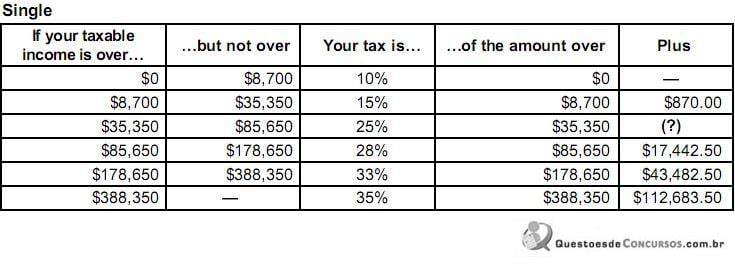
De acordo com o que é explicado no texto a respeito da tabela progressiva, o valor correto que preenche a célula (?) é
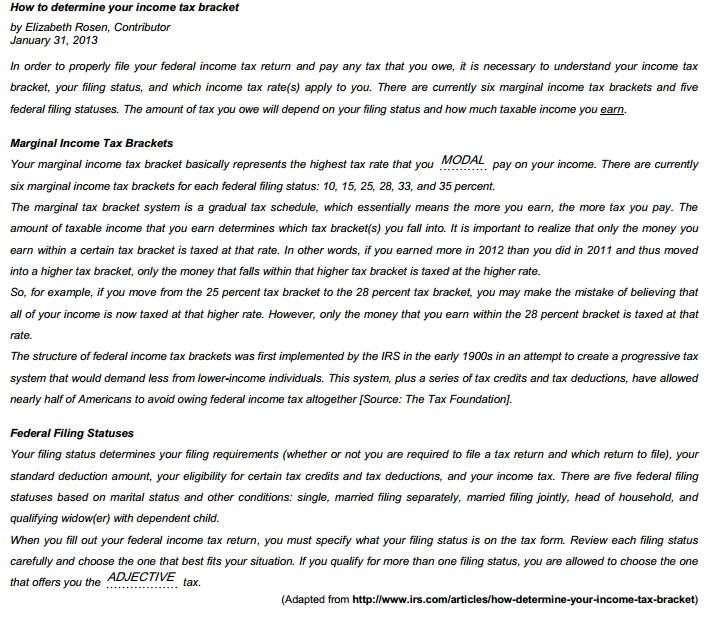
O termo do no trecho “-… "these immunological parameters in women than that in men is consistent with the fact that women live longer than do men"-.” – corresponde a
O termo that em destaque na frase – “Our findings indicate that the slower rate of decline in these immunological parameters in women than that in men is consistent with the fact that women live longer than do men.” – refere-se a
According to the text, the immune system
The study held
According to the text, women
Leia o texto para responder às questões de números 56 a 60.
Communication Skills
There’s a great deal of talk about the need to be a good communicator in today’s workplace. But what exactly does that mean? Which among the broad set of communication skills do managers need most in their employees? And what can you do to transition from being a good communicator to a great one?
Communication: A case history
As an administrative professional, you’ve always held a highly visible role in the workplace. You have been — and continue to be — the first point of contact for outside parties, such as potential clients, investors, customers and job candidates. All of these people are likely to get their first impression of the company through their interactions with you.
What’s changed? You’re still that vital first point of contact. But increasingly, you are the “go-to” person from beginning to end for a wide range of internal and external contacts. You follow through on tasks ranging from simple information requests to complex research projects. Your wider scope of responsibility and knowledge enables you to handle a constantly growing workload. You may communicate as much in writing as you do verbally, with e-mail communication being a prominent tool.
(www.iaap-hq.org. Adaptado)
The last sentence of the third paragraph – You may communicate as much in writing as you do verbally, with e-mail communication being a prominent tool. – contains the idea that
Leia o texto para responder às questões de números 56 a 60.
Communication Skills
There’s a great deal of talk about the need to be a good communicator in today’s workplace. But what exactly does that mean? Which among the broad set of communication skills do managers need most in their employees? And what can you do to transition from being a good communicator to a great one?
Communication: A case history
As an administrative professional, you’ve always held a highly visible role in the workplace. You have been — and continue to be — the first point of contact for outside parties, such as potential clients, investors, customers and job candidates. All of these people are likely to get their first impression of the company through their interactions with you.
What’s changed? You’re still that vital first point of contact. But increasingly, you are the “go-to” person from beginning to end for a wide range of internal and external contacts. You follow through on tasks ranging from simple information requests to complex research projects. Your wider scope of responsibility and knowledge enables you to handle a constantly growing workload. You may communicate as much in writing as you do verbally, with e-mail communication being a prominent tool.
(www.iaap-hq.org. Adaptado)
A palavra you que ocorre ao longo do texto refere-se a um leitor ideal, que é um
Leia o texto para responder às questões de números 56 a 60.
Communication Skills
There’s a great deal of talk about the need to be a good communicator in today’s workplace. But what exactly does that mean? Which among the broad set of communication skills do managers need most in their employees? And what can you do to transition from being a good communicator to a great one?
Communication: A case history
As an administrative professional, you’ve always held a highly visible role in the workplace. You have been — and continue to be — the first point of contact for outside parties, such as potential clients, investors, customers and job candidates. All of these people are likely to get their first impression of the company through their interactions with you.
What’s changed? You’re still that vital first point of contact. But increasingly, you are the “go-to” person from beginning to end for a wide range of internal and external contacts. You follow through on tasks ranging from simple information requests to complex research projects. Your wider scope of responsibility and knowledge enables you to handle a constantly growing workload. You may communicate as much in writing as you do verbally, with e-mail communication being a prominent tool.
(www.iaap-hq.org. Adaptado)
No segundo parágrafo, as seguintes pessoas mencionadas – potential clients, investors, customers and job candidates – são
Leia o texto para responder às questões de números 56 a 60.
Communication Skills
There’s a great deal of talk about the need to be a good communicator in today’s workplace. But what exactly does that mean? Which among the broad set of communication skills do managers need most in their employees? And what can you do to transition from being a good communicator to a great one?
Communication: A case history
As an administrative professional, you’ve always held a highly visible role in the workplace. You have been — and continue to be — the first point of contact for outside parties, such as potential clients, investors, customers and job candidates. All of these people are likely to get their first impression of the company through their interactions with you.
What’s changed? You’re still that vital first point of contact. But increasingly, you are the “go-to” person from beginning to end for a wide range of internal and external contacts. You follow through on tasks ranging from simple information requests to complex research projects. Your wider scope of responsibility and knowledge enables you to handle a constantly growing workload. You may communicate as much in writing as you do verbally, with e-mail communication being a prominent tool.
(www.iaap-hq.org. Adaptado)
Os profissionais administrativos
Segundo o texto, uma das tarefas do Database Administrator (DBA) é
No trecho do último parágrafo – … protecting and maintaining the integrity of all data while addressing the interests of different present and future user communities. – a palavra while indica uma ideia de
Segundo o texto, em bancos de dados centralizados de grandes organizações, uma arquitetura adequada deve proporcionar, entre outras qualidades,
No trecho final do segundo parágrafo – … a good database architecture should provide … – a palavra should pode ser corretamente substituída, sem alteração de sentido, por
The figure shows
No trecho do primeiro parágrafo – The former describes identifiable components and how they relate to one another structurally … – a expressão the former refere-se, no texto, a
According to the text,

 Conheça nossos planos