Questões de Concurso
Sobre interpretação de texto | reading comprehension em inglês
Foram encontradas 12.706 questões


UNEARTHED: REMAINS OF THE EARLIEST KNOWN TSUNAMI VICTIM
By Charles Choi | October 25, 2017 1:00 pm
Paragraph 1 Tsunamis have claimed hundreds of thousands of lives in the past two decades. Now a new study finds that a 6,000-year-old skull may come from the earliest known victim of these killer waves.
Paragraph 2 The partial human skull was discovered in 1929 buried in a mangrove swamp outside the small town of Aitape Papua New Guinea, about 500 miles north of Australia. Scientists originally thought it belonged to an ancient extinct human species, Homo erectus. However, subsequent research dated it to about 5,000 or 6,000 years in age, suggesting that it instead belonged to a modern human.
A Rare Specimen
Paragraph 3 The skull is one of just two examples of ancient human remains found in Papua New Guinea after more than a century of work there. As such, archaeologists wanted to learn more about this skull to elucidate how people settled this region.
Paragraph 4 The scientists went back to where this skull was found and sampled the soil in which it was discovered. They focused on details such as sediment grain size and composition.
Paragraph 5 In the sediment, the researchers discovered a range of microscopic organisms from the ocean known as diatoms. These were similar to ones found in the soil after a 1998 tsunami killed more than 2,000 people in Papua New Guinea — for instance, their shells of silica were broken, likely by extremely powerful forces.
Paragraph 6 These diatom shells, combined with the chemical compositions and the size ranges of the grains, all suggest that a tsunami occurred when the skull was buried. The researchers suggested the catastrophe either directly killed the person or ripped open their grave.
Paragraph 7 Tsunamis, which are giant waves caused by earthquakes, volcanic eruptions or underwater landslides, are some of the deadliest natural disasters known. The 2004 tsunami in the Indian Ocean killed more than 230,000 people, a higher death toll than any fire or hurricane.
Paragraph 8 The site where the skull was found is currently about 7.5 miles away from the coast. Still, the researchers noted that back when whoever the skull belonged to was alive, sea levels were higher, and the area would have been just behind the shoreline.
Paragraph 9 The waves of the tsunami that hit Papua New Guinea in 1998 reached more than 50 feet high and penetrated up to three miles inland. “If the event we have identified resulted from a similar process, it could have also resulted in extremely high waves,” study co-lead author Mark Golitko, an archaeologist at the University of Notre Dame in Indiana and the Field Museum in Chicago.
Paragraph 10 These results show “that coastal populations have been vulnerable to such events for thousands of years,” Golitko said. “People have managed to live with such unpredictable and destructive occurrences, but it highlights how vulnerable people living near the sea can be. Given the far larger populations that live along coastlines today, the potential impacts are far more severe now.”
Paragraph 11 Golitko plans to return to the area over the next few years “to further study the frequency of such events, how the environment changed over time, and how people have coped with the environmental challenges of living in that environment.” He and his colleagues detailed their findings Wednesday in the journal PLOS O.
Retrieved and adapted from:
<http://blogs.discovermagazine.com/dbrief/2017/10/25/first-tsunami-victim/#.WfYiYmhSzIU>
UNEARTHED: REMAINS OF THE EARLIEST KNOWN TSUNAMI VICTIM
By Charles Choi | October 25, 2017 1:00 pm
Paragraph 1 Tsunamis have claimed hundreds of thousands of lives in the past two decades. Now a new study finds that a 6,000-year-old skull may come from the earliest known victim of these killer waves.
Paragraph 2 The partial human skull was discovered in 1929 buried in a mangrove swamp outside the small town of Aitape Papua New Guinea, about 500 miles north of Australia. Scientists originally thought it belonged to an ancient extinct human species, Homo erectus. However, subsequent research dated it to about 5,000 or 6,000 years in age, suggesting that it instead belonged to a modern human.
A Rare Specimen
Paragraph 3 The skull is one of just two examples of ancient human remains found in Papua New Guinea after more than a century of work there. As such, archaeologists wanted to learn more about this skull to elucidate how people settled this region.
Paragraph 4 The scientists went back to where this skull was found and sampled the soil in which it was discovered. They focused on details such as sediment grain size and composition.
Paragraph 5 In the sediment, the researchers discovered a range of microscopic organisms from the ocean known as diatoms. These were similar to ones found in the soil after a 1998 tsunami killed more than 2,000 people in Papua New Guinea — for instance, their shells of silica were broken, likely by extremely powerful forces.
Paragraph 6 These diatom shells, combined with the chemical compositions and the size ranges of the grains, all suggest that a tsunami occurred when the skull was buried. The researchers suggested the catastrophe either directly killed the person or ripped open their grave.
Paragraph 7 Tsunamis, which are giant waves caused by earthquakes, volcanic eruptions or underwater landslides, are some of the deadliest natural disasters known. The 2004 tsunami in the Indian Ocean killed more than 230,000 people, a higher death toll than any fire or hurricane.
Paragraph 8 The site where the skull was found is currently about 7.5 miles away from the coast. Still, the researchers noted that back when whoever the skull belonged to was alive, sea levels were higher, and the area would have been just behind the shoreline.
Paragraph 9 The waves of the tsunami that hit Papua New Guinea in 1998 reached more than 50 feet high and penetrated up to three miles inland. “If the event we have identified resulted from a similar process, it could have also resulted in extremely high waves,” study co-lead author Mark Golitko, an archaeologist at the University of Notre Dame in Indiana and the Field Museum in Chicago.
Paragraph 10 These results show “that coastal populations have been vulnerable to such events for thousands of years,” Golitko said. “People have managed to live with such unpredictable and destructive occurrences, but it highlights how vulnerable people living near the sea can be. Given the far larger populations that live along coastlines today, the potential impacts are far more severe now.”
Paragraph 11 Golitko plans to return to the area over the next few years “to further study the frequency of such events, how the environment changed over time, and how people have coped with the environmental challenges of living in that environment.” He and his colleagues detailed their findings Wednesday in the journal PLOS O.
Retrieved and adapted from:
<http://blogs.discovermagazine.com/dbrief/2017/10/25/first-tsunami-victim/#.WfYiYmhSzIU>


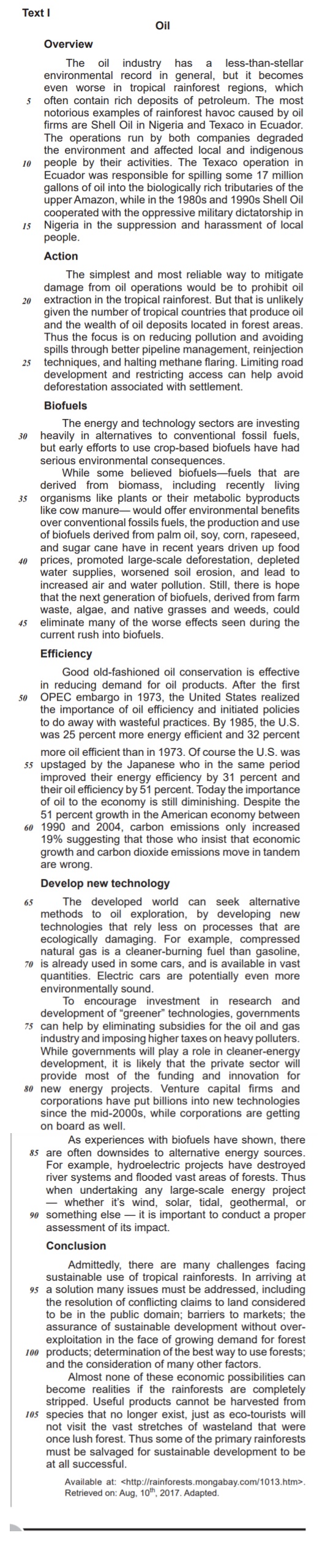
Text I refers to “conflicting claims to land” (line 96). In Text II there is an illustration to one of those claims.
It refers to

Consider the figure below.
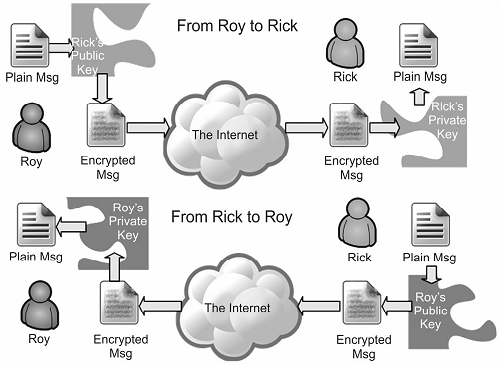
The correct way to describe the main concepts showing by the figure is:

Forensic computer analysts investigate crimes against computers, such as hacking, as well as crimes involving computers. They might search a suspect’s computer hard drive for incriminating files, pictures or other documents. They might also track the Internet activity of a suspect or victim to determine what sites he visited and whom he communicated with. In addition, they can often reveal information that suspects have attempted to hide, such as determining where an email or other electronic communication originated from even if the sender concealed his computer’s IP address to mask his location.
Internet:< http://oureverydaylife.com> (adapted).
According to the text, forensic computer analysts
There are specific types of systems analysts, such as systems architects or systems designers, but a systems analyst generally works in the computer department of a company providing the research and information necessary to maintain an up-to-date computer system. The main responsibility of a systems analyst is to make certain the computer system of his or her employer is functioning efficiently. To do this, a systems analyst may examine both the hardware and software currently being used and suggest or even design new programs to better meet the organization’s needs. In most cases, the systems analyst would also provide a cost-benefits analysis to make certain any proposed changes were fiscally responsible.
Internet: <http://study.com> (adapted).
It can be concluded from the text that systems analysts
Asem Hasna lost his leg in Syria – now he’s 3D-printing a second chance for fellow amputees
The story of Refugee Open Ware, and one wounded refugee’s efforts to help his countrymen back on their feet.
For most people, the first time they use a 3D printer is to create a simple object – a fridge magnet or a bookmark. Asem Hasna, then a 20-year-old Syrian refugee in Jordan, began with a prosthetic hand for a woman who lost hers in Syria’s civil war.
Hasna had met the woman in 2014 in Zaatari, the refugee camp 65 kilometers north-east of Amman, the capital of Jordan. The young woman, who has requested anonymity, lost her right hand during an attack and was struggling to care for her two daughters. Hasna, now 23, had just joined Refugee Open Ware (ROW), an Amman-based organisation that taught refugees how to 3D-print affordable artificial limbs for amputees.
(http://www.wired.co.uk/article/asem-hasna-prosthetics-syria)
A respeito do texto acima, considere as seguintes afirmativas:
1. Asem Hasna teve sua perna amputada antes de completar 23 anos.
2. Hasna, refugiado sírio, tem ajudado seus compatriotas feridos em conflitos confeccionando próteses em 3D.
3. Os primeiros objetos em 3D confeccionados por Hasna foram um marcador de livros e um ímã de geladeira.
4. A mulher que perdeu sua mão direita na guerra da Síria ajuda seu compatriota Hasna, confeccionando membros em 3D.
5. A organização – ROW –, situada em Amman, ensina refugiados a confeccionar membros em 3D a um preço acessível.
Assinale a alternativa correta.
Researchers at the University of Alabama at Birmingham suggest that brainwave-sensing headsets, also known as EEG or electroencephalograph headsets, need better security after a study reveals hackers could guess a user’s passwords by monitoring their brainwaves.
(Disponível: <https://www.sciencedaily.com/releases/2017/07/170701081756.htm>
Sobre a sigla EEG, considere as seguintes expressões:
1. Brainwave-sensing headsets.
2. Electroencephalograph headsets.
3. User’s passwords.
É/São expressão(ões) que substitui(em) a sigla EEG:

 Conheça nossos planos