Questões de Concurso
Sobre interpretação de texto | reading comprehension em inglês
Foram encontradas 12.687 questões


Ano: 2019
Banca:
MetroCapital Soluções
Órgão:
Prefeitura de Laranjal Paulista - SP
Prova:
MetroCapital Soluções - 2019 - Prefeitura de Laranjal Paulista - SP - Professor - Inglês |
Q1254124
Inglês
Texto associado
Use the following text to answer the question
TEXT
There is a famous expression in English: "Stop the
world, I want to get off!" This expression refers to a
feeling of panic, or stress, that makes a person want
to stop whatever they are doing, try to relax, and
become calm again. 'Stress' means pressure or
tension. It is one of the most common causes of health
problems in modern life. Too much stress results in
physical, emotional, and mental health problems.
There are numerous physical effects of stress. Stress
can affect the heart. It can increase the pulse rate,
make the heart miss beats, and can cause high blood
pressure. Stress can affect the respiratory system. It
can lead to asthma. It can cause a person to breathe
too fast, resulting in a loss of important carbon
dioxide. Stress can affect the stomach. It can cause
stomach aches and problems digesting food. These
are only a few examples of the wide range of illnesses
and symptoms resulting from stress.
Emotions are also easily affected by stress. People
suffering from stress often feel anxious. They may
have panic attacks. They may feel tired all the time.
When people are under stress, they often overreact to
little problems. For example, a normally gentle parent
under a lot of stress at work may yell at a child for
dropping a glass of juice. Stress can make people angry, moody, or nervous.
Long-term stress can lead to a variety of serious
mental illnesses. Depression, an extreme feeling of
sadness and hopelessness, can be the result of
continued and increasing stress. Alcoholism and
other addictions often develop as a result of overuse
of alcohol or drugs to try to relieve stress. Eating
disorders, such as anorexia, are sometimes caused by
stress and are often made worse by stress. If stress is
allowed to continue, then one's mental health is put at
risk.
It is obvious that stress is a serious problem. It attacks
the body. It affects the emotions. Untreated, it may
eventually result in mental illness. Stress has a great
influence on the health and well-being of our bodies,
our feelings, and our minds. So, reduce stress: stop
the world and rest for a while.
Choose the best answer to explain how alcoholism
is caused by stress.
Ano: 2019
Banca:
MetroCapital Soluções
Órgão:
Prefeitura de Laranjal Paulista - SP
Prova:
MetroCapital Soluções - 2019 - Prefeitura de Laranjal Paulista - SP - Professor - Inglês |
Q1254123
Inglês
Texto associado
Use the following text to answer the question
TEXT
There is a famous expression in English: "Stop the
world, I want to get off!" This expression refers to a
feeling of panic, or stress, that makes a person want
to stop whatever they are doing, try to relax, and
become calm again. 'Stress' means pressure or
tension. It is one of the most common causes of health
problems in modern life. Too much stress results in
physical, emotional, and mental health problems.
There are numerous physical effects of stress. Stress
can affect the heart. It can increase the pulse rate,
make the heart miss beats, and can cause high blood
pressure. Stress can affect the respiratory system. It
can lead to asthma. It can cause a person to breathe
too fast, resulting in a loss of important carbon
dioxide. Stress can affect the stomach. It can cause
stomach aches and problems digesting food. These
are only a few examples of the wide range of illnesses
and symptoms resulting from stress.
Emotions are also easily affected by stress. People
suffering from stress often feel anxious. They may
have panic attacks. They may feel tired all the time.
When people are under stress, they often overreact to
little problems. For example, a normally gentle parent
under a lot of stress at work may yell at a child for
dropping a glass of juice. Stress can make people angry, moody, or nervous.
Long-term stress can lead to a variety of serious
mental illnesses. Depression, an extreme feeling of
sadness and hopelessness, can be the result of
continued and increasing stress. Alcoholism and
other addictions often develop as a result of overuse
of alcohol or drugs to try to relieve stress. Eating
disorders, such as anorexia, are sometimes caused by
stress and are often made worse by stress. If stress is
allowed to continue, then one's mental health is put at
risk.
It is obvious that stress is a serious problem. It attacks
the body. It affects the emotions. Untreated, it may
eventually result in mental illness. Stress has a great
influence on the health and well-being of our bodies,
our feelings, and our minds. So, reduce stress: stop
the world and rest for a while.
Which of the following show how stress can affect
the emotions?
1. It can make people feel nervous 2. It can cause panic attacks 3. It can make people feel elated 4. It can make people fell angry
1. It can make people feel nervous 2. It can cause panic attacks 3. It can make people feel elated 4. It can make people fell angry
Ano: 2019
Banca:
MetroCapital Soluções
Órgão:
Prefeitura de Laranjal Paulista - SP
Prova:
MetroCapital Soluções - 2019 - Prefeitura de Laranjal Paulista - SP - Professor - Inglês |
Q1254122
Inglês
Texto associado
Use the following text to answer the question
TEXT
There is a famous expression in English: "Stop the
world, I want to get off!" This expression refers to a
feeling of panic, or stress, that makes a person want
to stop whatever they are doing, try to relax, and
become calm again. 'Stress' means pressure or
tension. It is one of the most common causes of health
problems in modern life. Too much stress results in
physical, emotional, and mental health problems.
There are numerous physical effects of stress. Stress
can affect the heart. It can increase the pulse rate,
make the heart miss beats, and can cause high blood
pressure. Stress can affect the respiratory system. It
can lead to asthma. It can cause a person to breathe
too fast, resulting in a loss of important carbon
dioxide. Stress can affect the stomach. It can cause
stomach aches and problems digesting food. These
are only a few examples of the wide range of illnesses
and symptoms resulting from stress.
Emotions are also easily affected by stress. People
suffering from stress often feel anxious. They may
have panic attacks. They may feel tired all the time.
When people are under stress, they often overreact to
little problems. For example, a normally gentle parent
under a lot of stress at work may yell at a child for
dropping a glass of juice. Stress can make people angry, moody, or nervous.
Long-term stress can lead to a variety of serious
mental illnesses. Depression, an extreme feeling of
sadness and hopelessness, can be the result of
continued and increasing stress. Alcoholism and
other addictions often develop as a result of overuse
of alcohol or drugs to try to relieve stress. Eating
disorders, such as anorexia, are sometimes caused by
stress and are often made worse by stress. If stress is
allowed to continue, then one's mental health is put at
risk.
It is obvious that stress is a serious problem. It attacks
the body. It affects the emotions. Untreated, it may
eventually result in mental illness. Stress has a great
influence on the health and well-being of our bodies,
our feelings, and our minds. So, reduce stress: stop
the world and rest for a while.
Which of the following can result from long-term
stress?
1. Bliss 2. Depression 3. Alcoholism 4. Whimsy
1. Bliss 2. Depression 3. Alcoholism 4. Whimsy
Ano: 2019
Banca:
MetroCapital Soluções
Órgão:
Prefeitura de Laranjal Paulista - SP
Prova:
MetroCapital Soluções - 2019 - Prefeitura de Laranjal Paulista - SP - Professor - Inglês |
Q1254121
Inglês
Texto associado
Use the following text to answer the question
TEXT
There is a famous expression in English: "Stop the
world, I want to get off!" This expression refers to a
feeling of panic, or stress, that makes a person want
to stop whatever they are doing, try to relax, and
become calm again. 'Stress' means pressure or
tension. It is one of the most common causes of health
problems in modern life. Too much stress results in
physical, emotional, and mental health problems.
There are numerous physical effects of stress. Stress
can affect the heart. It can increase the pulse rate,
make the heart miss beats, and can cause high blood
pressure. Stress can affect the respiratory system. It
can lead to asthma. It can cause a person to breathe
too fast, resulting in a loss of important carbon
dioxide. Stress can affect the stomach. It can cause
stomach aches and problems digesting food. These
are only a few examples of the wide range of illnesses
and symptoms resulting from stress.
Emotions are also easily affected by stress. People
suffering from stress often feel anxious. They may
have panic attacks. They may feel tired all the time.
When people are under stress, they often overreact to
little problems. For example, a normally gentle parent
under a lot of stress at work may yell at a child for
dropping a glass of juice. Stress can make people angry, moody, or nervous.
Long-term stress can lead to a variety of serious
mental illnesses. Depression, an extreme feeling of
sadness and hopelessness, can be the result of
continued and increasing stress. Alcoholism and
other addictions often develop as a result of overuse
of alcohol or drugs to try to relieve stress. Eating
disorders, such as anorexia, are sometimes caused by
stress and are often made worse by stress. If stress is
allowed to continue, then one's mental health is put at
risk.
It is obvious that stress is a serious problem. It attacks
the body. It affects the emotions. Untreated, it may
eventually result in mental illness. Stress has a great
influence on the health and well-being of our bodies,
our feelings, and our minds. So, reduce stress: stop
the world and rest for a while.
According to the essay, which of the following
parts of the body does not have physical
problems caused by stress.
Ano: 2019
Banca:
MetroCapital Soluções
Órgão:
Prefeitura de Laranjal Paulista - SP
Prova:
MetroCapital Soluções - 2019 - Prefeitura de Laranjal Paulista - SP - Professor - Inglês |
Q1254120
Inglês
Texto associado
Use the following text to answer the question
TEXT
There is a famous expression in English: "Stop the
world, I want to get off!" This expression refers to a
feeling of panic, or stress, that makes a person want
to stop whatever they are doing, try to relax, and
become calm again. 'Stress' means pressure or
tension. It is one of the most common causes of health
problems in modern life. Too much stress results in
physical, emotional, and mental health problems.
There are numerous physical effects of stress. Stress
can affect the heart. It can increase the pulse rate,
make the heart miss beats, and can cause high blood
pressure. Stress can affect the respiratory system. It
can lead to asthma. It can cause a person to breathe
too fast, resulting in a loss of important carbon
dioxide. Stress can affect the stomach. It can cause
stomach aches and problems digesting food. These
are only a few examples of the wide range of illnesses
and symptoms resulting from stress.
Emotions are also easily affected by stress. People
suffering from stress often feel anxious. They may
have panic attacks. They may feel tired all the time.
When people are under stress, they often overreact to
little problems. For example, a normally gentle parent
under a lot of stress at work may yell at a child for
dropping a glass of juice. Stress can make people angry, moody, or nervous.
Long-term stress can lead to a variety of serious
mental illnesses. Depression, an extreme feeling of
sadness and hopelessness, can be the result of
continued and increasing stress. Alcoholism and
other addictions often develop as a result of overuse
of alcohol or drugs to try to relieve stress. Eating
disorders, such as anorexia, are sometimes caused by
stress and are often made worse by stress. If stress is
allowed to continue, then one's mental health is put at
risk.
It is obvious that stress is a serious problem. It attacks
the body. It affects the emotions. Untreated, it may
eventually result in mental illness. Stress has a great
influence on the health and well-being of our bodies,
our feelings, and our minds. So, reduce stress: stop
the world and rest for a while.
Which of the following is not a common problem
caused by stress?
Ano: 2019
Banca:
CPCON
Órgão:
Prefeitura de Sumé - PB
Prova:
CPCON - 2019 - Prefeitura de Sumé - PB - Professor - Inglês |
Q1253462
Inglês
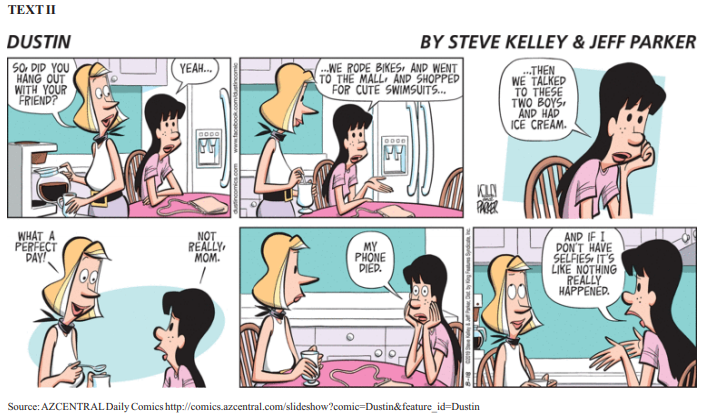
According to the comics, it is CORRECTto say that:
Ano: 2019
Banca:
CPCON
Órgão:
Prefeitura de Sumé - PB
Prova:
CPCON - 2019 - Prefeitura de Sumé - PB - Professor - Inglês |
Q1253459
Inglês
According to the text, it is CORRECTto say that:
Ano: 2019
Banca:
CPCON
Órgão:
Prefeitura de Solânea - PB
Prova:
CPCON - 2019 - Prefeitura de Solânea - PB - Professor - Inglês |
Q1253406
Inglês
Texto associado
TEXT III

In the cartoon, the student's question reveals
Ano: 2019
Banca:
CETREDE
Órgão:
Prefeitura de São Gonçalo do Amarante - CE
Prova:
CETREDE - 2019 - Prefeitura de São Gonçalo do Amarante - CE - Professor de Ensino Fundamental II - Inglês (20HS/S) |
Q1251161
Inglês
Complete the sentences with SOME or ANY
I. Please give me _____ more ice cream. II. I don't have ______ ice cream. III. She will be very angry if you don't bring ______. IV. I have _____ very delicious ice cream for you.
Mark the CORRECT arswer.
I. Please give me _____ more ice cream. II. I don't have ______ ice cream. III. She will be very angry if you don't bring ______. IV. I have _____ very delicious ice cream for you.
Mark the CORRECT arswer.
Ano: 2019
Banca:
CETREDE
Órgão:
Prefeitura de São Gonçalo do Amarante - CE
Prova:
CETREDE - 2019 - Prefeitura de São Gonçalo do Amarante - CE - Professor de Ensino Fundamental II - Inglês (20HS/S) |
Q1251158
Inglês
Complete the following sentences with “WHICH” or
“WHAT”.
I. ________ time do we have to be at school? At eight o'clock. II. ________ bus goes to the centre, number 20 or 21? III. ________ do you feed your dog? Milk.
Mark the CORRECT arswer.
I. ________ time do we have to be at school? At eight o'clock. II. ________ bus goes to the centre, number 20 or 21? III. ________ do you feed your dog? Milk.
Mark the CORRECT arswer.
Ano: 2019
Banca:
CETREDE
Órgão:
Prefeitura de São Gonçalo do Amarante - CE
Prova:
CETREDE - 2019 - Prefeitura de São Gonçalo do Amarante - CE - Professor de Ensino Fundamental II - Inglês (20HS/S) |
Q1251156
Inglês
Put the sentence into reported speech.
He asked us, "Are they waiting outside?"
He asked us, "Are they waiting outside?"
Ano: 2019
Banca:
CETREDE
Órgão:
Prefeitura de São Gonçalo do Amarante - CE
Prova:
CETREDE - 2019 - Prefeitura de São Gonçalo do Amarante - CE - Professor de Ensino Fundamental II - Inglês (20HS/S) |
Q1251155
Inglês
Texto associado
Should children watch toy unboxing videos?
Children around the world are currently trying to decide which toys
to put on their Christmas list. Some browse catalogues for
inspiration or look in toy shops and watch TV adverts, while others
are turning to toy unboxing videos to make up their minds. What
is the appeal of these videos, and are they in any way harmful?
For nine-year-old Verity, the unboxing videos have been a great
way to work out which toys she really wants this Christmas. In
these videos, children, or in some cases just a pair of hands, take
toys out of their packaging and play with them.
Verity particularly likes watching Shopkins, Lego and Harry Potter
toys being opened on YouTube, which is the main platform for this
type of content. "It gives you more information than just seeing an
advert. It's more interesting because these videos give you more
details about how something works and then they show you how
it works."
Verity, who lives in St Albans in Hertfordshire, also likes to make
her own videos, but only for family and friends to watch. "I don't
want everybody to see them because they might make fun of them
and make bad comments," she says. "People can be mean."
BBC: https://www.bbc.com/news/uk-england-beds-bucks-herts-49975644
The word “harmful”, line 5 could be best substituted for:
Ano: 2019
Banca:
CETREDE
Órgão:
Prefeitura de São Gonçalo do Amarante - CE
Prova:
CETREDE - 2019 - Prefeitura de São Gonçalo do Amarante - CE - Professor de Ensino Fundamental II - Inglês (20HS/S) |
Q1251154
Inglês
Texto associado
Should children watch toy unboxing videos?
Children around the world are currently trying to decide which toys
to put on their Christmas list. Some browse catalogues for
inspiration or look in toy shops and watch TV adverts, while others
are turning to toy unboxing videos to make up their minds. What
is the appeal of these videos, and are they in any way harmful?
For nine-year-old Verity, the unboxing videos have been a great
way to work out which toys she really wants this Christmas. In
these videos, children, or in some cases just a pair of hands, take
toys out of their packaging and play with them.
Verity particularly likes watching Shopkins, Lego and Harry Potter
toys being opened on YouTube, which is the main platform for this
type of content. "It gives you more information than just seeing an
advert. It's more interesting because these videos give you more
details about how something works and then they show you how
it works."
Verity, who lives in St Albans in Hertfordshire, also likes to make
her own videos, but only for family and friends to watch. "I don't
want everybody to see them because they might make fun of them
and make bad comments," she says. "People can be mean."
BBC: https://www.bbc.com/news/uk-england-beds-bucks-herts-49975644
In line 4, what does “make up” mean?
Ano: 2019
Banca:
CETREDE
Órgão:
Prefeitura de São Gonçalo do Amarante - CE
Prova:
CETREDE - 2019 - Prefeitura de São Gonçalo do Amarante - CE - Professor de Ensino Fundamental II - Inglês (20HS/S) |
Q1251153
Inglês
Texto associado
Should children watch toy unboxing videos?
Children around the world are currently trying to decide which toys
to put on their Christmas list. Some browse catalogues for
inspiration or look in toy shops and watch TV adverts, while others
are turning to toy unboxing videos to make up their minds. What
is the appeal of these videos, and are they in any way harmful?
For nine-year-old Verity, the unboxing videos have been a great
way to work out which toys she really wants this Christmas. In
these videos, children, or in some cases just a pair of hands, take
toys out of their packaging and play with them.
Verity particularly likes watching Shopkins, Lego and Harry Potter
toys being opened on YouTube, which is the main platform for this
type of content. "It gives you more information than just seeing an
advert. It's more interesting because these videos give you more
details about how something works and then they show you how
it works."
Verity, who lives in St Albans in Hertfordshire, also likes to make
her own videos, but only for family and friends to watch. "I don't
want everybody to see them because they might make fun of them
and make bad comments," she says. "People can be mean."
BBC: https://www.bbc.com/news/uk-england-beds-bucks-herts-49975644
Choose the alternative that is NOT a strategy that
children are using to help them decide what they want for
Christmas nowadays.
Ano: 2019
Banca:
CETREDE
Órgão:
Prefeitura de São Gonçalo do Amarante - CE
Prova:
CETREDE - 2019 - Prefeitura de São Gonçalo do Amarante - CE - Professor de Ensino Fundamental II - Inglês (20HS/S) |
Q1251152
Inglês
Texto associado
Should children watch toy unboxing videos?
Children around the world are currently trying to decide which toys
to put on their Christmas list. Some browse catalogues for
inspiration or look in toy shops and watch TV adverts, while others
are turning to toy unboxing videos to make up their minds. What
is the appeal of these videos, and are they in any way harmful?
For nine-year-old Verity, the unboxing videos have been a great
way to work out which toys she really wants this Christmas. In
these videos, children, or in some cases just a pair of hands, take
toys out of their packaging and play with them.
Verity particularly likes watching Shopkins, Lego and Harry Potter
toys being opened on YouTube, which is the main platform for this
type of content. "It gives you more information than just seeing an
advert. It's more interesting because these videos give you more
details about how something works and then they show you how
it works."
Verity, who lives in St Albans in Hertfordshire, also likes to make
her own videos, but only for family and friends to watch. "I don't
want everybody to see them because they might make fun of them
and make bad comments," she says. "People can be mean."
BBC: https://www.bbc.com/news/uk-england-beds-bucks-herts-49975644
Who is Verity?
Ano: 2019
Banca:
CETREDE
Órgão:
Prefeitura de São Gonçalo do Amarante - CE
Prova:
CETREDE - 2019 - Prefeitura de São Gonçalo do Amarante - CE - Professor de Ensino Fundamental II - Inglês (20HS/S) |
Q1251151
Inglês
Texto associado
Should children watch toy unboxing videos?
Children around the world are currently trying to decide which toys
to put on their Christmas list. Some browse catalogues for
inspiration or look in toy shops and watch TV adverts, while others
are turning to toy unboxing videos to make up their minds. What
is the appeal of these videos, and are they in any way harmful?
For nine-year-old Verity, the unboxing videos have been a great
way to work out which toys she really wants this Christmas. In
these videos, children, or in some cases just a pair of hands, take
toys out of their packaging and play with them.
Verity particularly likes watching Shopkins, Lego and Harry Potter
toys being opened on YouTube, which is the main platform for this
type of content. "It gives you more information than just seeing an
advert. It's more interesting because these videos give you more
details about how something works and then they show you how
it works."
Verity, who lives in St Albans in Hertfordshire, also likes to make
her own videos, but only for family and friends to watch. "I don't
want everybody to see them because they might make fun of them
and make bad comments," she says. "People can be mean."
BBC: https://www.bbc.com/news/uk-england-beds-bucks-herts-49975644
What is the main platform used for this type of content?
Ano: 2019
Banca:
CETREDE
Órgão:
Prefeitura de São Gonçalo do Amarante - CE
Prova:
CETREDE - 2019 - Prefeitura de São Gonçalo do Amarante - CE - Professor de Ensino Fundamental II - Inglês (20HS/S) |
Q1251150
Inglês
Texto associado
Should children watch toy unboxing videos?
Children around the world are currently trying to decide which toys
to put on their Christmas list. Some browse catalogues for
inspiration or look in toy shops and watch TV adverts, while others
are turning to toy unboxing videos to make up their minds. What
is the appeal of these videos, and are they in any way harmful?
For nine-year-old Verity, the unboxing videos have been a great
way to work out which toys she really wants this Christmas. In
these videos, children, or in some cases just a pair of hands, take
toys out of their packaging and play with them.
Verity particularly likes watching Shopkins, Lego and Harry Potter
toys being opened on YouTube, which is the main platform for this
type of content. "It gives you more information than just seeing an
advert. It's more interesting because these videos give you more
details about how something works and then they show you how
it works."
Verity, who lives in St Albans in Hertfordshire, also likes to make
her own videos, but only for family and friends to watch. "I don't
want everybody to see them because they might make fun of them
and make bad comments," she says. "People can be mean."
BBC: https://www.bbc.com/news/uk-england-beds-bucks-herts-49975644
Why doesn´t verity share her videos with everybody?
Ano: 2019
Banca:
CETREDE
Órgão:
Prefeitura de São Gonçalo do Amarante - CE
Prova:
CETREDE - 2019 - Prefeitura de São Gonçalo do Amarante - CE - Professor de Ensino Fundamental II - Inglês (20HS/S) |
Q1251149
Inglês
Texto associado
Should children watch toy unboxing videos?
Children around the world are currently trying to decide which toys
to put on their Christmas list. Some browse catalogues for
inspiration or look in toy shops and watch TV adverts, while others
are turning to toy unboxing videos to make up their minds. What
is the appeal of these videos, and are they in any way harmful?
For nine-year-old Verity, the unboxing videos have been a great
way to work out which toys she really wants this Christmas. In
these videos, children, or in some cases just a pair of hands, take
toys out of their packaging and play with them.
Verity particularly likes watching Shopkins, Lego and Harry Potter
toys being opened on YouTube, which is the main platform for this
type of content. "It gives you more information than just seeing an
advert. It's more interesting because these videos give you more
details about how something works and then they show you how
it works."
Verity, who lives in St Albans in Hertfordshire, also likes to make
her own videos, but only for family and friends to watch. "I don't
want everybody to see them because they might make fun of them
and make bad comments," she says. "People can be mean."
BBC: https://www.bbc.com/news/uk-england-beds-bucks-herts-49975644
What is the main reason people are watching this type
of video?
Ano: 2019
Banca:
CETREDE
Órgão:
Prefeitura de São Gonçalo do Amarante - CE
Prova:
CETREDE - 2019 - Prefeitura de São Gonçalo do Amarante - CE - Professor de Ensino Fundamental II - Inglês (20HS/S) |
Q1251148
Inglês
Texto associado
Should children watch toy unboxing videos?
Children around the world are currently trying to decide which toys
to put on their Christmas list. Some browse catalogues for
inspiration or look in toy shops and watch TV adverts, while others
are turning to toy unboxing videos to make up their minds. What
is the appeal of these videos, and are they in any way harmful?
For nine-year-old Verity, the unboxing videos have been a great
way to work out which toys she really wants this Christmas. In
these videos, children, or in some cases just a pair of hands, take
toys out of their packaging and play with them.
Verity particularly likes watching Shopkins, Lego and Harry Potter
toys being opened on YouTube, which is the main platform for this
type of content. "It gives you more information than just seeing an
advert. It's more interesting because these videos give you more
details about how something works and then they show you how
it works."
Verity, who lives in St Albans in Hertfordshire, also likes to make
her own videos, but only for family and friends to watch. "I don't
want everybody to see them because they might make fun of them
and make bad comments," she says. "People can be mean."
BBC: https://www.bbc.com/news/uk-england-beds-bucks-herts-49975644
What is the text about?
Ano: 2019
Banca:
GUALIMP
Órgão:
Prefeitura de Porciúncula - RJ
Prova:
GUALIMP - 2019 - Prefeitura de Porciúncula - RJ - Professor - Inglês |
Q1250591
Inglês
All the sentences are correct, EXCEPT one. Choose the INCORRECT answer.

 Conheça nossos planos