Questões de Concurso
Sobre interpretação de texto | reading comprehension em inglês
Foram encontradas 12.687 questões


Leia o texto e responda à questão.
The birth of a nation
The most memorable writing in eighteenth-century
America was done by the founding fathers, the men who
led the American Revolution of 1775-1783 and wrote the
constitution of 1989. But none of them were writers of fiction.
Rather, they were practical philosophers, and their most
typical product was the political pamphlet. They shared the
European Enlightenment belief that human reason could
understand both nature and man. Unlike the Puritans – who
saw man as a sinful failure – the Enlightenment men were
sure man could improve himself. They wanted to create a
happy society based on justice and freedom.
The writings of Benjamin Franklin (1706 -1790) show the Enlightenment spirit in America at its best and most optimistic. His style is quite modern and, even today, his works are a joy to read. At the same time, there’s something “anti-literary” about Franklin. He had no liking for poetry and felt that writing should always have a practical purpose.
Almanacs, containing much useful information for farmers and sailors (about the next year’s weather, sea tides, etc.), were a popular form of practical literature. Together with the Bible and the newspaper, they were the most-widely read and often the only reading matter in most Colonial households. Franklin made his Almanac interesting by creating the character “Little Richard”. Each new edition continued a simple but realist story about Richard, his wife and family. He also included many “sayings” about saving money and working hard. Some of those are known to most Americans today:
Lost time is never found again.
God helps those who help themselves.
In 1757 Franklin collected together the best of his sayings
and published The Way to Wealth. This little book became one
of the best-sellers of the Western World and was translated
into many languages.
(Peter High. Outline of American Literature . Essex, Longman. 1996. Adaptado)
Leia os quadrinhos e responda à questão.

(www.uninorte.edu.co)
Leia o texto e responda à questão.
For years attention has been paid to so-called communicative tests – usually implying tests dealing with speaking. More recently, efforts have been made to design truly communicative tests of other language skills as well, such as reading comprehension.
Canale (1984) points out that a good test is not just one which is valid, reliable, and practical in terms of test administration and scoring, but rather one that is accepted as fair, important and interesting by test takers (the teachers) and test users (the students). Also, a good test has feedback potential, rewarding both teachers and students with clear, rich, relevant, and generalizable information. Canale suggests that acceptability and feedback potential have often been accorded low priority, thus explaining the curious phenomenon of multiple-choice tests claiming to assess oral interaction skills.
One example of a communicative test has been referred to as a “storyline” test. In such a test, a common theme runs throughout in order to assess the effects of context. The basis for such an approach is that the respondents learn as they read on, that they check previous content, and that the ability to use language in conversation or writing depends in large measure on the skill of picking up information from past discussion and using it in formulating new strategies.
Swain (1984), for example, developed a storyline test of French as a foreign language for high school French immersion students. The test consisted of six tasks around a common theme, “finding summer employment”. There were four writing tasks (a letter, a note, a composition, a technical exercise) and two speaking tasks (a group discussion and a job interview). The test was designed so that the topic would be motivating to the students and so that there would be enough information provided in order to give the tasks credibility. There was access to dictionaries and reference material, and opportunity for students to review and revise their work. Swain’s main concern was to “bias for best” in the construction of the test – to make every effort to support the respondent in doing their best on the test.
(Andrew D.Cohen. Second Language Assessment.
IN: Marianne Celce-Murcia(ed). Teaching English as a second or foreign
language. Boston, Massachusstes: Heinle&Heinle. 2nd edition. 2001. Adaptado)
Leia o texto e responda à questão.
For years attention has been paid to so-called communicative tests – usually implying tests dealing with speaking. More recently, efforts have been made to design truly communicative tests of other language skills as well, such as reading comprehension.
Canale (1984) points out that a good test is not just one which is valid, reliable, and practical in terms of test administration and scoring, but rather one that is accepted as fair, important and interesting by test takers (the teachers) and test users (the students). Also, a good test has feedback potential, rewarding both teachers and students with clear, rich, relevant, and generalizable information. Canale suggests that acceptability and feedback potential have often been accorded low priority, thus explaining the curious phenomenon of multiple-choice tests claiming to assess oral interaction skills.
One example of a communicative test has been referred to as a “storyline” test. In such a test, a common theme runs throughout in order to assess the effects of context. The basis for such an approach is that the respondents learn as they read on, that they check previous content, and that the ability to use language in conversation or writing depends in large measure on the skill of picking up information from past discussion and using it in formulating new strategies.
Swain (1984), for example, developed a storyline test of French as a foreign language for high school French immersion students. The test consisted of six tasks around a common theme, “finding summer employment”. There were four writing tasks (a letter, a note, a composition, a technical exercise) and two speaking tasks (a group discussion and a job interview). The test was designed so that the topic would be motivating to the students and so that there would be enough information provided in order to give the tasks credibility. There was access to dictionaries and reference material, and opportunity for students to review and revise their work. Swain’s main concern was to “bias for best” in the construction of the test – to make every effort to support the respondent in doing their best on the test.
(Andrew D.Cohen. Second Language Assessment.
IN: Marianne Celce-Murcia(ed). Teaching English as a second or foreign
language. Boston, Massachusstes: Heinle&Heinle. 2nd edition. 2001. Adaptado)
Leia o texto e responda à questão.
For years attention has been paid to so-called communicative tests – usually implying tests dealing with speaking. More recently, efforts have been made to design truly communicative tests of other language skills as well, such as reading comprehension.
Canale (1984) points out that a good test is not just one which is valid, reliable, and practical in terms of test administration and scoring, but rather one that is accepted as fair, important and interesting by test takers (the teachers) and test users (the students). Also, a good test has feedback potential, rewarding both teachers and students with clear, rich, relevant, and generalizable information. Canale suggests that acceptability and feedback potential have often been accorded low priority, thus explaining the curious phenomenon of multiple-choice tests claiming to assess oral interaction skills.
One example of a communicative test has been referred to as a “storyline” test. In such a test, a common theme runs throughout in order to assess the effects of context. The basis for such an approach is that the respondents learn as they read on, that they check previous content, and that the ability to use language in conversation or writing depends in large measure on the skill of picking up information from past discussion and using it in formulating new strategies.
Swain (1984), for example, developed a storyline test of French as a foreign language for high school French immersion students. The test consisted of six tasks around a common theme, “finding summer employment”. There were four writing tasks (a letter, a note, a composition, a technical exercise) and two speaking tasks (a group discussion and a job interview). The test was designed so that the topic would be motivating to the students and so that there would be enough information provided in order to give the tasks credibility. There was access to dictionaries and reference material, and opportunity for students to review and revise their work. Swain’s main concern was to “bias for best” in the construction of the test – to make every effort to support the respondent in doing their best on the test.
(Andrew D.Cohen. Second Language Assessment.
IN: Marianne Celce-Murcia(ed). Teaching English as a second or foreign
language. Boston, Massachusstes: Heinle&Heinle. 2nd edition. 2001. Adaptado)
Leia o texto e responda à questão.
For years attention has been paid to so-called communicative tests – usually implying tests dealing with speaking. More recently, efforts have been made to design truly communicative tests of other language skills as well, such as reading comprehension.
Canale (1984) points out that a good test is not just one which is valid, reliable, and practical in terms of test administration and scoring, but rather one that is accepted as fair, important and interesting by test takers (the teachers) and test users (the students). Also, a good test has feedback potential, rewarding both teachers and students with clear, rich, relevant, and generalizable information. Canale suggests that acceptability and feedback potential have often been accorded low priority, thus explaining the curious phenomenon of multiple-choice tests claiming to assess oral interaction skills.
One example of a communicative test has been referred to as a “storyline” test. In such a test, a common theme runs throughout in order to assess the effects of context. The basis for such an approach is that the respondents learn as they read on, that they check previous content, and that the ability to use language in conversation or writing depends in large measure on the skill of picking up information from past discussion and using it in formulating new strategies.
Swain (1984), for example, developed a storyline test of French as a foreign language for high school French immersion students. The test consisted of six tasks around a common theme, “finding summer employment”. There were four writing tasks (a letter, a note, a composition, a technical exercise) and two speaking tasks (a group discussion and a job interview). The test was designed so that the topic would be motivating to the students and so that there would be enough information provided in order to give the tasks credibility. There was access to dictionaries and reference material, and opportunity for students to review and revise their work. Swain’s main concern was to “bias for best” in the construction of the test – to make every effort to support the respondent in doing their best on the test.
(Andrew D.Cohen. Second Language Assessment.
IN: Marianne Celce-Murcia(ed). Teaching English as a second or foreign
language. Boston, Massachusstes: Heinle&Heinle. 2nd edition. 2001. Adaptado)
Leia o texto e responda à questão.
For years attention has been paid to so-called communicative tests – usually implying tests dealing with speaking. More recently, efforts have been made to design truly communicative tests of other language skills as well, such as reading comprehension.
Canale (1984) points out that a good test is not just one which is valid, reliable, and practical in terms of test administration and scoring, but rather one that is accepted as fair, important and interesting by test takers (the teachers) and test users (the students). Also, a good test has feedback potential, rewarding both teachers and students with clear, rich, relevant, and generalizable information. Canale suggests that acceptability and feedback potential have often been accorded low priority, thus explaining the curious phenomenon of multiple-choice tests claiming to assess oral interaction skills.
One example of a communicative test has been referred to as a “storyline” test. In such a test, a common theme runs throughout in order to assess the effects of context. The basis for such an approach is that the respondents learn as they read on, that they check previous content, and that the ability to use language in conversation or writing depends in large measure on the skill of picking up information from past discussion and using it in formulating new strategies.
Swain (1984), for example, developed a storyline test of French as a foreign language for high school French immersion students. The test consisted of six tasks around a common theme, “finding summer employment”. There were four writing tasks (a letter, a note, a composition, a technical exercise) and two speaking tasks (a group discussion and a job interview). The test was designed so that the topic would be motivating to the students and so that there would be enough information provided in order to give the tasks credibility. There was access to dictionaries and reference material, and opportunity for students to review and revise their work. Swain’s main concern was to “bias for best” in the construction of the test – to make every effort to support the respondent in doing their best on the test.
(Andrew D.Cohen. Second Language Assessment.
IN: Marianne Celce-Murcia(ed). Teaching English as a second or foreign
language. Boston, Massachusstes: Heinle&Heinle. 2nd edition. 2001. Adaptado)
Leia o texto e responda à questão.
For years attention has been paid to so-called communicative tests – usually implying tests dealing with speaking. More recently, efforts have been made to design truly communicative tests of other language skills as well, such as reading comprehension.
Canale (1984) points out that a good test is not just one which is valid, reliable, and practical in terms of test administration and scoring, but rather one that is accepted as fair, important and interesting by test takers (the teachers) and test users (the students). Also, a good test has feedback potential, rewarding both teachers and students with clear, rich, relevant, and generalizable information. Canale suggests that acceptability and feedback potential have often been accorded low priority, thus explaining the curious phenomenon of multiple-choice tests claiming to assess oral interaction skills.
One example of a communicative test has been referred to as a “storyline” test. In such a test, a common theme runs throughout in order to assess the effects of context. The basis for such an approach is that the respondents learn as they read on, that they check previous content, and that the ability to use language in conversation or writing depends in large measure on the skill of picking up information from past discussion and using it in formulating new strategies.
Swain (1984), for example, developed a storyline test of French as a foreign language for high school French immersion students. The test consisted of six tasks around a common theme, “finding summer employment”. There were four writing tasks (a letter, a note, a composition, a technical exercise) and two speaking tasks (a group discussion and a job interview). The test was designed so that the topic would be motivating to the students and so that there would be enough information provided in order to give the tasks credibility. There was access to dictionaries and reference material, and opportunity for students to review and revise their work. Swain’s main concern was to “bias for best” in the construction of the test – to make every effort to support the respondent in doing their best on the test.
(Andrew D.Cohen. Second Language Assessment.
IN: Marianne Celce-Murcia(ed). Teaching English as a second or foreign
language. Boston, Massachusstes: Heinle&Heinle. 2nd edition. 2001. Adaptado)
Leia os quadrinhos para responder à questão.

(www.magoosh.com)
Leia os quadrinhos para responder à questão.
(www.magoosh.com)
Leia o texto e responda à questão.
Culture is really an integral part of the interaction between language and thought. Cultural patterns, customs, and ways of life are expressed in language; culture-specific world views are reflected in language. Each culture has at its disposal a particular range of colours, illustrating its particular world view on what color is and how to identify color. The African Shona and Bassa peoples, for example, have fewer color categories than speakers of European languages and they break up the spectrum at different points, as shown below:

Of course, the Shona or Bassa are able to perceive and describe other colors, in the same way that an English speaker might describe a “dark bluish green”, but the labels which the language provides tend to shape the person’s overall cognitive organization of color and to cause varying degrees of color discrimination. Eskimo tribes commonly have as many as seven different words for snow to distinguish among different types of snow (falling snow, snow on the ground, fluffy snow, wet snow, etc.), whereas certain African cultures in the equatorial forests of Zaire have no word at all for snow.
(Douglas Brown. Principles of language learning and teaching.
5th ed. Longman, 2000. Adaptado)
Leia o texto e responda à questão.
Culture is really an integral part of the interaction between language and thought. Cultural patterns, customs, and ways of life are expressed in language; culture-specific world views are reflected in language. Each culture has at its disposal a particular range of colours, illustrating its particular world view on what color is and how to identify color. The African Shona and Bassa peoples, for example, have fewer color categories than speakers of European languages and they break up the spectrum at different points, as shown below:
Of course, the Shona or Bassa are able to perceive and describe other colors, in the same way that an English speaker might describe a “dark bluish green”, but the labels which the language provides tend to shape the person’s overall cognitive organization of color and to cause varying degrees of color discrimination. Eskimo tribes commonly have as many as seven different words for snow to distinguish among different types of snow (falling snow, snow on the ground, fluffy snow, wet snow, etc.), whereas certain African cultures in the equatorial forests of Zaire have no word at all for snow.
(Douglas Brown. Principles of language learning and teaching.
5th ed. Longman, 2000. Adaptado)
Leia o texto e responda à questão.
Culture is really an integral part of the interaction between language and thought. Cultural patterns, customs, and ways of life are expressed in language; culture-specific world views are reflected in language. Each culture has at its disposal a particular range of colours, illustrating its particular world view on what color is and how to identify color. The African Shona and Bassa peoples, for example, have fewer color categories than speakers of European languages and they break up the spectrum at different points, as shown below:
Of course, the Shona or Bassa are able to perceive and describe other colors, in the same way that an English speaker might describe a “dark bluish green”, but the labels which the language provides tend to shape the person’s overall cognitive organization of color and to cause varying degrees of color discrimination. Eskimo tribes commonly have as many as seven different words for snow to distinguish among different types of snow (falling snow, snow on the ground, fluffy snow, wet snow, etc.), whereas certain African cultures in the equatorial forests of Zaire have no word at all for snow.
(Douglas Brown. Principles of language learning and teaching.
5th ed. Longman, 2000. Adaptado)
Leia o texto e responda à questão.
Culture is really an integral part of the interaction between language and thought. Cultural patterns, customs, and ways of life are expressed in language; culture-specific world views are reflected in language. Each culture has at its disposal a particular range of colours, illustrating its particular world view on what color is and how to identify color. The African Shona and Bassa peoples, for example, have fewer color categories than speakers of European languages and they break up the spectrum at different points, as shown below:
Of course, the Shona or Bassa are able to perceive and describe other colors, in the same way that an English speaker might describe a “dark bluish green”, but the labels which the language provides tend to shape the person’s overall cognitive organization of color and to cause varying degrees of color discrimination. Eskimo tribes commonly have as many as seven different words for snow to distinguish among different types of snow (falling snow, snow on the ground, fluffy snow, wet snow, etc.), whereas certain African cultures in the equatorial forests of Zaire have no word at all for snow.
(Douglas Brown. Principles of language learning and teaching.
5th ed. Longman, 2000. Adaptado)
Leia a charge e responda à questão.
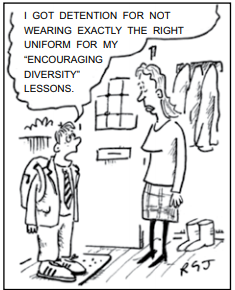
(www.cartoonstock.com)
Humor in the charge derives from

(Source: https://www.sciencedaily.com/releases/2019/11/191114141247.htm– Adapted)
I. Linguistic research suggests that accents are strongly shaped by the speaker's first language they learned growing up. II. The work is the first to evaluate these effects on a large scale and may help to improve methods of teaching for adults learning an additional language. III. New research pinpoints how to overcome specific problems related to more than 60 different languages when learning a foreign language.
Which ones are correct?
(Source: https://www.sciencedaily.com/releases/2019/11/191114141247.htm– Adapted)
I. Replacement of ‘sheds light on’ (l.07) with ‘clarifies’. II. Replacement of ‘handful’ (l.18) with ‘large number’. III. Replacement of ‘corroborate’ (l.37) with ‘validate’.
Disregarding any grammatical aspects, which ones alter the meaning of the sentence?
The Food and Drug Administration warned Wednesday that repeated or lengthy use of general anesthesia or sedation drugs _______ children younger than 3 or pregnant women in their third trimester may affect youngsters' developing brains. The agency, which said its warning is based _________ a comprehensive analysis of the latest research, issued a “drug-safety communication” to inform health-care providers, parents and pregnant women about the risks of using the drugs repeatedly or for more than three hours at a time. It also ordered manufacturers to add warnings to their products labels. “We recognize that in many cases these exposures may be medically necessary,” Janet Woodcock, director of the FDA's Center for Drug Evaluation and Research, said in a statement. The new data on potential harms, she said, “must be carefully weighed against the risk of not performing a specific medical procedure.
The agency said that laboratory studies show that using the drugs in pregnant or young animals for more than three hours at a time causes widespread loss of nerve cells, which correlated with long-term effects on learning and behavior.
Some studies have also been conducted in children, with some supporting the findings from the animal research, particularly after repeated or prolonged exposure to the drugs early ____ life. But, all the studies in children had limitations, and the FDA said that “it is unclear whether any negative effects seen in children’s learning or behavior were due to the drugs or to other factors, such as the underlying medical condition that led to the need for the surgery or procedure.” A single, short exposure to the drugs is unlikely to have a negative effect, the agency added. More than 1 million children under age 4 require anesthesia for surgery in the United States each year, for conditions such as congenital heart defects or pyloric stenosis, which is a narrowing of the opening from the stomach into the small intestine.
The FDA said it has been investigating the effects of anesthesia on brain development since the first animal study on the topic was published in 1999. In 2010, it formed a partnership ________ the International Anesthesia Research Society on a project called SmartTots – Strategies for Mitigating Anesthesia-Related Neurotoxicity in Tots – to fund research on the effect of the drugs on pregnant women and children.
The Washington Post - adapted.
The Food and Drug Administration warned Wednesday that repeated or lengthy use of general anesthesia or sedation drugs _______ children younger than 3 or pregnant women in their third trimester may affect youngsters' developing brains. The agency, which said its warning is based _________ a comprehensive analysis of the latest research, issued a “drug-safety communication” to inform health-care providers, parents and pregnant women about the risks of using the drugs repeatedly or for more than three hours at a time. It also ordered manufacturers to add warnings to their products labels. “We recognize that in many cases these exposures may be medically necessary,” Janet Woodcock, director of the FDA's Center for Drug Evaluation and Research, said in a statement. The new data on potential harms, she said, “must be carefully weighed against the risk of not performing a specific medical procedure.
The agency said that laboratory studies show that using the drugs in pregnant or young animals for more than three hours at a time causes widespread loss of nerve cells, which correlated with long-term effects on learning and behavior.
Some studies have also been conducted in children, with some supporting the findings from the animal research, particularly after repeated or prolonged exposure to the drugs early ____ life. But, all the studies in children had limitations, and the FDA said that “it is unclear whether any negative effects seen in children’s learning or behavior were due to the drugs or to other factors, such as the underlying medical condition that led to the need for the surgery or procedure.” A single, short exposure to the drugs is unlikely to have a negative effect, the agency added. More than 1 million children under age 4 require anesthesia for surgery in the United States each year, for conditions such as congenital heart defects or pyloric stenosis, which is a narrowing of the opening from the stomach into the small intestine.
The FDA said it has been investigating the effects of anesthesia on brain development since the first animal study on the topic was published in 1999. In 2010, it formed a partnership ________ the International Anesthesia Research Society on a project called SmartTots – Strategies for Mitigating Anesthesia-Related Neurotoxicity in Tots – to fund research on the effect of the drugs on pregnant women and children.
The Washington Post - adapted.
According to the text, analyze the following items:
I. The expression “which”, in “… agency, which said its warning…” (1st paragraph), refers to “agency”.
II. The word “single”, in “…single, short exposure to the drugs…” (3rd paragraph), has a similar meaning to “alone”.
III. The word “but”, in “… But, all the studies in children…” (3rd paragraph), could be substituted, without any change in meaning, by “also”.
The CORRECT item(s) is(are):
The Food and Drug Administration warned Wednesday that repeated or lengthy use of general anesthesia or sedation drugs _______ children younger than 3 or pregnant women in their third trimester may affect youngsters' developing brains. The agency, which said its warning is based _________ a comprehensive analysis of the latest research, issued a “drug-safety communication” to inform health-care providers, parents and pregnant women about the risks of using the drugs repeatedly or for more than three hours at a time. It also ordered manufacturers to add warnings to their products labels. “We recognize that in many cases these exposures may be medically necessary,” Janet Woodcock, director of the FDA's Center for Drug Evaluation and Research, said in a statement. The new data on potential harms, she said, “must be carefully weighed against the risk of not performing a specific medical procedure.
The agency said that laboratory studies show that using the drugs in pregnant or young animals for more than three hours at a time causes widespread loss of nerve cells, which correlated with long-term effects on learning and behavior.
Some studies have also been conducted in children, with some supporting the findings from the animal research, particularly after repeated or prolonged exposure to the drugs early ____ life. But, all the studies in children had limitations, and the FDA said that “it is unclear whether any negative effects seen in children’s learning or behavior were due to the drugs or to other factors, such as the underlying medical condition that led to the need for the surgery or procedure.” A single, short exposure to the drugs is unlikely to have a negative effect, the agency added. More than 1 million children under age 4 require anesthesia for surgery in the United States each year, for conditions such as congenital heart defects or pyloric stenosis, which is a narrowing of the opening from the stomach into the small intestine.
The FDA said it has been investigating the effects of anesthesia on brain development since the first animal study on the topic was published in 1999. In 2010, it formed a partnership ________ the International Anesthesia Research Society on a project called SmartTots – Strategies for Mitigating Anesthesia-Related Neurotoxicity in Tots – to fund research on the effect of the drugs on pregnant women and children.
The Washington Post - adapted.

 Conheça nossos planos