Questões de Concurso
Sobre interpretação de texto | reading comprehension em inglês
Foram encontradas 12.687 questões


Ano: 2023
Banca:
FUNDATEC
Órgão:
Prefeitura de Sapucaia do Sul - RS
Prova:
FUNDATEC - 2023 - Prefeitura de Sapucaia do Sul - RS - Professor A2 – Língua Inglesa |
Q2286503
Inglês
According to José Carlos Libâneo (2013), the planning of the school year involves
organizing and coordinating activities to achieve the goals that were previously established, as well as
reviewing and adjusting them through the year. He says that planning serves many purposes related
to school, teaching, and classroom management. Analyze the statements about the author’s take on
these purposes and mark T, if true, or F, if false.
( ) The planning should explain the principles, guidelines, and procedures of teaching that ensure the articulation between the school's tasks and the criteria of the social context.
( ) It should be as detailed as possible, so the school can ensure teachers and students follow the plan exactly as described, no matter the circumstances.
( ) It should decide the objectives, contents and methods, based on the demands posed by social reality and individual conditions of the students.
The correct order of filling the parentheses, from top to bottom, is:
( ) The planning should explain the principles, guidelines, and procedures of teaching that ensure the articulation between the school's tasks and the criteria of the social context.
( ) It should be as detailed as possible, so the school can ensure teachers and students follow the plan exactly as described, no matter the circumstances.
( ) It should decide the objectives, contents and methods, based on the demands posed by social reality and individual conditions of the students.
The correct order of filling the parentheses, from top to bottom, is:
Ano: 2023
Banca:
FUNDATEC
Órgão:
Prefeitura de Sapucaia do Sul - RS
Prova:
FUNDATEC - 2023 - Prefeitura de Sapucaia do Sul - RS - Professor A2 – Língua Inglesa |
Q2286502
Inglês
Celso Vasconcellos (2011) writes about didactics in class planning and teacher
formation. He says that for a student to actually learn something there are six key-elements. Which
of the sentences below does NOT represent a key-element to learning?
Ano: 2023
Banca:
FUNDATEC
Órgão:
Prefeitura de Sapucaia do Sul - RS
Prova:
FUNDATEC - 2023 - Prefeitura de Sapucaia do Sul - RS - Professor A2 – Língua Inglesa |
Q2286500
Inglês
Texto associado
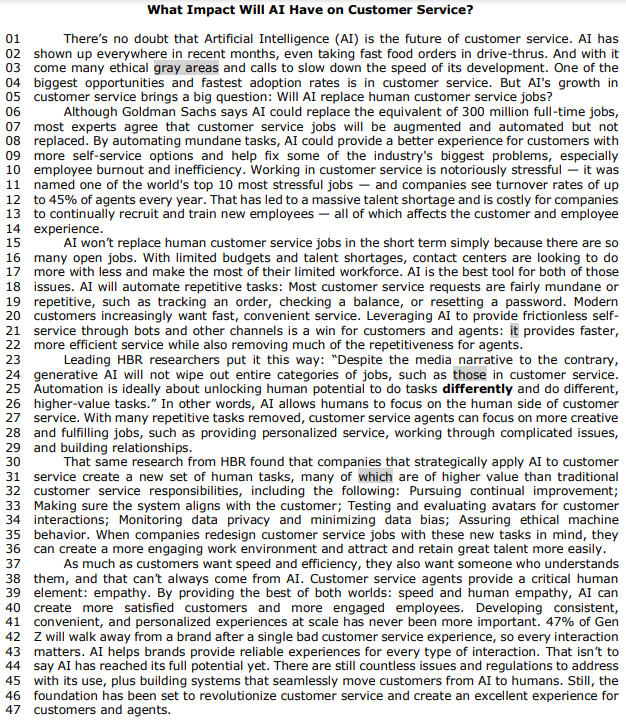
(Available at: https://www.forbes.com/sites/blakemorgan/2023/08/16/what-impact-will-ai-have-on-customer-
service/ - text especially adapted for this test).
*Bot: a computer program that works automatically, especially one that searches for and finds
information on the internet. (www.dictionary.cambridge.org 09/09/23).
The highlighted expression “gray areas” (l. 03) means that:
Ano: 2023
Banca:
FUNDATEC
Órgão:
Prefeitura de Sapucaia do Sul - RS
Prova:
FUNDATEC - 2023 - Prefeitura de Sapucaia do Sul - RS - Professor A2 – Língua Inglesa |
Q2286498
Inglês
Texto associado
(Available at: https://www.forbes.com/sites/blakemorgan/2023/08/16/what-impact-will-ai-have-on-customer-
service/ - text especially adapted for this test).
*Bot: a computer program that works automatically, especially one that searches for and finds
information on the internet. (www.dictionary.cambridge.org 09/09/23).
Consider the following excerpt from the text “The foundation has been set to
revolutionize customer service” (l. 45-46). Which of the alternatives below shows the sentence
correctly rewritten in the interrogative form?
Ano: 2023
Banca:
FUNDATEC
Órgão:
Prefeitura de Sapucaia do Sul - RS
Prova:
FUNDATEC - 2023 - Prefeitura de Sapucaia do Sul - RS - Professor A2 – Língua Inglesa |
Q2286495
Inglês
Texto associado
(Available at: https://www.forbes.com/sites/blakemorgan/2023/08/16/what-impact-will-ai-have-on-customer-
service/ - text especially adapted for this test).
*Bot: a computer program that works automatically, especially one that searches for and finds
information on the internet. (www.dictionary.cambridge.org 09/09/23).
What are the highlighted words “it” (l. 21), “those” (l. 24), and “which” (l. 31) referring to, respectively?
Ano: 2023
Banca:
FUNDATEC
Órgão:
Prefeitura de Sapucaia do Sul - RS
Prova:
FUNDATEC - 2023 - Prefeitura de Sapucaia do Sul - RS - Professor A2 – Língua Inglesa |
Q2286493
Inglês
Texto associado
(Available at: https://www.forbes.com/sites/blakemorgan/2023/08/16/what-impact-will-ai-have-on-customer-
service/ - text especially adapted for this test).
*Bot: a computer program that works automatically, especially one that searches for and finds
information on the internet. (www.dictionary.cambridge.org 09/09/23).
Which of the following questions is NOT answered by the text?
Ano: 2023
Banca:
FUNDATEC
Órgão:
Prefeitura de Sapucaia do Sul - RS
Prova:
FUNDATEC - 2023 - Prefeitura de Sapucaia do Sul - RS - Professor A2 – Língua Inglesa |
Q2286492
Inglês
Texto associado
(Available at: https://www.forbes.com/sites/blakemorgan/2023/08/16/what-impact-will-ai-have-on-customer-
service/ - text especially adapted for this test).
*Bot: a computer program that works automatically, especially one that searches for and finds
information on the internet. (www.dictionary.cambridge.org 09/09/23).
Analyze the following statements about the text and mark T, if true, or F, if false.
( ) Companies struggle to keep their customer service agents because the job is very stressful.
( ) Replacing agents constantly is costly for the companies and impacts the customer experience.
( ) AI will replace inefficient and stressed agents.
( ) AI will reduce the companies’ cost with agents in 45% per year.
The correct order of filling the parentheses, from top to bottom, is:
( ) Companies struggle to keep their customer service agents because the job is very stressful.
( ) Replacing agents constantly is costly for the companies and impacts the customer experience.
( ) AI will replace inefficient and stressed agents.
( ) AI will reduce the companies’ cost with agents in 45% per year.
The correct order of filling the parentheses, from top to bottom, is:
Ano: 2023
Banca:
FUNDATEC
Órgão:
Prefeitura de Sapucaia do Sul - RS
Prova:
FUNDATEC - 2023 - Prefeitura de Sapucaia do Sul - RS - Professor A2 – Língua Inglesa |
Q2286491
Inglês
Texto associado
(Available at: https://www.forbes.com/sites/blakemorgan/2023/08/16/what-impact-will-ai-have-on-customer-
service/ - text especially adapted for this test).
*Bot: a computer program that works automatically, especially one that searches for and finds
information on the internet. (www.dictionary.cambridge.org 09/09/23).
The text mentions a research conducted by HBR. The research says that if AI is
applied to customer service, companies can spend more time and energy in other tasks that will be more valued by clients. Which of the following is NOT on the list of suggested tasks?
Ano: 2023
Banca:
FUNDATEC
Órgão:
Prefeitura de Sapucaia do Sul - RS
Prova:
FUNDATEC - 2023 - Prefeitura de Sapucaia do Sul - RS - Professor A2 – Língua Inglesa |
Q2286490
Inglês
Texto associado
(Available at: https://www.forbes.com/sites/blakemorgan/2023/08/16/what-impact-will-ai-have-on-customer-
service/ - text especially adapted for this test).
*Bot: a computer program that works automatically, especially one that searches for and finds
information on the internet. (www.dictionary.cambridge.org 09/09/23).
Which of the following sentences best summarizes the text’s main idea?
Ano: 2023
Banca:
FUNDATEC
Órgão:
Prefeitura de Tapejara - RS
Prova:
FUNDATEC - 2023 - Prefeitura de Tapejara - RS - Professor Municipal de Língua Inglesa |
Q2284301
Inglês
Texto associado
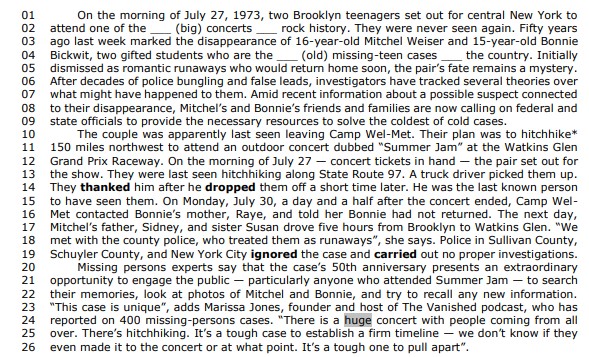
Two Teens Hitchhiked to a Concert. 50 Years Later, They Haven’t Come Home.
(Available at: https://www.rollingstone.com/culture/culture-features/mitchel-weiser-bonnie-bickwit-missingteens-summer-jam-1234798437/ – text especially adapted for this test).
*Hitchhike (verb): to travel by getting free rides in someone else's vehicle.
(In: www.dictionary.cambridge.org).
Which of the following questions is NOT answered by the text?
Ano: 2023
Banca:
FUNDATEC
Órgão:
Prefeitura de Tapejara - RS
Prova:
FUNDATEC - 2023 - Prefeitura de Tapejara - RS - Professor Municipal de Língua Inglesa |
Q2284300
Inglês
Texto associado
Two Teens Hitchhiked to a Concert. 50 Years Later, They Haven’t Come Home.
(Available at: https://www.rollingstone.com/culture/culture-features/mitchel-weiser-bonnie-bickwit-missingteens-summer-jam-1234798437/ – text especially adapted for this test).
*Hitchhike (verb): to travel by getting free rides in someone else's vehicle.
(In: www.dictionary.cambridge.org).
Analyze the following statements about the text and mark T, if true, or F, if false.
( ) Mitchel and Bonnie traveled to the concert with a friend who had a truck.
( ) The police thought the teenagers had planned not to return home.
( ) Bonnie’s family went out after the couple the day after Camp Wel-Met staff called.
( ) An expert says their case is difficult to solve because it is hard to confirm the order of events.
The correct order of filling the parentheses, from top to bottom, is:
( ) Mitchel and Bonnie traveled to the concert with a friend who had a truck.
( ) The police thought the teenagers had planned not to return home.
( ) Bonnie’s family went out after the couple the day after Camp Wel-Met staff called.
( ) An expert says their case is difficult to solve because it is hard to confirm the order of events.
The correct order of filling the parentheses, from top to bottom, is:
Q2284139
Inglês
Texto associado
The following text is reference to question.
When the Guggenheim Museum Bilbao opened in northern Spain 25 years ago, architect Frank Gehry’s curvy titanium-clad building was
itself as much a part of the attraction for many art lovers as the exhibits inside.
As Spain opens the long-awaited Royal Collections Gallery in Madrid next week, its sleek new eight-story building, perched on an iconic
hillside next to the Royal Palace, may also steal some of the attention from the Old Masters on display. Spanish architects Emilio Tuñon
and Luis Mansilla won the 2017 American Architecture Prize and a dozen other awards for this design, built with white concrete, granite
and oak and featuring hundreds of windows overlooking the leafy gardens below the Royal Palace and the expansive Casa de Campo
park beyond.
Available in: https://edition.cnn.com/2023/06/23/style/madrid-royal-collections-museum/index.html.
Consider the following sentences about the building of the Royal Collections Gallery:
1. It has eight floors.
2. It has won several architecture awards.
3. It has no wood in its construction.
4. It is placed on the top of a hill with a view of the impressive Casa de Campo park.
Mark the correct alternative.
1. It has eight floors.
2. It has won several architecture awards.
3. It has no wood in its construction.
4. It is placed on the top of a hill with a view of the impressive Casa de Campo park.
Mark the correct alternative.
Q2284138
Inglês
Texto associado
The following text is reference to question.
When the Guggenheim Museum Bilbao opened in northern Spain 25 years ago, architect Frank Gehry’s curvy titanium-clad building was
itself as much a part of the attraction for many art lovers as the exhibits inside.
As Spain opens the long-awaited Royal Collections Gallery in Madrid next week, its sleek new eight-story building, perched on an iconic
hillside next to the Royal Palace, may also steal some of the attention from the Old Masters on display. Spanish architects Emilio Tuñon
and Luis Mansilla won the 2017 American Architecture Prize and a dozen other awards for this design, built with white concrete, granite
and oak and featuring hundreds of windows overlooking the leafy gardens below the Royal Palace and the expansive Casa de Campo
park beyond.
Available in: https://edition.cnn.com/2023/06/23/style/madrid-royal-collections-museum/index.html.
According to the text, it is correct to say that the Guggenheim Museum in Bilbao:
Q2284137
Inglês
Consider the following text:
Alexis, 7 years old and in first grade, always got home from school around 2:05 p.m. When she hadn’t arrived by 2:55 on a Friday in May 2002, her mother, Ayanna Patterson, began to worry. At 3, Patterson ran to the school in a panic. “That’s when I found out that my baby never made it,” Patterson told USA TODAY. “She never made it to school.” The story of Alexis’ disappearance started with a massive search for the little girl and sympathy for her family, but that quickly changed as her parents became suspects. Over the years, there have been conspiracy theories and false leads and cases of mistaken identity. Still, her mom has never given up hope that Alexis will come home again someday. In Season 4 of Unsolved, we work to get to the bottom of what really happened to Alexis, what efforts were made to find [...] why so many missing Black kids in America are never found.
Available in: https://www.usatoday.com/in-depth/news/investigations/2023/04/18/unsolved-season.
According to the text, it is correct to say that Alexis:
Alexis, 7 years old and in first grade, always got home from school around 2:05 p.m. When she hadn’t arrived by 2:55 on a Friday in May 2002, her mother, Ayanna Patterson, began to worry. At 3, Patterson ran to the school in a panic. “That’s when I found out that my baby never made it,” Patterson told USA TODAY. “She never made it to school.” The story of Alexis’ disappearance started with a massive search for the little girl and sympathy for her family, but that quickly changed as her parents became suspects. Over the years, there have been conspiracy theories and false leads and cases of mistaken identity. Still, her mom has never given up hope that Alexis will come home again someday. In Season 4 of Unsolved, we work to get to the bottom of what really happened to Alexis, what efforts were made to find [...] why so many missing Black kids in America are never found.
Available in: https://www.usatoday.com/in-depth/news/investigations/2023/04/18/unsolved-season.
According to the text, it is correct to say that Alexis:
Q2284136
Inglês
Consider the following excerpt:
A seventh-grader in Michigan is being heralded a hero after he safely stopped his school bus after the driver passed out.
Available in: pr.org/2023/04/28/1172685391/michigan-school-bus-kid-driver.
According to the excerpt, it is correct to say that a Michigan student stopped the school bus as he noticed that the driver had:
A seventh-grader in Michigan is being heralded a hero after he safely stopped his school bus after the driver passed out.
Available in: pr.org/2023/04/28/1172685391/michigan-school-bus-kid-driver.
According to the excerpt, it is correct to say that a Michigan student stopped the school bus as he noticed that the driver had:
Q2284135
Inglês
Consider the following excerpt:
About 90 percent of species [ ] in the Clarion Clipperton Zone [ ], yet they [ ] at risk from mining for minerals such as cobalt and nickel.
Available in: https://www.nationalgeographic.com/animals/.
Mark the alternative that completes the brackets in the order they appear in the excerpt.
About 90 percent of species [ ] in the Clarion Clipperton Zone [ ], yet they [ ] at risk from mining for minerals such as cobalt and nickel.
Available in: https://www.nationalgeographic.com/animals/.
Mark the alternative that completes the brackets in the order they appear in the excerpt.
Q2284134
Inglês
Texto associado
The following text is reference to question.
The Strange Saga of Jack Teixeira Reveals New Security Challenges
Moments before his arrest by armed FBI agents on Thursday, a helicopter from a local news station caught footage of 21-year-old Jack
Teixeira reading a book on the sun-splashed back porch of his house in North Dighton, Mass. In his front yard, meanwhile, FBI agents in
camouflage tactical gear were climbing out of an armored vehicle, tightening the straps of their bullet-proof vests and gripping long guns.
The dramatic scene playing out in a sleepy, riverside exurb underscored the peculiarity of a case that exposed military documents,
complicated relations with U.S. allies, and triggered national embarrassment. Intelligence leaks of this magnitude in the past have been
the result of an alienated whistle-blower, double agent or successful spy operation. Now arguably the most damaging disclosure of U.S.
government documents in a decade may have stemmed from the hubris of a junior enlisted member in the Massachusetts Air National
Guard who shared them in a small online chat group called Thug Shaker Central.
Available in: https://time.com/6271787/jack-teixeira-arrest-leaks/.
One of the reasons the FBI agents arrested Jack Teixeira was that he:
Q2284133
Inglês
Texto associado
The following text is reference to question.
The Strange Saga of Jack Teixeira Reveals New Security Challenges
Moments before his arrest by armed FBI agents on Thursday, a helicopter from a local news station caught footage of 21-year-old Jack
Teixeira reading a book on the sun-splashed back porch of his house in North Dighton, Mass. In his front yard, meanwhile, FBI agents in
camouflage tactical gear were climbing out of an armored vehicle, tightening the straps of their bullet-proof vests and gripping long guns.
The dramatic scene playing out in a sleepy, riverside exurb underscored the peculiarity of a case that exposed military documents,
complicated relations with U.S. allies, and triggered national embarrassment. Intelligence leaks of this magnitude in the past have been
the result of an alienated whistle-blower, double agent or successful spy operation. Now arguably the most damaging disclosure of U.S.
government documents in a decade may have stemmed from the hubris of a junior enlisted member in the Massachusetts Air National
Guard who shared them in a small online chat group called Thug Shaker Central.
Available in: https://time.com/6271787/jack-teixeira-arrest-leaks/.
According to the text, it is correct to say that Jack Teixeira lives:
Q2284132
Inglês
Texto associado
The following text is reference to question.
The Strange Saga of Jack Teixeira Reveals New Security Challenges
Moments before his arrest by armed FBI agents on Thursday, a helicopter from a local news station caught footage of 21-year-old Jack
Teixeira reading a book on the sun-splashed back porch of his house in North Dighton, Mass. In his front yard, meanwhile, FBI agents in
camouflage tactical gear were climbing out of an armored vehicle, tightening the straps of their bullet-proof vests and gripping long guns.
The dramatic scene playing out in a sleepy, riverside exurb underscored the peculiarity of a case that exposed military documents,
complicated relations with U.S. allies, and triggered national embarrassment. Intelligence leaks of this magnitude in the past have been
the result of an alienated whistle-blower, double agent or successful spy operation. Now arguably the most damaging disclosure of U.S.
government documents in a decade may have stemmed from the hubris of a junior enlisted member in the Massachusetts Air National
Guard who shared them in a small online chat group called Thug Shaker Central.
Available in: https://time.com/6271787/jack-teixeira-arrest-leaks/.
According to the text, it is correct to say that while Teixeira was at home, a local news station was:
Ano: 2023
Banca:
CESPE / CEBRASPE
Órgão:
TBG
Prova:
CESPE / CEBRASPE - 2023 - TBG - Analista Júnior – Ênfase: Jurídico |
Q2281609
Inglês
Texto associado
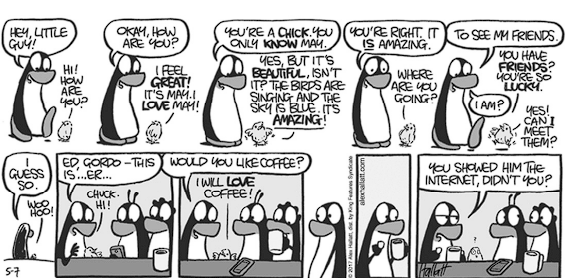
Internet: <alexhallat.com> (adapted).
Judge the following item, according to the preceding comic strip.
The penguin doesn’t seem surprised by the chick’s
affirmation that he is lucky to have friends.

 Conheça nossos planos