Questões de Concurso
Sobre interpretação de texto | reading comprehension em inglês
Foram encontradas 12.687 questões


The intrigue behind the Bermuda Triangle
On a sunny day nearly 80 years ago, five Navy
planes took off from their base in Florida on a _________
training mission, known as Flight 19. Neither the planes nor
the crew were ever seen again. Thus was a legend born. The
Bermuda Triangle is an area roughly bounded by Miami,
Bermuda, and Puerto Rico. No one keeps statistics, but in
the last century, numerous ships and planes have simply
vanished without a trace within the imaginary triangle.
The disappearances have been attributed to the machinations of enormous sea monsters, giant squid, or extra-terrestrials. Alien abductions, the existence of a mysterious third dimension created by unknown beings, and ocean flatulence—the ocean suddenly spewing great quantities of trapped methane—have all been suggested as culprits.
The reality, say many, is far more prosaic. They argue that a sometimes treacherous Mother Nature, human error, shoddy __________________ or design, and just plain bad luck can explain the many disappearances.
"The region is highly traveled and has been a busy crossroads since the early days of European exploration," said John Reilly, a historian with the U.S. Naval Historical Foundation. "To say quite a few ships and airplanes have gone down there is like saying there are an ________ lot of car accidents on the New Jersey Turnpike—surprise, surprise."
(Fonte: National Geographic. — adaptado.)
( ) It is necessary to have lots of special equipment to practice stand-up paddle boarding. ( ) The most expensive equipment item is the board. ( ) The paddle should be taller than you.
The correct order of filling the parentheses, from top to bottom, is:
Assinale a alternativa correta a respeito do texto.
Analise a charge a seguir:
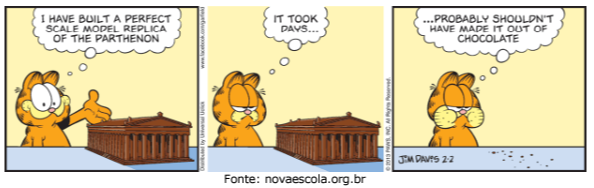
Considerando a situação de comunicação presente na tirinha, assinale a alternativa que indica a
melhor explicação para o emprego do tempo verbal utilizado no primeiro quadrinho.
Register is defined as the way a speaker uses language differently in different circumstances. Think about the words you choose, your tone of voice, even your body language. You probably behave very differently chatting with a friend than you would at a formal dinner party or during a job interview. These variations in formality, also called stylistic variation, are known as registers in linguistics. They are determined by such factors as social occasion, context, purpose, and audience. Registers are marked by a variety of specialized vocabulary and turns of phrases, colloquialisms, the use of jargon, and a difference in intonation and pace.
(Disponível em: www.thoughtco.com/language-variety-sociolinguistics-1691100 – texto adaptado especialmente para esta prova).
The tasks below are adapted versions of the activities, from the textbook, to work with the text. Match Tasks 1 – 6 with their main aim A – I. There are three extra aims which you do not need to use.
Tasks
Task 1 Discuss the questions in small groups.
1 Have you ever been to a job interview? How was the experience? What kind of questions did they ask you? Did you get the job?
2 What kind of questions do you expect to have in a job interview?
3 How can people get better prepared for a job interview?
Task 2 Look at the photo with the article. What do you think is happening? Do you think the question is one that someone might really ask in this situation? Why (not)?
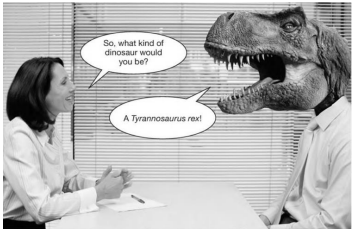
Task 3 Read the article once and find out. How would you answer the question?
Task 4 Look at the highlighted words and phrases in the text. With a partner, try to figure out what they might mean and how you think they are pronounced.
Task 5 Read the article again. Using your own words, answer the questions.
1 What are extreme interviews? 2 What kind of companies first started using them? 3 Why do some people think that they are better than normal interviews?
Task 6 Do you think extreme interviews are a good way of choosing candidates? Which of the questions below (used in real interviews) do you think would work well? Why?
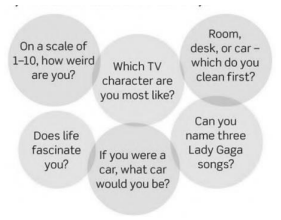
Adapted from: Face2Face Intermediate. Cris Redston and Gillie Cunningham. Cambridge University Press.
Main Aim
A. Integrating skills and personalizing the topic. B. Analyzing text organization. C. Inferring meaning of lexis from context. D. Predicting. E. Teaching grammar inductively using the text. F. Skimming. G. Activating schemata. H. Reading for details. I. Scanning.
Read Text I and answer the question.
Text I
Why We're Obsessed With the Mind-Blowing ChatGPT AI Chatbot
Stephen Shankland
Feb. 19, 2023 5:00 a.m. PT
This artificial intelligence bot can answer questions, write essays, summarize documents and write software. But deep down, it doesn't know what's true.
Even if you aren't into artificial intelligence, it's time to pay attention to ChatGPT, because this one is a big deal.
The tool, from a power player in artificial intelligence called OpenAI, lets you type natural-language prompts. ChatGPT then offers conversational, if somewhat stilted, responses. The bot remembers the thread of your dialogue, using previous questions and answers to inform its next responses. It derives its answers from huge volumes of information on the internet.
ChatGPT is a big deal. The tool seems pretty knowledgeable in areas where there's good training data for it to learn from. It's not omniscient or smart enough to replace all humans yet, but it can be creative, and its answers can sound downright authoritative. A few days after its launch, more than a million people were trying out ChatGPT.
But be careful, OpenAI warns. ChatGPT has all kinds of potential pitfalls, some easy to spot and some more subtle.
“It's a mistake to be relying on it for anything important right now,” OpenAI Chief Executive Sam Altman tweeted. “We have lots of work to do on robustness and truthfulness.” […]
What is ChatGPT?
ChatGPT is an AI chatbot system that OpenAI released in November to show off and test what a very large, powerful AI system can accomplish. You can ask it countless questions and often will get an answer that's useful.
For example, you can ask it encyclopedia questions like, “Explain Newton's laws of motion.” You can tell it, "Write me a poem," and when it does, say, "Now make it more exciting." You ask it to write a computer program that'll show you all the different ways you can arrange the letters of a word.
Here's the catch: ChatGPT doesn't exactly know anything. It's an AI that's trained to recognize patterns in vast swaths of text harvested from the internet, then further trained with human assistance to deliver more useful, better dialog. The answers you get may sound plausible and even authoritative, but they might well be entirely wrong, as OpenAI warns.
Adapted from: https://www.cnet.com/tech/computing/why-were-all-obsessedwith-the-mind-blowing-chatgpt-ai-chatbot/
Read Text I and answer the question.
Text I
Why We're Obsessed With the Mind-Blowing ChatGPT AI Chatbot
Stephen Shankland
Feb. 19, 2023 5:00 a.m. PT
This artificial intelligence bot can answer questions, write essays, summarize documents and write software. But deep down, it doesn't know what's true.
Even if you aren't into artificial intelligence, it's time to pay attention to ChatGPT, because this one is a big deal.
The tool, from a power player in artificial intelligence called OpenAI, lets you type natural-language prompts. ChatGPT then offers conversational, if somewhat stilted, responses. The bot remembers the thread of your dialogue, using previous questions and answers to inform its next responses. It derives its answers from huge volumes of information on the internet.
ChatGPT is a big deal. The tool seems pretty knowledgeable in areas where there's good training data for it to learn from. It's not omniscient or smart enough to replace all humans yet, but it can be creative, and its answers can sound downright authoritative. A few days after its launch, more than a million people were trying out ChatGPT.
But be careful, OpenAI warns. ChatGPT has all kinds of potential pitfalls, some easy to spot and some more subtle.
“It's a mistake to be relying on it for anything important right now,” OpenAI Chief Executive Sam Altman tweeted. “We have lots of work to do on robustness and truthfulness.” […]
What is ChatGPT?
ChatGPT is an AI chatbot system that OpenAI released in November to show off and test what a very large, powerful AI system can accomplish. You can ask it countless questions and often will get an answer that's useful.
For example, you can ask it encyclopedia questions like, “Explain Newton's laws of motion.” You can tell it, "Write me a poem," and when it does, say, "Now make it more exciting." You ask it to write a computer program that'll show you all the different ways you can arrange the letters of a word.
Here's the catch: ChatGPT doesn't exactly know anything. It's an AI that's trained to recognize patterns in vast swaths of text harvested from the internet, then further trained with human assistance to deliver more useful, better dialog. The answers you get may sound plausible and even authoritative, but they might well be entirely wrong, as OpenAI warns.
Adapted from: https://www.cnet.com/tech/computing/why-were-all-obsessedwith-the-mind-blowing-chatgpt-ai-chatbot/
Read Text I and answer the question.
Text I
Why We're Obsessed With the Mind-Blowing ChatGPT AI Chatbot
Stephen Shankland
Feb. 19, 2023 5:00 a.m. PT
This artificial intelligence bot can answer questions, write essays, summarize documents and write software. But deep down, it doesn't know what's true.
Even if you aren't into artificial intelligence, it's time to pay attention to ChatGPT, because this one is a big deal.
The tool, from a power player in artificial intelligence called OpenAI, lets you type natural-language prompts. ChatGPT then offers conversational, if somewhat stilted, responses. The bot remembers the thread of your dialogue, using previous questions and answers to inform its next responses. It derives its answers from huge volumes of information on the internet.
ChatGPT is a big deal. The tool seems pretty knowledgeable in areas where there's good training data for it to learn from. It's not omniscient or smart enough to replace all humans yet, but it can be creative, and its answers can sound downright authoritative. A few days after its launch, more than a million people were trying out ChatGPT.
But be careful, OpenAI warns. ChatGPT has all kinds of potential pitfalls, some easy to spot and some more subtle.
“It's a mistake to be relying on it for anything important right now,” OpenAI Chief Executive Sam Altman tweeted. “We have lots of work to do on robustness and truthfulness.” […]
What is ChatGPT?
ChatGPT is an AI chatbot system that OpenAI released in November to show off and test what a very large, powerful AI system can accomplish. You can ask it countless questions and often will get an answer that's useful.
For example, you can ask it encyclopedia questions like, “Explain Newton's laws of motion.” You can tell it, "Write me a poem," and when it does, say, "Now make it more exciting." You ask it to write a computer program that'll show you all the different ways you can arrange the letters of a word.
Here's the catch: ChatGPT doesn't exactly know anything. It's an AI that's trained to recognize patterns in vast swaths of text harvested from the internet, then further trained with human assistance to deliver more useful, better dialog. The answers you get may sound plausible and even authoritative, but they might well be entirely wrong, as OpenAI warns.
Adapted from: https://www.cnet.com/tech/computing/why-were-all-obsessedwith-the-mind-blowing-chatgpt-ai-chatbot/
Based on Text I, mark the statements below as true (T) or false (F).
( ) The author thinks that this artificial intelligence bot launched in November should not be overlooked.
( ) ChatGPT is able to keep up with conversation sequences.
( ) According to OpenAI, the bot is fully trustworthy.
The statements are, respectively,
You wake up one morning to find that your neighborhood has experienced a power outage. As a result, you are unable to use any electronic devices. You decide to write a piece of text that vividly captures the emotions and events of this experience, using literary techniques to engage the reader.
What genre of creative writing would be most suitable for expressing your experience of the power outage in a captivating and imaginative way?
"The speaker's use of rhetorical questions effectively engages the audience and prompts them to reflect on their own beliefs."
Which of the following aspects of discourse is exemplified in the sentence?
"Not only did he complete the marathon, but he also set a new record."
Select the correct alternative:
"Her determination made her unconquerable in the face of adversity."
Select the correct alternative:

 Conheça nossos planos