Questões de Concurso
Sobre interpretação de texto | reading comprehension em inglês
Foram encontradas 12.687 questões


Ano: 2024
Banca:
IGEDUC
Órgão:
Prefeitura de Salgueiro - PE
Prova:
IGEDUC - 2024 - Prefeitura de Salgueiro - PE - Professor Quilombola EF - Português/Inglês |
Q2574474
Inglês
Julgue o item a seguir.
When we write a text where the messages have an isolated meaning, and we carry out the incorrect ordering, our understanding of the text's meaning is not affected.
When we write a text where the messages have an isolated meaning, and we carry out the incorrect ordering, our understanding of the text's meaning is not affected.
Ano: 2024
Banca:
IGEDUC
Órgão:
Prefeitura de Salgueiro - PE
Prova:
IGEDUC - 2024 - Prefeitura de Salgueiro - PE - Professor Quilombola EF - Português/Inglês |
Q2574469
Inglês
Julgue o item a seguir.
Ao realizar a leitura de um texto desenvolvendo a técnica de Inglês Instrumental, podemos fazer uso das seguintes estratégias de leitura: antecipação, previsão, inferência, skimming e skanning.
Ao realizar a leitura de um texto desenvolvendo a técnica de Inglês Instrumental, podemos fazer uso das seguintes estratégias de leitura: antecipação, previsão, inferência, skimming e skanning.
Ano: 2024
Banca:
IGEDUC
Órgão:
Prefeitura de Salgueiro - PE
Prova:
IGEDUC - 2024 - Prefeitura de Salgueiro - PE - Professor Quilombola EF - Português/Inglês |
Q2574468
Inglês
Julgue o item a seguir.
Historical Fiction is a literary subgenre that takes place in the past, with all elements of the story following the norms of the time. Often the setting is real, but the characters are not.
Historical Fiction is a literary subgenre that takes place in the past, with all elements of the story following the norms of the time. Often the setting is real, but the characters are not.
Ano: 2024
Banca:
IGEDUC
Órgão:
Prefeitura de Salgueiro - PE
Prova:
IGEDUC - 2024 - Prefeitura de Salgueiro - PE - Professor Quilombola EF - Português/Inglês |
Q2574465
Inglês
Julgue o item a seguir.
A elipse é um mecanismo de coesão que consiste em coisas que não têm significado sozinhas. Esse mecanismo remete ou faz referência a outros itens do discurso.
A elipse é um mecanismo de coesão que consiste em coisas que não têm significado sozinhas. Esse mecanismo remete ou faz referência a outros itens do discurso.
Ano: 2024
Banca:
IGEDUC
Órgão:
Prefeitura de Salgueiro - PE
Prova:
IGEDUC - 2024 - Prefeitura de Salgueiro - PE - Professor Quilombola EF - Português/Inglês |
Q2574463
Inglês
Julgue o item a seguir.
Ao lermos um texto seguindo os princípios da psicolinguística da compensação, podemos superar lacunas em uma fonte de conhecimento usando conhecimentos de outro domínio. Por exemplo, se não conhecermos o significado de uma palavra, nosso entendimento prévio sobre o assunto do texto pode nos ajudar a deduzir o significado do termo desconhecido.
Ao lermos um texto seguindo os princípios da psicolinguística da compensação, podemos superar lacunas em uma fonte de conhecimento usando conhecimentos de outro domínio. Por exemplo, se não conhecermos o significado de uma palavra, nosso entendimento prévio sobre o assunto do texto pode nos ajudar a deduzir o significado do termo desconhecido.
Ano: 2024
Banca:
COSEAC
Órgão:
Prefeitura de Maricá - RJ
Prova:
COSEAC - 2024 - Prefeitura de Maricá - RJ - Docente I – Língua Estrangeira – Inglês |
Q2574153
Inglês
Texto associado
Question relate to teaching skills
and abilities:
In the same book, bell hooks (2003, p. 11)
states that “Teaching is a performative act”.
This means that teachers:
Ano: 2024
Banca:
COSEAC
Órgão:
Prefeitura de Maricá - RJ
Prova:
COSEAC - 2024 - Prefeitura de Maricá - RJ - Docente I – Língua Estrangeira – Inglês |
Q2574152
Inglês
Texto associado
Question relate to teaching skills
and abilities:
In the introduction of the book “Teaching
to Transgress: education as the practice of
freedom”, bell hooks (2003) shares her
experience as a student in “all-black grade
schools” and “desegregated, white schools”
and then at undergraduate and graduate
schools in the U.S. How were these
experiences different?
Ano: 2024
Banca:
COSEAC
Órgão:
Prefeitura de Maricá - RJ
Prova:
COSEAC - 2024 - Prefeitura de Maricá - RJ - Docente I – Língua Estrangeira – Inglês |
Q2574151
Inglês
Texto associado
Question relate to teaching skills
and abilities:
In the chapter “Da aplicação de
Linguística à Linguística Aplicada Indisciplinar”,
Moita Lopes (2009) proposes the term
“Linguística Aplicada Indisciplinar” as an area of
study that:
Ano: 2024
Banca:
COSEAC
Órgão:
Prefeitura de Maricá - RJ
Prova:
COSEAC - 2024 - Prefeitura de Maricá - RJ - Docente I – Língua Estrangeira – Inglês |
Q2574150
Inglês
Texto associado
Question relate to teaching skills
and abilities:
Orlando and Ferreira (2013) discuss the
contributions of new literacies and
multiliteracies studies to teacher education
regarding identity issues. The authors, based
on New Literacies theory, defend that the role
of the language teacher in contemporary
society is to:
Ano: 2024
Banca:
COSEAC
Órgão:
Prefeitura de Maricá - RJ
Prova:
COSEAC - 2024 - Prefeitura de Maricá - RJ - Docente I – Língua Estrangeira – Inglês |
Q2574149
Inglês
Texto associado
Question relate to teaching skills
and abilities:
According to Motta-Roth (2006) the
concept of genre has been a common reference
in official documents for education, especially in
relation to the PCNs of Foreign Languages, Arts
and Computing. However, she states that there
is a “fluctuation in the concept of genre in these
references” (p. 498). Within these concepts, the
one(s) that she considers the most appropriate
is/are:
Ano: 2024
Banca:
COSEAC
Órgão:
Prefeitura de Maricá - RJ
Prova:
COSEAC - 2024 - Prefeitura de Maricá - RJ - Docente I – Língua Estrangeira – Inglês |
Q2574148
Inglês
Texto associado
Question relate to teaching skills
and abilities:
Baladeli and Ferreira (2012) defend that
due to the increasingly use of web 2.0
technologies in contemporary society, new
digital literacies need to be approached in both
pre-service and in-service teacher education.
The concept of digital literacy can be defined as:
Ano: 2024
Banca:
COSEAC
Órgão:
Prefeitura de Maricá - RJ
Prova:
COSEAC - 2024 - Prefeitura de Maricá - RJ - Docente I – Língua Estrangeira – Inglês |
Q2574147
Inglês
Texto associado
Question relate to teaching skills
and abilities:
The Pedagogy of Multiliteracies is
presented by the New London Group as this
attempt to broaden the traditional concept of
literacy practices due to the constant changes
in contemporary societies and the need to
incorporate new literacy practices. This
pedagogy includes four components that are
related in complex ways. The components
described by the authors are:
Ano: 2024
Banca:
COSEAC
Órgão:
Prefeitura de Maricá - RJ
Prova:
COSEAC - 2024 - Prefeitura de Maricá - RJ - Docente I – Língua Estrangeira – Inglês |
Q2574146
Inglês
Texto associado
Question relate to teaching skills
and abilities:
Cope & Kalantzis (2000) present the
discussions made by the New London Group in
1996, when different educators met to discuss
traditional literacy pedagogy and the need of
new literacy practices in contemporary society.
They assert that they “attempt to broad this
understanding of literacy and literacy teaching
and learning to include negotiating a multiplicity
of discourses” (p. 9). Within this perspective, the
two principal aspects of this multiplicity of
discourses include:
Ano: 2024
Banca:
COSEAC
Órgão:
Prefeitura de Maricá - RJ
Prova:
COSEAC - 2024 - Prefeitura de Maricá - RJ - Docente I – Língua Estrangeira – Inglês |
Q2574145
Inglês
Texto associado
Question relate to teaching skills
and abilities:
Scrivener (2011) presents alternative
ways to teach grammar opposed to the
traditional “present-practice” structure lesson
shape. One of these ways is Task-Based
Learning, which comprises the following
procedures:
Ano: 2024
Banca:
COSEAC
Órgão:
Prefeitura de Maricá - RJ
Prova:
COSEAC - 2024 - Prefeitura de Maricá - RJ - Docente I – Língua Estrangeira – Inglês |
Q2574144
Inglês
Texto associado
Question relate to teaching skills
and abilities:
Harmer (2015) suggests a basic
procedure for teaching receptive skills that
involves two types of tasks:
I (1) Lead in; (2) T directs comprehension task; (3) SS read/listen for task; (4) T directs feedback; (5) T directs text-related texts.
II (1) Lead in; (2) T directs comprehension task; (3) SS read/listen for task; (4) T directs feedback; (5) T directs comprehension task; (6) SS read/listen for task; (7) T directs feedback; (8) T directs text-related texts.
Looking at I and II, the most appropriate conclusion is that:
I (1) Lead in; (2) T directs comprehension task; (3) SS read/listen for task; (4) T directs feedback; (5) T directs text-related texts.
II (1) Lead in; (2) T directs comprehension task; (3) SS read/listen for task; (4) T directs feedback; (5) T directs comprehension task; (6) SS read/listen for task; (7) T directs feedback; (8) T directs text-related texts.
Looking at I and II, the most appropriate conclusion is that:
Ano: 2024
Banca:
COSEAC
Órgão:
Prefeitura de Maricá - RJ
Prova:
COSEAC - 2024 - Prefeitura de Maricá - RJ - Docente I – Língua Estrangeira – Inglês |
Q2574143
Inglês
Texto associado
Answer question according to
TEXT 4 below.
TEXT 4
The Future of Education: How Artificial
Intelligence is Transforming Learning
Education is a fundamental pillar in society.
Throughout history, education has been the
means through which future generations
acquire knowledge and skills to thrive in an
ever-evolving world. However, the world is
changing at a dizzying pace, and education
must also adapt. Artificial intelligence (AI) has
become one of the most powerful tools in
shaping the future of education. In the
educational context, this means that machines
can assist students in learning in a way more
efficiently and personally. Let's explore how AI
is transforming education and what role it plays
in shaping the classroom of the future.
1 – Adapting Education to Individual Needs:
Every student is unique, with different learning
paces and comprehension styles. One of the
main advantages of AI in education is its ability
to offer personalized learning.
2 – Personalized Educational Content: AI
does not only personalize the way content is
presented, but also the content itself. It can
generate learning materials based on each
student's specific needs and interests.
3 – Prognostics: AI can analyze vast amounts
of educational data to identify trends and
patterns. This is especially useful for school
administrators and teachers to make decisions
and plan future action.
4 – Access to Education: AI-based education
is not limited by geographical or temporal
constraints. This is particularly important for
those who have difficulty attending in-person
classes due to geographical barriers or work
commitments.
5 – Development of 21st Century Skills:
Education is not only about acquiring
knowledge but also about developing skills. AI
helps students develop 21st-century skills such
as critical thinking, problem-solving, and
effective communication.
6 – Identification and Support for Diverse
Learning: Every student is different, and some
may have special needs. AI can identify students who need additional support and
provide specific resources for their needs.
Conclusion
Taking all the above into account, the
advantages that AI offers are irrefutable, and, in
the area of education, it is no exception.
However, despite all the potential benefits, the
implementation of AI in education also raises
challenges and ethical issues. US Government
entities have proposed the parameters that
educational entities must comply with, if they
want to make use of AI. These regulations focus
on privacy, equity and transparency, in order to
protect the rights of students and also
guarantee access to these innovations.
Avaliable at LINKEDIN, published at Oct 27, 2023, in
https://www.linkedin.com/pulse/future-education-how-artificialintelligence-transforming-alyre. Access on: Mar. 21st, 2024.
Adapted.
In the introductory paragraph of text 4, the
noun phrase “a dizzying pace” is a metaphoric
expression which implies that:
Ano: 2024
Banca:
COSEAC
Órgão:
Prefeitura de Maricá - RJ
Prova:
COSEAC - 2024 - Prefeitura de Maricá - RJ - Docente I – Língua Estrangeira – Inglês |
Q2574142
Inglês
Texto associado
Answer question according to
TEXT 4 below.
TEXT 4
The Future of Education: How Artificial
Intelligence is Transforming Learning
Education is a fundamental pillar in society.
Throughout history, education has been the
means through which future generations
acquire knowledge and skills to thrive in an
ever-evolving world. However, the world is
changing at a dizzying pace, and education
must also adapt. Artificial intelligence (AI) has
become one of the most powerful tools in
shaping the future of education. In the
educational context, this means that machines
can assist students in learning in a way more
efficiently and personally. Let's explore how AI
is transforming education and what role it plays
in shaping the classroom of the future.
1 – Adapting Education to Individual Needs:
Every student is unique, with different learning
paces and comprehension styles. One of the
main advantages of AI in education is its ability
to offer personalized learning.
2 – Personalized Educational Content: AI
does not only personalize the way content is
presented, but also the content itself. It can
generate learning materials based on each
student's specific needs and interests.
3 – Prognostics: AI can analyze vast amounts
of educational data to identify trends and
patterns. This is especially useful for school
administrators and teachers to make decisions
and plan future action.
4 – Access to Education: AI-based education
is not limited by geographical or temporal
constraints. This is particularly important for
those who have difficulty attending in-person
classes due to geographical barriers or work
commitments.
5 – Development of 21st Century Skills:
Education is not only about acquiring
knowledge but also about developing skills. AI
helps students develop 21st-century skills such
as critical thinking, problem-solving, and
effective communication.
6 – Identification and Support for Diverse
Learning: Every student is different, and some
may have special needs. AI can identify students who need additional support and
provide specific resources for their needs.
Conclusion
Taking all the above into account, the
advantages that AI offers are irrefutable, and, in
the area of education, it is no exception.
However, despite all the potential benefits, the
implementation of AI in education also raises
challenges and ethical issues. US Government
entities have proposed the parameters that
educational entities must comply with, if they
want to make use of AI. These regulations focus
on privacy, equity and transparency, in order to
protect the rights of students and also
guarantee access to these innovations.
Avaliable at LINKEDIN, published at Oct 27, 2023, in
https://www.linkedin.com/pulse/future-education-how-artificialintelligence-transforming-alyre. Access on: Mar. 21st, 2024.
Adapted.
In the conclusive paragraph of text 4, the
connectors “however” and “despite” are used to
establish a contrast between the benefits of AI
in education and
Ano: 2024
Banca:
COSEAC
Órgão:
Prefeitura de Maricá - RJ
Prova:
COSEAC - 2024 - Prefeitura de Maricá - RJ - Docente I – Língua Estrangeira – Inglês |
Q2574141
Inglês
Texto associado
Answer question according to
TEXT 4 below.
TEXT 4
The Future of Education: How Artificial
Intelligence is Transforming Learning
Education is a fundamental pillar in society.
Throughout history, education has been the
means through which future generations
acquire knowledge and skills to thrive in an
ever-evolving world. However, the world is
changing at a dizzying pace, and education
must also adapt. Artificial intelligence (AI) has
become one of the most powerful tools in
shaping the future of education. In the
educational context, this means that machines
can assist students in learning in a way more
efficiently and personally. Let's explore how AI
is transforming education and what role it plays
in shaping the classroom of the future.
1 – Adapting Education to Individual Needs:
Every student is unique, with different learning
paces and comprehension styles. One of the
main advantages of AI in education is its ability
to offer personalized learning.
2 – Personalized Educational Content: AI
does not only personalize the way content is
presented, but also the content itself. It can
generate learning materials based on each
student's specific needs and interests.
3 – Prognostics: AI can analyze vast amounts
of educational data to identify trends and
patterns. This is especially useful for school
administrators and teachers to make decisions
and plan future action.
4 – Access to Education: AI-based education
is not limited by geographical or temporal
constraints. This is particularly important for
those who have difficulty attending in-person
classes due to geographical barriers or work
commitments.
5 – Development of 21st Century Skills:
Education is not only about acquiring
knowledge but also about developing skills. AI
helps students develop 21st-century skills such
as critical thinking, problem-solving, and
effective communication.
6 – Identification and Support for Diverse
Learning: Every student is different, and some
may have special needs. AI can identify students who need additional support and
provide specific resources for their needs.
Conclusion
Taking all the above into account, the
advantages that AI offers are irrefutable, and, in
the area of education, it is no exception.
However, despite all the potential benefits, the
implementation of AI in education also raises
challenges and ethical issues. US Government
entities have proposed the parameters that
educational entities must comply with, if they
want to make use of AI. These regulations focus
on privacy, equity and transparency, in order to
protect the rights of students and also
guarantee access to these innovations.
Avaliable at LINKEDIN, published at Oct 27, 2023, in
https://www.linkedin.com/pulse/future-education-how-artificialintelligence-transforming-alyre. Access on: Mar. 21st, 2024.
Adapted.
A tabela a seguir apresenta uma lista das implicações mais práticas de cada um dos seis itens discutidos no texto 4.
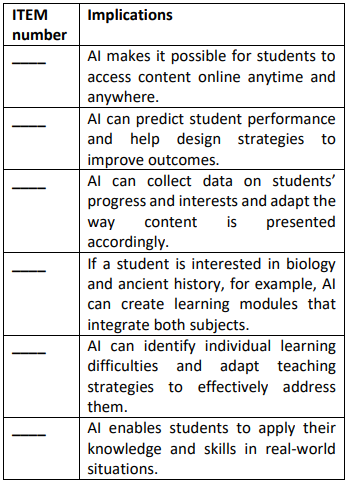
Indique o número do item (de 1 a 6) a que cada implicação se refere e, abaixo, marque a alternativa que contém os itens que você indicou, na ordem em que aparecem na tabela.
Indique o número do item (de 1 a 6) a que cada implicação se refere e, abaixo, marque a alternativa que contém os itens que você indicou, na ordem em que aparecem na tabela.
Ano: 2024
Banca:
COSEAC
Órgão:
Prefeitura de Maricá - RJ
Prova:
COSEAC - 2024 - Prefeitura de Maricá - RJ - Docente I – Língua Estrangeira – Inglês |
Q2574140
Inglês
Texto associado
Answer question according to
TEXT 4 below.
TEXT 4
The Future of Education: How Artificial
Intelligence is Transforming Learning
Education is a fundamental pillar in society.
Throughout history, education has been the
means through which future generations
acquire knowledge and skills to thrive in an
ever-evolving world. However, the world is
changing at a dizzying pace, and education
must also adapt. Artificial intelligence (AI) has
become one of the most powerful tools in
shaping the future of education. In the
educational context, this means that machines
can assist students in learning in a way more
efficiently and personally. Let's explore how AI
is transforming education and what role it plays
in shaping the classroom of the future.
1 – Adapting Education to Individual Needs:
Every student is unique, with different learning
paces and comprehension styles. One of the
main advantages of AI in education is its ability
to offer personalized learning.
2 – Personalized Educational Content: AI
does not only personalize the way content is
presented, but also the content itself. It can
generate learning materials based on each
student's specific needs and interests.
3 – Prognostics: AI can analyze vast amounts
of educational data to identify trends and
patterns. This is especially useful for school
administrators and teachers to make decisions
and plan future action.
4 – Access to Education: AI-based education
is not limited by geographical or temporal
constraints. This is particularly important for
those who have difficulty attending in-person
classes due to geographical barriers or work
commitments.
5 – Development of 21st Century Skills:
Education is not only about acquiring
knowledge but also about developing skills. AI
helps students develop 21st-century skills such
as critical thinking, problem-solving, and
effective communication.
6 – Identification and Support for Diverse
Learning: Every student is different, and some
may have special needs. AI can identify students who need additional support and
provide specific resources for their needs.
Conclusion
Taking all the above into account, the
advantages that AI offers are irrefutable, and, in
the area of education, it is no exception.
However, despite all the potential benefits, the
implementation of AI in education also raises
challenges and ethical issues. US Government
entities have proposed the parameters that
educational entities must comply with, if they
want to make use of AI. These regulations focus
on privacy, equity and transparency, in order to
protect the rights of students and also
guarantee access to these innovations.
Avaliable at LINKEDIN, published at Oct 27, 2023, in
https://www.linkedin.com/pulse/future-education-how-artificialintelligence-transforming-alyre. Access on: Mar. 21st, 2024.
Adapted.
The items 1 to 6, presented in text 4,
represent:
Ano: 2024
Banca:
COSEAC
Órgão:
Prefeitura de Maricá - RJ
Prova:
COSEAC - 2024 - Prefeitura de Maricá - RJ - Docente I – Língua Estrangeira – Inglês |
Q2574139
Inglês
Texto associado
Answer question according to
TEXT 4 below.
TEXT 4
The Future of Education: How Artificial
Intelligence is Transforming Learning
Education is a fundamental pillar in society.
Throughout history, education has been the
means through which future generations
acquire knowledge and skills to thrive in an
ever-evolving world. However, the world is
changing at a dizzying pace, and education
must also adapt. Artificial intelligence (AI) has
become one of the most powerful tools in
shaping the future of education. In the
educational context, this means that machines
can assist students in learning in a way more
efficiently and personally. Let's explore how AI
is transforming education and what role it plays
in shaping the classroom of the future.
1 – Adapting Education to Individual Needs:
Every student is unique, with different learning
paces and comprehension styles. One of the
main advantages of AI in education is its ability
to offer personalized learning.
2 – Personalized Educational Content: AI
does not only personalize the way content is
presented, but also the content itself. It can
generate learning materials based on each
student's specific needs and interests.
3 – Prognostics: AI can analyze vast amounts
of educational data to identify trends and
patterns. This is especially useful for school
administrators and teachers to make decisions
and plan future action.
4 – Access to Education: AI-based education
is not limited by geographical or temporal
constraints. This is particularly important for
those who have difficulty attending in-person
classes due to geographical barriers or work
commitments.
5 – Development of 21st Century Skills:
Education is not only about acquiring
knowledge but also about developing skills. AI
helps students develop 21st-century skills such
as critical thinking, problem-solving, and
effective communication.
6 – Identification and Support for Diverse
Learning: Every student is different, and some
may have special needs. AI can identify students who need additional support and
provide specific resources for their needs.
Conclusion
Taking all the above into account, the
advantages that AI offers are irrefutable, and, in
the area of education, it is no exception.
However, despite all the potential benefits, the
implementation of AI in education also raises
challenges and ethical issues. US Government
entities have proposed the parameters that
educational entities must comply with, if they
want to make use of AI. These regulations focus
on privacy, equity and transparency, in order to
protect the rights of students and also
guarantee access to these innovations.
Avaliable at LINKEDIN, published at Oct 27, 2023, in
https://www.linkedin.com/pulse/future-education-how-artificialintelligence-transforming-alyre. Access on: Mar. 21st, 2024.
Adapted.
The aim of text 4 is indicated in the
following sentence, taken from the introductory
paragraph:

 Conheça nossos planos