Questões de Concurso Comentadas sobre formação de palavras (prefixos e sufixos) | word formation (prefix and suffix) em inglês

Foram encontradas 253 questões

Q3378329 Inglês
TEXT 1


World Cup 2022: why is Qatar a controversial location for the tournament? Nov 29, 2022 (Reuters)


The decision to award Qatar hosting rights for the 2022 World Cup has been marred by controversy around issues such as local climate conditions, human rights violations, and, in particular, the welfare of migrant workers, since it was first announced 12 years ago.


Local climate conditions and FIFA’s calendar

FIFA awarded the 2022 tournament to the Middle Eastern country in 2010, with the understanding it would be held during the summer, where temperatures exceed 40 degrees.


In 2015, FIFA recommended that Qatar host a shorter World Cup over the cooler months of November and December in a move that was sure to put soccer's world governing body on a collision course with the major European leagues. The big European leagues would prefer an AprilMay option to minimise disruption to their lucrative domestic seasons. But this latter alternative did not prevail and the schedule change to the northern hemisphere winter marked the first time that the World Cup moved from its regular slot of June and July when Europe's domestic leagues have concluded their seasons.


Welfare of migrant workers

Britain’s 7newspaper reported that at least 6,500 migrant workers – many of them working on World Cup projects – had died in Qatar since it won the right in 2010 to stage the World Cup. The International Labour Organization has questioned that number, which it said included all deaths in the overall migrant population, which consists of 2, 9 million people. Qatari World Cup organisers have said that there have been three work-related fatalities and 34 non-work-related deaths among workers at World Cup 2022 sites.

Amnesty International and other rights groups have led calls for FIFA to compensate migrant workers in Qatar for human rights abuses by setting aside $440 million, matching the World Cup prize money. They believe that their fight for compensation may make up for the abuse suffered by migrant workers.

Apart from the schedule change and the welfare of migrant workers, violation in women's and LGBT’s rights, as well as the strict control on alcohol were other issues which nurtured the controversy around the 2022 Word Cup in Qatar.


Available at : https://www.reuters.com/lifestyle/sports/world-cup-2022-why-is-qatar-controversial-location-fifa-tournament. Access: 03 Dec. 2022. Adapted.
The suffix “er” in the word “cooler”, used in the text, has the same grammatical meaning as used in the word: 
Alternativas
Q2645231 Inglês

In the sequence, the terms unkind, misuse, helpful and fearless are:

Alternativas
Q2379807 Inglês
Two roads diverged in a yellow wood, And sorry I could not travel both', identify which word contains a prefix and what that prefix is.
Alternativas
Q2379805 Inglês
In English, prefixes and suffixes are essential for changing the meaning of words and adapting them to different contexts. Understanding their functions is crucial for effective communication. Identify the correct prefix that turns the word "agree" into its opposite meaning.
Alternativas
Q2346533 Inglês
In the story, the main character discovers an underground city that nobody knows about, leading them on a thrilling adventure. Which word below has a prefix that means "under"? 
Alternativas
Q2346523 Inglês
In a science fiction movie, alien creatures with the ability to become invisible are called "invisoids." Based on this word, what is the most likely meaning of the prefix "in-" and the suffix "-oid"? Choose the correct option.
Alternativas
Q2346518 Inglês
'Reserving judgments is a matter of infinite hope. I am still a little afraid of missing something if I forget that, as my father snobbishly suggested, and I snobbishly repeat, a sense of the fundamental decencies is parcelled out unequally at birth.'. 

Identify the words that contain a prefix and suffix respectively.
Alternativas
Q2335660 Inglês
TEXT:


How do people overcome fossilization and achieve nativelike fluency in second language acquisition?

There are a lot of common misconceptions about fossilization and language development. It's impossible to correct all of them in a post here, but I'll address a few that have been mentioned below.

Fossilization is a stage at which a second language speaker seems to cease making progress toward becoming more targetlike in his or her use of the language, so a "learning plateau" is a reasonable analogy. The comparison wherein "the L2 learner has his own linguistic system" that's still influenced by L1 and other things is known as the "interlanguage." The question researchers cannot conclusively answer is whether or not that "plateau" is reversible after a certain point, be it age, fluency level, etc., in order to start making progress again.

Different people are motivated by different things, which range from need (to pass a test, to get a job, to watch movies without subtitles, to make friends, etc.) to learning style (preferring to study from texts, liking/disliking impromptu, small-talk with people just to practice, preference for/against learning formal rules, and aptitude). It is easy to remember verb conjugations. There is no single formula.

Finding someone who can correct your errors tactfully and effectively most certainly does not need to be demotivating, depressing or draining whatsoever. I'm a very fluent non-native speaker of Spanish, and I actively request that my native speaker (NS) friends correct me when I make a mistake, or use a phrase that sounds funny in their dialect, etc. How else will I learn? It's fascinating to learn little details like that now after so many years. As long as they don't do it in a mocking or condescending way, or at a socially inappropriate time, why wouldn't I want their help? Of course, if you correct a beginner every time they try to utter a sentence, it could be discouraging - and obnoxious - but everything in moderation.

One of the biggest cognitive challenges is whether or not L2 speakers can learn to consciously notice differences between their L2 efforts and the way a NS talks. There are decades of research on this (my own included) and I'll gladly give references if anyone actually cares. Noticing falls into two broad categories. First, the ability to "notice the gap," i.e. hear a NS say a sentence and think, "Hmm, I understand what he meant but I've never heard that word before; it must mean ___" or "I know what he meant but it would not have occurred to me to say it that way; I'll try to remember that for later." The second is the ability to "notice the hole," i.e. when the L2 learner is trying to speak/ write and realizes that his "interlanguage" lacks a word, sound or structure needed to accurately convey his own thought. If he can seek the input necessary to fill the hole, he has a much stronger chance of acquiring it. The thought processes involved during that moment are holding the forms (or lack thereof) in working memory, and the longer it stays there for further processing, the greater the possibility that it is retained in long-term memory for later use. The NS interlocutor can help promote noticing through corrective feedback (also a subject of decades of research, for which I'm also happy to provide resources if anyone is genuinely interested.)

I have been using a variety of strategies for years as a language coach when working with my clients, whether helping IT executives from India and Egypt learn to write more grammatically accurate e-mail or helping priests from Nigeria improve prosodic aspects of their pronunciation (i.e. stress and intonation patterns.) Each person is different. I have found no evidence to support the argument that a person who has fossilized cannot begin to make progress again toward a more target-like L2 use at least in some areas, with the right motivation, input and effort. The question is only about how much progress, in what areas, in how much time, and through what methods.


Adapted form: https://www.quora.com/How-do-people-overcome-fossilization-andachieve-native-like-fluency-in-second-language-acquisition Acesso em 22/09/2023
No trecho “Finding someone who can correct your errors tactfully and effectively…”, o termo em destaque recebeu o sufixo -ING por se tratar de:
Alternativas
Q2297181 Inglês
TEXT:

Mistakes help you learn
Maija Kozlova
May 19, 2021


It is not uncommon for English language lessons to favour communication over accuracy: real life is nothing like a classroom! In real-life situations, when you make a mistake in the language you are learning, context provides ample information as to what the intended message is. In fact, most of the time, impeccable accuracy is not needed at all! “Don’t worry about making mistakes,” I used to tell my English language students. “Communicating is the most important thing!”


While making mistakes when trying to master a language might seem counter-intuitive, letting learners freely communicate and negotiate meaning is key to success. A learner who communicates a lot while making a few mistakes is much more likely to develop confidence for dealing with real-life situations than a learner who communicates very little because they’re afraid of making any. In communicative language teaching, for example, the teacher is tasked with both encouraging the learner to express themselves and with providing corrective feedback in a way that is not obstructive to communication. 


This means that if a learner says, “I go swimming last night,” it is much more effective to respond with, “Oh, that’s nice, you went swimming. What did you do after?” rather than, “No! You went swimming! Use past simple for past events!” – the former encourages the learner to continue their narrative while the latter is much more likely to make the learner stop in their tracks, re-evaluate the context, and think twice before expressing themselves again in the future, for the fear of making a mistake again. Teachers need to be careful not to parrot back everything the students say in this manner, of course, but the technique can be an effective method of acknowledging the content of a student’s response, while also providing feedback on accuracy.


The importance of the freedom to make mistakes in language learning is also supported by research in psychology, which suggests that learners who try a task without having mastered it completely experience improved retention of new information. A similar experiment in the context of language learning also indicates that the process of making mistakes activates a greater network of related knowledge in the brain, which leads to superior learning outcomes.


It is believed that the key to help learners feel relaxed and ready for communicating freely in the classroom is authenticity. This means that there should be both a real communicative need for a learner to speak and the authentic reaction from those around to what the learner has said.


Here are a few ways of how such authentic communicative interactions can be practiced in the classroom: 


• surround learners with the English language – encourage them to speak to you and each other in English;

• don’t worry about diverging from topics that are not strictly covered in your lesson plan;

• model communication by telling your students stories and anecdotes about your own life and encourage them to do the same;

• let your learners have fun with English – give them colloquial expressions to try and ask them to share some expressions

; • do not overcorrect – make a note of errors and cover it in subsequent lessons;

• avoid the temptation to turn what was intended as speaking practice into a full-on grammar lesson.


While easier said than done, especially when the outcome of an exam is at stake, it is worth remembering that people that our learners might come to interact with outside of the classroom are driven by the natural desire to understand the people they communicate with. This is especially powerful when practiced in the context of a classroom. They set the learners up for success in real-life communication. In other words, when communication is the goal, mistakes are secondary, and that’s real life, isn’t it?


Adapted from: https://wwwcambridgeenglish.org/blog/mistakes-help-you-learnfreedom-to-fail-in-games-and-language-learning/
Na frase “It is not uncommon for English language lessons to favour communication over accuracy”, o adjetivo em destaque foi formado pelo acréscimo de prefixo. O adjetivo formado corretamente pelo mesmo prefixo de “uncommon” é:
Alternativas
Ano: 2023 Banca: Quadrix Órgão: CRT-BA Prova: Quadrix - 2023 - CRT-BA - Assistente de T.I. |
Q2276167 Inglês


 Internet: <www.britannica.com> (with adaptations).

Regarding the text and its linguistics aspects, judge the item below.
The adverb “bloodily” (line 18) follows the same spelling rule of the adverbs nicely, simply and easily. 
Alternativas
Q2267388 Inglês
Which word does not have the correct prefix? Choose the INCORRECT answer
Alternativas
Q2238773 Inglês

Observe the morphological process of the formation of the following words:
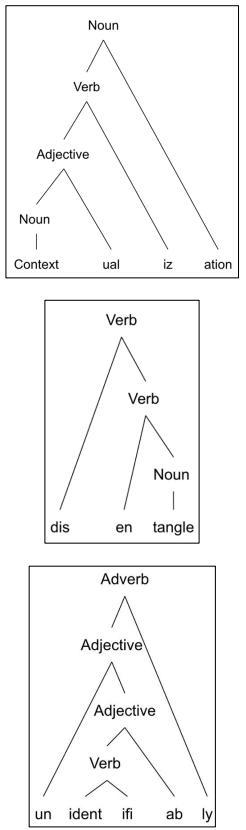

Imagem associada para resolução da questão

Now analyze the following statements.

I. -context- and -tangle- are free roots, while -ident- is a bound root.

II. These three words are formed both by prefixation and suffixation.

III. In the noun, -ual- and -iz- are derivational suffixes, while in the adverb, -ifi- and -ab- are inflectional suffixes.

IV. dis- and en- both have negative meanings.

V. The head of the noun is -ation, the head of the verb is en- and the head of the adverb is -ly.

The correct statements are

Alternativas
Q2184914 Inglês
A questão foi desenvolvida em língua inglesa e/ou língua portuguesa oficial do Brasil. 
Analyze the word suffix ‘Philosopher’. Choose the word with the same suffix function that forms the idea of a profession.
Alternativas
Q2121435 Inglês

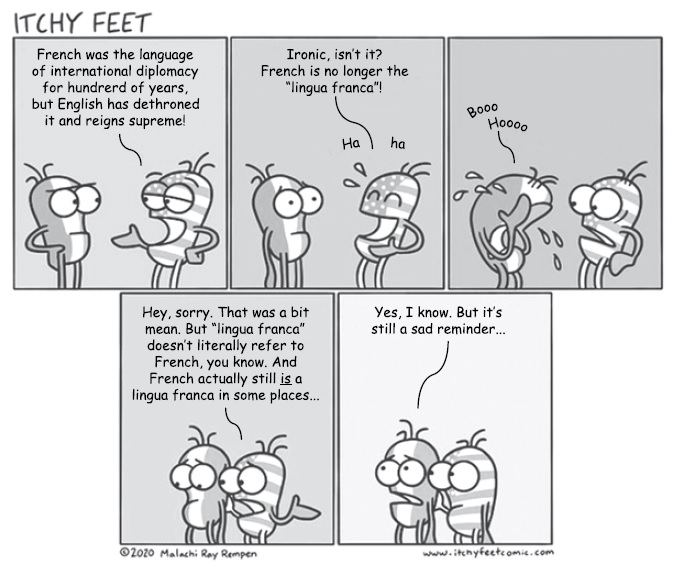
Leia a charge para responder a questão.

(twitter.com. Adaptado)

Assinale a alternativa em que o prefixo de- assume o mesmo sentido que lhe é atribuído em “dethroned”, no primeiro quadrinho.
Alternativas
Q2066018 Inglês
Assinale a alternativa que contém apenas palavras que apresentam sufixo.
Alternativas
Q2064506 Inglês
Leia o excerto: “Nikola Tesla was an engineer and scientist known for designing the alternating-current (AC) electric system”, observe a formação -ING em ‘designing’. Agora assinale a alternativa que a explique corretamente.
Alternativas
Q2064498 Inglês

Leia o texto 1 para responder a questão que se segue.
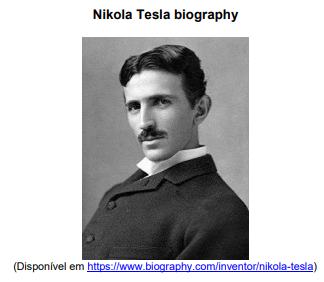


               Nikola Tesla was an engineer and scientist known for designing the alternating-current (AC) electric system, which is the predominant electrical system used across the world today. He also created the "Tesla coil," which is still used in radio technology.

              Born (01) ______ modern day Croatia, Tesla came to the United States in 1884 and briefly worked with Thomas Edison before the two parted ways. He sold several patent rights, including those to his AC machinery, to George Westinghouse.

                   Early Life
                   Tesla was born in Smiljan, Croatia, on July 10, 1856.

                  Tesla was one of five children, including (02) ______ Dane, Angelina, Milka and Marica. Tesla's interest in electrical invention was spurred by his mother, Djuka Mandic, who (03) ______ small household appliances in her spare time while her son was growing up.

Leia o texto e encontre a palavra ‘engineer’, importa destacar que ela é formada por um sufixo -er. Agora assinale a alternativa em que o sufixo -er não tenha a mesma função da palavra em foco.
Alternativas
Q4301860 Inglês
One of the words below has a spelling problem in its prefix. Which one? Choose the INCORRECT answer
Alternativas
Q4240833 Inglês
Considering the morphological process in the English language, choose the alternative that presents an example of a word with affixation.
Alternativas
Q4168106 Inglês

Why women make way less than men do in more religious places


By Stephanie Pappas


   Why is there a persistent wage gap between men and women? Turns out, religion may play a big role in the disparity.


   New research finds that the wage gap is 8 percentage points wider in the five most religious states than in the five most secular, with women making 18% less than men in the least religious states and 26% less in the most religious. What's more, the gender gap is projected to vanish in 28 years in the most secular states, compared with a stunning 109 years in the most religious. "If they're in a religious community, our children are not going to know a world in which they're paid equitably," said Traci Sitzmann, an associate professor of management at the University of Colorado, Denver. "It's a little bit scary." 


Religion and wages


  Sitzmann and her colleague Elizabeth Campbell, an assistant professor of work and organizations at the University of Minnesota, were interested in exploring the impacts of religiosity on workforce issues. They started with a global view. Using data from 140 countries, they compared the likelihood of citizens answering "yes" to the question, "Is religion important in your daily life?" with the gender wage gap in those countries as of 2013, the most recent global data available. They found a striking association: The more religious a country, the greater the wage gap. In nations where more than 95% or more people said religion was important in their daily lives, such as Pakistan and the Philippines, women earned around 46% as much as men.


   In countries where fewer than 20% of people said religion was important to them in daily life, such as Sweden and Estonia, women averaged around 75% of men's wages. The United States had moderately high religiosity and women in the U.S. earned 66 cents for every dollar men earned, Sitzmann told Live Science.


  The effect held true for all major world religions, Sitzmann said. It didn't matter if most believers in a country were Jewish, Christian, Muslim, Buddhist, Hindu or adherants to a folk religion. The wage gap was still greater in countries where religion played a major role in daily life.


   The researchers then turned to Gallup survey data on religious service attendance and the importance of religion in daily life in the 50 U.S. states. In the U.S. data, the researchers looked only at full-time wages so as not to skew the results due to women working fewer hours.


   They again found that the more religious the state, the greater the wage gap. (Mississippi, Alabama, Utah, South Dakota and South Carolina were the most religious states; Vermont, Maine, Massachusetts, Rhode Island and Nevada were the least.) The researchers found that religiosity explained 17% of the variability in the gender wage gap between states. To ensure that the wider economy or levels of conservatism weren’t responsible for the difference, the researchers then looked at year-over-year data between 2008 and 2018 and found that the association between religion and wages still held. The gender gap is shrinking over time in the U.S., they found, but it is shrinking faster in secular states compared with religious ones. At current rates, it will take more than a century for the gap to close in the most religious states.


   According to the workplace data analysis company PayScale, women make 81 cents for every dollar men make as of 2020. This analysis compares median salaries for men and women, and does not control for factors like seniority, years experience and education, all of which can be impacted by gender discrimination and gender role expectations.


The pathway to a wage gap


   Sitzmann and Campbell found three reasons for this difference in wages between secular and religious regions. The more religious a country or state, the more that society differentiated the roles of men and women. In other words, women in more religious societies are expected to put family first. The researchers measured this by looking at how many babies women have, how many women work at all, access to abortion and family-friendly work policies. In more religious societies, women have more children, participate less in the workforce, have less access both to abortion and to policies that help balance work with family. 


  Religious societies are also more likely to sexually objectify women, the researchers found. They measured this by looking at regional Google Trends for the search terms "pornography" and "rape." Both were correlated with religiosity, and both were correlated with the gender wage gap.


   Finally, religious societies are also less likely to promote or accept women in leadership positions. "We've got the Pope saying, 'the door is closed, women are not allowed to be leaders in the church,'" Sitzmann said, referring to Pope Francis' 2013 statement on female priests in the Catholic Church. "That sets the stage for a very strong norm."


   She and Campbell found that in more religious societies, women have less representation in politics and in organizational leadership. They also have lower educational attainment and less legal equality.


Closing the gap


  Finally, the researchers conducted experiments to confirm that it was indeed religion, and not some closely related concept like conservatism, that explained the results. They set up an online game in which 91 participants, about half women and half men, acted as managers who had to allocate wages to employees based on performance reviews. All of the participants saw the same performance reviews, but in some cases the employee was named Patricia Anderson and in others was called Michael Taylor.


   Before seeing the performance reviews, some participants saw a description of the mock company they were working for that described it as faith-based. Others saw a description that focused on the company's dedication to communication and community.


   Those who were primed to believe they were working for a religious company allocated 3% more to the male employee compared with the female employee. In contrast, those who thought the organization was secular allocated 6% more to the female employee.


   But there was a way to reverse the inequality. When the researchers told people in the mock religious company that one of the company values was that women needed to be involved, and that the company had a strict anti-sexual-harassment policy, it wiped out the gender wage gap, according to their research paper published Oct. 27 in the Academy of Management Journal.


   This was a heartening result, Sitzmann said, because it suggests that simply being aware of expectations for gender equality will help make people behave more equitably. 


Adapted from: https://www.livescience.com/religious-states-wider-gender-pay-gap.html

Check the alternative which contains a noun to adjective conversion.
Alternativas
Respostas
181: A
182: C
183: C
184: A
185: D
186: C
187: A
188: A
189: B
190: E
191: D
192: C
193: A
194: C
195: D
196: E
197: D
198: A
199: B
200: B