Questões de Concurso Comentadas sobre ensino da língua estrangeira inglesa em inglês

Foram encontradas 2.026 questões

Q2184952 Inglês
Leia o fragmento a seguir e assinale a qual estratégia de leitura ele pertence: “It is a model of fast reading. It is used to get a rapid general impression of the central idea of the text. The teacher controls the reading time spent by the students.
Alternativas
Q2184933 Inglês
Text: The importance of the PowerPoint as a classroom resource
(Text adapted from Teachers: 5 Tips for Creating Great PowerPoint Presentations, retrieved

   PowerPoint is a resource developed by Microsoft and released initially in 1990. It is mainly used in professional meeting presentations all over the world.
    One of these professions is in educational area: teacher.
    PowerPoint presentation is spread among teachers because it is different from lecturing or teaching with a textbook; it is also a way of sharing content with students.
    To produce a PowerPoint correctly, teachers need to know how to put the slides together, it can be an effective way of reinforcing content to students so that they are better able to retain it. Otherwise, teachers can print and distribute the PowerPoint presentation or post it online, so students can go back and access it as reference material. However, if it is not put together correctly, a PowerPoint presentation can disengage and make students bored.
   To develop PowerPoint presentation is simple and it can also provide a fun time noticed by its characteristics: basic, simple, and not distracting, it can be focused on keywords; for instance, always be sure to include a summary slide of what the presentation is intending to accomplish as well as a table of contents on the different topics that will be covered in the program. The summary slide serves as the main topic and what students should learn after viewing the presentation. Then, at the end of the PowerPoint presentation, teachers should include another summary slide, going over everything that was just covered and, again, highlighting the main point.

Bottom line
    PowerPoint presentations need to have a purpose and the teacher must make sure that the purpose is understood.

Add pictures
    Teachers can reinforce the content with pictures, charts, symbols, and other images. In fact, sometimes it’s better to have more pictures than text in a PowerPoint presentation, because images work to reinforce a content main point.
     Teachers typically will just share it with their classes, so they can pull images straight from the Internet. However, for teachers who are making more public and widespread presentations, copyright law needs to be considered (Brazil Information Access Law nº 12.527; Art. 31; paragraph 3; item II). 

Add video
      Pictures can help to reinforce a main point or support content, as well as videos. Some research affirm that students enjoy watching videos and retain information from them well, especially if the video is engaging, interesting and informative. Teachers can embed videos right from YouTube or from their desktops to complement a PowerPoint presentation.

Practice
      Nothing turns off a class like a poorly put together PowerPoint presentation, so teachers should always be sure to do a quick rehearsal before they present it to the class. While testing it, make sure all the images load up on the slides, videos load up properly and audio works, too. Also, it’s important for teachers to make sure that there’s a way to connect their computer, or upload anything that’s storing the PowerPoint presentation, to a larger TV monitor or projector screen so the whole class does not have to huddle around a computer screen to view it. Teachers should also make sure that any text can be read and understood. Be sure that the color scheme is good.

Make it fun
    A PowerPoint presentation can be an innovative way of teaching. It’s a more interesting and engaging way for students to learn than the typical lecture. Teachers should embrace this teaching resource and have fun with it. Throw in some jokes, possibly some funny pictures and be sure to get creative with presentations.

      As we previously noted, the more students enjoy a lecture, presentation, or activity, the more likely they are to retain information. 
In reading strategies there are nominal groups. The main word of them is called Headword. Choose the correct alternative that marks the Headword in this fragment: “a larger TV monitor”.
Alternativas
Q2184925 Inglês
Text: The importance of the PowerPoint as a classroom resource
(Text adapted from Teachers: 5 Tips for Creating Great PowerPoint Presentations, retrieved

   PowerPoint is a resource developed by Microsoft and released initially in 1990. It is mainly used in professional meeting presentations all over the world.
    One of these professions is in educational area: teacher.
    PowerPoint presentation is spread among teachers because it is different from lecturing or teaching with a textbook; it is also a way of sharing content with students.
    To produce a PowerPoint correctly, teachers need to know how to put the slides together, it can be an effective way of reinforcing content to students so that they are better able to retain it. Otherwise, teachers can print and distribute the PowerPoint presentation or post it online, so students can go back and access it as reference material. However, if it is not put together correctly, a PowerPoint presentation can disengage and make students bored.
   To develop PowerPoint presentation is simple and it can also provide a fun time noticed by its characteristics: basic, simple, and not distracting, it can be focused on keywords; for instance, always be sure to include a summary slide of what the presentation is intending to accomplish as well as a table of contents on the different topics that will be covered in the program. The summary slide serves as the main topic and what students should learn after viewing the presentation. Then, at the end of the PowerPoint presentation, teachers should include another summary slide, going over everything that was just covered and, again, highlighting the main point.

Bottom line
    PowerPoint presentations need to have a purpose and the teacher must make sure that the purpose is understood.

Add pictures
    Teachers can reinforce the content with pictures, charts, symbols, and other images. In fact, sometimes it’s better to have more pictures than text in a PowerPoint presentation, because images work to reinforce a content main point.
     Teachers typically will just share it with their classes, so they can pull images straight from the Internet. However, for teachers who are making more public and widespread presentations, copyright law needs to be considered (Brazil Information Access Law nº 12.527; Art. 31; paragraph 3; item II). 

Add video
      Pictures can help to reinforce a main point or support content, as well as videos. Some research affirm that students enjoy watching videos and retain information from them well, especially if the video is engaging, interesting and informative. Teachers can embed videos right from YouTube or from their desktops to complement a PowerPoint presentation.

Practice
      Nothing turns off a class like a poorly put together PowerPoint presentation, so teachers should always be sure to do a quick rehearsal before they present it to the class. While testing it, make sure all the images load up on the slides, videos load up properly and audio works, too. Also, it’s important for teachers to make sure that there’s a way to connect their computer, or upload anything that’s storing the PowerPoint presentation, to a larger TV monitor or projector screen so the whole class does not have to huddle around a computer screen to view it. Teachers should also make sure that any text can be read and understood. Be sure that the color scheme is good.

Make it fun
    A PowerPoint presentation can be an innovative way of teaching. It’s a more interesting and engaging way for students to learn than the typical lecture. Teachers should embrace this teaching resource and have fun with it. Throw in some jokes, possibly some funny pictures and be sure to get creative with presentations.

      As we previously noted, the more students enjoy a lecture, presentation, or activity, the more likely they are to retain information. 
Complete this text definition with one of the reading strategies alternatives.
(I) ______ is reading rapidly to get a general overview of the material. (II) ______ is reading rapidly to find specific facts. While (III) ______ shows you a general information, (IV) ______ helps you locate a particular information.
Alternativas
Q2184924 Inglês
Text: The importance of the PowerPoint as a classroom resource
(Text adapted from Teachers: 5 Tips for Creating Great PowerPoint Presentations, retrieved

   PowerPoint is a resource developed by Microsoft and released initially in 1990. It is mainly used in professional meeting presentations all over the world.
    One of these professions is in educational area: teacher.
    PowerPoint presentation is spread among teachers because it is different from lecturing or teaching with a textbook; it is also a way of sharing content with students.
    To produce a PowerPoint correctly, teachers need to know how to put the slides together, it can be an effective way of reinforcing content to students so that they are better able to retain it. Otherwise, teachers can print and distribute the PowerPoint presentation or post it online, so students can go back and access it as reference material. However, if it is not put together correctly, a PowerPoint presentation can disengage and make students bored.
   To develop PowerPoint presentation is simple and it can also provide a fun time noticed by its characteristics: basic, simple, and not distracting, it can be focused on keywords; for instance, always be sure to include a summary slide of what the presentation is intending to accomplish as well as a table of contents on the different topics that will be covered in the program. The summary slide serves as the main topic and what students should learn after viewing the presentation. Then, at the end of the PowerPoint presentation, teachers should include another summary slide, going over everything that was just covered and, again, highlighting the main point.

Bottom line
    PowerPoint presentations need to have a purpose and the teacher must make sure that the purpose is understood.

Add pictures
    Teachers can reinforce the content with pictures, charts, symbols, and other images. In fact, sometimes it’s better to have more pictures than text in a PowerPoint presentation, because images work to reinforce a content main point.
     Teachers typically will just share it with their classes, so they can pull images straight from the Internet. However, for teachers who are making more public and widespread presentations, copyright law needs to be considered (Brazil Information Access Law nº 12.527; Art. 31; paragraph 3; item II). 

Add video
      Pictures can help to reinforce a main point or support content, as well as videos. Some research affirm that students enjoy watching videos and retain information from them well, especially if the video is engaging, interesting and informative. Teachers can embed videos right from YouTube or from their desktops to complement a PowerPoint presentation.

Practice
      Nothing turns off a class like a poorly put together PowerPoint presentation, so teachers should always be sure to do a quick rehearsal before they present it to the class. While testing it, make sure all the images load up on the slides, videos load up properly and audio works, too. Also, it’s important for teachers to make sure that there’s a way to connect their computer, or upload anything that’s storing the PowerPoint presentation, to a larger TV monitor or projector screen so the whole class does not have to huddle around a computer screen to view it. Teachers should also make sure that any text can be read and understood. Be sure that the color scheme is good.

Make it fun
    A PowerPoint presentation can be an innovative way of teaching. It’s a more interesting and engaging way for students to learn than the typical lecture. Teachers should embrace this teaching resource and have fun with it. Throw in some jokes, possibly some funny pictures and be sure to get creative with presentations.

      As we previously noted, the more students enjoy a lecture, presentation, or activity, the more likely they are to retain information. 
You are a teacher that uses PowerPoint during your classes. Mark the correct alternative that identify the approach or method that has PowerPoint as a resource.
Alternativas
Q2184910 Inglês

Text: Paulo Freire and Communication Studies

(Adapted from Tania Ramalho article in Communication

- Oxford University Press


       Paulo Freire, the Brazilian activist educator and philosopher of education, affirmed that communication is at the heart of pedagogy, as teaching, and learning through praxis that involves reflection and action ultimately to address social injustice and dehumanization. Dialogue is at the center of his pedagogical approach, as means to individualization and humanization. Dialogue assumes participants from EJA - young and adult education- to be on an equal level even in the presence of difference. In his literacy work, Freire required teacher-facilitators to co-investigate the most important themes in the lives of students. These themes were codified into pictures and brought to dialogue that animated the re-creation of knowledge of participants’ world in the process of learning how to read, achieving the meaning of the word. The objective of this approach was not to reproduce “banking” education but to promote revolutionary emancipation of individual and society. Freire developed his work in life context at the state of Pernambuco, in the challenging circumstances – socially, historically, and geographically – of the Brazilian Northeast Region. He experienced poverty and hunger and was lucky in his access to education thanks to the efforts of his mother. He rose through the ranks of civil service, serving at state and national levels, addressing the literacy and emancipatory needs of the population, particularly adults in rural areas. Exiled during the military dictatorship in Brazil, Freire lived in Chile, the United States, and Switzerland, where he worked on education projects worldwide. 


A questão foi desenvolvida em língua portuguesa oficial do Brasil.

Em relação à compreensão e à interpretação do texto apresentado, assinale a alternativa incorreta.
Alternativas
Q2169482 Inglês
A. Read the definition on communicative activities.
“Communicative activities are the ones designed to motivate students to interact speaking and listening to each other. During these activities students generally communicate when one of the speakers have some information (facts, opinions, ideas, etc) and the others don’t. They aim at making students use the language they are learning to interact in a real and meaningful way, generally involving exchange of information” (SCRIVENER, 1994, p. 62) 
B. Considering the definition above which item on the following list is a communicative activity? 
Alternativas
Q2169481 Inglês
A. Read the following sentences and write true (T) or false (F).
I – Beowulf is a narrative poem and an example from the Old English Literature Period. ( )
II – The Canterbury Tales was written by Geoffrey Chaucer in The Middle Ages. ( )
III – William Shakespeare wrote tragedies, comedies and histories during The Renaissance. ( )
IV – Pride and Prejudice is a set of short stories and was written by Jane Austen. ( )
B. Considering Rainsford’s studies (2014), choose the correct alternative. 
Alternativas
Q2169477 Inglês
Read the following Reading skills and some examples and then check the correct option.
I- “Previewing and predicting. Giving the text a quick once-over to be able to guess what is to come; II- Skimming. Carefully getting the most detailed analysis of a passage or book; III- Guessing the meaning of unknown words from the context. Using such clues as knowledge of word parts, syntax, and relationship patterns”.
(MIKULECKY, 2008)

Source: https://docplayer.net/5689737-Teaching-reading-in-a-second-language.html Access on March, 20th 2023 
Alternativas
Q2169476 Inglês
A. Read the paragraphs below.
“What is reading? Reading is a conscious and unconscious thinking process. The reader applies many strategies to reconstruct the meaning that the author is assumed to have intended. The reader does this by comparing information in the text to his or her background knowledge and prior experience.” “What is literacy? Literacy is a set of attitudes and beliefs about the ways of using spoken and written language that are acquired in the course of a person’s socialization into a specific cultural context.” “It is important to clarify the relationship between reading and literacy, since research has shown that they are not the same thing. In fact, the definitions and uses of literacy vary culturally, and the cultural contexts of literacy are the underpinnings of the acquisition and use of reading and writing.”
(MIKULECKY, 2008)
Adapted from: https://docplayer.net/5689737-Teaching-reading-in-a-second-language.html Access on March 20th , 2023

B. Concerning teaching literacies approaches, identify the option that best describe a social literacy activity. 
Alternativas
Q2169474 Inglês
Read the poem I too below to answer QUESTION.

I, Too

Langston Hughes - 1901-1967

I, too, sing America.
I am the darker brother.
They send me to eat in the kitchen
When company comes,
But I laugh,
And eat well,
And grow strong.
Tomorrow,
I'll be at the table
When company comes.
Nobody'll dare
Say to me,
“Eat in the kitchen,”
Then.
Besides,
They'll see how beautiful I am
And be ashamed —
I, too, am America.

Source: The Collected Poems of Langston Hughes, published by Knopf and Vintage Books. Copyright © 1994 by the Estate of Langston Hughes. All rights reserved. Used by permission of Harold Ober Associates Incorporated.
A. Read the excerpt below and answer the question:
A collocation, as one of the units of formulaic language, is a series of words or terms that cooccur more often than would be expected by chance. In phraseology, a collocation is a type of compositional phraseme, meaning that it can be understood from the words that make it up. This contrasts with an idiom, where the meaning of the whole cannot be inferred from its parts, and may be completely unrelated (WARD, 2007; SCHMITT, 2007; 2012). B. Refer to the poem line “But I laugh, And eat well, And grow strong”. Which is the best definition for the collocation grow strong
Alternativas
Q2169468 Inglês
Read the excerpt of the chapter “Decolonization” from the book Post-Colonial Studies: The Key Concepts below to answer QUESTION.

“Decolonization is the process of revealing and dismantling colonialist power in all its forms. This includes dismantling the hidden aspects of those institutional and cultural forces that had maintained the colonialist power and that remain even after political independence is achieved. Initially, in many places in the colonized world, the process of resistance was conducted in terms or institutions appropriated from the colonizing culture itself. This was only to be expected, since early nationalists had been educated to perceive themselves as potential heirs to European political systems and models of culture. This occurred not only in settler colonies where the white colonial élite was a direct product of the system, but even in colonies of occupation. Macaulay’s infamous 1835 Minute on Indian Education had proposed the deliberate creation in India of just such a class of ‘brown white men’, educated to value European culture above their own. This is the locus classicus of this hegemonic process of control, but there are numerous other examples in the practices of other colonies. […]
As well as direct and indirect economic control, the continuing influence of Eurocentric cultural models privileged the imported over the indigenous: colonial languages over local languages; writing over orality and linguistic culture over inscriptive cultures of other kinds (dance, graphic arts, which had often been designated ‘folk culture’). Against all these occlusions and overwritings of pre-colonial cultural practices, a number of programmes of decolonization have been attempted. Notable among these have been those that seek to revive and revalue local languages. The pressure of the global economy means that élite communication is dominated by the use of the ex-colonial languages, notably the new ‘world language’ of English, whose power derives from its historical use across the largest of the modern empires and from its use by the United States.” (ASHCROFT, et al., 2007, p. 56-57)
A. Read the excerpt from the text and answer the question:
“Decolonization is the process of revealing and dismantling colonialist power in all its forms. This includes dismantling the hidden aspects of those institutional and cultural forces that had maintained the colonialist power and that remain even after political independence is achieved.” (ASHCROFT, et al., 2007, p. 56).
B. Considering this discussion, how could a teacher follow a decolonial approach while teaching English as a Foreign Language? 
Alternativas
Q2163889 Inglês

Julgue o item subsequente. 

 A aprendizagem de uma língua estrangeira deve possibilitar o aluno a se envolver nos processos de construir significados nessa língua se torne um ser discursivo no uso de uma língua estrangeira. 
Alternativas
Q2163888 Inglês

Julgue o item subsequente. 

No que diz respeito ao processo avaliativo de língua inglesa, é correto afirmar que a aprendizagem da língua inglesa deve ser avaliada preferencialmente por meio de ferramentas quantitativas, com o objetivo de classificar os alunos e prepará-los para exames. 
Alternativas
Q2163844 Inglês

Julgue o item subsequente. 

Even though it is generally considered obsolete, the Grammar-Translation Method, also called “Classic Method”, is still widely used, especially when the focus is on teaching reading and writing skills. 
Alternativas
Q2163842 Inglês

Julgue o item subsequente. 

According to Vygotsky, the learning process results of the mediation of teachers, peers and parents on the Proximal Development Zone of students. 
Alternativas
Q2143851 Inglês
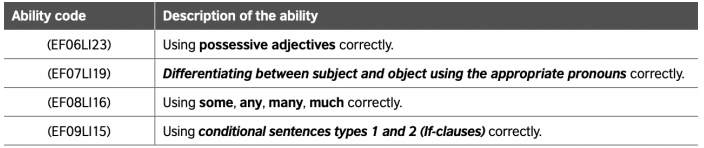
Learning goals, which are referred to in version 3 of the BNCC as abilities, are intended to list the basic knowledge to be acquired by students, and to serve as a reference for drafting and updating the regional, state and municipal curricula.
[…]
Imagem associada para resolução da questão

Available at: https://www.britishcouncil.org.br/sites/default/files/leitura_critica_bncc_-_en_-_v4_final.pdf. [Fragment]. Accessed on: Oct. 10, 2022.
The BNCC abilities listed above are examples of ones which reinforce the use of basic skills and systemic knowledge of the English language. In the English teaching context, it is strongly recommended that English teachers mainly help students 
Alternativas
Q2127436 Inglês

Julgue as frases abaixo.


I.Aprender uma língua estrangeira pode ser uma forma de promover a tolerância e o respeito mútuo entre culturas a partir de uma perspectiva etnocêntrica.


II.Ao falar fluentemente uma língua estrangeira, a pessoa pode construir relacionamentos interpessoais e expandir sua rede global.


III.A língua é um elemento fundamental da identidade cultural de uma pessoa e aprender uma língua estrangeira pode ser uma forma de entrar em contato com uma cultura diferente e compreender suas tradições, valores e modos de pensar.


Está(ão) CORRETA(S) a(s) seguinte(s) proposição(ões).

Alternativas
Q2121452 Inglês
Leia o texto para responder a questão.

        Learning strategies are defined as “specific actions, behaviors, steps, or techniques—such as seeking out conversation partners, or giving one self-encouragement to tackle a difficult language task—used by students to enhance their own learning. When the learner consciously chooses strategies that suit his or her learning style and the L2 task at hand, these strategies become a useful toolkit for active, conscious, and purposeful self-regulation of learning. Learning strategies can be classified into six types; the compensatory strategies, for example, are those that help the learner make up for missing knowledge.

        A given strategy is neither good nor bad; it is neutral until the context of its use is thoroughly considered. What makes a strategy positive and helpful for a given learner? A strategy is useful if the following conditions are present: (a) the strategy relates to the L2 task at hand; (b) the strategy fits the particular student’s learning style preferences to one degree or another; and (c) the student employs the strategy effectivety and links it with other relevant strategies. Strategies that fulfill these conditions “make learning easier, faster, more enjoyable, more self-directed, more effective, and more transferable to new situations” (Oxford 1990, p. 8). Learning strategies can also enable students to become more independent and lifelong learners.
(Rebecca Oxford. Language Learning Styles and Strategies. Adaptado)
It is an example of a compensatory strategy a good reader would resort to while reading an unknown text:
Alternativas
Q2121451 Inglês
Leia o texto para responder a questão.

        Learning strategies are defined as “specific actions, behaviors, steps, or techniques—such as seeking out conversation partners, or giving one self-encouragement to tackle a difficult language task—used by students to enhance their own learning. When the learner consciously chooses strategies that suit his or her learning style and the L2 task at hand, these strategies become a useful toolkit for active, conscious, and purposeful self-regulation of learning. Learning strategies can be classified into six types; the compensatory strategies, for example, are those that help the learner make up for missing knowledge.

        A given strategy is neither good nor bad; it is neutral until the context of its use is thoroughly considered. What makes a strategy positive and helpful for a given learner? A strategy is useful if the following conditions are present: (a) the strategy relates to the L2 task at hand; (b) the strategy fits the particular student’s learning style preferences to one degree or another; and (c) the student employs the strategy effectivety and links it with other relevant strategies. Strategies that fulfill these conditions “make learning easier, faster, more enjoyable, more self-directed, more effective, and more transferable to new situations” (Oxford 1990, p. 8). Learning strategies can also enable students to become more independent and lifelong learners.
(Rebecca Oxford. Language Learning Styles and Strategies. Adaptado)
In a reading class, the text is about “World Cup host countries in the 21st century”. Aware of the fact that “a strategy is useful if it relates to the L2 task at hand”, the teacher coherently offers the following instruction to develop learners’ ability to scan texts in English:
Alternativas
Q2121450 Inglês
Leia o texto para responder a questão.

        Learning strategies are defined as “specific actions, behaviors, steps, or techniques—such as seeking out conversation partners, or giving one self-encouragement to tackle a difficult language task—used by students to enhance their own learning. When the learner consciously chooses strategies that suit his or her learning style and the L2 task at hand, these strategies become a useful toolkit for active, conscious, and purposeful self-regulation of learning. Learning strategies can be classified into six types; the compensatory strategies, for example, are those that help the learner make up for missing knowledge.

        A given strategy is neither good nor bad; it is neutral until the context of its use is thoroughly considered. What makes a strategy positive and helpful for a given learner? A strategy is useful if the following conditions are present: (a) the strategy relates to the L2 task at hand; (b) the strategy fits the particular student’s learning style preferences to one degree or another; and (c) the student employs the strategy effectivety and links it with other relevant strategies. Strategies that fulfill these conditions “make learning easier, faster, more enjoyable, more self-directed, more effective, and more transferable to new situations” (Oxford 1990, p. 8). Learning strategies can also enable students to become more independent and lifelong learners.
(Rebecca Oxford. Language Learning Styles and Strategies. Adaptado)
The second paragraph points to the fact that the use of strategies
Alternativas
Respostas
1541: C
1542: D
1543: B
1544: A
1545: C
1546: E
1547: D
1548: B
1549: E
1550: B
1551: D
1552: C
1553: E
1554: C
1555: C
1556: C
1557: C
1558: A
1559: E
1560: C