Questões de Concurso
Sobre comparativo e superlativo de adjetivos | comparative and superlative em inglês
Foram encontradas 217 questões


“My Family My name is Tomas and I have a big family, I have 3 sisters, Andrea, Samantha and Jennifer. I also have 2 brothers, John and Peter. I am the youngest of my family I am 9 years old my sister Andrea is the oldest! , she is 27 years old. We all love to study and to play soccer. My sister Samantha is the smartest girl in her class and I am the fastest boy in my soccer team, but My brother Peter is the slowest. John is the smallest person in our family, he is really short!! But I still really love my great family!.”
(https://www.englishexercises.org/makeagame/viewgame.asp ?id=4953)
Assinale a alternativa que apresenta o superlativo.
Based on the text above, judge the following item.
The fragment “most likely” (first paragraph) is an example
of the superlative form.

Concerning the text above and previous knowledge, judge the
item from
China has charged ahead with a bold effort to remake the way that government-backed money works, rolling out its own digital currency with different qualities than cash or digital deposits. The country’s central bank started testing a new electronic currency, which was named electronic Chinese yuan or eCNY, last year in four cities and have recently expanded those trials to bigger cities such as Beijing and Shanghai, according to government presentations. No other major power is as far along with a homegrown digital currency.
The effort is one of several by central banks around the world to try new forms of digital money that can move faster and give even the most disadvantaged people access to online financial tools. Digital currencies created by central banks give governments more of a financial grip. These currencies can enable direct handouts of money that expire if not used by a particular date and can make it easier for governments to track financial transactions to stamp out tax evasion and crack down on dissidents.
If the eCNY is successful, it will give the central bank new powers, including novel types of monetary policy to help the economy grow. In one possibility that economists have discussed, a central bank could program its digital currency to slowly lose value so that consumers are encouraged to spend it immediately. Also, the eCNY could immediately give the Chinese government more power to monitor finance flows because a digital currency system can record every transaction.
Internet: <www.nytimes.com>(adapted).
Judge the following item, concerning the ideas stated in the text and the words used in it.
The word “major”, on the last sentence of the first paragraph,
can be correctly replaced by biggest without changing the
meaning of the text.
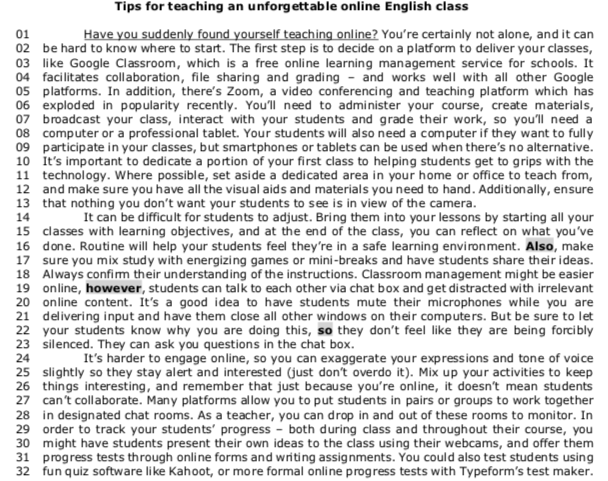
(Avaliable in: https://www.cambridgeenglish.org/blog/12-tips-for-teaching-an-online-english-class/ – text adapted specially for this test).
I. My apartment is ____ than yours. II. What is the _____ growing plant in the world? III. The dog is the _____ friend of the man.
Assinale a alternativa que, correta e gramaticalmente, completa as frases.
1- A proton is ________than an electron?
2- In the US, coffee is _________ with men than with women.
3- The Nile river is _________ than the Amazon river.
4- The Atacama desert is_________ than the
Sahara desert.
TEXT
REFERS TO QUESTION
The Literary Influences of Superstar Musician David Bowie
BY JOHN O'CONNELL ON 10/31/19 AT 5:00 AM EDT
David Bowie was a pop star for most of his career from the 1960s until his death in 2016. He was known for his flamboyant style, songwriting and the ability to artistically turn on a dime. But Bowie, who died of cancer at 69, was more than a multi-platinum rock and roller. He was also one of the more literate composers in the business.
So much so, in fact, that in conjunction with a career retrospective in 2013 at the Victoria & Albert Museum in London, Bowie issued a list of the one hundred books he considered the most important and influential. British music columnist John O'Connell linked this list to Bowie's prolific music. The result? A book called Bowie's Bookshelf out this month from Gallery Books.
William S. Burroughs first made the link between Bowie's lyrics and T. S. Eliot's poetry. In a Rolling Stone interview, Burroughs asked if Hunky Dory's "Eight Line Poem" had been influenced by Eliot's "The Hollow Men." Bowie's reply: "Never read him." But Bowie was definitely exposed to Eliot's influence. "Goodnight Ladies" on Transformer, the album Bowie produced for Lou Reed in 1972, is a riff on the end of the second section, "A Game of Chess," from Eliot's poem "The Waste Land." Eliot, for his part, is deliberately quoting Ophelia's "Good night, sweet ladies" speech from Hamlet. Eliot's method established a new protocol for artistic theft—the modern poet in dialogue with his or her predecessors. Bowie, too, was candid about how much he took from other artists. "You can't steal from a thief," he said when LCD Soundsystem's James Murphy admitted to stealing from Bowie's songs.
Avaiable in : https://www.newsweek.com/2019/11/15, accessed on
February 20th, 2020. Adapted.
Instructions: answer question based on the following text
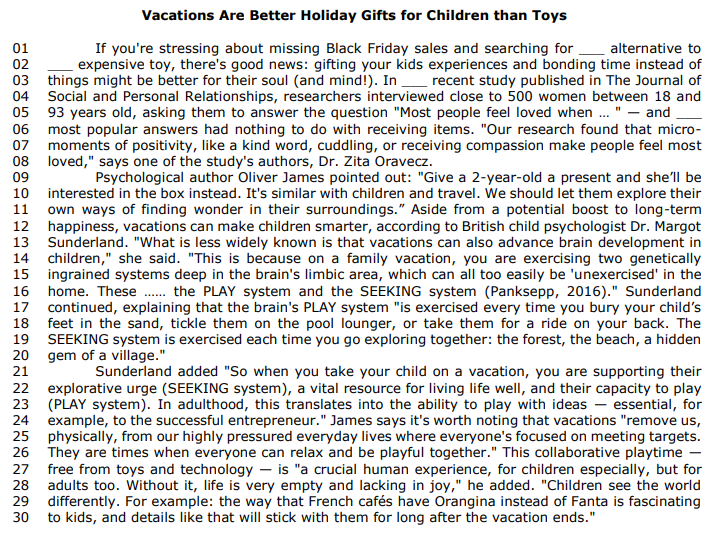
(Avaliable in: https://people.com/parents/vacations-better-than-toys-holiday-gifts-kids/ – text specially
adapted for this test.)
An interview with Paolo Kwan, 20, from Hong Kong, who is improving his English while studying Business Administration at Sierra College in northern California.
WHY DID YOU DECIDE TO STUDY IN THE USA?
It provides a nice education in a beautiful country. When I
was younger I used to watch American movies and I
wanted to visit the United States. They always talked about
the American dream, and I wanted to come and see it.
HOW DID YOU CHOOSE YOUR INTENSIVE ENGLISH PROGRAM?
Sierra College is one of the biggest community colleges in northern California. It is in a quiet location but has a beautiful campus.
The college has a good business program. I can study for two years at Sierra College and then two years at my transfer school to earn my degree.
WHAT DO YOU LIKE BEST?
I also enjoy the quality of the teaching at the college. There is a writing center where I can go at any time. The teachers can make suggestions to improve my essay, regarding grammar and my vocabulary. At the Math Center, they can explain in detail the problems.
WHAT DO YOU MISS MOST?
I miss the food and also my family.
WHAT WAS YOUR BIGGEST SURPRISE?
I was surprised by the cultural difference. The taste and style of food is very different. The amount of food is a lot larger. A small portion in the USA is a large portion in Hong Kong. When people from America find out that I am from another country they ask a lot of questions. They are very interested in you and finding out about Hong Kong.
... YOUR BIGGEST DISAPPOINTMENT?
I have not had any since I came here.
HOW HAVE YOU HANDLED:
... LANGUAGE DIFFERENCES?
It is important not to be shy, as that does not help you when you are trying to improve your language. I make sure that I study, practice and speak as often as I can—that is the only way to improve. ...
FINANCES?
I am being supported by my family.
... ADJUSTING TO A DIFFERENT EDUCATIONAL SYSTEM?
The American system is much more open. In Hong Kong you just learn what the teacher writes on the board. In America, you discuss the issues and focus more on ideas
WHAT ARE YOUR ACTIVITIES?
I am interested in traveling around the USA. I have been to San Francisco, which you can reach by train from Sierra College. In my free time I go out with friends.
HOW EASY OR DIFFICULT IS MAKING FRIENDS?
It has not been that hard to make friends in the USA. Other people at the college are friendly and want to make friends as well.
HOW IS YOUR U.S. EDUCATION RELEVANT TO YOUR PERSONAL GOALS AND TO THE NEEDS OF YOUR COUNTRY?
I think that the U.S. education system will provide me with
good resources and skills to be able to support myself in
order to get hired in my own country
WHAT IS YOUR ADVICE TO OTHER STUDENTS?
An awesome life experience is waiting for you in the future. You will learn so much more than you think. Nothing is impossible, so go ahead and give it a try.
Adapted from: https://www.studyusa.com
In the interview, Paolo compares the food in the States with the food in Hong Kong.
Choose the sentence in which the comparative form of the adjective has been correctly used.
Choose the sentence in which the comparative form was correctly used.
The opposite of the superlative form THE BEST is:

 Conheça nossos planos