Questões de Concurso Sobre análise sintática | syntax parsing em inglês

Foram encontradas 579 questões

Q3715168 Inglês

Text from question:


Fox and the grapes

It was a very hot and sunny afternoon. A fox, which had been hunting the whole day, was very thirsty. 'How I wish there

was some water, the fox thought to himself.

Just then, he saw bunches of fat and juicy grapes hanging from a vine above his head. The grapes looked ripe and ready to

burst with juice.

'Oh, my! Oh, my!' the fox said as his mouth began to water. 'Sweet grape juice, quench my thirst!'

The fox stood on tiptoe and stretched as high as he could, but the grapes were out of his reach. Not about to give up, the

fox walked back a short distance and took a running leap at the grapes. Again, he could not reach the grapes.

The fox jumped and leapt, again and again, but each time he could not reach the grapes. Until, at last, the fox was tired

and thirstier than ever. 'What a fool I am!' said the fox furiously. 'These grapes are sour and not fit for eating. Why would

I want them anyway?'

The expression spoken by the Fox 'Oh, my! Oh my!' is:
Alternativas
Q3698433 Inglês

A rose by any other name would smell as sweet.


William Shakespeare


In parsing the following sentence, determine what traditional function each unit in the sentence has, according to this code:


                                                    Imagem associada para resolução da questão

Alternativas
Q3669689 Inglês
Identify the sentence with a causative verb form:
Alternativas
Q3668620 Inglês
Concerning the title of the last text, the underlined word in “As few as 4,000 steps a day can reduce your risk of death, but more is better.” is classified as a/an:
Alternativas
Q3668617 Inglês
The comma can be such an important tool to build texts and it can make the writer's ideas much more understandable to their readers. In the phrase “The agency is rolling out new ads it hopes will increase confidence in the vaccines with a clear, straightforward message” the comma is used:
Alternativas
Q3665566 Inglês
In the sentence, "The scientist who discovered the new species of butterflies is giving a lecture tomorrow," the relative clause "who discovered the new species of butterflies" functions as: 
Alternativas
Q3654166 Inglês
Identify the auxiliary verb in the following question. Does she like pizza?
Alternativas
Q3654165 Inglês
Identify the subject the following sentence. Open the door!
Alternativas
Q3654161 Inglês
Identify the subject in the following sentence. The car is red.
Alternativas
Q3653353 Inglês
Read the sentences below and choose the option which is grammatically INCORRECT
Alternativas
Q3643014 Inglês
What are the options that apply the correct grammar rules.

I. Cody is working at that new supermarket.
II. I’m going to do an assignment for my english class.
III. Will she is go to the festival with us?
IV. Well, it’re not a good thing to do.
Alternativas
Q3637158 Inglês
Relative clauses are a specific type of subordinate clause, which can be classified as restrictive or nonrestrictive. Restrictive clauses are pretty much essential to the meaning of the sentences they belong to. Nonrestrictive clauses work the opposite way. With this information, mark the option that carries a nonrestrictive clause in its structure:
Alternativas
Q3634340 Inglês

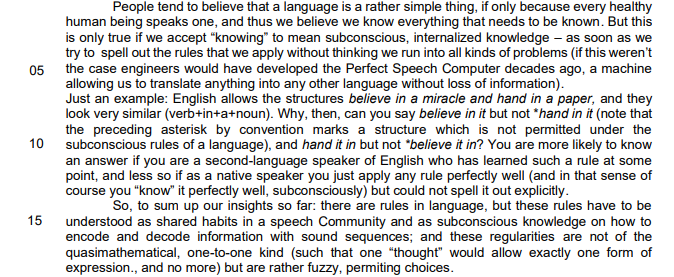
TEXT I -

The World English(es) and linguistic diversity in the English language class:

proposal of a didactic activity 


Available from: <http://revistas.ufcg.edu.br/ch/index.php/RLR/article/viewFile/2425/1866>. Accessed on: Nov 10 , 2022 th

The terms “cultural impact”, “educational environment” and “didactic activity” (in bold in Text I - lines 2, 6 and 12/13) are examples of:
Alternativas
Q3607746 Inglês
In the sentence "Although it was raining, they decided to go for a hike," what is the function of the subordinate clause "Although it was raining"? 
Alternativas
Q3587397 Inglês
Match the sentences with its syntactical classification:

(1) - Time clause;
(2) - Causal clause;
(3) - Concession clause;
(4) - Consecutive clause;
(5) - Final clause.

(__) - She has the visa. She isn’t able to pass, though.
(__) - This is a special service for delivering.
(__) - We crossed it by the time the bridge was risen.
(__) - The food was such salty, we couldn’t eat it.
(__) - Since I had the Green card, I was allowed to get in. 
Alternativas
Q3573273 Inglês

An archaeologist talks trash


Author, UChicago Asst. Prof. Sarah Newman reframes history of waste in her new book


(1º§) Seeing constant images of floating trash islands and overwhelmed landfills can make it seem as though garbage has been a problem piling up for all of human existence.


(2º§) Book cover for Unmaking Waste by Sarah Newman. Cover has a blue background with grey and white images of trash items. However, UChicago Asst. Prof. Sarah Newman wants to dispose of this simplified version of history. In "Unmaking Waste: New Histories of Old Things," she argues that "waste is neither universal nor self-evident." The anthropological archaeologist claims that waste—what we deem "unwanted"—is a relatively recent idea.


(3º§) According to Newman, Western assumptions about waste begin with an imagined long, dirty stretch of "ancient past" broken up by a few expectations like a gleaming Rome (which Newman says is nastier than we think). In traditional histories of trash, this is followed by a filthy, unwashed Middle Ages leading into a dawning awareness of hygiene, public health and sanitation.


(4º§) Newman moves away from this sanitized narrative and heads to ancient Mesoamerica where the story of waste is far from linear. Using examples and archeological evidence from before and during colonization, Newman shows that people have thought about—and used—"trash" in many different ways.


(5º§) Q: What drew you to study the history of waste?


(6º§) I got interested in the history of waste during graduate school, while I was working at an ancient Maya city called El Zotz, in northern Guatemala. Over a couple of field seasons, archaeologists from our team uncovered unusual, very dense deposits of artifacts in the palace at the city's center.


(7º§) Basically, they were things that seemed to be ancient trash because they were burnt, broken and scattered, but they were also things that didn't seem to be ancient trash because some of the materials were rare or valuable.


(8º§) This made me wonder not only how exactly other archaeologists and I were classifying ancient artifacts as trash or not-trash, but also whether people in the past even had something like the category of "waste" that we have today.


(9º§) Q: In what ways has "trash" defined archaeology and in what ways has our understanding of waste been defined by archaeologists?


(10º§) Archaeology has sometimes been called "the science of rubbish." Although meant to be something of a joke, this also reflects an assumption that archaeologists usually deal with things that people have left behind because they are unwanted or useless. That may be true in some cases, but people also leave things behind that are valuable or serve a specific purpose (such as a burial or an offering).


(11º§) Archaeologists are the ones who decide whether or not what we find is or is not trash, but we don't do that in a vacuum—we can't help but be influenced by the ways the societies that we come from decide what is or is not trash.


(12º§) For example, in the mid-20th century, when the U.S. was celebrating postwar production and consumerism, archaeologists tended to view ancient trash the same way most people viewed modern trash: as evidence of technological progress. With the rise of environmentalism, however, people (including archaeologists) were suddenly more conscious of the trash they themselves were making and we started to view ancient trash and ways of discarding it as reflections of broader social structures.


(13º§) I also think archaeology has had a role (even if an unintentional one) in making trash appear to be an inevitable, even natural fact of life—imagining that our ancestors have been making waste for many thousands of years gives us a convenient excuse for all the trash we make today.


(14º§) Q: You talk about how trash has some mirror-like qualities. What can our trash tell us about ourselves?


(15º§) If you were to imagine someone you know going through the contents of your trash can right now, it would probably make you uncomfortable. Think about all the things someone would learn about you—what you've eaten recently, what newspapers or magazines you've read, what kinds of health or beauty products you use, maybe even some financial details, just to name a few.


(16º§) When I'm teaching about trash, I often use an incredible series of photos by Gregg Segal called "7 Days of Garbage" to illustrate this point. Sometimes I remove the individuals in the portraits and ask my students to describe the missing people just from their trash. It's surprising how much the students can tell about the people—the products and packaging reveal details about family composition, socioeconomic status, ethnicity, gender roles, tastes and hobbies, etc.


(17º§) Q: What are some interesting ways that people have thought about or managed waste in the past?


(18º§) One of the things I write about in the book is the way that the Aztec capital of Tenochtitlán (now Mexico City) had a sophisticated system of waste management in place in the early sixteenth century—a time when many European cities were plagued by garbage-lined streets, clogged gutters, and the indiscriminate dumping of bodily wastes and animal remains.


(19º§) Spaniards described the size and structures of Tenochtitlán with wonder, but they also marveled at the order and cleanliness throughout the city. Several accounts note that an army of laborers were constantly at work sweeping and whitewashing the streets, temples, stairways, courtyards, and houses.


(20º§) One conquistador even describes a system of public latrines, hidden from sight with reeds or grass, from which excrement was collected and reused as agricultural fertilizer. The same account also mentions that canoes full of human waste were sold at the local marketplace, where it was then used in tanning animal hides. Bodily waste could also sometimes be used as a religious offering, especially in acts of penitence.


(21º§) Q: What are some of the common myths we have about trash?


(22º§) The biggest myth about trash is simply that we talk about throwing things "away." There is not, nor has there ever been, an "away" for things to go. As inhabitants of industrialized cities, we often think of landfills as places set apart for things to decay, deteriorate and vanish, but in reality, landfills tend to offer ideal conditions for preservation.


(23º§) Not only do materials refuse to disappear, but the things we think we discard make their way back to us, into our very bodies. Of all the plastic waste ever created—billions of metric tons—about 9% has been recycled. The rest has been found, often reduced to microplastics, everywhere from the Mariana Trench to the top of Mount Everest and from human breast milk to human blood.


(24º§) The title of my book is really about this myth—there is no unmaking our actual waste, but I think we can unmake the idea that it is an inevitable part of human life.


https://news.uchicago.edu/story/archaeologist-talks-trash

In the sentence "Newman moves away from this sanitized narrative and heads to ancient Mesoamerica where the story of waste is far from linear, [...]" (4º§) what is the grammatical function o of waste is far from linear"?

Alternativas
Q3542909 Inglês

Analyze the following expression and answer the question


Q33.png (251×182)

Fonte:https://www.amazon.com.br/Light-Has-Been-BrokenSupernatural-ebook/acesso em: 06 de out de 2023.

The expression, “The light has been broken" performs what syntactic function? 
Alternativas
Q3542899 Inglês

ANALISE OS QUADRINHOS E RESPONDA À QUESTÃO.


Q23.png (345×243)

Fonte:http://www.comicstriparchive.com/Beetle_Bailey/acesso em: 06 de 0ut. de 2023. 

The term "At" in the fourth panel can be classified as:
Alternativas
Q2639859 Inglês

In which of the following sentences is the bold word “traveling” the object of the verb?

Alternativas
Q2639835 Inglês

In which of the following sentences the bold word is used as the subject?

Alternativas
Respostas
401: D
402: A
403: C
404: A
405: D
406: B
407: D
408: C
409: B
410: B
411: E
412: A
413: E
414: A
415: E
416: A
417: A
418: A
419: C
420: A