Questões de Concurso
Sobre advérbios de: lugar, modo, tempo e freqüência | adverbs of: place, manner, time and frequency em inglês
Foram encontradas 118 questões


Read the text to answer question.
“A few light taps upon the pane made him turn to the window. It had begun to snow again. He watched sleepily the flakes, silver and dark, falling obliquely against the lamplight. The time had come for him to set out on his journey westward. Yes, the newspapers were right: snow was general all over Ireland. It was falling on every part of the dark central plain, on the treeless hills, falling softly upon the Bog of Allen and, farther westward, softly falling into the dark mutinous Shannon waves. It was falling, too, upon every part of the lonely churchyard on the hill where Michael Furey lay buried. It lay thickly drifted on the crooked crosses and headstones, on the spears of the little gate, on the barren thorns. His soul swooned slowly as he heard the snow falling faintly through the universe and faintly falling, like the descent of their last end, upon all the living and the dead.”
― James Joyce, Dubliners
"The Road Not Taken" By Robert Frost (1916)
Two roads diverged in a yellow wood, And sorry I could not travel both And be one traveler, long I stood And looked down one as far as I could To where it bent in the undergrowth; Then took the other, as just as fair, And having perhaps the better claim, Because it was grassy and wanted wear; Though as for that the passing there Had worn them really about the same, And both that morning equally lay In leaves no step had trodden black. Oh, I kept the first for another day! Yet knowing how way leads on to way, I doubted if I should ever come back. I shall be telling this with a sigh Somewhere ages and ages hence: Two roads diverged in a wood, and I— I took the one less traveled by, And that has made all the difference.
Read TEXT I and answer the question: What does the speaker most likely mean when he says, “I doubted if I should ever come back” (line 15)?
"Satellites are deployed_____to improve internet access."
Read Text I and answer question

TEXT 1
Why is music good for the brain?
October 7, 2020
By Andrew E. Budson, MD, Editorial Advisory Board Member, Harvard Health Publishing
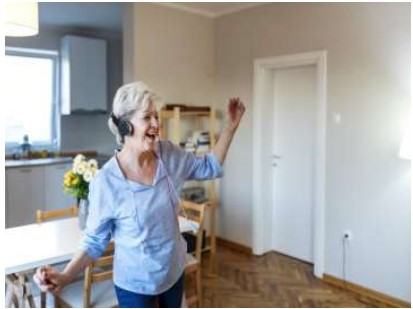
1. Can music really affect your well-being, learning, cognitive function, quality of life, and even happiness? Hand in a recent survey on music and brain health conducted by AARP revealed some interesting findings about the impact of music on cognitive and emotional well-being: music listeners had higher scores for mental well-being and slightly reduced levels of anxiety and depression compared to people overall.
2. Of survey respondents who currently go to musical performances, 69% rated their brain health as “excellent” or “very good,” compared to 58% for those who went in the past and 52% for those who never attended. Of those who reported often being exposed to music as a child, 68% rated their ability to learn new things as “excellent” or “very good,” compared to 50% of those who were not exposed to music.
3. Active musical engagement, including those over age 50, was associated with higher rates of happiness and good cognitive function. Adults with no early music exposure but who currently engage in some music appreciation show above average mental well-being scores. Those are pretty impressive results, to be sure. However, this 20-minute online survey has some limitations. For one, it included 3,185 US adults ages 18 and older; that is a small number if you are extrapolating to 328 million people across the country. For another, it is really a survey of people’s opinions. For example, although people might report their brain health as “excellent,” there was no objective measure of brain health such as an MRI scan, or even a test to measure their cognition.
4. Lastly, even if the ratings were true, the findings are only correlations. They do not prove that, for example, it was the exposure to music as a child that led to one’s improved ability to learn new things. It may be equally likely that those children brought up in more affluent households were both more likely to be exposed to music and to be given a good education that led to their being able to easily learn new things later in life.
5. Music has been shown to activate some of the broadest and most diverse networks of the brain. Of course, music activates the auditory cortex in the temporal lobes close to your ears, but that’s just the beginning. The parts of the brain involved in emotion are not only activated during emotional music, they are also synchronized. Music also activates a variety of memory regions. And, interestingly, music activates the motor system. In fact, it has been theorized that it is the activation of the brain’s motor system that allows us to pick out the beat of the music even before we start tapping our foot to it!
6. Okay, get along! so music activates just about all of the brain. Why is that so important? Well, have you ever heard the expression, “If you don’t use it, you’ll lose it”? It turns out this is actually true in the brain. Brain pathways — and even whole networks — are strengthened when they are used and are weakened when they are not used. The reason is that the brain is efficient; it isn’t going to bother keeping a brain pathway strong when it hasn’t been used in many years. The brain will use the neurons in that pathway for something else. These types of changes should be intuitively obvious to you — that’s why it is harder to speak that foreign language if you haven’t used it in 20 years; many of the old pathways have degraded and the neurons are being used for other purposes.
BUDSON, Andrew E. Why is music good for the brain? Harvard Health Publishing, 7 out. 2020. Disponível em:
Read the following dialogue.
Caio: Have you seen Joana lately?
Ramon: I hadn’t, but I heard she borrowed some money from the bank.
Caio: But what about her inheritance?
Ramon: Word has it she frittered all away.
Caio: That’s crazy!
Ramon: Yeah, I know.
Based on this dialogue, analyze the assertions below.
I. In “she frittered all away”, Ramon intends to say that Joana squandered all her inheritance.
II. Ramon correctly uses auxiliary verbs in his first and last lines.
III. “Lately” is a time adverb in Caio’s fist line.
The CORRECT assertion(s) is(are):
I. I am exhausted because I’ve been working hard.
II. She tried hard to remember my name but she couldn’t.
III. Roger Federer is a great tennis player. He hits the ball hardly.
IV. This shirt is practically new. I’ve hardly worn it.
( 1 ) MANNER ( 2 ) TIME ( 3 ) PLACE ( 4 ) FREQUENCY ( 5 ) DEGREE ( 6 ) CONJUNCTIVE
( ) Very, absolutely, totally, rather, quite, really, completely, extremely, fairly
( ) There, here, somewhere, everywhere, nowhere, anywhere, abroad, northwards.
( ) Also, however, otherwise, indeed, finally, furthermore, nonetheless, in fact.
( ) Usually, sometimes, never, often, always, rarely, occasionally, seldom.
( ) Soon, early, now, today, tomorrow, yesterday, then, now, lately, next.
( ) Quickly, slowly, easily, fast, well, carefully, correctly, noisily, silently.
Text 3
Digital habits across generations
Today’s grandparents are joining their grandchildren on social media, but the different generations’ online habits couldn’t be more different. In the UK the over55s are joining Facebook in increasing numbers, meaning that they will soon be the site’s second biggest user group, with 3.5 million users aged 55-64 and 2.9 million over-65s.
Sheila, aged 59, says, ‘I joined to see what my grandchildren are doing, as my daughter posts videos and photos of them. It’s a much better way to see what they’re doing than waiting for letters and photos in the post. That’s how we did it when I was a child, but I think I’m lucky I get to see so much more of their lives than my grandparents did.’ Ironically, Sheila’s grandchildren are less likely to use Facebook themselves. Children under 17 in the UK are leaving the site – only 2.2 million users are under 17 – but they’re not going far from their smartphones.
Chloe, aged 15, even sleeps with her phone. ‘It’s my alarm clock so I have to,’ she says. ‘I look at it before I go to sleep and as soon as I wake up.’ Unlike her grandmother’s generation, Chloe’s age group is spending so much time on their phones at home that they are missing out on spending time with their friends in real life. Sheila, on the other hand, has made contact with old friends from school she hasn’t heard from in forty years. ‘We use Facebook to arrange to meet all over the country,’ she says. ‘It’s changed my social life completely.’ Teenagers might have their parents to thank for their smartphone and social media addiction as their parents were the early adopters of the smartphone. Peter, 38 and father of two teenagers, reports that he used to be on his phone or laptop constantly. ‘I was always connected and I felt like I was always working,’ he says. ‘How could I tell my kids to get off their phones if I was always in front of a screen myself?’ So, in the evenings and at weekends, he takes his SIM card out of his smartphone and puts it into an old-style mobile phone that can only make calls and send text messages. ‘I’m not completely cut off from the world in case of emergencies, but the important thing is I’m setting a better example to my kids and spending more quality time with them.’ Is it only a matter of time until the generation above and below Peter catches up with the new trend for a less digital life?
Source: https://learnenglish.britishcouncil.org
Analyze the sentences from text 3 below according to structure and grammar use.
1. The phrasal verb in: Unlike her grandmother’s generation, Chloe’s age group is spending so much time on their phones at home that they are missing out on spending time with their friends in real life. means in its context that they are not be able to experience an opportunity or chance.
2. The word Ironically, in bold in the second paragraph is being used as an adverb to express irony.
3. The reference words in bold in the first paragraph their and they, create cohesion that
precedes coherence.
4. In the following sentence from the third paragraph: Unlike her grandmother’s generation, Chloe’s age group is spending so… the (‘s) in grandmother’s and Chloe’s indicates the short form of the verb to be in the present tense.
5. The conjunctive adverb Unlike in bold in the third paragraph, is used to introduce a statement that contrasts with a previous statement.
Choose the alternative which contains the correct
sentences.
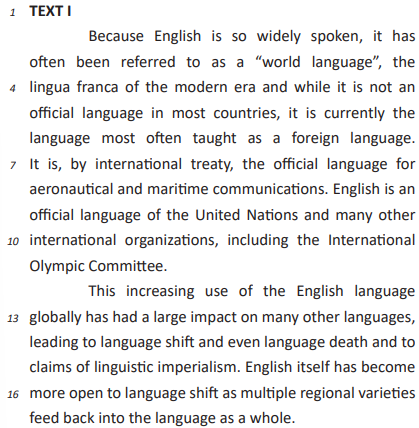
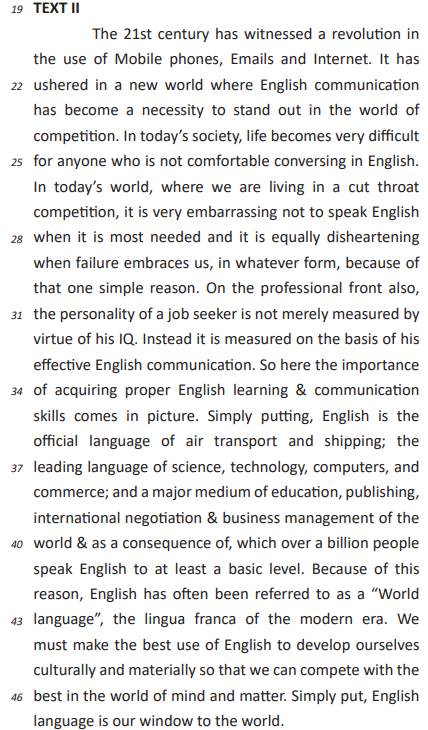
In text I, the suffix ‑ly was added to the adjectives wide, current and global so they could turn into adverbs of manner.
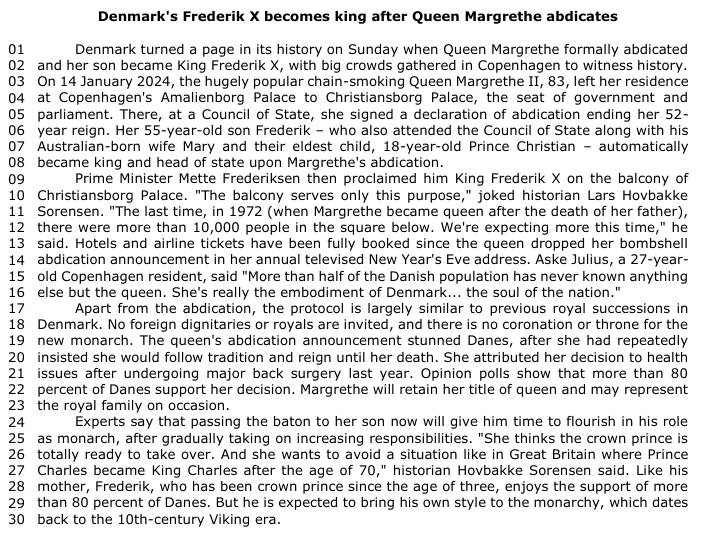
(Available in: https://www.france24.com/en/europe/20240114-denmark-s-frederik-x-to-become-king-afterqueen-margrethe-s-abdication – text especially adapted for this test).
Read Text I and answer the fourteen questions that follow it
Text I The “literacy turn” in education: reexamining
what it means to be literate
In response to the phenomena of mass migration and the emergence of digital communications media that defined the last decade of the 20th century, the New London Group (NLG) called for a broader view of literacy and literacy teaching in its 1996 manifesto, A Pedagogy of Multiliteracies: Designing Social Futures. The group argued that literacy pedagogy in education must (1) reflect the increasing cultural and linguistic diversity of the contemporary globalized world, and (2) account for the new kinds of texts and textual engagement that have emerged in the wake of new information and multimedia technologies. In order to better capture the plurality of discourses, languages, and media, they proposed the term ‘multiliteracies’.
Within the NLG’s pedagogy of multiliteracies, language and
other modes of communication are viewed as dynamic resources
for meaning making that undergo constant changes in the
dynamics of language use as learners attempt to achieve their
own purposes. Within this broader view of literacy and literacy
teaching, learners are no longer “users as decoders of language”
but rather “designers of meaning.” Meaning is not viewed as
something that resides in texts; rather, deriving meaning is
considered an active and dynamic process in which learners
combine and creatively apply both linguistic and other semiotic
resources (e.g., visual, gesture, sound, etc.) with an awareness of
“the sets of conventions connected with semiotic activity [...] in a
given social space” (NLG, 1996, p. 74).
Grounded within the view that learning develops in social,
cultural, and material contexts as a result of collaborative
interactions, NLG argued that instantiating literacy-based
teaching in classrooms calls on the complex integration and
interaction of four pedagogical components that are neither
hierarchical nor linear and can at times overlap: situated practice,
overt instruction, critical framing, and transformed practice. […]
Although the NLG’s pedagogy of multiliteracies was
conceived as a “statement of general principle” (1996, p. 89) for
schools, the group’s call for educators to recognize the diversity
and social situatedness of literacy has had a lasting impact on
foreign language (FL) teaching and learning. The reception of the
group’s work along with that of other scholars from critical
pedagogy appeared at a time when the field was becoming less
solidly anchored in theories of L2 acquisition and more interested
in the social practice of FL education itself. In the section that
follows, we describe the current state of FL literacy studies as it
has developed in recent years, before finally turning to some very
recent emerging trends that we are likely to see develop going
forward.
(Adapted from: https://www.colorado.edu/center/altec/sites/default/files/ attachedfiles/moving_toward_multiliteracies_in_foreign_language_teaching.pdf)
Read Text I and answer the fourteen questions that follow it
Text I The “literacy turn” in education: reexamining
what it means to be literate
In response to the phenomena of mass migration and the emergence of digital communications media that defined the last decade of the 20th century, the New London Group (NLG) called for a broader view of literacy and literacy teaching in its 1996 manifesto, A Pedagogy of Multiliteracies: Designing Social Futures. The group argued that literacy pedagogy in education must (1) reflect the increasing cultural and linguistic diversity of the contemporary globalized world, and (2) account for the new kinds of texts and textual engagement that have emerged in the wake of new information and multimedia technologies. In order to better capture the plurality of discourses, languages, and media, they proposed the term ‘multiliteracies’.
Within the NLG’s pedagogy of multiliteracies, language and
other modes of communication are viewed as dynamic resources
for meaning making that undergo constant changes in the
dynamics of language use as learners attempt to achieve their
own purposes. Within this broader view of literacy and literacy
teaching, learners are no longer “users as decoders of language”
but rather “designers of meaning.” Meaning is not viewed as
something that resides in texts; rather, deriving meaning is
considered an active and dynamic process in which learners
combine and creatively apply both linguistic and other semiotic
resources (e.g., visual, gesture, sound, etc.) with an awareness of
“the sets of conventions connected with semiotic activity [...] in a
given social space” (NLG, 1996, p. 74).
Grounded within the view that learning develops in social,
cultural, and material contexts as a result of collaborative
interactions, NLG argued that instantiating literacy-based
teaching in classrooms calls on the complex integration and
interaction of four pedagogical components that are neither
hierarchical nor linear and can at times overlap: situated practice,
overt instruction, critical framing, and transformed practice. […]
Although the NLG’s pedagogy of multiliteracies was
conceived as a “statement of general principle” (1996, p. 89) for
schools, the group’s call for educators to recognize the diversity
and social situatedness of literacy has had a lasting impact on
foreign language (FL) teaching and learning. The reception of the
group’s work along with that of other scholars from critical
pedagogy appeared at a time when the field was becoming less
solidly anchored in theories of L2 acquisition and more interested
in the social practice of FL education itself. In the section that
follows, we describe the current state of FL literacy studies as it
has developed in recent years, before finally turning to some very
recent emerging trends that we are likely to see develop going
forward.
(Adapted from: https://www.colorado.edu/center/altec/sites/default/files/ attachedfiles/moving_toward_multiliteracies_in_foreign_language_teaching.pdf)
Read Text I and answer the fourteen questions that follow it
Text I The “literacy turn” in education: reexamining
what it means to be literate
In response to the phenomena of mass migration and the emergence of digital communications media that defined the last decade of the 20th century, the New London Group (NLG) called for a broader view of literacy and literacy teaching in its 1996 manifesto, A Pedagogy of Multiliteracies: Designing Social Futures. The group argued that literacy pedagogy in education must (1) reflect the increasing cultural and linguistic diversity of the contemporary globalized world, and (2) account for the new kinds of texts and textual engagement that have emerged in the wake of new information and multimedia technologies. In order to better capture the plurality of discourses, languages, and media, they proposed the term ‘multiliteracies’.
Within the NLG’s pedagogy of multiliteracies, language and
other modes of communication are viewed as dynamic resources
for meaning making that undergo constant changes in the
dynamics of language use as learners attempt to achieve their
own purposes. Within this broader view of literacy and literacy
teaching, learners are no longer “users as decoders of language”
but rather “designers of meaning.” Meaning is not viewed as
something that resides in texts; rather, deriving meaning is
considered an active and dynamic process in which learners
combine and creatively apply both linguistic and other semiotic
resources (e.g., visual, gesture, sound, etc.) with an awareness of
“the sets of conventions connected with semiotic activity [...] in a
given social space” (NLG, 1996, p. 74).
Grounded within the view that learning develops in social,
cultural, and material contexts as a result of collaborative
interactions, NLG argued that instantiating literacy-based
teaching in classrooms calls on the complex integration and
interaction of four pedagogical components that are neither
hierarchical nor linear and can at times overlap: situated practice,
overt instruction, critical framing, and transformed practice. […]
Although the NLG’s pedagogy of multiliteracies was
conceived as a “statement of general principle” (1996, p. 89) for
schools, the group’s call for educators to recognize the diversity
and social situatedness of literacy has had a lasting impact on
foreign language (FL) teaching and learning. The reception of the
group’s work along with that of other scholars from critical
pedagogy appeared at a time when the field was becoming less
solidly anchored in theories of L2 acquisition and more interested
in the social practice of FL education itself. In the section that
follows, we describe the current state of FL literacy studies as it
has developed in recent years, before finally turning to some very
recent emerging trends that we are likely to see develop going
forward.
(Adapted from: https://www.colorado.edu/center/altec/sites/default/files/ attachedfiles/moving_toward_multiliteracies_in_foreign_language_teaching.pdf)
Plurilingualism and translanguaging: commonalities and divergences
Both plurilingual and translanguaging pedagogical practices in the education of language minoritized students remain controversial, for schools have a monolingual and monoglossic tradition that is hard to disrupt, even when the disrupting stance brings success to learners. At issue is the national identity that schools are supposed to develop in their students, and the Eurocentric system of knowledge, circulated through standardized named languages, that continues to impose what Quijano (2000) has called a coloniality of power.
All theories emerge from a place, an experience, a time, and a position, and in this case, plurilingualism and translanguaging have developed, as we have seen, from different loci of enunciation. But concepts do not remain static in a time and place, as educators and researchers take them up, as they travel, and as educators develop alternative practices. Thus, plurilingual and translanguaging pedagogical practices sometimes look the same, and sometimes they even have the same practical goals. For example, educators who say they use plurilingual pedagogical practices might insist on developing bilingual identities, and not solely use plurilingualism as a scaffold. And educators who claim to use translanguaging pedagogical practices sometimes use them only as a scaffold to the dominant language, not grasping its potential. In the United States, translanguaging pedagogies are often used in English-as-a-Second Language programs only as a scaffold. And although the potential for translanguaging is more likely to be found in bilingual education programs, this is also at times elusive. The potential is curtailed, for example, by the strict language allocation policies that have accompanied the growth of dual language education programs in the last decade in the USA, which come close to the neoliberal understanding of multilingualism espoused in the European Union.
It is important to keep the conceptual distinctions between plurilingualism and translanguaging at the forefront as we develop ways of enacting them in practice, even when pedagogies may turn out to look the same. Because the theoretical stance of translanguaging brings forth and affirms dynamic multilingual realities, it offers the potential to transform minoritized communities sense of self that the concept of plurilingualism may not always do. The purpose of translanguaging could be transformative of socio-political and socio-educational structures that legitimize the language hierarchies that exclude minoritized bilingual students and the epistemological understandings that render them invisible. In its theoretical formulation, translanguaging disrupts the concept of named languages and the power hierarchies in which languages are positioned. But the issue for the future is whether school authorities will allow translanguaging to achieve its potential, or whether it will silence it as simply another kind of scaffold. To the degree that educators act on translanguaging with political intent, it will continue to crack some openings and to open opportunities for bilingual students. Otherwise, the present conceptual differences between plurilingualism and translanguaging will be erased.
Source: GARCÍA, Ofelia; OTHEGUY, Ricardo. Plurilingualism and translanguaging: Commonalities and divergences. International Journal of Bilingual Education and Bilingualism, v. 23, n. 1, p. 17-35, 2020.
Garcia e Otheguy (2020)
Observe the following comic strip and select the correct alternative:
STUDENT OPINION
How Does Social Media Affect Your Mental Health?
Facebook has delayed the development of an Instagram app for children amid questions about its harmful effects on young people’s mental health. Does social media have an impact on your well-being?
By Nicole Daniels Oct. 1, 2021
What is your relationship with social media like? Which platforms do you spend the most time on? Which do you stay away from? How often do you log on?
What do you notice about your mental health and wellbeing when spending time on social networks?
In “Facebook Delays Instagram App for Users 13 and Younger,” Adam Satariano and Ryan Mac write about the findings of an internal study conducted by Facebook and what they mean for the Instagram Kids app that the company was developing:
Facebook said on Monday that it had paused development of an Instagram Kids service that would be tailored for children 13 years old or younger, as the social network increasingly faces questions about the app’s effect on young people’s mental health.
The pullback preceded a congressional hearing this week about internal research conducted by Facebook, and reported in The Wall Street Journal, that showed the company knew of the harmful mental health effects that Instagram was having on teenage girls. The revelations have set off a public relations crisis for the Silicon Valley company and led to a fresh round of calls for new regulation.
Facebook said it still wanted to build an Instagram product intended for children that would have a more “age appropriate experience,” but was postponing the plans in the face of criticism.
Fonte: https://www.nytimes.com/2021/10/01/learning/how-does-social-media-affect-your-mental-health.html
The word “increasingly”, as used in the text, is an example of:
Galway Girl, by Ed Sheeran
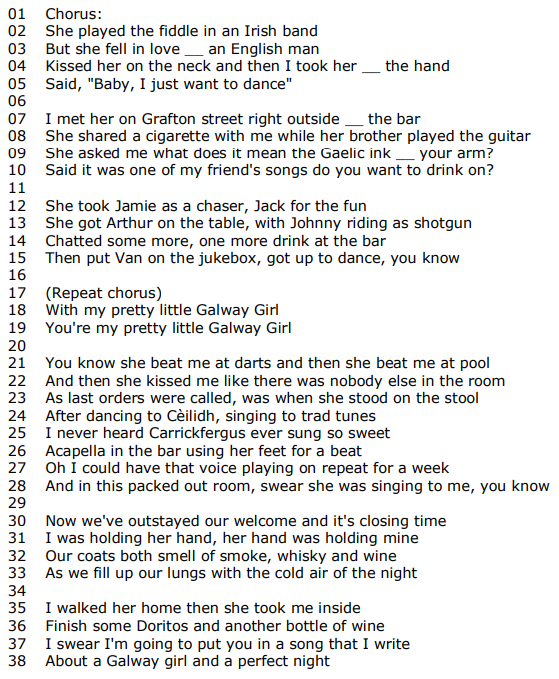
(Available at: www.azlyrics.com/lyrics/edsheeran/galwaygirl.html – text specially adapted for this test).

 Conheça nossos planos